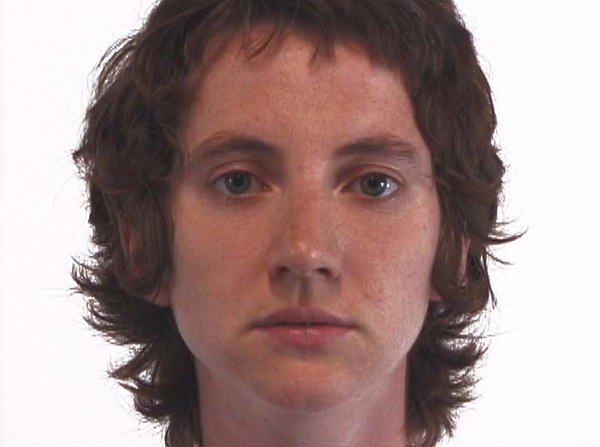
Sharon Hayes, still from “Symbionese Liberation Army (SLA) Screeds #13, 16, 20 & 29,” four screen video projection, color, sound 2003 (courtesy the artist and Tanya Leighton Gallery)
Whitney Museum of American Art
945 Madison Ave. at 75th St.
Wednesday – Sunday through September 9, $18 (pay-what-you-wish Fridays 6:00 – 9:00)
212-570-3600
www.whitney.org
www.shaze.info
New York-based multidisciplinary performance artist Sharon Hayes has occupied the third floor of the Whitney with the powerful and engaging “There’s So Much I Want to Say to You.” Comprising older projects with newly commissioned works, all arranged in an invitingly makeshift set designed by Hayes and Andrea Geyer that integrates the private with the public, the installation uses text, video, sound, photography, signage, and spoken-word LPs to expand on Hayes’s idea of “speech acts,” examining the state of political discourse in America since the 1960s. The first thing people see as they enter the space is a long banner that announces, “Now a chasm has opened between us that holds us together and keeps us apart,” but all the words are not visible because of the way the banner is unfurled, setting the stage for a unique journey through the many challenges that accompany free speech. Curated by Chrissis Iles, “There’s So Much I Want to Say to You” includes numerous stations where visitors stop for very different experiences. “Join Us” is a wall of hundreds of political-action flyers dating back more than fifty years and going all the way up to the Occupy Wall Street movement. In the four-channel video “Symbionese Liberation Army (SLA) Screeds #13, 16, 20, & 29,” Hayes recites audiotapes Patty Hearst made, with Hayes speaking them from memory, an unseen audience correcting every tiny mistake. In “Voice Portraits,” Hayes shows various women on video monitors but has eliminated the sound, taking their voices away, in stark contrast to a nearly hidden piece that projects onto a narrow wall the media’s text-based responses to speeches given by women, concentrating on the quality of the voices instead of the substance of what they said. In “Everything Else Has Failed! Don’t You Think It’s Time for Love,” Hayes uses speakers and posters to present five lunchtime love letters she performed in front of the UBS building in Midtown Manhattan in September 2007. In “Gay Power,” Hayes and feminist author and activist Kate Millet discuss footage of one of the first gay pride marches through the city. And in “Yard (Sign),” Hayes has reimagined Allan Kaprow’s 1961 “Yard” with political signs ranging from mass-produced declarations of support of political candidates to handwritten cries of help from New Orleans. Intriguingly, Hayes focuses on old-fashioned methods in “There’s So Much I Want to Say to You,” eschewing digital technology in favor of ancient slide projectors and records playing on turntables, with much of the sound crashing together, as if there are many voices trying to speak at once, their messages becoming garbled. The installation closes September 9, right after both conventions have concluded and the race for president heats up, when political discourse reaches massive proportions and the people’s vote, and voice, is, at least in theory, supposed to matter.