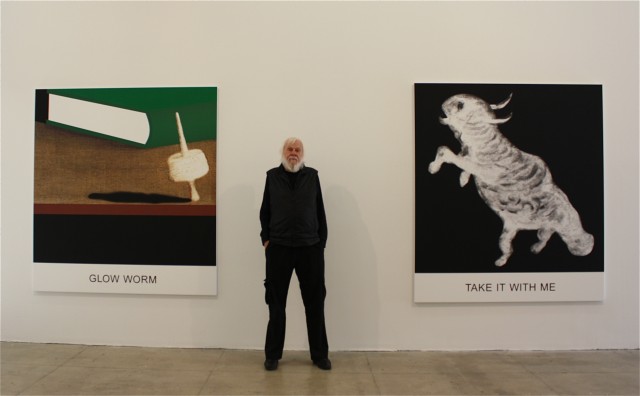
John Baldessari is once again screwing with people’s minds in latest solo show at Marian Goodman (photo by twi-ny/mdr)
JOHN BALDESSARI: DOUBLE PLAY
Marian Goodman Gallery
24 West 57th St. between Fifth & Sixth Aves.
Tuesday – Saturday through November 21, free, 10:00 am – 6:00 pm
212-977-7160
www.mariangoodman.com
As John Baldessari and I sat down in the conference room at Marian Goodman Gallery to discuss his latest solo show there, “Double Play,” I realized that the cord on my old-fashioned tape recorder couldn’t reach the nearest outlet. Sensing the dilemma, the six-foot-seven, eighty-one-year-old artistic genius said, “Too bad you can’t use that,” and pointed behind me. When I turned around, I saw his 1997 Goya Series canvas “It Serves You Right,” a black-and-white image of a plug beneath an empty four-pronged outlet. Fortunately, the good people at the gallery were kind enough to find a long, orange extension cord so we could get down to business.
“I’ve got to say, I don’t like being labeled a California artist, or a Los Angeles artist, or a Conceptual artist,” Baldessari later pointed out. “I just like it to be artist.” For more than fifty years, Baldessari has been creating provocative paintings, video, and sculpture that combine text and language with art-historical and pop-culture imagery. He’s placed colorful circles over subjects’ faces and filmed himself posing in front of a camera and declaring over and over again, “I am making art.” He’s experienced a kind of renaissance lately, with a well-received traveling retrospective, “Pure Beauty,” that came to the Met in the fall of 2010, and two recent promotional videos that have gone viral, “A Brief History of John Baldessari,” a wildly funny biography narrated by musician Tom Waits, and a Pacific Standard Time short in which Baldessari’s giant head chases actor Jason Schwartzman through the streets of L.A.
For “Double Play,” Baldessari made inkjet prints of enlarged sections of works by such artists as Paul Gauguin, Honoré Daumier, Otto Dix, and Édouard Manet, painted over them, then named them after song titles by Waits, Kander and Ebb, Portastic, Johnny Mercer, and others. “Eggs and Sausage” reimagines Gustave Courbet’s “Portrait of Paul Ansout,” combining it with block type of the title of a 1975 song by Waits. For “Animal Crackers in My Soup,” Baldessari focuses on two of the women in Félix Valloton’s “Three Women and a Young Girl Frolicking in the Water,” making it look like they’re kissing, and adding the title of the song made famous by Shirley Temple.
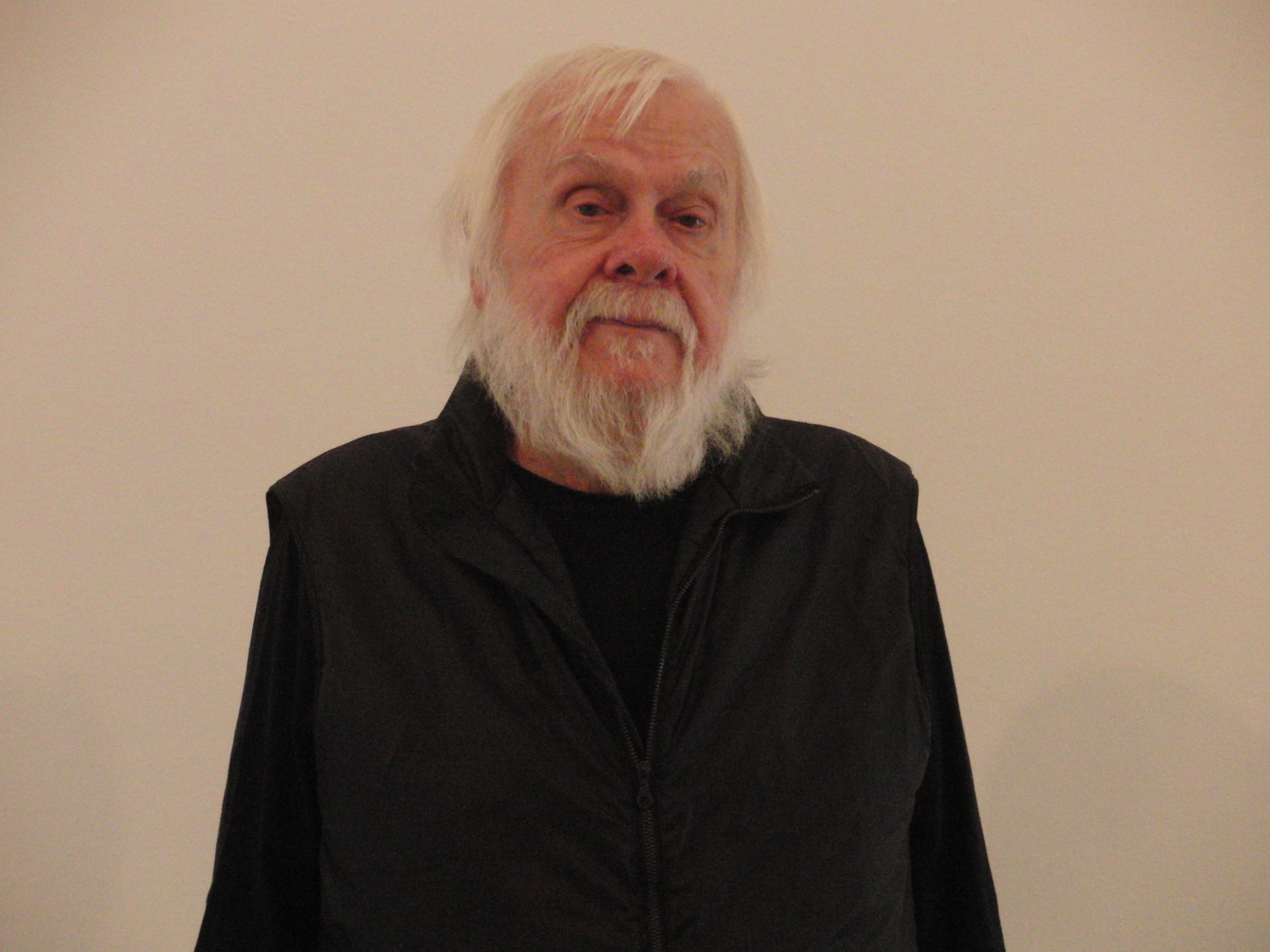
A careful thinker who punctuates many of his statements with an infectious laugh, Baldessari is a gentle, unassuming man whose striking white hair and beard and mustache stand out in stark contrast to his black clothing. He spoke honestly and openly about art and life, encouraging more questions even as our time together was coming to a close.
twi-ny: You’ve spent part of the last few years looking back at your long career, with the “Pure Beauty” retrospective and a continuing series of Catalogue Raisonné volumes. Do you think that has directly influenced your current work?
John Baldessari: Well, I think it’s always valuable to look at the arc of your career, of what you’ve done and what you might do, and retrospectives can provide that. So do Catalogue Raisonnés. It all helps, to see where you’ve been and where you might go.
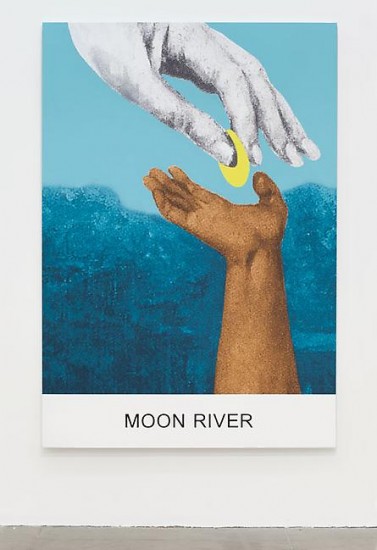
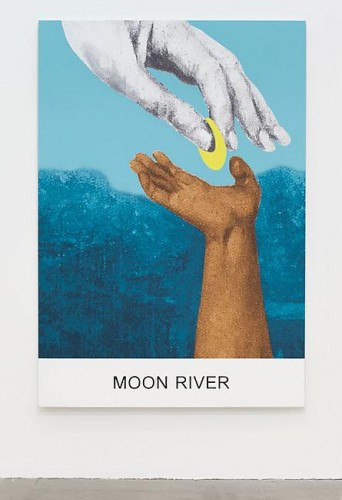
John Baldessari, “Double Play: Moon River,” varnished inkjet print on canvas with acrylic and oil paint, 2012 (photo courtesy Marian Goodman Gallery)
twi-ny: In putting together the two new series, you compare yourself to Dr. Frankenstein. How do you go about choosing the different elements?
John Baldessari: The underlying idea is that I always think of language and imagery as of equal value. So very often in my work I have both — sometimes not, but right now I do — but I consider the song title as valuable as the image. What I’m trying to do is not make it easy for people to make the connection between the image and the language, make it a little difficult. Which is impossible, because people want to do that, they want to hook up things together. A few of them, I just look the other direction, like the dog and “Feelings” — that’s like a Hallmark card. But on the other ones, I think, “Moon River,” I mean, come on. But a lot of them, I found out, I went through the list of song titles trying to hit ones that wouldn’t provide a ready connection. And as a result, I have five or more that are Tom Waits; he’s really good at that.
twi-ny: In “Feelings,” for example, you have a dog, but “Walking the Dog” isn’t with the picture of a dog, which confuses people.
John Baldessari: Exactly.
twi-ny: Are the selections random?
John Baldessari: They’re not random at all. They’re very well thought out. I mean, they’re very well thought out in trying to avoid a connection.
twi-ny: And people can make their own connections.
John Baldessari: Of course they will. But then it’s going to be a weird connection.
twi-ny: When I looked at “Animal Crackers in My Soup,” I’m thinking Shirley Temple, and you’ve got the image of two women kissing.
John Baldessari: And you’re gonna start thinking. I kind of played this “fucking with your mind” game.
twi-ny: In regards to Tom Waits, another National City guy, did you know him or his music before the LACMA video or “Double Play”?
John Baldessari: I’ll tell you how the connection happened. I was teaching in a community college, and I had heard that he had attended that after I had left. And then I mentioned it to my sister, and she said, “Oh yeah, he was a gardener for one of my girlfriends,” and I thought, Wow, that’s amazing. And then I was checking around some more, and it turned out he worked in a pizza restaurant that was located in a building that was owned by my father in National City before he began to get really well known.
Somehow I got his phone number — he was living in L.A. at the time — and I called him. I said, “Is this true?” and he started laughing and said, “Yeah, it’s all true.” You know, I’ve yet to meet him. But then, two years back, in Vanity Fair they had that thing in the back they called the Proust Questionnaire, and they had him, and one of the questions was “What was one of the most enjoyable times in your life?” and he said working in the pizza restaurant in National City, California. Isn’t that amazing?
We talk on the phone. He did send me a note, did a drawing about that movie, and he said, “These guys are making us famous.” And I said, “Tom, you’re already famous.”
twi-ny: You famously proclaimed that you “will not make any more boring art.” Recently you stalked Jason Schwartzman in a Pacific Standard Time video and you told him, “Art should be fun.” You seem to be having a lot of fun.
John Baldessari: Yes, I think that’s high on my list. You know, you should enjoy what you’re doing. Well, anyone should enjoy what they’re doing. Not everybody’s that lucky. They get trapped having to make a living; it’s not what they enjoy. I feel very fortunate I can do what I like doing.
twi-ny: Whose idea was it to put your face on the buildings?
John Baldessari: That was kind of a set-up, which I didn’t mind. They wanted to do two videos, one of me, and one of Ed Ruscha — I guess, the two senior artists in L.A., whatever — and I said, sure, what the hell. They went through various names and they said, “How about Jason Schwartzman?” I’m so out of the loop, but all of my staff, young artists, they went gaga. “Jason Schwartzman? How cool is that?” And I said okay. Jason Schwartzman it is. Then the filmmaker came to talk to me, and it was the son of Bob Dylan, Jesse. Then, the way he described it, with this face-to-face, Jason and I, in conversation, I said, piece of cake, I’ve done that. But the structure was all him. It’s brilliant.
twi-ny: In the digital age, it seems that everyone now can be an artist, a photographer, a journalist, a writer, a filmmaker, whatever they want. Is there a lot more boring art now?
John Baldessari: I think one thing, everybody carries a camera with them, in terms of their smart phone, and we never see any physical prints. There are no more photo albums. As a result of that, I’m not interested in taking photographs. I mean, only if I need to. I used to carry a camera around with me. But now I think, why? I have no need to because somebody is going to have an image of this. I don’t have to do anything.
twi-ny: It’s taken away the process of acquiring source material.
John Baldessari: The pleasure. I remember in 1970 I gave my Nikon to my wife and said, “Listen, I have an assignment for you. Go out and photograph — the whole thirty-six-exposure roll — the most boring things you can find. Now it’s not so easy. It’s interesting too, your question. When I was teaching, one of my colleagues was Allan Kaprow at CalArts, and he was very prescient. He said the artist of the future will be an art director. You don’t have to do anything, like Jeff Koons, Damien Hirst, me — you just have the idea. It’s really conceptual art with a vengeance. With conceptual art, you never presuppose that there would be much physicality to it, but my god, it’s physicality overkill.
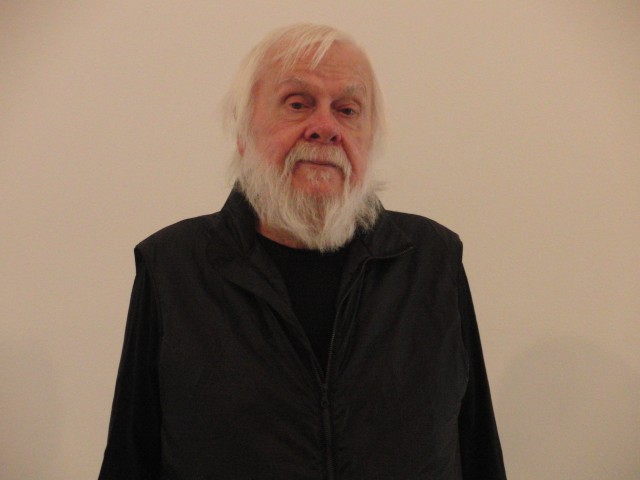
John Baldessari combines art-historical imagery with song titles in latest exhibition (photo by twi-ny/mdr)
twi-ny: Getting back to “Double Play,” the range of works include Gauguin, Bacon, Dix, and primarily Courbet and Eilshemius. Were you looking specifically for images, or were there particular artists you had in mind?
John Baldessari: About two years ago, I decided I was going to start mining imagery from the history of art rather than from newspapers and magazines and TV, whatever, but going about it the same way. I wouldn’t try to get a good image of the work. I wanted it from the media. And then I’d have a huge library, and so I just started plowing through books, collections, individual artists, on and on and on. What I would be looking for would be something in an artist’s work that would be, in a way, inconsequential. There’s always a hierarchy of things in an artist’s work. If it’s a person, obviously you’re going to look at the person’s face, then you might look at what he has on or how he or she is standing. So I looked for something that seems to be the least interesting — oh, like this; that’s not very interesting, you know, that kind of thing — and then I would map out and isolate part of the image and say to an assistant, “Print all these out” so I could look at them and I would sort through those. I guess what I’d be looking for were things that would be visually interesting — to me, anyway, in a formalistic sense, not just in terms of subject matter — and then hopefully it will be interesting to somebody else, who knows. And then I start going through lists and lists of song titles, and then I play marriage broker in trying to get the two of them together somehow and in some way that provided some tension. You know, not an easy association, as I said, but something that was a little bit more difficult because I think one of the things I like to do is make things difficult for people, not in a burdensome way, but I think I got that idea once from reading Kierkegaard and he said, “My job in life is to make life difficult for people.”
twi-ny: To further the challenge, you don’t always take the most obvious part of the image.
John Baldessari: It’s a bit of an art history test. Yeah, some things are pretty obscure, so I made it difficult in that sense. But I think I’ve got a pretty good sense of the viewer, or the spectator, in having taught so long to support myself. So I couldn’t be so obtuse that I would lose people, you know, the students, or be so simplistic that I would lose the smart people. So I think I know how to be a little seductive but have enough there for the most intelligent person but not lose the average person. And of course, for me a model would be, like, Giotto or Matisse, where it looks deceptively simple but it’s not at all.
twi-ny: You mentioned your teaching. Some of your students have gone on to become famous artists themselves, people like Tony Oursler, who also has such an element of fun in his work.
John Baldessari: Absolutely. David Salle, another one, Matt Mullican, and on and on and on. Mike Kelley.
twi-ny: When you had them as students, could you tell which ones would potentially be successful, not necessarily financially but at least creatively?
John Baldessari: I had one sort of idea and I don’t even know if it’s true but I’ll share it with you. There’s always a kid in school that’s really smart, but I think because of that they’ve worked less hard, and the ones that are sort of a little bit way down, they work harder. Those are the students that seem to become successful.
twi-ny: One of the pieces you mentioned before, “Feelings,” is part of the Artists for Obama Portfolio, which also includes works by Frank Gehry, David Hammons, Jasper Johns, and many more. Why did you choose that piece for the project?
John Baldessari: I didn’t do it in any political way. I just thought, who doesn’t love dogs?
twi-ny: Finally, over the last several years, and in the video with Jason Schwartzman, you use cheese as a metaphor for appreciating art. What is your ideal cheese?
John Baldessari: You know, I think I said gorgonzola cheese because my father was Italian and that was the only cheese he would eat. And then I remember some perceptual psychologist writing about art and talking about tastes in art changing. I wish I had said it but I think it’s very apt. He said, when you start out, if you eat cheese at all, it might be Kraft cheese or whatever, and then you get tired of that and you sort of escalate and then you get to the point where smelly cheeses are all you can tolerate. And I thought that was a pretty good description of how taste changes.