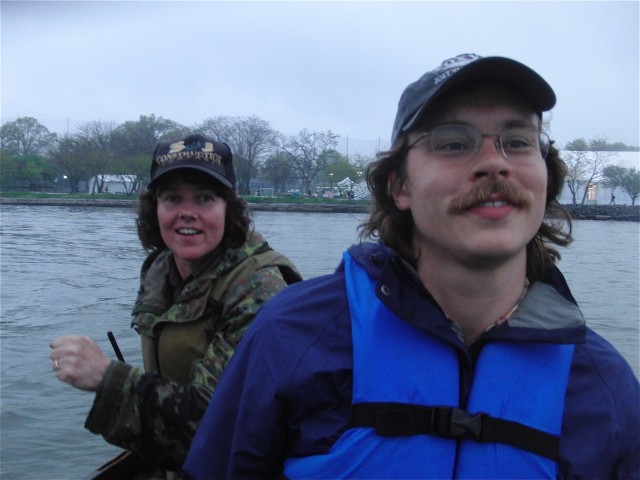
Visitors can contribute to “Draftsmen’s Congress” through Sunday, then take a piece home with them April 23-27 (photo by twi-ny/mdr)
New Museum of Contemporary Art
235 Bowery at Prince St.
Second & fourth floors: Wednesday – Sunday through April 20, $16
Thursday, April 17, 11:00 am – 9:00 pm: one-day exhibition of new sculptures, 231 Bowery, free
April 23-27, “Draftsmen’s Congress” disassembled and distributed to public for free
212-219-1222
www.newmuseum.org
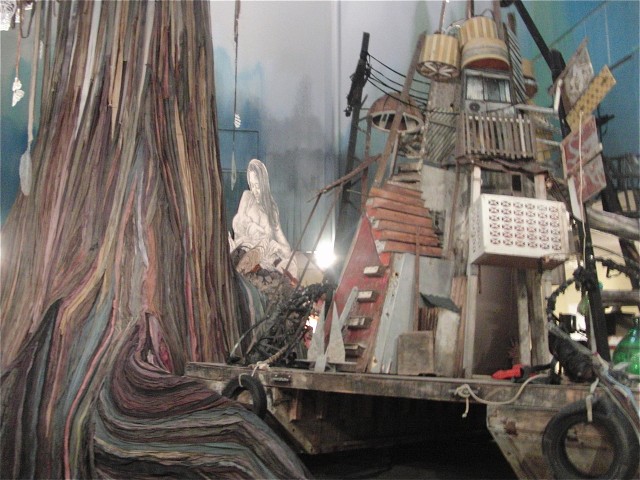
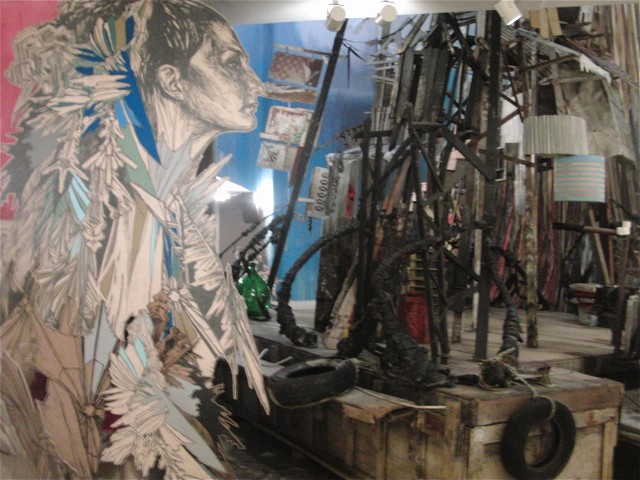
The work of Polish artist Paweł Althamer is very much about collaboration, cooperation, and community, fostering a positive sense of togetherness and sharing without getting treacly. As his first U.S. museum retrospective, “Paweł Althamer: The Neighbors,” winds down at the New Museum, Althamer still has a few surprises in store, as he says in the exhibition catalog, “to share the experience of what we are doing — to see people doing one thing together. . . . The idea is to switch the rules of the game a little so that everybody is included.” Since the show opened back in February, museum visitors and local organizations have been contributing in its evolution, painting on the walls and floors in the participatory, palimpsestual “Draftsmen’s Congress.” The painting will come to a stop on Easter Sunday, but that’s not the end of the piece; from April 23 to 27, the work will be disassembled, cut into pieces, and handed out to visitors free of charge, furthering Althamer’s democratization not only of the creation of art but of its ownership. On April 17, Althamer, whom Joanna Mytkowska’s catalog essay calls “The People’s Artist,” has collaborated with Dogon sculptor Youssouf Dara, the Bowery Mission, and other neighbors for a free one-day exhibition that will be held in the New Museum’s next-door space at 231 Bowery. (Dara’s work can also be seen in the museum’s window display.)

Paweł Althamer’s “Venetians” mix with visitors on the second floor (Courtesy New Museum, New York. Photo: Benoit Pailley)
In addition, the second floor of “The Neighbors” will remain on view through April 20, where museumgoers can walk among dozens of Althamer’s “Venetians,” gray, life-size steel-and-plastic skeletal sculptures of strangers he encountered in the Italian city and made face casts of, with a specific focus on those who often find themselves excluded or marginalized in one way or another. “It’s about being with them and identifying with them,” Althamer tells cocurator Massimiliano Gioni in the catalog. “People are generally scared of outsiders, but if we can confront and then lose our fear, it’s fantastic.” It’s no accident that the figures, which have gathered around eight video screens showing Althamer’s “So-Called Waves and Other Phenomena of the Mind,” in which he films himself in various altered mental states, have an alienlike quality. (The third floor, which closed April 13, featured many sculptural portraits, which he refers to as “totems,” of the artist himself and members of his family, as well as the miniature landscape “Mezalia” and an accompanying film.) Social collaboration is at the heart of Althamer’s practice, and that extends even to museum admission, as visitors can get in free if they bring a new or gently used men’s coat, which will be donated to the Bowery Mission.

Director Don Argott details a very different kind of art theft in the gripping documentary The Art of the Steal. But in this case, it’s not a famous painting that disappears from a museum in the middle of the night but an entire collection, as well as a man’s legacy, absconded with in full view of the art world. In 1922, Dr. Albert C. Barnes established the Barnes Foundation, displaying his remarkable collection of post-Impressionism art in an arboretum in Merion, Pennsylvania, outside of Philadelphia. His goal was to share his magnificent works — including a stunning array of paintings by Cézanne, Renoir, Matisse, Picasso, Seurat, and Van Gogh — with bona fide art lovers and students, setting up a school and denying access to the general public, the mass media, and the rich and powerful. He adamantly refused to let any single piece ever be loaned, sold, or moved, outlining the demand very specifically in his will. After his death in 1951, Violette de Mazia continued to carry out his wishes as the Arboretum School expanded, but when she died in 1988, the trust was put in the hands of small Lincoln University and suddenly the Barnes Foundation, which had treasured its privacy, was put into play as politicians, charities, collectors such as the Annenbergs, the press, and the public at large descended on the Barnes like vultures, everyone wanting a piece of the action. Argott follows the money with archival footage and photographs and new interviews with many of those involved on both sides of the caper — although several of the more prominent “thieves” refused to participate. The Art of the Steal is a fascinating glimpse into the inner workings of the ritzy art world, a must-see for art lovers who get to peek behind the scenes of a multibillion-dollar heist going on in plain sight. The Art of the Steal is being shown April 19 at noon, preceded by the frieze magazine video Audience Appreciation, as part of two Nitehawk Cinema series, “Art Seen” and “Brunch Screenings.” “Art Seen” returns May 5 with Jamie Shovlin’s Rough Cut, while “Nitehawk Brunch Screenings” continues April 26-27 with the Coen brothers’ unstoppable The Big Lebowski.