this week in art

ROCKAWAY!

Rockaway!

Visitors are encouraged to move around rocks in Patti Smith installation in Rockaway Beach (photo by twi-ny/mdr)

MoMA PS1
Fort Tilden and Rockaway Beach
Thursday – Sunday through September 1, free, 12 noon – 6:00 pm
www.momaps1.org
rockaway! slideshow

Both MoMA PS1 director Klaus Biesenbach and multidisciplinary artist Patti Smith had close ties to the Rockaways prior to the destruction wrought by Hurricane Sandy in October 2012, each having homes there that were affected by the disaster. As part of the continuing recovery effort, the two have teamed up with the Jamaica Bay-Rockaway Parks Conservancy, the Rockaway Artists Alliance, and the National Park Service for the free public arts festival “Rockaway!” Held in conjunction with the reopening of Fort Tilden, a former U.S. Army Coast Artillery Post established nearly a century ago and a place that Smith visited often with Robert Mapplethorpe back in the 1970s, “Rockaway!” consists of several projects spread throughout the vast acreage. In the military chapel, which is undergoing restoration, Janet Cardiff has installed her delightful audio piece “The Forty Part Motet,” which has previously been shown at MoMA PS1’s home base in Long Island City and at the Cloisters, the first contemporary artwork ever presented at the Met’s medieval-themed outpost in Fort Tryon Park. “The Forty Part Motet” consists of forty speakers on stands arranged in a circle, each speaker playing the voice of one of the forty members of the Salisbury Cathedral Choir as they perform Thomas Tallis’s sixteenth-century choral composition “Spem in Alium Nunquam habui,” the English translation of which is “In no other is my hope,” a title that is particularly appropriate given the location. First walk around to hear each unique voice, then sit in the middle and let the glorious full music envelop you. “The Forty Part Motet” is on view through August 17; the rest of the show is up through September 1.

Patti Smith

Patti Smith’s “Resilience of the Dreamer” creates a kind of fairy tale in middle of decimated building (photo by twi-ny/mdr)

In another building, Smith and her daughter, Jesse, pay tribute to one of Patti’s heroes, Walt Whitman, with the short film The Good Gray Poet, in which Patti reads the New York-born writer’s “Country Days and Nights,” “Mannahatta,” and “Crossing Brooklyn Ferry” (“Flood-tide below me! I see you face to face! . . . On the ferry-boats the hundreds and hundreds that cross, returning home, are more curious to me than you suppose”) while wandering through the Camden cemetery where he is buried. The film also includes shots of other places related to Whitman’s life, and there are various historical items in a display case and a bookshelf where visitors are invited to read more by and about the Bard of Democracy.

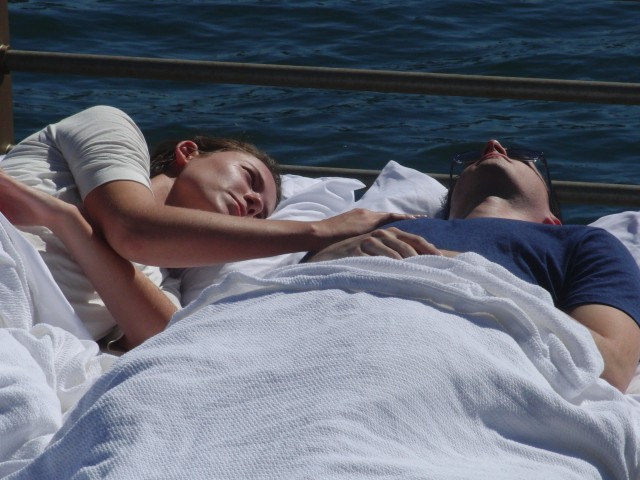
The centerpiece of the exhibition is Smith’s “Resilience of the Dreamer,” a gilded four-poster canopy bed positioned in the middle of building T9, a former locomotive repair facility that has been filled with junk and detritus since Sandy. The piece, which calls to mind the destruction of so many homes along the beach, their facades ripped away during the storm, exposing people’s lives, has been decaying since its installation in June; the canopy is ripping, the sheets turning yellow, dirt collecting on the bed as the elements lay waste to it through the broken windows and battered roof. In a heavily graffitied side room, Smith has collected white stones and placed them in a large birdbath, where people are encouraged to pick one out and place it somewhere else — there are rocks in virtually every nook and cranny, from light switches and windowsills to holes in the wall and floor — or even take one home as a memory. In addition, in the sTudio 7 Gallery, Smith is displaying more than one hundred small-scale black-and-white photos primarily of possessions of friends, colleagues, and influences as well as gravesites. Among the images are Robert Graves’s hat, William Burroughs’s bandanna, Virginia Woolf’s cane, Mapplethorpe’s star mirror, and the Rimbaud family atlas, as well as beds belonging to Woolf, Victor Hugo, John Keats, Vanessa Bell, and Maynard Keynes and the tombs and headstones of Susan Sontag, Herman Hesse, Percy Bysshe Shelley, and Jim Morrison. There is also a stage in the room where musical performances are held on Sunday nights; the next one will be the Jammin Jon Birthday Concert Bash on August 17 at 6:00, with fusion trio Dream Speed and experimental guitarist and Brooklyn native Jammin Jon Kiebon.

Patti Smith

Granite cubes throughout Fort Tilden are part of Patti Smith tribute to Walt Whitman (photo by twi-ny/mdr)

Scattered throughout Fort Tilden, which is part of the Gateway National Recreation Area, are five granite cubes on which Smith has put Whitman quotes (“O madly the sea pushes upon the land, with love, with love”; “Passing stranger! You do not know how longingly I look upon you”) in addition to a dozen small mud-and-straw nests from Adrián Villar Rojas’s “Brick Farm” series, which evoke both home and protection. There’s a map to help locate these objects; wear long pants and closed-toe shoes because several of the passageways are laden with poison ivy. And be sure to walk to the top of the battery for a spectacular view, then make your way down a winding path to the beach. “Rockaway!” is a not only an exciting artistic venture but a terrific exploration of the past, present, and future of the area, so decimated by Hurricane Sandy but even more determined to rebuild its way of life.

Janet Cardiff

Janet Cardiff’s captivating sound installation continues through August 17 (photo by twi-ny/mdr)

(The exhibition is supplemented by a satellite show of works by more than seventy artists — from Marina Abramović and Ryan McNamara to Michael Stipe and Laurie Simmons, from Doug Aitken and Olaf Breuning to Olafur Eliasson and Ugo Rondinone — at Rockaway Beach Surf Club. There are several ways to get to Fort Tilden, all of which involve multiple modes of transportation. You can take the $3.50 Rockaway ferry from Pier 11 downtown to Beach 108th St., then get on the Q22 bus, or take the A train to Broad Channel, switch for the shuttle, then get the Q22 at 116th St. None of the options are quick and easy, but the ferry ride does go past Coney Island and the Statue of Liberty and under the Verazzano-Narrows Bridge. Yes, it’s a hassle, but it’s well worth it.)

FIFI HOWLS FROM HAPPINESS

FIFI HOWLS

Iconoclastic and opinionated artist Bahman Mohassess opens up about his life and career in FIFI HOWLS FROM HAPPINESS

FIFI HOWLS FROM HAPPINESS (Mitra Farahani, 2013)
Lincoln Plaza Cinema
1886 Broadway at 63rd St.
Opens Friday, August 8
212-757-2280
www.lincolnplazacinema.com
www.musicboxfilms.com

“I really don’t understand what this film you are making about me is all about. If it’s a film about a subject, I must know what role it is I am to play,” Iranian-born, Rome-based artist Bahman Mohassess tells director Mitra Farahani in the captivating, bittersweet documentary Fifi Howls from Happiness. “I don’t know the structure of your work. How does it start? What does it want to say? And where does it end?” he continues. A successful artist in his home country, Mohassess ultimately left Iran for Italy because of regime change and political unrest, which eventually involved government destruction of his work. He was so outraged that he destroyed even more of his own creations and eventually stopped showing his paintings, sculptures, and collages. Iranian artist and documentarian Farahani (Just a Woman, Zohre and Manouchehr) went in search of Mohassess, finding him living as a near-recluse in a hotel in Rome. The iconoclastic artist opens up to Farahani, talking about his parents and the end of his era while expressing his doubt about future generations. He also shares his views on the censorship and destruction of his art, political and social mores, inheritance, legacy, the general devastation going on around the world, and death. “I am only one John the Baptist, preaching alone in the desert,” he says. “It will make no difference. It never will.” In addition, he regularly tells Farahani what she should be doing with her film, directing the director, even though he points out, “I am not directing. I am only giving you my opinion.”

Bahman Mohassess becomes reinvigorated when a pair of collectors want to commission a large-scale painting from him

Bahman Mohassess becomes reinvigorated when a pair of collectors want to commission a large-scale painting from him

The narrative takes a delightful turn when Farahani arranges for a pair of Dubai-based brothers and collectors, Rokni and Ramin Haerizadeh, to meet Mohassess and commission a large-scale work from him. Mohassess suddenly has renewed vigor, spouting poetry and showing them Luchino Visconti’s The Leopard. Farahani compares the events to the plot of Honoré de Balzac’s The Unknown Masterpiece, the two tales having remarkable similarities. Farahani also includes archival footage of Ahmad Faroughi’s 1967 documentary on Mohassess, The Eye That Hears, in which the artist, much younger then, states, “My work deals with one thing only, the condemnation of existence. . . . But at the same time I have compassion.” That just about sums up Mohassess, a beguiling mix of condemnation and compassion, a hugely talented artist who is seemingly devoid of any sentimentality, with a deep-throated, cackling laugh that is unlike any you’ve ever heard.

BLADE: KING OF GRAFFITI

blade

Museum of the City of New York
1220 Fifth Avenue at 103rd St.
Friday, August 8, $10 ($40 with book), 6:30
212-534-1672
www.mcny.org
www.bladekingofgraf.com

During the 1970s, Bronx native Steven Ogburn began turning subway trains into his canvas. Taking the street name BLADE, he went on to tag more than five thousand cars between 1972 and 1984. The man also known as the King of Graffiti and the King of Trains is now coming to the Museum of the City of New York in conjunction with the exhibit “City as Canvas: Graffiti Art from the Martin Wong Collection.” On August 8, BLADE will sit down for an intimate conversation, accompanied by a slideshow, with Chris Pape, his cowriter on the new book Blade: King of Graffiti (Schiffer, June 2014, $39.99). “I was just developing my moral compass at the time,” BLADE writes near the beginning of the book, “and if there’s one thing I learned it’s that everyone drew the line in the sand somewhere.” BLADE will talk about the line and more as he examines his life and career; the discussion will be followed by a book signing. “City as Canvas” continues at MCNY through September 21.

SUMMER STREETS 2014

Park Ave. & 72nd St. to Foley Square
Saturday, August 2, 9, 16, free, 7:00 am – 1:00 pm
www.nyc.gov

Now in its fifth year, Summer Streets takes place the next three Saturday mornings, as Park Ave. will be closed to vehicular traffic from 72nd St. to Foley Square and the Brooklyn Bridge from 7:00 am to 1:00 pm, encouraging people to walk, run, jog, blade, skate, and bike down the famous thoroughfare, getting exercise and enjoying the great outdoors without car exhaust, speeding taxis, and slow-moving buses. There are five rest stops along the route (Uptown at 52nd St., Midtown at 25th, Astor Pl. at Lafayette St., SoHo at Spring & Lafayette, and Foley Square at Duane & Centre), where people can stop for some food and drink, live performances, fitness classes, site-specific art installations, dog walks, bicycle and parkour workshops, ziplining, wall climbing, and other activities, all of which are free. Below are only some of the many highlights.

August 2, 9, 16
Cigna Recovery Zone classes: Bendable Body (7:00), Sunrise Salutations (7:30), Body Art (8:00), Balanced Body Yoga (8:30), Yoga Unplugged (9:00), Brazilian Burn n’ Firm Pilates (9:30), Pon De Flo (10:00), Ab Attack (10:30), Retro-Robics (11:00), Hard Knocks (11:30), Masala Bhangra (12 noon), Astor Place Rest Stop

“The Course of Emotions: A mini-golf experience by Risa Puno,” nine-hole miniature golf course in which each hole represents a different emotion, Uptown Rest Stop, 7:00 am – 1:00 pm

“Dive by Jana Winderen,” site-specific sound installation turning Park Ave. Tunnel into an underwater environment, line begins at Park Ave. & 32nd St., 7:00 am – 12:30 pm

August 2
Live music by the Poor Cousins (9:30), Yaz Band (10:00), Mecca Bodega (10:30), Robert Anderson Band (11:00), Uptown Rest Stop

Live performances by Annabella Gonzalez Dance Theatre (10:00), Salsa NY (11:00), Underground Horns (11:30), NY Laughs (12 noon), Feraba (12:30), Foley Square Rest Stop

“Matt Postal, Midtown Modern Tour,” two-hour MAS tour, Uptown Rest Stop, northwest corner of 52nd St. & Park Ave., 10:30

Food demos and talks by Veggiecation (10:30), Seeds in the Middle (10:50), Omowale Adewale (11:10), Jenne Claiborne the Nourishing Vegan (11:25), Creative Kitchen (11:45), Asphalt Green (12:07), Midtown Rest Stop

“Trumpet City: Park Avenue by Craig Shepard,” ninety-one trumpeters join musician Craig Shepard, lining up between 45th & 72nd Sts. on Park Ave., playing a one-hour piece that interacts with such natural sounds as traffic, 11:30 am – 12:30 pm

August 9
Live performances by Salieu Suso and Malang Jobateh (9:00), Caty Grier: NYC Subway Girl (9:30), Leah Coloff (10:00), TAANY Santaizi Troupe (10:30), Charly and Margaux (11:00), Afrikumba (11:30), Karikatura (12 noon), Uptown Rest Stop

Live performances by Salsa NY (10:00), Harmony Program (10:30), Cherub Improv (11:00), Improv 4 Kids (12 noon), Foley Square Rest Stop

Abolitionist Walking Tour, African Burial Ground, National Park Service tour, Foley Square Rest Stop, southwest corner of Duane & Lafayette Sts., 10:00 (also August 16 at 10:00 and 12 noon)

“Peter Laskowich, New York City: A Gateway,” two-hour MAS tour, Foley Square Rest Stop, southwest corner of Duane & Lafayette Sts., 10:00

“Tilt Brass by Chris McIntyre,” interactive sound installation using infrared technology and live trombones, trumpets, and drums, Foley Square Rest Stop, 10:30 – 1:00

Food demos and talks by Sally Graves the Supermarket Fairy (10:30), Omowale Adewale (11:10), Seeds in the Middle (11:25), Taza Chocolate (11:45), Midtown Rest Stop

August 16
“My (Our) Way by Nick Tobler,” interactive musical event in which Tobler will hand out between fifty and a hundred music boxes for a mass performance of “My Way,” Astor Place Rest Stop, 8:00 and 10:30

Live performances by Seya (10:00), Exit 12 (10:30), Salsa NY (11:00), Darrah Carr (12 noon), Foley Square Rest Stop

Food demos and talks by Yoli Ouiya (10:12), Creative Kitchen (10:30), Omowale Adewale (10:50), Chris Santos of Morningstar Farms (11:10), Min Liao from Culinary (11:45), and Seeds in the Middle (12:07), Midtown Rest Stop

Live performances by Matt Pana (10:30), Yung-Li Dance Company (11:00), the Vocalists (11:30), Cupcake Ladies Productions comedy wrestling (12 noon), Uptown Rest Stop

“Judy Richeimer, Public Art in New York’s Civic Center,” two-hour MAS tour, Foley Square Rest Stop, southwest corner of Duane & Lafayette Sts., 11:00

FIRST SATURDAYS: CARIBBEAN COMMUNITY

Brooklyn Museum
200 Eastern Parkway at Washington St.
Saturday, August 2, free, 5:00 – 11:00 ($10 discounted admission to “Ai Weiwei: According to What?”)
212-864-5400
www.brooklynmuseum.org

The Brooklyn Museum starts getting ready for the annual West Indian American Day Carnival on Labor Day with a Caribbean-themed First Saturdays program on August 2. There will be live music from the Crossfire Street Orchestra, Heritage O.P., Melanie Charles, and Request Band (RQB), a movement workshop with Candace Thompson, screenings of Hannah Roodman’s Crown Heights-set documentary 2×1 and Dalton Narine’s Mas Man, a woven-fish arts workshop, a Caribbean-inspired fashion show, and Uraga storytelling with James Lovell. In addition, you can check out a quartet of exhibitions about art and activism: “Ai Weiwei: According to What?” (which closes August 10), “Swoon: Submerged Motherlands” (which closes August 24), “Chicago in L.A.: Judy Chicago’s Early Works, 1963–74,” and “Revolution! Works from the Black Arts Movement.”

MoMA NIGHTS 2014

La Luz kicks off woman-centric MoMA Nights summer outdoor concert series on July 31 in the sculpture garden (photo by Zoe Rain)

La Luz kicks off woman-centric MoMA Nights summer outdoor concert series on July 31 in the sculpture garden (photo by Zoe Rain)

Museum of Modern Art
Abby Aldrich Rockefeller Sculpture Garden
11 West 53rd St. between Fifth & Sixth Aves.
Thursday nights, July 31 – August 28, free with museum admission, 5:30 – 8:00
212-708-9400
www.moma.org

Every summer, the Museum of Modern Art’s lovely Abby Aldrich Rockefeller Sculpture Garden becomes one of the city’s most beautiful spots to enjoy outdoor music. Free with regular admission, MoMA Nights, which this year focuses on woman-led bands, begins on July 31 at 6:30 (doors open at 5:30, with limited seating) with a performance by all-female Seattle quartet La Luz, who pays tribute to girl-group sounds. The series continues August 7 with LA dream popsters Tashaki Miyaki, named for guitarist Rocky Tashaki and drummer and vocalist Lucy Miyaki (bassist and vocalist Dora Hiller fills out the trio). Frankie Cosmos, a local four piece led by singer-songwriter Greta Kline, will highlight tunes from its March 2014 studio debut, Zentropy, on August 14. The jazzy, funkadelic THEESatisfaction, the Seattle duo consisting of Stasia “Stas” Irons and Catherine “Cat” Harris-White, takes over the garden on August 21. MoMA Nights comes to a close August 28 with Brooklyn twosome Widowspeak (Molly Hamilton and Robert Earl Thomas), whose “True Believer” was twi-ny’s song of the day back on November 13.

PAWEŁ ALTHAMER: QUEEN MOTHER OF REALITY / ŽILVINAS KEMPINAS: SCARECROW

(photo by twi-ny/mdr)

A collaborative closing ceremony will bid farewell to Paweł Althamer’s “Queen Mother of Reality” on August 2 (photo by twi-ny/mdr)

Socrates Sculpture Park
32-01 Vernon Blvd.
Daily through August 3, free
718-956-1819
www.socratessculpturepark.org

Socially conscious Polish artist Paweł Althamer has followed up his wide-ranging, vastly entertaining one-man New Museum survey, “The Neighbors,” with the engaging “Queen Mother of Reality,” on view at Socrates Sculpture Park through August 3. Originally commissioned by Performa 13 and seen in Williamsburg last fall, the interactive work, of a large-scale reclining woman that people are invited to walk inside of, lies luxuriously in the shade in the south side of the Long Island City park. The fifty-foot-high, eighteen-foot-long piece is named for Queen Mother Dr. Delois Blakely, the founder and president of the New Future Foundation, a nonprofit whose mission is to “facilitate international and domestic economic social development, community outreach, education, and health”; in 1995, Dr. Blakely became the first woman Community Mayor of Harlem, and she is also the UN Ambassador of Goodwill to Africa. Constructed of all kinds of found materials and scraps with the help of such volunteers as artists Noah Fischer, Roman Stańczak, Rafal Zwirek, and Eric Gottshall as well as Althamer’s sons Bruno and Szymon — using some rather inventive objects for various body parts — “Queen Mother” is a symbolic public gesture “to protect mothers against eviction,” offering people the opportunity to go inside, take a seat, write down a wish, and contemplate their own living situation as well as that of the many displaced and homeless people in New York and throughout the world. The interior includes a chair-throne, Chinese lanterns, flowers, fencing, and plates honoring such women as suffragist Susan B. Anthony, first lady Michelle Obama, civil rights leader Queen Mother Moore, artist Frida Kahlo, and Occupy activist Cecily McMillan. Socrates has hosted a slew of events involving “Queen Mother”; the closing ceremony is set for August 2, when Althamer will lead visitors in “A Draftsmen’s Congress,” a collaborative gathering in which anyone and everyone can come and create their own paintings, drawings, and collages in, on, and around the impressive structure.

(photo by twi-ny/mdr)

Žilvinas Kempinas’s “Scarecrow” invites people in rather than frightening them away (photo by twi-ny/mdr)

Žilvinas Kempinas, whose “Double O” was a highlight of MoMA’s recent “On Line: Drawing through the Twentieth Century,” regularly uses fans in his immersive, often kinetic sculptures. For the 250-foot-long, 13-foot-high site-specific “Scarecrow,” the largest installation in Socrates’s history, the Lithuanian-born, New York-based artist relies on the natural environment to bring the work to life. With minimal materials—two parallel rows of slender stainless-steel mirrored poles joined by an open “roof” of fluttering Mylar strips overhead, “Scarecrow” physically and energetically reflects the surrounding river and sky, seamlessly amplifying and responding to the movement of water and air. The near weightlessness of the Mylar allows it to twist in the wind and wink in the sun continuously, depending only on natural power. Without engines or electricity, the installation nevertheless is in constant motion, even more so as you move through it, making your way across the green grass. Without solid walls and a ceiling, it nonetheless encloses you, shaping and accentuating their experience of the surrounding park space, especially as a woman passes by pushing a stroller, two people stop and chat as their dogs sniff each other, and a shirtless man practices martial arts at the far end. Using the bare essentials, Kempinas has created a truly monumental work. (Also at the park through August 3 is Meschac Gaba’s psychedelic “Broadway Billboard: Citoyen du Monde” and Austin+Mergold’s “Folly: SuralArk.”