this week in art

RACHEL FEINSTEIN’S “THE LAST DAYS OF FOLLY” PERFORMANCE FESTIVAL

“Rococo Hut” is one of three sculptural pieces that make up Rachel Feinstein’s “Folly” in Madison Square Park (photo by twi-ny/mdr)

“Rococo Hut” is one of three sculptural pieces that make up Rachel Feinstein’s “Folly” in Madison Square Park (photo by twi-ny/mdr)

FOLLY
Madison Square Park
23rd to 25th Sts. between Madison Ave. & Broadway
Wednesday, September 3, free, 5:30 – 8:30
Exhibition continues through September 7
www.madisonsquarepark.org
folly slideshow

At first look, Rachel Feinstein’s site-specific “Folly” installation in Madison Square Park appears to be a trio of fragile ornamental structures, seemingly crudely made out of paper (they began life as handmade paper models), that could serve as backdrops for a high school play. Echoing fairy-tale-like nonfunctional garden decoration from eighteenth- and nineteenth-century Europe as well as Nymphenburg porcelain, the three pieces — “Cliff House,” inspired by Ballets Russes sets; “Rococo Hut,” influenced by Marie Antoinette’s château Le Petit Triannon; and “The Flying Ship,” based on a Commedia dell’arte skit about Punchinello — are actually constructed from powder-coated aluminum. The works, which also give nods to Federico Fellini, Marlene Dietrich’s portrayal of Catherine the Great in The Scarlet Empress, and Giovanni Battista Piranesi’s real and imagined landscapes, might look like they could collapse at any moment — “Rococo Hut” features crooked steps, “The Flying Ship” uses a tree for balance, and “Cliff House” looks supremely unsafe — but they are sturdy enough to be home to a wide-ranging collection of performances on September 3. “The Madison Park Conservancy has given me the opportunity to marry my early interest in theater and performance with my later obsession with the handmade in one of the most spectacular settings. I picture ‘Folly’ as an empty Fellini-esque set dropped into the middle of a lush green wonderland in the historical Flatiron district of New York City,” the New York City-based Feinstein (“The Snow Queen”), who was born in Defiance, Arizona, and raised in Miami, said in a statement. “I have always been driven by the stark contrast between good and evil in old fairy tales. Having this setting, a hidden natural jewel situated within the tall skyscrapers of yesterday and today, will be the perfect backdrop for my theater, where the real people who occupy the park every day will stand in as Commedia dell’arte performers.”

Rachel Feinstein’s “Folly” will be home to a wide-ranging performance festival on September 3 (photo by twi-ny/mdr)

Rachel Feinstein’s “Folly” will be home to a wide-ranging performance festival on September 3 (photo by twi-ny/mdr)

On Wednesday, “The Last Days of Folly” will consist of My Barbarian performing its “Broke Baroque Suite”; a procession through the park led by artists Allison Brainard and Cara Chan; musical segues by Jarvis Cocker based on Maurice Ravel’s Daphnis et Chloé for the Ballets Russes; Sofia Coppola directing six Joffrey Ballet School ballerinas dancing to Isao Tomita’s version of one of Claude Debussy’s Arabesques; a sound-and-movement piece from multidisciplinary artist Tamar Ettun; Little Did Productions’ magic lantern interpretation of parts of the Ramayana with Luke Santy on sitar and Jessica Lorence on vocals; an improvised dance by Lil Buck set to music by Paul Cantelon and cellist Wolfram Koessel; Kalup Linzy’s “Romantic Loner” and “One Life to Heal,” with live music by Mike Jackson; Molly Lowe’s nude costume incorporating numerous performers; a music set by Angela McCluskey and Cantelon, joined by Lil Buck and others; a puppet show from Shana Moulton; a new video work by Tony Oursler collaborating with Constance DeJong; a sound installation by Carlos Vela-Prado; and “Folly”-inspired fashion from Giles Deacon, Duro Olowu, Zac Posen, Narciso Rodriguez, Cynthia Rowley, Proenza Schouler, and Madeline Weinrib. We have no idea how this is all going to be squeezed into a mere three hours, but we can’t wait to find out.

CROSSING THE LINE 2014

Fernando Rubio’s “Everything by My Side” takes place on seven beds in Hudson River Park as part of FIAF’s Crossing the Line festival

Fernando Rubio’s “Everything by My Side” takes place on seven beds in Hudson River Park as part of FIAF’s Crossing the Line festival

French Institute Alliance Française and other locations
Florence Gould Hall, 55 East 59th St. between Madison & Park Aves.
FIAF Gallery, 22 East 60th St. between Madison & Park Aves.
September 8 – October 20, free – $35
212-355-6160
www.fiaf.org

One of the best multidisciplinary arts festivals every year, FIAF’s Crossing the Line is back for its eighth season, featuring another exciting lineup of dance, theater, music, installation, exhibitions, and hard-to-describe events. Cocurators Lili Chopra, Simon Dove, and Gideon Lester explain it thusly: “This year’s edition of Crossing the Line brings together fifteen extraordinary international artists and companies, each of them offering unique perspectives on the world we all share. We invite New Yorkers to explore their meticulous and deeply considered work, both the familiar and the unknown, and find inspiration, provocation, and pure pleasure.” Hosted by the French Institute Alliance Française and taking place there as well as several other locations, CTL offers numerous opportunities to “find inspiration, provocation, and pure pleasure.” Palais Galliera director Olivier Saillard gets seven former supermodels to open up in Models Never Talk, a world premiere at Milk Studios. Trajal Harrell continues his Twenty Looks or Paris Is Burning at the Judson Church with a week of special performances at the Kitchen. Justin Vivian Bond is joined by special guest Miguel Gutierrez for the one-night-only Love Is Crazy, consisting of songs and stories about love and romance.

Prune Nourry’s “Terracotta Daughters” will stand guard at 104 Washington St. for eighth edition of CTL

Prune Nourry’s “Terracotta Daughters” will stand guard at 104 Washington St. for eighth edition of CTL

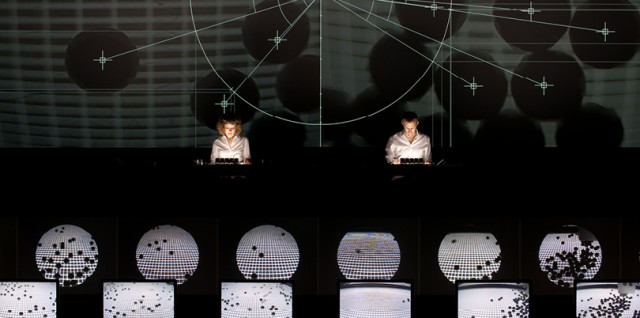
Patti Smith, her daughter, Jesse, and Soundwalk Collective examine the death of Nico in unique ways in Killer Road at FIAF. Swiss choreographer Gilles Jobin and German visual artist Julius von Bismarck use motion-sensor technology and lighting to delve into physics in Quantum at BAM Fisher. Jessica Mitrani and Pedro Almodóvar regular Rossy de Palma pay tribute to Nellie Bly in Traveling Lady at FIAF. The audience is encouraged to participate in Aaron Landsman’s free Republic of New York: Perfect City Discussions at Abrons Arts Center. Fernando Rubio’s Everything by My Side is a fifteen-minute rotating performance on seven beds in Hudson River Park. The works of French choreographer Xavier Le Roy will be re-created at MoMA PS1. Prune Nourry’s “Terracotta Daughters” exhibition at 104 Washington St. challenges gender roles in China and the world. Julie Béna’s site-specific “T&T Consortium: You’re Already Elsewhere” at the FIAF Gallery puts visitors into a fantastical setting. The star of the festival is Japanese electronic artist Ryoji Ikeda, whose Park Avenue Armory installation “The Transfinite” dazzled New York back in 2011; the mathematical mastermind will present the immersive, multimedia Superposition at the Metropolitan Museum of Art, a gallery exhibition at Salon 94, and “Test Pattern [Times Square],” which can be seen on nearly four dozen screens in Times Square as part of the “Midnight Moment” program each night in October from 11:57 pm to midnight. CTL is also one of the most affordable festivals, with nothing costing more than $35, so you have no excuse not to check out at least a few of these ultracool events.

CHRISTOPH SCHLINGENSIEF

Christoph Schlingensief, The Animatograph. 2005. Installation view in Christoph Schlingensief at MoMA PS1, 2014. © 2014 MoMA PS1; Photo Matthew Septimus.

Christoph Schlingensief’s “The Animatograph” offers a unique, unpredictable journey at MoMA PS1 (© 2014 MoMA PS1; photo by Matthew Septimus)

MoMA PS1
22-25 Jackson Ave. at 46th Ave.
Thursday – Monday through September 1, suggested admission $10
718-784-2084
www.momaps1.org
www.schlingensief.com

Staging a retrospective of a late performance artist whose work was very much of the moment can be a daunting, difficult task, but curators Klaus Biesenbach, Anna-Catharina Gebbers, and Susanne Pfeffer have done a terrific job with the simply titled “Christoph Schlingensief,” MoMA PS1’s exciting exploration of the career of the German multidisciplinary artist who died in 2010 at the age of forty-nine. Over the course of thirty years, Schlingensief produced experimental films, cutting-edge operas, radical theater pieces, and public actions and interventions that shattered the boundaries between audience and performer and challenged the social and political status quo of his native country and beyond. The expansive exhibition examines Schlingensief’s working process and the reaction to his pieces through film and video clips, photographs, documentation, installation, related paraphernalia, and lots of wall text that puts his oeuvre in context. For “Chance 2000,” Schlingensief formed a political party that fought for the rights of the marginalized; for one event, Schlingensief called for people to bathe in a lake at Chancellor Helmut Kohl’s summer home, hoping to get enough participants to flood the house. In “Please Love Austria — First Austrian Coalition Week,” Schlingensief mocked right-wing anti-immigration zealots by placing twelve supposed asylum seekers in containers and filming them Big Brother-style. For Parsifal, Schlingensief reimagined Richard Wagner’s opera at the Bayreuth Festival, incorporating contemporary religious symbolism and a decomposing rabbit.

Christoph Schlingensief, The Stairlift to Heaven. 2007. Installation view in Christoph Schlingensief at MoMA PS1, 2014. © 2014 MoMA PS1; Photo Matthew Septimus

Visitors are sure to get a rise out of Christoph Schlingensief’s intimate and personal “Stairlift to Heaven” (© 2014 MoMA PS1; photo by Matthew Septimus)

The audience became protesters in Rocky Dutschke ’68, following Schlingensief into the street as he re-created a famous shooting while declaring, “No Power for Anyone.” MoMA PS1 visitors can get involved themselves in several interactive installations. You can take a seat in a comfy living-room set to watch Schlingensief’s unique television show Talk 2000, which challenged the conventions of the genre. You most definitely should walk all around “The Animatograph,” a rotating multimedia house of bizarre horrors with surprises at every turn. And in “Stairlift to Heaven,” individuals strap themselves into a chairlift that takes them up past a projection of excerpts from Schlingensief’s 2007 film, The African Twin Towers, and to a private viewing booth. Schlingensief’s legacy continues with “Opera Village Africa,” an “artistic reservoir for the future” that is an actual village he and his wife, Aino Laberenz, built in Burkina Faso, complete with a hospital, a primary school, a theater group, a birthing clinic, and more, overseen by Laberenz since her husband’s death from lung cancer in 2010. “What kind of art is it that no longer has any access, no longer lets anyone in, and also doesn’t step out of itself?” Schlingensief asked. “Here the idea is to finance an art platform which is to serve as a basis for children and teenagers. So we can learn again how creativity comes about and develops. That’s the idea of the Opera Village.” It’s also the central focus of most of his work, the intersection of art and activism, producing public actions and interventions — with a wicked sense of humor and an anarchic distaste of authority — that can impact complacency and conventionality potentially on a global scale, even after his death. “Nothing is certain because I show it. Everything describes itself, overwrites and dissolves,” he once said. “This is not fatalism; this is my principle of pleasure.” There is much pleasure to be found in this dazzling display, especially for those who invest the time to soak in all the thrilling details.

LAST CHANCE TICKET ALERT: NEW YORK COMIC CON

Crowds keep getting bigger and bigger every year for New York Comic Con (photo by twi-ny/mdr)

Crowds keep getting bigger and bigger every year for New York Comic Con (photo by twi-ny/mdr)

NEW YORK COMIC CON / NEW YORK SUPER WEEK
Jacob K. Javits Convention Center
655 West 34th St. (11th Ave. between 34th & 39th Sts.)
Thursday, October 9, $35, 12 noon – 7:00
Con continues through October 12; New York Super Week runs October 3-12
888-605-6059
www.newyorkcomiccon.com
www.newyorksuperweek.com

New York Comic Con continues to get more and more popular every year, with bigger and bigger guests and longer and longer lines. Tickets for the ninth annual event, running October 9-12 at the Javits Center, are already sold out for Friday, Saturday, and Sunday, and the organizers haven’t even announced the full slate of activities for any of the days. So your only chance for getting in will be to go on Thursday, when there will be appearances by such spotlight guests as Giancarlo Esposito of Breaking Bad, Hollows series author Kim Harrison, and Kristian Nairn (Hodor) and Natalia Tena (Osha) of Game of Thrones and such featured guests as Jason David Frank of Mighty Morphin Power Rangers, Ben Templesmith, Bob McLeod, Dustin Nguyen, Jimmy Palmiotti, Peter David, Stuart Moore, and Terry Moore, and dozens of special guests as well. In conjunction with NYCC, New York Super Week runs October 3-12 at various locations throughout the city, consisting of related events, including a thirtieth anniversary screening of The Karate Kid at the 92nd St. Y with Ralph Macchio, William Zabka, and Martin Kove; metal monsters X Japan at Madison Square Garden; Neil Gaiman as the subject of host Ophira Eisenberg’s “Ask Me Another” live show at the Y; “Dr. Horrible’s Sing-Along Blog Sing-Along and Whedonverse Party” at Union Hall; “The First (and Probably Last) Annual New York Feline Film & Video Festival for Humans” at Galapagos Art Space; a “Dr. Who Trivia and Costume Contest” at the Way Station; “Cure You or Kill You: 19th Century Medical Science and Quackery” at the Museum of Morbid Anatomy; and “Rave of Thrones,” a DJ set by Nairn with special guests Zedd Stark and Trance Rayder at B. B. King’s.

THE GREEK MONSTERS

Greek Monsters (photo by twi-ny/mdr)

The Minotaur hangs out with Medusa and Scylla in “Greek Monsters” show at Onassis Cultural Center (photo by twi-ny/mdr)

Onassis Cultural Center NY
Olympic Tower Atrium
641 Fifth Ave. between 51st & 52nd Sts.
Daily through August 24, free, 10:00 am – 6:00 pm
www.onassisusa.org
www.beetroot.gr

Who let the monsters out? While the downstairs Onassis Cultural Center is undergoing renovation, the Olympic Tower Atrium in Midtown has been overrun with mythical creatures of all shapes and sizes. But there’s nothing scary about these adorably cute black, orange, and white symbolic figures that hail from Ancient Greek literature and evoke Athenian vase painting of the fourth to sixth centuries BCE. Created by the award-winning design firm Beetroot as a response to the European demonization of Greece because of its severe financial problems, the exhibition “The Greek Monsters” has been traveling for several years, including stops at the Alte Münze Berlin and the Benaki Museum in Athens. Consisting of big and small sculptures, bas-reliefs, and a stenciled mural, the show will remain on view in the atrium through Sunday, August 24. Polyphemus, the Cyclops who is the son of Poseidon and Thoosa, stands guard over the revolving doors of the south entrance, attended by three of his sheep, while man-eating Stymphalian birds, who battled Hercules, fly over the north doors. The giant Minotaur, one hand covering his right eye, the other on his left knee, seemingly hides in a corner (in front of Medusa and Scylla), not looking nearly as menacing as he probably did when he fought Theseus. Among the other “misunderstood monsters,” purposely humanized by Beetroot, are Cerberus, Pan, Chimera, and the Sirens. Poems and verse accompany many of the figures; the Lernaean Hydra is described with the couplet “Her breath reeked of fire and poison / But her middle head was immortal,” while the Cyclops declares, “I have one eye / Although it looks at everything / It captures only what I wish.” And as a whole, they proclaim in unison, “We are the monsters in your head / We are your monsters.” And we wouldn’t be the same without them.

21st PRECINCT ART EXHIBIT

(photo by twi-ny/mdr)

The former 2st Precinct station house bids farewell with a five-floor graffiti show (photo by twi-ny/mdr)

327 East 22nd St. between First & Second Aves.
August 23-24, free, 1:00 – 6:00
www.facebook.com
21st precinct art exhibit slideshow

Does graffiti enhance New York City real estate or is it a misappropriation of private property and our public visual space? The relationship between NYC walls and street art has always been fraught with controversy; the latest wrinkle seems to be to have developers give about-to-be-demolished edifices over to the artists for licensed, noncriminal, uninhibited expression. In December 2006, the Wooster Collective put together “Wooster on Spring,” a spectacular exhibit in which dozens of street artists went to town on 11 Spring St., a building that was going to be turned into luxury housing; some of the greatest graffiti artists in the world descended on SoHo to make sure that every nook and cranny was covered.

(photo by twi-ny/mdr)

RAE’s bedroom installation is one of the highlights of graffiti exhibit (photo by twi-ny/ees)

Over the last few months, we’ve had to say goodbye to the Queens capital of legal graffiti, 5 Pointz, which has now been whitewashed and will be demolished (which was always its destiny) to make room for luxury rentals. The latest building to get an artistic send-off is 327 East Twenty-Second St., the former 21st Precinct station house (from 1863 to 1914) that Suzuki Capital is turning into boutique condos. But before the wrecking ball arrives, a group of street artists has decorated virtually every possible space, transforming it into a graffiti lover’s paradise. (It opened last weekend and will remain on view this Saturday and Sunday only.) Savior Elmundo, Pesu Art, and Outlaw Arts invited such friends as Bad Pedestrian, bunny M, Cash4, Curb Your Ego, Dizmology, Erasmo, GIZ, Matt Siren, Mr. Toll, Pixote, Queen Andrea, and Zoens to participate, giving each a specific area for them to show what they can do.

(photo by twi-ny/mdr)

N. Carlos Jay’s “Vandal” honors building’s past while emphasizing relationship between cops and graffiti artists (photo by twi-ny/mdr)

Pablo Picasso and Salvador Dali square off against each other in the ring. Elle’s prone wax woman melts as candles burn down across her body. Vexta’s bird flies out of the box. Rambo pays tribute to Al Pacino as Scarface. You can talk photography with Jesper Haynes in his darkroom. RAE creates a Basquiat-influenced mesmerizing blue bedroom. Chris RWK warns us that Robots Will Kill, and Mr. Toll equates skulls with dripping fried eggs — your brain on drugs, perhaps? Hellbent amazes with a psychedelic rainbow explosion. Sheryo & the Yok brilliantly turn a room red. N. Carlos Jay honors the Gashouse District battle between cops and graffiti artists. Watch out for Adam Dare’s brokenhearted chained rabbit. And you might want to stay away from Nick Tengri’s bathroom filled with broken glass, as well as another one bathed in blood. And URNY (SKI & 2ESAE) reminds everyone that this was a police precinct by writing such statements as “Stop the police from murdering people” and “You have the right to remain silent. . . . Anything you say can & will be used against you!!!” Meanwhile, others claim that “Graffiti is now for the bourgeois” and that “Artists shouldn’t work for free.”

(photo by twi-ny/mdr)

One of the themes of graffiti show is to “make art,” as depicted here by Savior Elmundo (photo by twi-ny/mdr)

Legal graffiti is always a bit tricky — the “criminal” element is a large part of its draw — and many of the works, including those on paper, wood, and canvas, are for sale. But the debate over the commercialization of graffiti style has long been over among the cognoscenti, and the art market and the real estate market, two of the more exciting arenas of ego and money in NYC, have combined here to produce another awe-inspiring, evanescent show — as fleeting as fame and fortune ever are.

JEFF KOONS: SPLIT-ROCKER

Jeff Koons sculpture will keep on rockin’ through September 12 at Rockefeller Center (photo by twi-ny/mdr)

Jeff Koons topiary sculpture will keep on rockin’ through September 12 at Rockefeller Center (photo by twi-ny/mdr)

Rockefeller Plaza
49th to 50th Sts. between Fifth & Sixth Aves.
Through September 12, free
www.publicartfund.org
www.rockefellercenter.com

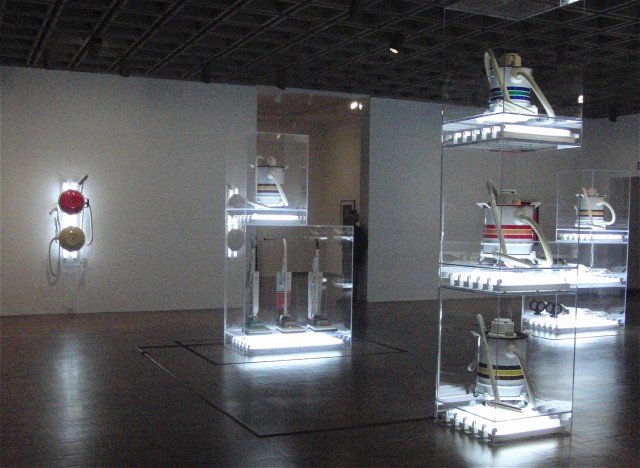
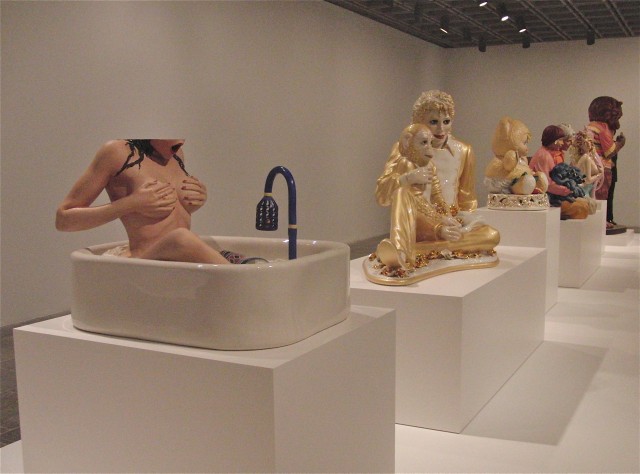
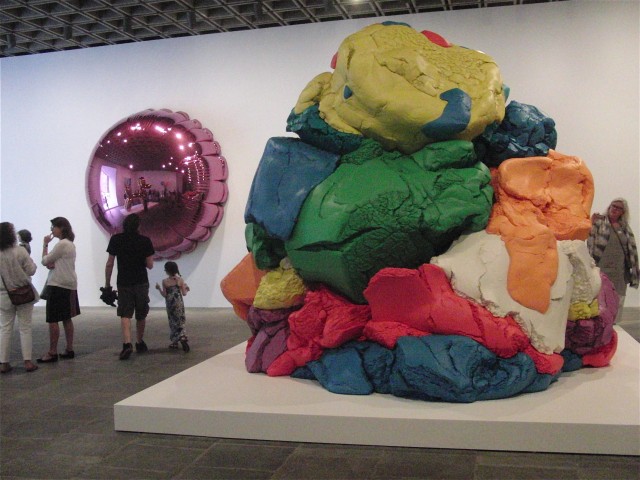
Back in the summer of 2000, Jeff Koons’s massive “Puppy” looked out over the crowds at Rockefeller Center. Koons is back at the plaza this season with “Split-Rocker,” a Public Art Fund project that serves as a tasty amuse-bouche to his career-redefining retrospective at the Whitney. Standing thirty-seven-feet high and covered with fifty thousand flowering plants, “Split-Rocker” is a giant children’s rocking chair, a pony head on one side (based on his son’s toy) and a dinosaur (“Dino”) on the other. The 150-ton topiary sculpture, previous versions of which have been displayed in Avignon, Versailles, Riehen/Basel, and Potomac, Maryland, since 2000, is much brighter and more colorful on the pony half, but the work will change during its stay as some flowers die off and others come to life; among the varieties are begonias, geraniums, petunias, and fuchsias. The title is key, as the “split” is more than evident; Koons fashioned the piece so there is a clear differentiation between the two halves, which are slightly misaligned, allowing viewers to glimpse the mirrorlike metal separator. In addition, there is an inviting opening in the back — seemingly offering shelter, although you are not allowed inside — that reveals how the structure was built, with beams and an irrigation system. “I love the dialogue with nature in creating a piece that needs so much control — How many plants should be planted? How will these plants survive? — while at the same time giving up the control,” Koons said in a statement. “It’s in nature’s hands, even though you try to plan everything to make the plants survive. This sense of giving up control is very beautiful. The balance between control and giving up control reminds us of the polarity of existence.” The utterly delightful piece will remain on view through September 12, while the Whitney show, which includes a maquette of “Split-Rocker,” continues until October 19. Koons, who lives and works in New York City and York, Pennsylvania, where he was born and raised, will discuss the project in a Public Art Fund Talk at the New School on September 10; he will also deliver the prestigious 2014 Walter Annenberg Lecture at the Whitney on September 30.