this week in art

MATT BOLLINGER: READING ROOMS

Matt Bollinger, “The Reading Room,” flashe, acrylic, collage on unstretched canvas, 2014

Matt Bollinger, “The Reading Room,” flashe, acrylic, collage on unstretched canvas, 2014

Zürcher Studio
33 Bleecker St. at Mott St.
Tuesday – Sunday through January 30, free, 12 noon – 6:00 pm (Sunday 2:00 – 6:00)
212-777-0790
www.galeriezurcher.com
www.mattbollinger.com

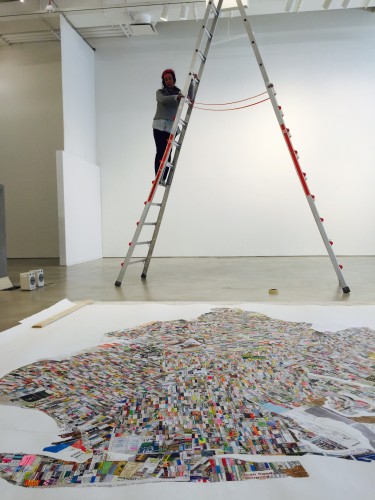
Matt Bollinger’s latest exhibit at Zürcher Studio, “Reading Rooms,” is highlighted by a pair of stunning large-scale canvases, “The Reading Room” and “The Reservoir,” that depict old bookstore shelves; in the former, the shelves are collapsing in on themselves, books, paper, magazines, and garbage strewn about, while in the latter, the shelves are still standing and full, with books piled on the floor, but in both cases it feels like it’s been quite some time since someone has been there. The two works set the stage for the rest of the show, as if all the other paintings are pages from books from these shelves, each merging Bollinger’s — and the viewer’s — past and present. “I used to work in a bookstore,” Bollinger says in a catalog interview for his spring 2014 show at Zürcher in Paris, which also included “The Reservoir.” He continues, “It had a mold-riddled basement that I was always eager to explore; you could find all sorts of stuff down there. I want this picture of a bookstore to operate as a reservoir. A holder, a backdrop, for all the other reservoirs in the show.” Now Bollinger has symbolically transformed Zürcher’s Bleecker St. gallery into a kind of psychological library, with works that are like pages from a book. Among the chapters of Bollinger’s tome are “Mayhem,” “Nancy (Reflection),” “Odd Jobs,” “Brian in Nancy’s Room,” and “Sheet Rock,” featuring repeating characters. In the back room, “Renovations” consists of twenty-eight smaller pieces arranged in rows, creating another kind of narrative; nearby is a painting of the book’s torn cover. However, despite the serious nature of the paintings and how they bring up thoughts of the future of libraries and bookstores and hard copy, Bollinger, who was born in Kansas City and is based in Brooklyn, also says in the catalog, “I’ve been thinking about the obsolescence of the paper book, but I don’t want the pieces to be laments. I want the work to present treasures, private discoveries.” There are many treasures and private discoveries to be found in “Reading Rooms.”

STRANGER THAN FICTION — FAR OUT ISN’T FAR ENOUGH: THE TOMI UNGERER STORY

(photo by Sam Norval /  Corner of the Cave Media)

Illustrator Tomi Ungerer talks about his fascinating life in compelling documentary (photo by Sam Norval / Corner of the Cave Media)

FAR OUT ISN’T FAR ENOUGH: THE TOMI UNGERER STORY (Brad Bernstein, 2012)
IFC Center
323 Sixth Ave. at West Third St.
Monday, January 19, 8:00
Winter series runs Tuesdays at 8:00 through March 24
212-924-7771
www.faroutthemovie.com
www.stfdocs.com

“I am a self-taught raving maniac, but not as crazy as Tomi, or as great as Tomi,” Maurice Sendak says early on in Brad Bernstein’s engaging documentary, Far Out Isn’t Far Enough: The Tomi Ungerer Story, adding, “He was disarming and funny and not respectable at all.” Another children’s book legend, Jules Feiffer, feels similarly, explaining, “Tomi was this wonderfully brilliant, innovative madman.” Born in Alsace in 1931, Tomi Ungerer developed a remarkably diverse career as an illustrator, incorporating the emotional turmoil he suffered after losing his father when he was still a young child and then living under Nazi rule. In Far Out Isn’t Far Enough, Ungerer takes Bernstein and the audience on a fascinating journey through his personal and professional life, traveling to Strasbourg, Nova Scotia, New York City, and Ireland, which all served as home to him at one time or another as he wrote and illustrated such picture books as The Three Robbers and Crictor for editor Ursula Nordstrom, made bold political posters in support of the civil rights movement and against the Vietnam War, and published a book of erotic drawings, Fornicon, that ultimately led to a twenty-three-year exile from America during which he stopped making books for children. “I am full of contradictions, and why shouldn’t I be?” the eighty-one-year-old Ungerer says in the film. Ungerer discusses how he uses fear, tragedy, and trauma as underlying themes in his stories, trusting that kids can handle that amid the surreal nature of his entertaining tales.

He opens up his archives, sharing family photographs and old film footage, which reveal that he’s been pushing the envelope for a very long time, unafraid of the consequences. He also visits the Eric Carle Museum to check out a retrospective of his work for children, appropriately titled “Tomi Ungerer: Chronicler of the Absurd.” Meanwhile, Rick Cikowski animates many of Ungerer’s drawings, bringing to life his characters, both for children and adults, adding another dimension to this wonderful documentary. Far Out Isn’t Far Enough is a lively, engaging film about a seminal literary figure with an infectious love of life and art, and a unique take on the ills of society, that is a joy to behold. The film kicks off the IFC Center’s winter season of Stranger than Fiction on January 19 at 8:00, followed by a Q&A with Bernstein and Ungerer; Ungerer aficionados will also want to check out the new exhibit ”Tomi Ungerer: All in One” at the Drawing Center through March 22. Stranger than Fiction continues Tuesday nights through March 24 with such other nonfiction works as The Hand that Feeds, Freeway: A Crack in the System, Occupation: Dreamland, Seymour: An Introduction, and A Dangerous Game; each screening will be followed by a Q&A with the director(s), producer(s), and/or subject.

COIL — ALEXANDRA BACHZETSIS: FROM A TO B VIA C

COIL

Swiss choreographer Alexandra Bachzetsis examines beauty and the act of viewing in free COIL presentation, FROM A TO B VIA C

Swiss Institute / Contemporary Art
18 Wooster St.
Performance: Wednesday, January 14, free with advance RSVP, 7:00
Installation: January 12-13, free, 12 noon – 6:00 pm
212-352-3101
www.ps122.org/from-a-to-b
www.swissinstitute.net

Swiss choreographer Alexandra Bachzetsis once again explores gender identity, body language, concepts of beauty, and the very nature of art and performance in today’s communication-obsessed world in her latest work, From A to B via C, inspired by the fascinating history of Diego Velázquez’s “The Toilet of Venus.” In that painting, which is also known as “Venus at Her Mirror” and “The Rokeby Venus,” Cupid holds up a reflecting glass so his nude, reclining mother, Venus, the goddess of love, can admire her visage. The controversial work, completed by the Spanish painter in 1651, stirred one viewer, Canadian suffragette Mary Richardson, to repeatedly slash it in March 1914; her attack was a very public response to the brutal treatment being given fellow feminist activist Emmeline Parkhurst. “I have tried to destroy the picture of the most beautiful woman in mythological history, as a protest against the government for destroying Mrs Pankhurst, who is the most beautiful character in modern history,” Richardson wrote at the time. “Justice is an element of beauty as much as colour and outline on canvas.” One hundred years after that attack, Bachzetsis’s multimedia performance installation From A to B via C, taking place this week at the Swiss Institute as part of PS122’s tenth annual COIL festival, investigates this strange conjunction of art, protest, and feminism. In the hour-long U.S. premiere, Bachzetsis and Gabriel Schenker, wearing Cosima Gadient’s costumes depicting the inner musculature of the human body, are joined by a naked Anne Pajunen, who holds up a monitor showing a live feed as Bachzetsis reclines on a couch and looks at herself. The Zurich-born Bachzetsis’s previous work includes The Stages of Staging, Bluff, and Mainstream; the installation From A to B via C can be seen January 12 & 13 from 12 noon to 6:00, while the final live performance is scheduled for January 14 at 7:00. Admission is free with advance RSVP.

KARA WALKER: AFTERWORD

Kara Walker follow-up packs another powerful punch (photo by twi-ny/mdr)

Kara Walker follow-up packs another powerful punch (photo by twi-ny/mdr)

Sikkema Jenkins & Co.
520 West 22nd St. between Tenthy & Eleventh Aves.
Tuesday – Saturday through January 17, free, 10:00 am – 6:00 pm
212-929-2262
www.sikkemajenkinsco.com

Brooklyn-based multimedia artist Kara Walker didn’t have much to say about her staggering installation “A Subtlety or the Marvelous Sugar Baby: an Homage to the unpaid and overworked Artisans who have refined our Sweet tastes from the cane fields to the Kitchens of the New World on the Occasion of the demolition of the Domino Sugar Refining Plant” before and during its May 10 to July 6 run in Williamsburg. Instead, she let the work, a monumental white sphinx/mammy hovering over a collection of molasses-dripping “Sugar Babies,” speak for itself to more than 130,000 visitors who came to experience it (and posted nearly 20,000 photographs to Instagram and Twitter). Walker has now followed that up with “Afterword,” a telling three-part exhibit at Sikkema Jenkins that gives new perspective on the work, which was commissioned by Creative Time. The first room contains a series of preparatory sketches, including a 2013 ink-and-watercolor version of the central figure throwing up and a cut-paper black silhouette of the sphinx on archival board, reversing the black-white, racially charged color scheme. The second room is dominated by the sphinx’s left fist, along with several “Sugar Babies”; watercolors in bold pinks, yellows, blues, and reds made during the run of the installation that reveal aspects of the history of the sugar trade and the building of the sphinx, visualizing the construction activities in terms of slavery; and the large-scale gouache-on-paper “Terrible Vacation,” a swirling horizontal update of J. M. W. Turner’s The Slave Ship (which plays an important role in the new film Mr. Turner).

Kara Walker has the last word in examination of her popular Domino Sugar Refinery installation (photo by twi-ny/mdr)

Kara Walker has the last word in examination of her popular Domino Sugar Refinery installation (photo by twi-ny/mdr)

In the third room, a brown maquette of the sphinx sits in a glass case, surrounded by more sketches, including a twenty-panel narrative on the history of sugar production, leading to a screening room that shows a pair of films: For An Audience, six cameras captured the last hour of the installation, as visitors took pictures in front of the work, stared in disbelief, cried, laughed, and, in the final few minutes, were allowed to touch it, each person relating to it in a unique way. “During its eight week run,” Walker writes about the twenty-eight-minute film, “conversation around A Subtlety wound its way across different social media platforms to become an object of contention as well as reverence, and a talking point about historic injustice, artistic hubris, the public gaze, responsible viewership, black audiences vs. white ones, black female representation, aggressive male behavior, self recognition, and ‘selfies.’ . . . It was certainly a curiosity.” Of course, she knows it was much more than a curiosity, continuing, “One could observe many meanings taking shape in individual viewers, and unlike most contemporary art events — especially one featuring large nude female figures with negro physiognomies and colossal genitalia — full families with small children, elderly churchgoers, artists, grandstanders, and a general public of all shapes came out each weekend in large numbers to bear witness.” If you were not able to bear witness yourself when the piece was on display in Brooklyn — the lines did tend to get rather long at prime times — you can at least get a feel for what all the deserved hoopla was about through this exhibit, which looks at the before, during, and after, culminating in the other film being screened, the six-and-a-half-minute Rhapsody, which shows the installation being torn down to the “exuberant” sounds of Emmanuel Chabrier’s 1883 orchestral composition, “España.”

MR. TURNER

MR. TURNER

British painter J. M. W. Turner (Timothy Spall) and his devoted housekeeper, Hanna Danby (Dorothy Atkinson), pause for a moment in Mike Leigh’s biopic

MR. TURNER (Mike Leigh, 2014)
Opened December 19
www.sonyclassics.com/mrturner

Timothy Spall was named Best Actor at the Cannes Film Festival for his compelling portrayal of British artist Joseph Mallord William Turner in Mike Leigh’s lovely biopic, Mr. Turner. Spall, who played Peter Pettigrew in the Harry Potter series and has appeared in such other Leigh films as Topsy-Turvy, All or Nothing, Life Is Sweet, and Secrets & Lies, portrays Turner as a gruff, self-involved painter who grunts and growls his way through life. At his home studio he is assisted by his aging father, William (Paul Jesson), and his devoted housekeeper, Hanna Danby (Dorothy Atkinson), who he occasionally shags when in the mood. Turner carries his sketchbook wherever he goes, always on the look-out for a beautiful landscape or winter storm that could become the subject of his next painting. With that in mind, he rents a room in a small seaside inn run by Sophia Booth (Marion Bailey), who eventually becomes more than just his landlady. An artist well ahead of his time, Turner becomes frustrated with the men at the Royal Academy of Arts and lisping art critic John Ruskin (Joshua McGuire), who don’t appreciate his work properly, especially when he starts heading toward abstraction.

MR. TURNER

J. M. W. Turner (Timothy Spall) is always on the look-out for a subject to paint in MR. TURNER

Leigh (Naked, Happy-Go-Lucky) does not paint the kindest portrait of J. M. W. Turner, who turned his back on his former mistress, the shrill Sarah Danby (Ruth Sheen), and their two daughters (Sandy Foster and Amy Dawson); doesn’t have the nicest things to say about such contemporaries as John Constable (James Fleet) and Benjamin Haydon (Martin Savage); and refuses to listen to the stern warnings of his doctor (David Horovitch). Turner is an artist first and foremost; everything else takes a backseat in his life. Despite being based on actual events, the film was made in Leigh’s usual style, with the actors improvising within set scenes; Spall, who studied painting for two years in preparing for the role, takes full advantage of the opportunity, often refusing to articulate, grunting and growling as he deals with other people who dare share their thoughts and opinions with him. It’s a very funny conceit that helps define a rather unusual character. As befits a story about a masterful painter, cinematographer Dick Pope, who has shot most of Leigh’s films, beautifully photographs the sun rising and setting over vast landscapes, capturing its glowing light cast over the sea. Leigh keeps the narrative subtle, as when Turner and Sophia sit for a daguerreotype; almost nothing extraordinary happens in the scene, but from a few groaned questions and Spall’s expression, viewers can sense Turner realizing the changes that photography will bring to realist painting, spurring his controversial switch to more abstract canvases. It is not shown as a eureka moment but just another part of Turner’s development in becoming one of the most important and influential artists of the nineteenth century. And then there are the paintings themselves, glorious works that are always a joy to see, especially in a film that is a work of art itself.

HENRI MATISSE: THE CUT-OUTS

Henri Matisse, “Blue Nude,” gouache on paper, cut and pasted, on paper, mounted on canvas, spring 1952 (Musée national d’art moderne/Centre de création industrielle, Centre Georges Pompidou, Paris)

Henri Matisse, “Blue Nude,” gouache on paper, cut and pasted, mounted on canvas, spring 1952 (Musée national d’art moderne/Centre de création industrielle, Centre Georges Pompidou, Paris)

Museum of Modern Art
The Joan and Preston Robert Tisch Exhibition Gallery, sixth floor
11 West 53rd St. between Fifth & Sixth Aves.
Timed tickets daily through February 10, $25
212-708-9400
www.moma.org

Near the center of “Henri Matisse: The Cut-Outs,” visitors gather to watch excerpts from Frédéric Rossif’s 1950 Matisse film, which show the white-bearded artist at work, creating masterpieces with only painted paper and a pair of scissors. There’s a smile on everyone’s face as the eighty-year-old Matisse cuts shapes out of yellow paper, perhaps a bit more sophisticated than a young child making a row of paper dolls. And that gets right to the heart of why the exhibition is so successful, and why Matisse’s cut-outs are so beloved: It seems so simple, something that anyone can do, but of course that is not quite true, as no one has ever used a pair of scissors quite like Matisse did. In her catalog essay “Bodies and Waves,” Jodi Hauptman discusses Matisse’s methods when beginning his first “Blue Nude.” She writes, “The process was arduous. Matisse labored for a number of weeks, relentlessly revising. His studio assistant at the time, Paule Martin, pushed by Matisse to work with equal rigor, describes the tense conditions: ‘Whereas subsequent forms were cut in a single movement, the first figure demanded such patience and attention on Matisse’s part, but also from me, that it exhausted me and I was on the brink of collapse. He made me pin tiny squares of paper to enhance the curvature of the thigh or some other part of the body, then remove parts of the figure to remove colour strips, then set it back in place as my febrile fingers fumbled with the pins.’ These enhancements and removals along with markings in chalk can be seen in a series of black and white photographs made by [secretary and studio assistant] Lydia Delectorskaya to document each stage, reminding the artist where he was and where he had been in order for him to decide where to go next.” The process was so organic that Matisse used pins to place the cut-outs on the walls of his studio, moving them around in different configurations until he was ready to mount them on canvas; if you look close enough, you can still see the pinholes on these marvelous works, not quite like a child pinning them onto a board in a classroom.

Installation view, “Henri Matisse: The Cut-Outs,” with (from left) “Black Leaf on Green Background,” gouache on paper, cut and pasted, 1952; “Christmas Eve,” maquette for stained-glass window, gouache on paper, cut and pasted, mounted on board, 1952; “Black Leaf on Red Background,” gouache on paper, cut and pasted, 1952; and “Christmas Eve,” stained glass, summer-fall 1952 (photo by Jonathan Muzikar © 2014 the Museum of Modern Art)

Installation view, “Henri Matisse: The Cut-Outs,” with (from left) “Black Leaf on Green Background,” gouache on paper, cut and pasted, 1952; “Christmas Eve,” maquette for stained-glass window, gouache on paper, cut and pasted, mounted on board, 1952; “Black Leaf on Red Background,” gouache on paper, cut and pasted, 1952; and “Christmas Eve,” stained glass, summer-fall 1952 (photo by Jonathan Muzikar © 2014 the Museum of Modern Art)

“Matisse: The Cut-Outs” consists of some 170 cut-outs, drawings, maquettes, stained glass, photographs, screenprints, illustrated books, and other ephemera related to Matisse’s use of cut paper painted over with gouache, which he began in the 1930s but became his preferred medium in the mid-to-late-1940s. This creative resurgence resulted in glorious works that combine a childlike innocence with a complex mastery of space, light, shape, and color, melding abstraction with imagery of the natural world. In “Icarus,” a maquette for the 1947 book Jazz, a silhouetted figure with a red heart floats among yellow stars. (“You have no idea how, during the cut-out paper period, the sensation of flight which emanated from me helped me better to adjust my hand when it used the scissors,” Matisse said. “It’s a kind of linear and graphic equivalence to the sensation of flight.”) Leaflike images come alive in “White Alga on Red and Green Background,” “Two Masks (The Tomato),” and “Composition with Red Cross.” A somewhat figurative element is added in “Black Boxer,” a black image over a red rectangle on a green background. Matisse displays a more spiritual side in his maquettes, studies, and trials for stained-glass windows for the Chapel of the Rosary in Vence. His four blue nudes, dating from spring 1952, are simply breathtaking, as blue geometric shapes and white spaces come together to form seated figures with slightly different body positions like a contemplative four-part dance. That summer, Matisse made the nine-panel room installation “The Swimming Pool,” an extraordinary horizontal swirl about which he said, “I have always adored the sea and now that I can no longer go for a swim, I have surrounded myself with it.” It was MoMA’s conservation of the piece that led to the idea of staging the cut-out exhibition in the first place, so now the work surrounds visitors from around the world.

Matisse at the Hôtel Régina, Nice, April 15, 1950 (photo by Walter Carone © Getty Images)

Matisse at the Hôtel Régina, Nice, April 15, 1950 (photo by Walter Carone © Getty Images)

An April 15, 1950, black-and-white photograph by Walter Carone shows Matisse in his bed, using a long pole to draw on the wall of his room at the Hôtel Régina in Nice with charcoal. The wall already includes elements that would become “The Thousand and One Nights.” It’s a charming photo of the artist, apparently relaxing in bed while continuing to work. Of course, just as the cut-outs themselves are not simple, neither were Matisse’s last years, much of which was spent in bed and in his wheelchair. The catalog essay “The Studio as Site and Subject” notes, “In a 1952 interview with the writer André Verdet, Henri Matisse describes a cluster of colourful cut-paper forms pinned to his studio walls as a ‘little garden.’ ‘You see,’ he explains, ‘as I am obliged to remain often in bed because of the state of my health, I have made a little garden all around me where I can walk . . . There are leaves, fruits, a bird.’ As Matisse speaks, he points to ‘a large mural composition of cut paper that encompassed half the room.’” The artist is referring to pieces that he would use to create “The Parakeet and the Mermaid,” but he could just as well be describing what visitors experience as they walk through this magical exhibition, like meandering through a colorful garden filled with joy and beauty. “Matisse: The Cut-Outs” is a revelatory show, the happiest of the season, displaying a childlike wonder as experienced by an aging yet still determined artist of extraordinary talent.

FIRST SATURDAY: “CROSSING BROOKLYN” ARTISTS’ CHOICE

Brooklyn Museum
200 Eastern Parkway at Washington St.
Saturday, January 3, free, 5:00 – 11:00
212-864-5400
www.brooklynmuseum.org

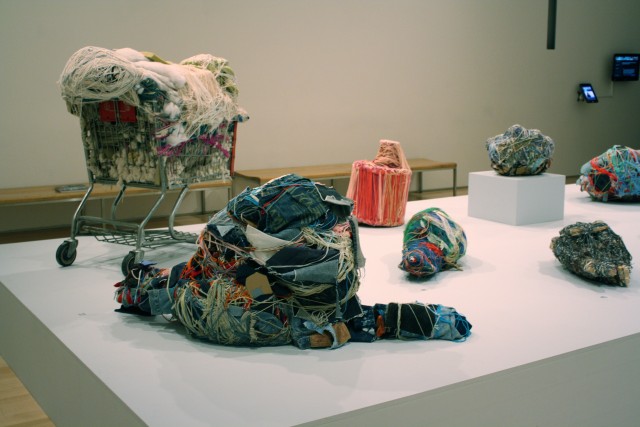
The Brooklyn Museum welcomes in 2015 by handing over the reins of its free monthly First Saturdays program to several of the artists featured in “Crossing Brooklyn: Art from Bushwick, Bed-Stuy, and Beyond,” which concludes on January 4. The night before, curators Eugenie Tsai and Rujeko Hockley will discuss the exhibition at 5:30, “Crossing Brooklyn” artist Linda Goode Bryant will talk about urban farming at 6:15, jazz percussionist Ches Smith will activate David Horvitz’s forty-seven suspended bells as part of a site-specific musical composition at 6:30, and BFAMFAPhD (Blair Murphy, Susan Jahoda, and Vicky Virgin) will delve into the nature of creativity and debt at 7:15. “‘Crossing Brooklyn’ Artists’ Choice” also features live performances by Snarky Puppy, DJ Selly and DJ Asen from Fon, ventriloquist Nigel “Docta Gel” Dunkley (telling the story of Cindy Hot Chocolate from Geltown), immersive dance company Ani Taj and the Dance Cartel, Fela! veterans Chop and Quench led by Sahr Ngaujah, and spoken word poets Corina Copp, Patricia Spears Jones, Rickey Laurentiis, and Charles North as well as Greg Barris’s “Heart of Darkness” comedy showcase with Janeane Garofalo and Ilana Glazer, a print-making art workshop, a creative writing workshop led by Jaime Shearn Coan, and D’hana Perry’s multimedia improvisational “LOOSE.” In addition, you can check out such exhibitions as “Revolution! Works from the Black Arts Movement,” “Judith Scott — Bound and Unbound,” and “Chitra Ganesh: Eyes of Time.”