this week in art

WANG JIANWEI: SPIRAL RAMP LIBRARY

Who: Wang Jianwei
What: “Spiral Ramp Library,” live performance held in conjunction with the closing of the exhibition “Wang Jianwei: Time Temple”
Where: Solomon R. Guggenheim Museum, 1071 Fifth Ave. at 89th St., 212-423-3587
When: Thursday, February 12, $12, 8:00, and Friday, February 13, $15, 8:00
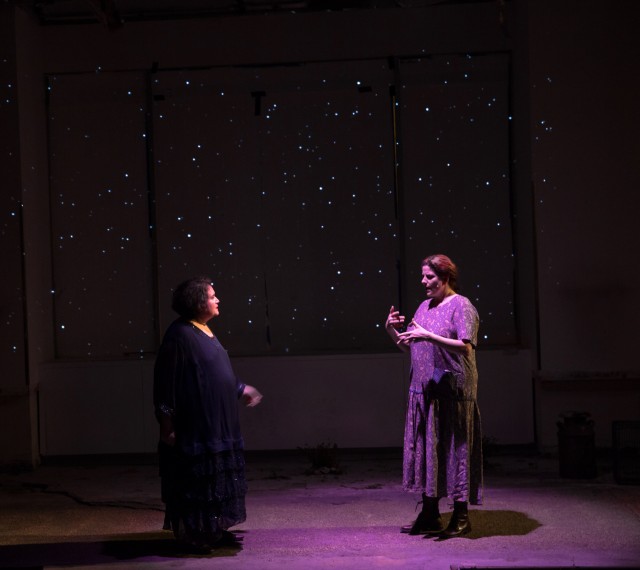
Why: “I always want to position my works, the exhibitions, and the audience’s relationship to the exhibitions as part of a process. The process includes changes that take place during different periods of time. For example, the production of works as time, the exhibition cycle as time, and the audience’s viewing experience in different locations as time,” Beijing-based artist Wang Jianwei says in a video about his Guggenheim exhibition, “Time Temple.” The exhibition consists of a room of painting and sculpture on view through February 16; the fifty-five-minute film The Morning Time Disappeared, inspired by Franz Kafka’s Metamorphosis, screening daily at 1:00; and the live multimedia performance event “Spiral Ramp Library,” taking place February 12-13 in the museum’s rotunda, incorporating sound, video, dance, theater, and improvisation, gathering ideas generated by the exhibition’s opening event, in which twenty speakers discussed ten topics, including maps, Jorge Luis Borges, climate, Frank Lloyd Wright, the universe, and the Guggenheim itself, in a way reimagining the building as Borges’s Tower of Babel in which every person is a book. (The February 13 performance will be followed by a Q&A with Wang.)

JOHN WATERS: BEVERLY HILLS JOHN

Beverly Hills John

John Waters, “Beverly Hills John,” C-print, 2012 (courtesy of the artist and Marianne Boesky Gallery)

Marianne Boesky Gallery
509 West 24th St. between Tenth & Eleventh Aves.
Tuesday – Saturday through February 14, free, 10:00 am – 6:00 pm
212-680-9889
www.marianneboeskygallery.com

King of Filth John Waters gives Hollywood celebrity culture, and himself, an extremely funny and clever facelift in his latest exhibit at Marianne Boesky in Chelsea. “Beverly Hills John” consists of photography, collage, sculpture, installation, and a new full-length film, his first as writer and director since 2004’s A Dirty Shame. (In the meantime, the Baltimore native has been performing his one-man show, This Filthy World, and writing such books as Role Models and Carsick: John Waters Hitchhikes Across America.) “Separate But Equal” is a black-and-white C-print of a black man drinking from a water fountain labeled “Gay Single,” which is connected to a sink labeled “Gay Married.” In “Library Science,” Waters offers adult takes on classic literature covers, turning, for example, Ian Fleming’s Chitty Chitty Bang Bang into Dion Dermot’s Clitty Clitty Bang Bang and Erskine Caldwell’s God’s Little Acre into Channy Wadd’s God’s Little Faker. Waters pays homage to innovative multimedia artist Mike Kelley, who committed suicide in 2012, with “R.I.P. Mike Kelley,” a miniature sculpture of a cozy living room with a fireplace, comfy chair, and cat urn. The Death character from Ingmar Bergman’s The Seventh Seal hovers over a deplaning John F. Kennedy and Jackie O in “Grim Reaper.” In “Brainiac,” Waters reconstructs a tabloid magazine cover with such headlines as “Joan Didion Hits 250 Pounds!” and “Nude Photos of W. H. Auden Found!” Waters alternates pictures of a flustered Curly from the Three Stooges with shots of rectal exams in “Probe.” (In an odd coincidence, a man named John Waters served as assistant director on the 1933 film Broadway to Hollywood, in which Moe and Curly make cameos as clowns.) “Stolen Jean Genet” is a re-creation of the headstone of French writer and activist Jean Genet, which was actually stolen and is still missing. And in “Mom and Dad,” Waters repurposes stills from William Beaudine’s 1945 film Mom and Dad, which features a notorious sexual hygiene movie used as a terrifying teaching tool.

John Waters’s latest exhibit is highlighted by new film showing children reading script of cleaned-up version of PINK FLAMINGOS retitled KIDDIE FLAMINGOS

John Waters’s latest exhibit is highlighted by new film showing children reading script of cleaned-up version of PINK FLAMINGOS retitled KIDDIE FLAMINGOS

The centerpiece of the show is the seventy-four-minute Kiddie Flamingos, in which Waters films children doing a table reading of a somewhat, er, watered-down version of the script of Waters’s breakthrough 1972 trailer-park cult black comedy, Pink Flamingos, about Babs Johnson (Divine), her son, Crackers (Danny Mills), her mother, Edie (Edith Massey), their friend Cotton (Mary Vivian Pearce), and their battle with the mean and nasty Marbles (David Lochary and Mink Stole). The children, in various stages of garish makeup, including one boy with a pencil-thin mustache playing the narrator (Waters), don’t always understand what they’re saying, but it’s a riot to watch them tell this hysterical tale of oddballs who have rather extreme eccentricities. Waters, of course, is not above making fun of himself and his own eccentricities as well. The title piece is a creepy self-portrait that depicts him as a victim of plastic surgery gone terribly wrong, in between photos of fellow knife casualties Justin Bieber and Lassie. Sitting empty in the gallery is “Bill’s Stroller,” emblazoned with the names of strip clubs and boasting a spiked leather harness meant for Waters’s fake baby, Bill. (He really does have an angry doll-child he calls Bill who he keeps at home.) And in “Self Portrait #5,” Waters casts himself as a dogcatcher, smiling devilishly at the viewer and holding a carrier with a cute little puppy inside. It’s a wonderfully sly image, emblematic of all of us who treasure Waters’s ongoing counterculture shenanigans, willing to be carried by him wherever he may go as he continues to fight the establishment in his unique, wickedly subversive ways.

TONY CRAGG: WALKS OF LIFE

Tony Cragg’s undulating “Points of View” is part of Madison Square Park installation “Walks of Life” (photo by twi-ny/mdr)

Tony Cragg’s undulating “Points of View” is part of Madison Square Park installation “Walks of Life” (photo by twi-ny/mdr)

Who: Tony Cragg
What: “Walks of Life”
Where: Madison Square Park, between Madison Ave. & Broadway and 23rd & 26th Sts., 212-520-7600
When: Daily through February 8
Why: For nearly twenty years, Turner Prize-winning artist Tony Cragg’s “Resonating Bodies” have flanked the entrance to Robert F. Wagner Jr. Park, a lively pair of large-scale musical instruments. Now the Liverpool-born artist, who lives and works in Wuppertal, Germany, has placed a trio of bronze sculptures, collectively titled “Walks of Life,” on the Madison Square Park lawns, twisting shapes that seem to shake with the location’s high energy. In the southwest corner, visitors are encouraged to walk inside “Caldera,” which stands on three tiptoes, and look up at the sky. On the central Oval Lawn, three eighteen-foot-high works form “Points of View,” rising up with dynamic, humanistic undulating forms; from various angles you can make out abstract facial profiles. And in the northwest corner, the green, dynamic “Mixed Feelings” teeters like a warped Statue of Liberty

V. S. GAITONDE: PAINTING AS PROCESS, PAINTING AS LIFE

(photo by David Heald)

Breathtaking exhibition welcomes visitors into the meditative world of Indian painter V. S. Gaitonde (photo by David Heald)

Solomon R. Guggenheim Museum
1071 Fifth Ave. at 89th St.
Friday – Wednesday through February 11, $18-$22 (pay-what-you-wish Saturday 5:45-7:45)
212-423-3587
www.guggenheim.org

“I don’t work, I relax and wait, and then I apply some paint on the canvas. The most important aspect of painting is waiting, waiting, waiting, between one work and the next,” Indian painter V. S. Gaitonde said shortly after winning the 1989–90 Kalidas Samman prize in the plastic arts. That quote is also good advice as to how his magnificent canvases should be experienced. Nearly four dozen of the Indian artist’s paintings and works on paper are on view in “V. S. Gaitonde: Painting as Process, Painting as Life,” continuing at the Guggenheim through February 11. This first-ever major museum career retrospective introduces audiences to the unique style of Vasudeo S. Gaitonde, called “Gai” by his peers, who was born in Maharashtra in 1924 and passed away in August 2001. Gaitonde, who made only a handful of paintings every year, was influenced by Paul Klee and Mark Rothko, Zen Buddhism and silence, Japanese and Chinese hanging scrolls and calligraphy. He referred to his work, which began with more figuration, as “non-objective” instead of “abstract,” so it is fitting that the survey is being held at the Guggenheim, which opened as the Museum of Non-Objective Painting in 1939 on East Fifty-Fourth St. Little is known about Gaitonde’s life outside of painting, and his work is as mysterious as the man. Using multiple layers of paint, strips of wet newspaper, and a palette knife, Gaitonde created primarily untitled oil on canvas paintings, watercolors, and ink on paper drawings boasting unique combinations of color, form, and texture. The works have both a physical and metaphysical depth, daring the viewer to breathe it all in. The exhibition, curated by Sandhini Poddar, occurs at a time when Gaitonde’s work is now selling in the millions at auction; a 1979 painting recently went for $3.8 million, the most ever paid for a work by a modern Indian artist.

(photo by David Heald)

V. S. Gaitonde’s pure painting is about life and process (photo by David Heald)

In one fiery orange painting, a sun rises over an amalgamation of what could be body parts. In another, it looks as if Gaitonde has torn through an earth-toned canvas. In a third work, four arrows point at a central circle, coming together like a totem. Poddar, who had quite a task collecting the works, lays out the aptly titled exhibition beautifully, inviting visitors to take their time as they discover the many wonders of Gaitonde’s pure, impressive skill, revealing that his process was life, and life was his process. “A painting always exists within you, even before you actually start to paint,” he said. “You just have to make yourself the perfect machine to express what is already there.” What is already there is a love of pure painting that is now, at last, getting its due.

BLACK HISTORY MONTH: LIVING LEGACY

Carrie Hawks will discuss her upcoming documentary, BLACK ENUF, at the Brooklyn Museum’s free First Saturday program for Black History Month

FIRST SATURDAY
Brooklyn Museum
200 Eastern Parkway at Washington St.
Saturday, February 7, free, 5:00 – 11:00
212-864-5400
www.brooklynmuseum.org

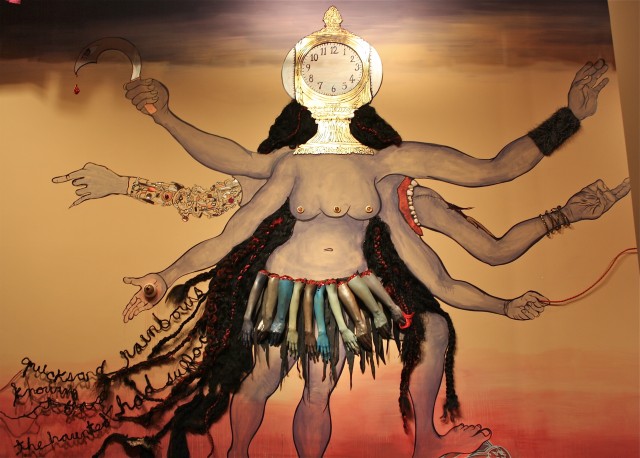
The theme of this year’s annual Brooklyn Museum First Saturday celebration of Black History Month is “Living Legacy,” another eclectic, wide-ranging collection of music, dance, film, art, discussion, and more. The free evening will feature live performances by Chel Lo and Asante Amin’s multimedia “Soundtrack ’63,” Water Seed, and Bilal; screenings of Byron Hurt’s 2013 documentary Soul Food Junkies and Carrie Hawks’s doc-in-progress Black Enuf, both followed by talkbacks with the directors; a quilt-making workshop; a talk with artists Devin Kenny and Sondra Perry with Black Contemporary Art blog founder Kim Drew; a poetry reading and community forum hosted by Mahogany L. Browne, Jonterri Gadson, and Amanda Johnston of Black Poets Speak Out; and J. Ivy discussing his new memoir, Dear Father: Breaking the Cycle of Pain. In addition, you can check out such exhibitions as “Revolution! Works from the Black Arts Movement,” “Judith Scott — Bound and Unbound,” “Double Take: African Innovations,” and “Chitra Ganesh: Eyes of Time.”

FRED MOTEN ON CHRIS OFILI: BLUETS, BLACK + BLUE, IN LOVELY BLUE

Chris Ofili’s “Blue Rider” paintings is the centerpiece of solo exhibition at the New Museum (© Chris Ofili; photo by Maris Hutchinson/EPW)

Chris Ofili’s “Blue Rider” paintings highlight solo exhibition at the New Museum (© Chris Ofili; photo by Maris Hutchinson/EPW)

CHRIS OFILI: NIGHT AND DAY
New Museum of Contemporary Art
235 Bowery at Prince St.
Thursday, January 29, $10 (includes half-price gallery admission), 7:00
Exhibition continues through Sunday February 1, $16 (pay-what-you-wish Thursday 7:00 – 9:00)
212-219-1222
www.newmuseum.org

Tonight at 7:00, with the revelatory midcareer-redefining exhibit “Chris Ofili: Night and Day” about to begin its final weekend at the New Museum, writer and professor Fred Moten will be at the downtown institution for a special presentation, “Fred Moten on Chris Ofili: Bluets, Black + Blue, in Lovely Blue.” Moten, author of the 2014 National Book Award finalist The Feel Trio, will be discussing Ofili’s influences, historical references, and multidisciplinary trajectories, with a particular focus on the artist’s “Blue Rider” paintings. In 2004, Ofili, who was born in Manchester and moved from London to Trinidad in 2005, began a series of striking large-scale oil-on-linen works, some with charcoal and/or acrylic as well, with varying shades of deep blue over a silver background. At first glance, the paintings appear to be virtually all dark blue, nearly black, with no figuration apparent. Nine of the works are hanging together in a dark room on the third floor of the museum; visitors will benefit from allowing time for their eyes to adjust to the lack of light, moving around and viewing the canvases from different angles to let the paintings’ magic and mystery slowly reveal themselves. When we were there, a woman got angry when people just walked in and out, thinking that there was not much to see; she got down on her hands and knees, examining every detail of the works, imploring others to do the same. The paintings have quite a collection of stories to tell, incorporating elements of slavery, mythology, blues music, the Bible, and modern life. “Ofili’s work suggests a way of seeing where the centrality of the color is taken for granted,” artist Glenn Ligon writes in his catalog essay, “Blue Black.” He continues, “‘Iscariot Blues’ (2006), ‘Blue Riders’ (2006), ‘Blue Steps (fall from grace)’ (2011), ‘Blue Smoke (Pipe Dreams)’ (2011), and ‘Blue Devils’ (2014) use blue as a kind of dark matter, a force not easily quantified but which holds the universes [Ofili] creates on canvas together. Blue is a bitch.” Ofili might be best known for the controversy surrounding his use of elephant dung in “The Holy Virgin Mary” when it was shown as part of the 1999 Brooklyn Museum exhibit “Sensation” and publicly decried by Mayor Rudolph Giuliani, so it’s fascinating that there have been no such issues about “Blue Devils,” which is based on symbolic figures during Trinidadian Carnival in Paramin but is essentially about police brutality affiliated with Britain’s “stop and search” program; the powerful piece also evokes the tragedies of Stephen Lawrence, Trayvon Martin, and other black men and women who either died at the hands of the police or had their cases botched by law enforcement.

 (© Chris Ofili; photo by Maris Hutchinson/EPW)

New Museum survey shows Chris Ofili’s wide range of work (© Chris Ofili; photo by Maris Hutchinson/EPW)

“In choosing ‘Blue Devils’ (2014) as the title of his ominous, dark new painting, Chris Ofili has disturbingly and deliciously subverted that famous Trinidadian Carnival reference, transposing it to the streets of London, Manchester, or New York,” writes lawyer Matthew Ryder in his catalog essay, “Blue Devils.” Ryder, who handles police brutality cases, further explains, “Through this piece, Ofili adds his voice at a timely point to the long-running debate concerning the relationship of black men with the police, both in the United Kingdom and the United States, since it has gained unusual intensity in recent months. . . . ‘Blue Devils,’ with its twisted, interlocked figures barely discernible beneath the deep, overlapping shades of blue, evokes a misconduct occurring in a state of near invisibility. It also captures something much harder to express — the peculiar way that such confrontations between black men and the police are simultaneously intensely crude and unusually subtle.” The nine “Blue Rider” works are harrowing and emotional, but this first major solo museum show for Ofili, which has been extended through February 1 and is curated by Massimiliano Gioni, Gary Carrion-Murayari, and Margot Norton, also displays Ofili’s wide range, including his “Afromuse” and “Afro Margin” series, his recent paintings inspired by Ovid’s Metamorphoses, and “The Holy Virgin Mary,” one of a roomful of pieces by Ofili that consist of acrylic, oil, polyester resin, glitter, map pins, and elephant dung on linen, many precipitously set on the floor at an angle, with myriad details that require up-close examination, and not just because of their provocative titles: “No Woman, No Cry,” “Foxy Roxy,” “Pimpin’ ain’t easy.” There are also drawings, sculptures, watercolors — but it all leads back to these dark, sociopolitically daring, sensational works. As Ligon concludes, “To approach black through blue, to be in its vicinity but not quite get there, blackness an event horizon, blackness with a ‘u’ instead of an ‘e,’ a ‘state of mind’ not a ‘state,’ something always under construction, subject to revision, is what Ofili’s canvases suggest. In them, he proposes new ways to see blackness, new pathways to travel. For Ofili, blue black is the new black.” It should be fascinating to hear Moten’s take on the subject as well. (The event is sold out, but there will be a standby line beginning at 6:00. You can also watch the event on Livestream. For a conversation between Ofili and Gioni, go here.)

EL GRECO AT THE FRICK COLLECTION / EL GRECO IN NEW YORK

El Greco, “St. Jerome,” oil on canvas, 1590-1600 (Henry Clay Frick Bequest)

El Greco, “St. Jerome,” oil on canvas, 1590-1600, Henry Clay Frick Bequest (photo by Michael Bodycomb)

EL GRECO AT THE FRICK COLLECTION
The Frick Collection
1 East 70th St. at Fifth Ave.
Tuesday – Sunday through February 1, $20 (pay-what-you-wish Sundays 11:00 am – 1:00 pm)
212-288-0700
www.frick.org

In the summer of 2008, the Frick moved six of its masterpieces from the Living Hall to the Oval Room while the former was being refurbished, offering art lovers the opportunity to view such Frick favorites as Hans Holbein the Younger’s breathtaking “Sir Thomas More” and El Greco’s marvelous “St. Jerome” in close conjunction and different surroundings, giving them a kind of new lease on life. In celebration of the quadricentennial of the death of Crete-born artist Domenikos Theotokopoulos, better known as El Greco, the Frick has moved all three of its paintings by the Spanish master into the Oval Room: “St. Jerome,” “Vincenzo Anastagi,” and “Purification of the Temple.” Presented side by side for the first time ever, the trio forms a striking triumvirate. In the center, above the fireplace, stands Italian knight Vincenzo Anastagi, wearing armor over his upper body and puffy green pantaloons, his helmet on the floor to his left, an open window barely visible to his right, his sword oddly showing through between his legs, a curtain behind him creating geometric shapes in the background. He is both mysterious and dignified. On one side of “Vincenzo Anastagi” is a rare religious scene purchased by Henry Clay Frick, “Purification of the Temple,” a small, richly dense, boldly colorful depiction of Christ throwing the moneychangers out of the temple. To Christ’s right are sinners, a relief of Adam and Eve in the Garden of Eden above them; to his left are his believers, a relief of Abraham about to sacrifice Isaac above them. El Greco’s brushwork dazzles in this compact, claustrophobic, emotionally powerful work. Meanwhile, on the other side of “Vincenzo Anastagi” resides “St. Jerome,” the biblical translator looking just away from the viewer. His head, ears, nose, gray-white beard, and fingers are elongated, his red robe sharply defined against a dark background. Up close, one can revel in the folds of his clothes, the touch of color peeking through the end of his white sleeves, his left thumb placed firmly in the margin of the Bible in front of him. His face is craggy and wrinkled, with dark, deep-set eyes and sunken cheekbones. The painting is centered by the vertical buttons running down St. Jerome’s robe, pulling at the viewer. It’s a striking portrait that is a joy to behold in this new setting, like experiencing it again for the first time.

El Greco (Domenikos Theotokopoulos) (Greek, 1540/41–1614). View of Toledo (detail), ca. 1598–99. Oil on canvas; 47 3/4 x 42 3/4 in. (121.3 x 108.6 cm). The Metropolitan Museum of Art, New York, H. O. Havemeyer Collection, Bequest of Mrs. H. O. Havemeyer, 1929 (29.100.6)

El Greco (Domenikos Theotokopoulos), detail, “View of Toledo,” oil on canvas, ca. 1598–99 (The Metropolitan Museum of Art, New York, H. O. Havemeyer Collection)

EL GRECO IN NEW YORK
Metropolitan Museum of Art
1000 Fifth Ave. at 82nd St.
Gallery 608
Through Sunday, February 1, recommended admission $25
212-535-7710
www.metmuseum.org

A later version of El Greco’s portrait of St. Jerome, “Saint Jerome as Scholar,” is part of the Metropolitan Museum of Art’s “El Greco in New York,” which brings together all of their El Greco holdings along with those from the Hispanic Society of America, collected by Archer Huntington. The Met’s pieces are highlighted by the unfinished and truncated “The Vision of Saint John,” in which the apostle, in blue dress, dominates the left side of the frame, holding his hands up to the heavens, the color palette similar to the Frick’s “Purification of the Temple”; “Cardinal Fernando Niño de Guevara,” a portrait of the Spanish inquisitor in elegant dress sitting in a chair, his hands dangling over the armrests, with ornate wallpaper behind him and a sheet of paper at his feet, looking as if he is ruing what he has to do next; and “View of Toledo,” one of the greatest landscapes in art, with dark, foreboding clouds hovering over lush green fields and gray buildings, a condensed, ominous depiction of “the Holy City.” The Hispanic Society works include “Pietá,” showing Christ being carried in the center, the three crosses nearly hidden at the upper left, his mother in agony behind him; “The Holy Family,” with the baby Jesus nursing at his mother’s teat; the rare miniature “Portrait of a Man”; and “Saint Francis,” a side view of the friar that was originally part of a larger canvas. Over the course of the more than four hundred years since El Greco began painting, his work has been in and out of style, forgotten and rediscovered, widely hailed and sinfully dismissed. But the gathering of all his paintings in New York, from the Frick, the Met, and the Hispanic Society, reveal him to be a man ahead of his time, an artist whose influence continues to grow.