this week in art

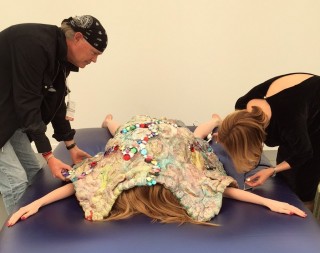
HUMAN KINETICS MOVEMENT ARTS: FACETS OF TIME

(photo by Harry Schnitzler)

The striking FACETS OF TIME takes place in the Urban Garden Room near Bryant Park (photo by Harry Schnitzler)

Who: human kinetics movement arts
What: Facets of Time
Where: Urban Garden Room, 1095 Sixth Ave. at 43rd St.
When: Wednesday, April 22 & 24, and Friday, April 29, free, 9:00
Why: Yana Schnitzler’s human kinetics movement arts specializes in site-specific dance installations in public places. In the past, they have performed at the Hudson River, on Wrightsville Beach, in a storefront on Maiden Lane, at Ground Zero, in the windows of a bank, and outside the Metropolitan Museum of Art. Their latest work, Facets of Time, finds them in the lovely Urban Garden Room in Midtown, a glassed-in public plaza with a quartet of living green sculptures. The trilogy of slow-moving pieces, which explores the nature of perception, features a seemingly endless sheet of colorful fabric that daringly connects with the area; the audience watches from outside on the street, looking in. “Each movement installation is inspired by and created for a specific environment,” Schnitzler has written. “By utilizing elements of surprise and (dis)integration, the installations become an integral part of that environment, and at the same times give it new meaning. In their often sculpturesque character, the installations expose the hidden poetry of public spaces.”

PERFORMING, RE-ENACTING AND REACTING

Martha Wilson will be part of April 22 panel discussion looking back at the history of Franklin Furnace and the reperformance of historical works

Martha Wilson will be part of April 22 panel discussion looking back at the history of Franklin Furnace and the reperformance of historical works

Who: Martha Wilson, Robert Longo, Nicolás Dumit Estévez, Tavia Nyong’o, and Alaina Claire Feldman
What: “Performing, Re-enacting and Reacting”
Where: Pratt Manhattan Gallery, 144 West 14th St., second floor, room 213
When: Wednesday, April 22, free, 6:30
Why: In conjunction with the traveling exhibition “Performing Franklin Furnace,” curated by FF founder Martha Wilson and continuing at the Pratt Manhattan Gallery through April 30, and “Martha Wilson: Downtown” at the NYU Fales Library also through April 30, Pratt will host the panel discussion “Performing, Re-enacting and Reacting,” with Wilson, fellow artists Robert Longo and Nicolás Dumit Estévez, and cultural critic Tavia Nyong’o, moderated by Alaina Claire Feldman of Independent Curators International, celebrating the highly influential Franklin Furnace, the artist-run space whose archives have now moved into Pratt in Brooklyn, and considering the current trend of re-performing historical works.

THOMAS HART BENTON’S “AMERICA TODAY” MURAL REDISCOVERED

Thomas Hart Benton, detail, “City Activities with Dance Hall” from “America Today,” egg tempera with oil glazing over Permalba on a gesso ground on linen mounted to wood panels with a honeycomb interior, 1930–31 (The Metropolitan Museum of Art, New York, Gift of AXA Equitable, 2012)

Thomas Hart Benton, detail, “City Activities with Dance Hall” from “America Today,” egg tempera with oil glazing over Permalba on a gesso ground on linen mounted to wood panels with a honeycomb interior, 1930–31 (The Metropolitan Museum of Art, New York, Gift of AXA Equitable, 2012)

Metropolitan Museum of Art, Gallery 746
1000 Fifth Ave. at 82nd St.
Daily through April 19, recommended admission $12-$25
212-535-7710
www.metmuseum.org

Several years ago, I was giving a friend a tour of Midtown lobby art when I started to lead him into the AXA Equitable Center on Seventh Ave. between Fifty-First and Fifty-Second Sts. “Why are we going in here?” he asked, adding, “I worked here for six years.” We walked in and I pointed up at the walls, which contained Thomas Hart Benton’s swirling 1930-31 mural, “America Today.” Glancing around, he said, “I can’t believe I never noticed this before.” Upon recently encountering “America Today” at the Met — AXA donated the seminal work to the museum in December 2012 while undergoing renovations — I felt as if I’d never seen it before myself, even though I had marveled at its wonder dozens of times. It has been carefully reinstalled to its original dimensions, complete with zigzagging silver Art Deco elements cutting through each piece, as commissioned in 1930 by New School for Social Research director Alvin Johnson for a circular boardroom in Joseph Urban’s West Twelfth St. modernist building. You can now get up close and personal with Benton’s dramatic depiction of contemporary America, a country built by hardworking people as technology and industry grow at an unstoppable pace. Using egg tempera that he made himself with eggs given to him by the New School (in lieu of actual monetary payment), Missouri native Benton divided the work into ten panels, each one based on scenes he had witnessed during his travels across the country in the 1920s. “Every detail of every picture is a thing I myself have seen and known,” he said. “Every head is a real person drawn from life.” Among his models was one of his students, Jackson Pollock, who posed for several characters. The panels range from the futuristic “Instruments of Power” to the Jazz Age “City Activities with Dance Hall,” from the cotton-heavy “Deep South” to the fiery “Steel” and “Coal,” from “Outreaching Hands” grasping for more to “City Building,” with skyscrapers rising in the background while men toil in the foreground. In addition to being a dynamic piece of art, “America Today” serves as an important historical document, capturing a country obsessed with progress despite the coming Great Depression. Benton’s naturalistic flair and use of color, especially reds, which stand out in every panel, add dramatic impact and cinematic scope to his narrative of America’s resiliency and determination, a story that would be told very differently if Benton were around today to report on the state of things.

Thomas Hart Benton, “Outreaching Hands” from “America Today,” egg tempera with oil glazing over Permalba on a gesso ground on linen mounted to wood panels with a honeycomb interior, 1930–31 (The Metropolitan Museum of Art, New York, Gift of AXA Equitable, 2012)

Thomas Hart Benton, “Outreaching Hands” from “America Today,” egg tempera with oil glazing over Permalba on a gesso ground on linen mounted to wood panels with a honeycomb interior, 1930–31 (The Metropolitan Museum of Art, New York, Gift of AXA Equitable, 2012)

“Thomas Hart Benton’s ‘America Today’ Mural” is supplemented with works that inspired Benton, including Pieter Bruegel the Elder’s “The Harvesters,” Giorgio de Chirico’s “Ariadne,” James Lesesne Wells’s “Builders,” Reginald Marsh’s “The Bowery,” and Grant Wood’s “The Midnight Ride of Paul Revere,” as well as other Benton paintings. There is also a very informative video presentation that follows the path of the mural from inception to installation at the Met. It’s quite a story, and quite a work.

MULTIMEDIA ARTIST TALK: KEHINDE WILEY AND DJ SPOOKY

Who: Kehinde Wiley and DJ Spooky
What: Interactive multimedia talk
Where: Brooklyn Museum, Iris and B. Gerald Cantor Auditorium, 200 Eastern Pkwy. at Washington St., 718-638-5000
When: Thursday, April 16, $16 (includes museum admission), 7:00
Why: Kehinde Wiley and DJ Spooky will team up at the Brooklyn Museum to discuss Wiley’s midcareer retrospective, “Kehinde Wiley: A New Republic,” featuring five dozen of his unique portraits and sculptures. The evening will include a talk, a performance by Paul D. Miller, better known as That Subliminal Kid, DJ Spooky, and a Q&A.

GALLERY SESSIONS: BJÖRK EXPLAINED BY A FAN

Björk (photo by twi-ny/mdr)

“Björk” exhibit at MoMA has led to quite a cacophony (photo by twi-ny/mdr)

BJÖRK
MoMA, Museum of Modern Art
11 West 53rd St. between Fifth & Sixth Aves.
Exhibit runs through June 7, $14-$25 (timed tickets available same day only)
212-708-9400
www.moma.org
bjork.com

There doesn’t seem to be a whole lot more that can be said about Björk’s disastrous solo exhibition at MoMA, so reviled that critics are calling for the heads of chief curator at large Klaus Biesenbach and museum director Glenn D. Lowry. The truth hurts; it’s a head-scratchingly absurd show. I went in determined to see something everyone else missed, trying to find something positive in the four-part presentation, having admired Björk Guðmundsdóttir’s work for many years, from her time leading the Sugarcubes to her award-winning performance in Lars von Trier’s Dancer in the Dark to her innovative Biophilia album, app, tour, and concert film. But alas, the simply titled “Björk” exhibition seems to go out of its way to annoy. The MoMA-commissioned ten-minute “Black Lake” music video, for a song from her latest album, Vulnicura, about her breakup with longtime partner Matthew Barney, is fine, a two-screen projection in which she lets loose against Barney, who just last week sued her for custody of their twelve-year-old daughter. “My soul torn apart / My spirit is broken / Into the fabric of all / He is woven,” she sings in a haunting volcanic landscape that features dripping substances evoking Barney’s use of petroleum jelly at the Guggenheim and in Drawing Restraint 9 (in which Björk had a major role) and lava and feces in “River of Fundament.” However, you will have to wait a lot longer than ten minutes to get into the specially designed area in MoMA’s atrium, then wait again after it’s over to enter the theater that shows many of Björk’s cutting-edge videos. Also, several of her unique Biophilia instruments play music in the lobby by the sculpture garden entrance. But it’s the heart of the show that is so disturbing, the time-ticketed “Songlines,” in which an iPod touch guides visitors through eight rooms, a chronological trip through Björk’s eight albums, from 1993’s Debut through January’s Vulnicura. The very small spaces feature handwritten notes and lyrics, costumes, video paraphernalia, and, through headphones, a bizarre fairy-tale-like fictionalized narrative, written by Icelandic poet Sjón and narrated by actress Margret Vilhjalmsdottir, about a young girl (Björk) growing up to become someone. You can’t purchase timed tickets in advance (only same day, onsite), so you might be shut out if you get to MoMA too late in the afternoon. Also, once you start going through “Songlines,” you are not allowed to go back to a previous room; you must proceed forward, and since it’s unlikely you’ll actually need all five minutes for each stop, the audio will often not be in sync with your physical surroundings.

Despite living part-time in New York (and Iceland and London) and having held several concerts in the city on her Vulnicura tour (she had to cancel her April 4 show but will be coheadlining the Governors Ball on Randall’s Island on June 6), Björk has not participated in any events and given only one interview (to Time magazine) in conjunction with the exhibit — although there are mannequins of an ornately designed Björk in “Songlines” — so MoMA is leaving it up to others to put it all in perspective and try to make sense of this utter mess. But they’re not exactly calling in the big guns; instead, on April 10 at 11:30 and April 22 at 1:30, the gallery session “Björk Explained by a Fan” will be led by an unnamed “dedicated fan of the composer, musician, and artist,” moderated by a museum educator. On April 12 and 18 at 11:30, “Sights and Sounds” will delve into how sound can be made visible. On April 17 and 24 at 11:30, “Björk” will examine art in relation to post-technological culture. And on April 26 at 11:30 and April 30 at 1:30, anyone can participate in “Björk: Human Behavior,” an open group discussion about Björk’s exploration of the connections between nature and human behavior; people are encouraged to share “their personal experience of the Björk exhibition,” which could be quite fascinating in and of itself. All talks are first-come, first-served and do not include a visit to the show. I can’t imagine that any of these talks will enhance your personal experience of a show that has been called “abominable,” “an ill-conceived disaster,” “oh so disappointing,” “a waste of time,” “a strangely unambitious hotchpotch,” and, quite simply and right to the point, “bad.”

MoCCA FEST 2015

mocca fest

Who: Guests of honor Aline Kominsky-Crumb, Scott McCloud, and Raina Telgemeier, international special guests Pénélope Bagieu, DoubleBob, Annie Goetzinger, Ilan Manouach, Anne-Françoise Rouche, and Barbara Stok, and many other comic artists
What: Society of Illustrators: MoCCA Arts Festival
Where: Center 548, 548 West 22nd St. between Tenth & Eleventh Aves., and the High Line Hotel, 180 Tenth Ave. at Twentieth St.
When: Saturday, April 11, and Sunday, April 12, $5, 11:00 am – 6:00 pm
Why: More than 350 publishers and artists will be exhibiting at the annual MoCCA Fest at Center 548, including Nick Bertozzi, C. M. Duffy, Fantagraphics, Dean Haspiel, Keren Katz, Peter Kuper, Liz Means, NBM, Greg Ruth, and Daniel Zender. Among the special programs (advance RSVP recommended), taking place at the nearby High Line Hotel, are Q&As with Scott McCloud, Aline Kominsky-Crumb, and Raina Telgemeier and such panel discussions as “Work in Progress” with Kim Deitch, Sarah Glidden, Dash Shaw, and Julia Wertz, moderated by Richard Gehr; “Alt-Weekly Comics” with Ben Katchor, Michael Kupperman, and Mark Newgarden, moderated by Bill Kartalopoulos; and “Saul Steinberg 101” with Austin English, Françoise Mouly, Joel Smith, and Patterson Sims.

CINDY KANE: EYES ON THE GROUND — JOURNALS OF WAR

Powerful Flatiron exhibit pays tribute to war journalists (photo by twi-ny/mdr)

Powerful Flatiron exhibit pays tribute to war journalists (photo by twi-ny/mdr)

The Sprint Prow Art Space
Flatiron Building
175 Fifth Ave. at Broadway & Fifth Ave.
Daily through April 15, free
www.cherylmcginnisgallery.com
www.cindykane.com

Although hats were often featured in the nineteenth-century shop windows of Fifth Avenue’s fashionable Ladies Mile, a different kind of headgear is on display there now. In 2008, visual artist Cindy Kane began creating collages on fifty used Vietnam War-era military helmets she purchased online. She contacted journalists who had covered international conflicts, asking them to contribute items from their reporting. Kane, who is based in Martha’s Vineyard, then took the objects — handwritten notes, photographs, press badges, foreign currency, e-mail exchanges, airline tickets, Band-Aids, expense bills, and other memorabilia — and layered them, decoupage-style, onto the helmets, each one dedicated to an individual journalist. The Helmet Project, which was first seen in a different iteration in New York City in 2009, has been transformed into “Eyes on the Ground — Journals of War,” a powerful exhibition extended through April 15 at the Sprint Prow Art Space in the Flatiron Building. The triangular street-level glass-walled gallery, pointing north on the corner of Twenty-Third St. and Broadway, contains the fifty helmets hanging from the ceiling at varying levels, paying tribute to the men and women who risk their lives to reveal the truth behind what is happening in battles around the world, from Iran, Iraq, and Afghanistan to El Salvador, Bosnia, and Democratic Republic of Congo, from the Balkans, Israel, and Russia to the Sudan, Libya, and New York City in September 2001. Curated by Cheryl McGinnis, the installation is a poignant reminder of the importance of a free press and the dangers these award-winning journalists face every day. Among the participants, many of whom have won Pulitzers in addition to other prestigious prizes, are Geraldine Brooks, Chris Hedges, Jeri Laber, Ward Just, Martha Raddatz, Steve Mumford, Deborah Amos, Scott Simon, Lynsey Addario, Nelson Bryant (who parachuted into Normandy on D-Day), and Anthony Shadid, the Washington Post Middle East correspondent who died from an asthma attack in 2012 while trying to leave Syria.

Award-winning journalist Chris Hedges is among fifty reporters contributing to Cindy Kane’s “Eyes on the Ground” exhibit (photo by Richard Kranzler / courtesy of Cheryl McGinnis Gallery)

Award-winning journalist Chris Hedges is among fifty reporters contributing to Cindy Kane’s “Eyes on the Ground” exhibit (photo by Richard Kranzler / courtesy of Cheryl McGinnis Gallery)

Hanging in the Prow Art Space, the helmets are unidentified, essentially representing all war journalists, but details about each reporter are included in the online site, including a short biography and what paraphernalia they contributed. Cairo-based McClatchy journalist Hannah Allam wrote to Kane, “Each item has a story,” while CBS News correspondent Kimberly Dozier explained, “It was harder than I thought to face gathering these.” Pulitzer Prize winner and bestselling author Brooks sums it all up with this statement: “The unexpected juxtaposition of an anonymous military helmet and deeply personal memorabilia provides a profound comment on the universality and the particularity of war. Each helmet, with its unique ephemera and calligraphy, offers an abbreviated portrait of an individual reporter; together, encircling the viewer, the Helmet Project becomes a monument to the hardships, the losses, and the absolute necessity of war reporting.”