this week in art

FRIEZE WEEK 2016

Frieze will feature free tours and conversations on collecting, among other programs

Frieze will feature free tours and conversations on collecting, among other programs

FRIEZE ART FAIR
Randall’s Island Park
May 5-8, $29-$49 per day
friezenewyork.com

There are a ton of art fairs from March through May here in New York City, but the only one we make sure to go to every year is Frieze. Held on Randall’s Island, Frieze has a terrific mix of art, performance, discussion, outdoor sculpture, and food, and it tends not to get too horrifically crowded even at prime times. This year’s fair, taking place May 5-8, features more than five dozen galleries from around the world, divided into four sections: Main, Focus, Frame, and Spotlight. Other works are part of the special programs Frieze Talks, Frieze Sounds (Giorgio Andreotta Calo & MADRIEMA, Liz Magic Laser, GCC), Frieze Education, and Frieze Projects (Alex Da Corte, Anthea Hamilton, David Horvitz, Eduardo Navarro, Heather Phillipson, Maurizio Cattelan). Every day there is a free guided tour with advance RSVP. Beginning on Thursday, the Reading Room will host seven hours of daily talks, live performance, and book signings, including “Prints, Polaroids, and Picassos” at 1:30 on Thurday with Melanie Gerlis, Lisa Schiff, and Nicholas Campbell, Bill Powers in conversation with Nathaniel Mary Quinn at 4:30, and the Brooklyn Museum talk “Ai Weiwei and Bicycles” at 5:30 with Sharon Matt-Atkins and a limited-edition bicycle made by Ai. Also on Thursday, Eileen Myles will deliver the keynote address, “What a Poet Might Be Doing Here,” at 4:00 in the Frieze auditorium. On Friday, the Reading Room schedule includes a book signing by Hans Ulrich Obrist (Conversations in Colombia: ANAÑAM-YOU-REYA) at 11:30, the ArtMag talk “The Stars Were Aligned for a Century of New Beginnings” with Basim Magdy and Omar Kholeif at 2:00, and the Art in America discussion “Comics in America” with Julia Wolkoff in conversation with Dan Nadel and Alexi Worth at 3:30. Also on Friday, Dan Fox and Mark Leckey will team up for the Frieze Talk “Haunted by What” in the auditorium at noon, while Omar Kholeif, Zach Blas, Andrea Crespo, and Jacolby Satterwhite gather at 4:00 for “The Technological Body and Its Discontents.”

Saturday’s Reading Room programming kicks off at 11:30 with “The Captioning Séance,” live aura readings by Wayne Koestenbaum in conjunction with his new book, Notes on Glaze, followed by talks with Evan Moffitt and Carlos Motta at 1:30, W magazine at 2:30 (“Art Heist”), Petra Cortright and Lindsay Howard at 3:30 (“Net Speak”), and Negar Azimi and Ketuta Alexi-Meskhishvili at 4:30 (“Hollow Body”). At 12 noon in the auditorium, Hal Foster and Ben Lerner will delve into the topic “On Hating On . . . ,” while the 4:00 Frieze Talk, “Version Control,” brings together Joanne McNeil, Thomas Demand, Oliver Laric, and Stephanie Syjuco. In the Reading Room on Sunday, Harry Thorne, Harry Burke, and Laura McLean Ferris will discuss “The Fast and the Slow — Writing and Reading On- and Offline” at 1:30, followed by Jason Farago in conversation with Agnieszka Kurant at 2:30, “On Ecstasy” with Rachel Rose and Ryan McNamara at 3:30, and Eli Diner in conversation with Martine Syms at 4:30. The last day’s Frieze Talks consist of Lawrence Abu Hamdan and Holly Herndon discussing sound and surveillance at noon and Jens Hoffmann, Julia Bryan-Wilson, Michelle Grabner, Emiliano Valdés, and Beatrice von Bismarck answering the question “Curator: Autodidact Polymath or Academic Expert?” at 4:00. Below are events at other fairs taking place during Frieze Week.

nada

NADA
Basketball City
299 South St.
May 5-8, $20 per day, $40 run of show
newartdealers.org

Thursday, May 5
Artist DJs: Michael Mahalchick + Melissa Brown, 2:00 –5:00

Performance and ritual blessing by Angie Jennings, 5:30

“Fan Boys,” a performance by Brian Belott and Billy Grant, and “Cold Steel,” by Tyson Reeder, 6:00

“The New Neurotic,” a performance by the Shandaken Project, featuring Childress, 6:30

Friday, May 6
“Extensions,” a performance by Naama Tsabar, 1:00

“The Art of the (Cough) Deal: Why Artist-Gallerists Do It Better,” with Sarah Braman, Max Warsh, Ridley Howard, Margaret Lee, and Elyse Derosia, moderated by Andrew M. Goldstein, 2:00

Artist DJs: Annie Pearlman 2:00 – 4:00

“Go Pro: The Hyper-Professionalization of the Emerging Artist,” with Daniel S. Palmer, Jamian Juliano-Villani, Diane Simpson, and Jayne Johnson, moderated by M. H. Miller, 3:00

“The Event Economy: The Role of Performance in Gallery Programming,” with Emma Hazen, Claire Mirocha, Vanessa Thill, Mike Pepi, Rin Johnson, and Harry Burke, moderated by Nicole Reber, 4:00

Artist DJs: Ben Vida 4:00 – 6:00

“Art Fair,” new video work by Talk Hole (Steven Phillips-Horst & Eric Schwartau), followed by a discussion, 6:00

Saturday, May 7
The NADA Hoops Know Wave 3-on-3 Tournament, court designed by Michael Genovese (pick-up games available Thursday and Friday)

“Daata Editions meets Moran Bondaroff,” with David Gryn, Jessica Witkin, and Rory Padeken, 1:00

“NSK State: Imagined Territories,” with Charles Lewis and David K. Thompson, 2:00

“Models of Practice: New Territories and Frameworks for Public Art,” with Diya Vij, Maayan Strauss, and Brooke Singer, moderated by Mariel Villeré, 3:00

“Alternative Narratives: An exploration of hybrid creative practices,” with Angel Otero, Larry Ossei-Mensah, and Erik Hougen, 4:00

“TURBOFILM and the Uncertain Future of Moving Images” by Alterazioni Video, with live music performance and the U.S. premiere Rosa Perfetto, 5:00

“The Soft Side of Hardcore starring Old Put the Clown,” with performance by Bailey Scieszka, 6:00

Artist DJs: Michael Bauer 2:00 – 4:00

Artist DJs: Andrew Kuo 4:00 – 6:00

Sunday, May 8
Wearable Art Workshop with the Children’s Museum of the Arts, 1:00

Artist DJs: Denise Kupferschmidt 2:00 – 4:00

“Suits You,” sculptural performance by Poncili Creación (Zuleyka Alejandro, Jimena Lloreda, and Pablo & Efrain del Hierro), 3:30

Michelangiolo Bastiani, “Tentativo Impossibile”, 2016. Courtesy of Liquid Art System | Capri3

Michelangiolo Bastiani, “Tentativo Impossibile,” 2016 (courtesy of Liquid Art System | Capri3)

CONTEXT New York
Pier 94, 55th St. & West Side Highway
May 4-8, $25 per day, $55 run of show
www.contextnyfair.com

Friday, May 6
Artist Spotlight: Why Are Artists Willing to Starve in New York for Their Art?, with Bruce Helander, 2:00

Trends of the Art World from an Investment Perspective, with Annelien Bruins, Terence Doran, and Madelaine D’Angelo, 3:00

The Habits of Successful Collectors, with Nica Gutman Rieppi and Jessica Davidson, 4:15

Saturday, May 7
Artist Spotlight: Guardians — The Art of Healing and Hope with Kim Sun Tei, 1:00

Artist Spotlight: The Inside Secrets of Art Patronage — Case Study on Yuroz, with Pandora Pang and Bruce Helander, 2:00

The Evolution of Art and Finance Services in Wealth Management, with Phillip Klein and Donald Poster, 3:00

Book signing: The Art of John Keane by Mark Lawson, 4:00

Balance of Power — Who are Today’s Market Makers?, with Heidi Lee-Komaromi, Peter Priede, Amelie Chabannes, and Lenise Logan, 4:15

Sunday, May 8
Artist Spotlight: Pushing the 2-D Boundaries of an Art Collection, with Jennifer Kostuik, 2:00

New Tools of the Trade, with Lucy Redoglia, Connor Williams, and Jenny Park Adam, 3:00

Digits to Digital — Trends in Merging the Handmade with Digital Technologies, with Regine Basha, Kristin Lucas, and Birgit Rathsmann, 4:15

Mickalene Thomas will be at 1:54 to discuss and sign her new book

Mickalene Thomas will be at 1:54 to discuss and sign her new book

1:54 Contemporary African Art Fair
Pioneer Works, Red Hook
May 6-8, $10-$20
1-54.com/new-york

Friday, May 6
Welcome & Opening Remarks by Touria El Glaoui and Koyo Kouoh, 1:00

Beyond Cultural Polarities: Africa’s Creative “Repats,”
With Andrew Dosunmu, Nina Keïta, and Elinyisia Mosha, moderated by Claude Grunitzky, 1:30

Media Platforms for the Promotion of the Arts, Visual Cultures, and Social Experiences of and about Africa and the Diaspora, with Claude Grunitzky and Abiola Oke, moderated by Ugochukwu-Smooth C. Nzewi, 3:00

The Politics and Privilege of Play: Dexter Wimberly in conversation with ruby onyinyechi amanze, 4:30

Friday, May 6
and
Saturday, May 7

1:54 PERFORMS, “This ship would set sail, even anchored as it was,” site-specific interactive performance project by Dave McKenzie

Saturday, May 7
Book presentation and signing with Mickalene Thomas in conversation with Lesley A. Martin, Muse: Mickalene Thomas Photographs, 12 noon

Emerging Social Entrepreneurs and Cultural Brokers, with Ifeanyi Awachie, Shimite Obialo, Sharon Obuobi, and Amy Sall, moderated by Ugochukwu-Smooth C. Nzewi, 2:00

Museums and Contemporary African Art, with Karen Milbourne, Kevin Dumouchelle, and Yesomi Umolu, moderated by Ugochukwu-Smooth C. Nzewi, 3:30

Materiality, Storytelling, and Grand Narratives in Contemporary African Art: Dexter Wimberly (independent curator) in conversation with Billie Zangewa, 5:00

Adrienne Edwards in conversation with Dave McKenzie, 6:30

Sunday, May 8
Second Sundays: live performances by Osei Korankye and the Mandingo Ambassadors

Book presentation and signing with Sue Williamson in conversation with Chika Okeke-Agulu, Sue Williamson: Life and Work, 4:00

Collective Design fair

Collective Design fair showcases innovative design thinking

COLLECTIVE DESIGN
Skylight Clarkson Sq.
550 Washington St.
May 4-8, $16.82 – $36.24
collectivedesignfair.com

Thursday, May 5
Frank de Biasi, 12 noon

Robert Couturier, 3:00

Stteven Gambrel, 5:00

Friday, May 6
Kelly Behun, 12 noon

Brad Ford, 3:00

James Huniford, 5:00

Saturday, May 7
Sandra Nunnerley, 12 noon

Suchi Reddy, 3:00

Sunday, May 8
Christopher Coleman, 12 noon

Robert Stilin, 3:00

FIRST SATURDAY — DISGUISE: MASKS AND GLOBAL AFRICAN ART

Zina Saro-Wiwa, detail, “The Invisible Man,” pigmented inkjet print, 2015 (Seattle Art Museum, Commission, courtesy of the artist © Zina Saro-Wiwa)

Zina Saro-Wiwa, detail, “The Invisible Man,” pigmented inkjet print, 2015 (Seattle Art Museum, commission, courtesy of the artist © Zina Saro-Wiwa)

Brooklyn Museum
200 Eastern Parkway at Washington St.
Saturday, May 7, free, 5:00 – 11:00
212-864-5400
www.brooklynmuseum.org

The Brooklyn Museum celebrates its new exhibition, “Disguise: Masks and Global African Art,” which pairs twenty-five contemporary works of art with historical masquerade pieces to create a dialogue, at its free First Saturday program on May 7. The evening will feature live performances by Ifetayo Youth Ensemble, Jojo Abot, DJ Tunez, Laara Garcia (activating Saya Woolfalk’s “ChimaTEK: Virtual Chimeric Space”), and Djassi DaCosta Johnson (performing Brendan Fernandes’s In Touch); screenings of Jennie Livingston’s Paris Is Burning and short films from Wangechi Mutu’s AFRICA’SOUT!; a multimedia book club reading and discussion with Nnedi Okorafor, N. K. Jemisin, and Ibi Zoboi, along with performing arts collective BKLYN ZULU; pop-up gallery talks; a hands-on workshop in which participants can make their own masks and costumes; a talk by Arts of Africa and the Pacific Islands associate curator Kevin Dumouchelle on African masquerade around the world; interactive storytelling exploring African myth with Gage Cook; and, for the grand finale, a Vogue Ball hosted by Jacolby Satterwhite. In addition, you can check out such other exhibitions as “This Place,” “Tom Sachs: Boombox Retrospective, 1999–2016,” “Stephen Powers: Coney Island Is Still Dreamland (to a Seagull),” and “Agitprop!”

VINTAGE THEATER ON A MODERN STAGE: THE GOLDEN BRIDE

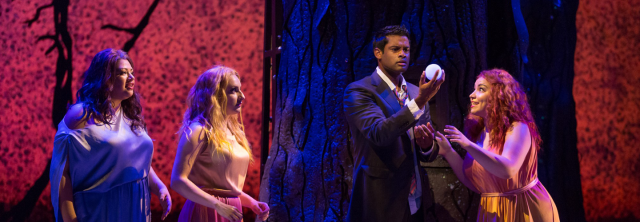
MCNY event will go behind the scenes of the making of classic Yiddish musical THE GOLDEN BRIDE (photo by Ben Moody Cameron Johnson)

MCNY event will go behind the scenes of the making of classic Yiddish musical THE GOLDEN BRIDE (photo by Ben Moody Cameron Johnson)

Museum of the City of New York
1220 Fifth Avenue at 103rd St.
Wednesday, May 4, $25, 6:30
212-534-1672
www.mcny.org
nytf.org

This past December, we raved about National Yiddish Theatre Folksbiene’s utterly delightful revival of the long-lost 1923 operetta The Golden Bride (“Di Goldnene Kale”) at the company’s new home at the Museum of Jewish Heritage. The production is back by popular demand this summer, running July 4 through August 28. You can get a behind-the-scenes sneak peek at the show on May 4 when the Museum of the City of New York presents “Vintage Theater on a Modern Stage: The Golden Bride,” being held in conjunction with the exhibition “New York’s Yiddish Theater: From the Bowery to Broadway,” which continues through July 31. The event features a discussion with musical archaeologist Michael Ochs, codirectors Bryna Wasserman and Motl Didner, musical director Zalmen Mlotek, costume designer Izzy Fields, and NYTF executive producer Chris Massimine as well as select songs performed by Rachel Policar, who stars as Goldele, Glenn Seven Allen (Jerome), Jillian Gottlieb (Khanele), and other cast members, followed by an exhibition viewing and reception. The Golden Bride has many similarities to Fidder on the Roof, which is currently playing at the Broadway Theatre; in a fun coincidence, both shows have been nominated for Outstanding Revival of a Musical by the Drama Desk. In addition, Wasserman and Didner are up for Outstanding Director, battling it out against Spring Awakening’s Michael Arden, The Color Purple’s John Doyle, American Psycho’s Rupert Goold, and Fiddler’s Bartlett Sher. (On June 19, MJH is hosting a Fiddler on the Roof sing-along, consisting of a screening of the Oscar-winning 1971 film and appearances by members of the current Broadway cast; attendees are encouraged to come dressed as their favorite character.) If you register for “Vintage Theater on a Modern Stage: The Golden Bride,” you will also receive a free ticket to a preview of The Golden Bride.

OPEN PLAN: STEVE McQUEEN PUBLIC PROGRAMS

Steve McQueen, “End Credits,” sequence of digitally scanned files, sound, continuous projection, 2012 (courtesy of the artist; Thomas Dane Gallery, London; and Marian Goodman Gallery)

Steve McQueen, “End Credits,” sequence of digitally scanned files, sound, continuous projection, 2012 (courtesy of the artist; Thomas Dane Gallery, London; and Marian Goodman Gallery)

Who: Steve McQueen and Donna De Salvo, Harry Belafonte and Dr. Cornel West
What: Two public programs in conjunction with the exhibition “Open Plan: Steve McQueen”
Where: Whitney Museum of American Art, 99 Gansevoort St., 212-570-3600
When: Friday, April 29, Steve McQueen in Conversation with Donna De Salvo, $15, 6:30; Sunday, May 1, Harry Belafonte and Dr. Cornel West Discuss Paul Robeson, $20, 5:00
Why: The Whitney’s five-part “Open Plan” series, which previously featured installations by Andrea Fraser, Lucy Dodd, Michael Heizer, and Cecil Taylor, concludes with a project by visual artist Steve McQueen that expands on his 2012 work, “End Credits,” an exploration of the FBI’s investigation into the political activities of actor, singer, athlete, lawyer, and civil rights activist Paul Robeson. McQueen, who began his career as an experimental short filmmaker (his 2004 exhibition at the Davis Museum at Wellesley College was an eye opener), wrote and directed Hunger and Shame before directing 2013’s 12 Years a Slave, which won the Best Picture Oscar. In conjunction with the multimedia show, the Whitney will be hosting two talks. On April 29, McQueen will discuss his career with senior curator Donna De Salvo, who organized the show with curatorial assistant Christie Mitchell. And on May 1 — not coincidentally May Day — actor, singer, songwriter, and activist Harry Belafonte and philosopher, professor, author, activist, and self-described “prominent and provocative democratic intellectual” Dr. Cornel West will team up to explore Robeson’s life and legacy. End Credits will be on view in the expansive Neil Bluhm Family Galleries through May 14; in addition, the Whitney is presenting the U.S. debut of McQueen’s “Moonlit” sculpture in the adjacent Kaufman Gallery.

OPEN STUDIOS WITH WORKSPACE ARTISTS-IN-RESIDENCE

Workspace Artist-in-Residence Tamar Ettun rehearses at LMCC’s Studios at 28 Liberty (photo by Jonathan Patkowski for LMCC)

Workspace Artist-in-Residence Tamar Ettun rehearses at LMCC’s Studios at 28 Liberty (photo by Jonathan Patkowski for LMCC)

Who: Sarah Anderson, Mirene Arsanios, Chloë Bass, Jesse Bonnell, Esteban Cabeza De Baca, Glendaliz Camacho, Adriane Connerton, Nick Doyle, Tamar Ettun, Joel W. Fisher, Nadja Frank, Susan Karwoska, Amy Khoshbin, Lisa Ko, Courtney Krantz, Tora Lopez, Melanie McLain, Rangi McNeil, Irini Miga, Trokon Nagbe, Meredith Nickie, New Saloon, Christina Olivares, Piehole, Ronny Quevedo, Maria Rapoport, Keisha Scarville, Pascual Sisto, Stacy Spence, Yuliya Tsukerman, Jessica Vaughn
What: LMCC Open Studios
Where: LMCC’s Studios at 28 Liberty, 28 Liberty St. between Pine, Liberty, Nassau, & William Sts.
When: Friday, April 29, 6:00–9:00, and Saturday, April 30, 1:00–6:00 (Open Texts 6:00–8:00), free with advance RSVP
Why: The Lower Manhattan Cultural Council, which “empowers artists by providing them with networks, resources, and support, to create vibrant, sustainable communities in Lower Manhattan and beyond,” is kicking off its annual Open Studios by welcoming visitors on Friday night, April 29, and Saturday afternoon and evening, April 30, to wander through its Financial District space and check out works-in-progress by thirty-one artists artists who have been busy since September immersed in paintings, sketches, photographs, sculptures, videos, poetry, dances, plays, and more. The event is free with advance RSVP; the studios will close Saturday at 6:00 for two hours of spoken-word performances. The Open Studios program continues through October with presentations at 28 Liberty and 125 Maiden Lane and on Governors Island with such performers and choreographers as Okwui Okpokwasili, the Czechoslovak-American Marionette Theatre, Faye Driscoll, Netta Yerushalmy, Amber Hawk Swanson, Ephrat Asherie, Jodi Melnick, and YACKEZ (Larissa and Jon Velez-Jackson).

LAURA POITRAS: ASTRO NOISE

(photo by Ronald Amstutz)

Laura Poitras examines the War on Terror from various intriguing angles in immersive Whitney exhibition (photo by Ronald Amstutz)

Whitney Museum of American Art
99 Gansevoort St.
Through May 1, $18-$22
212-570-3600
whitney.org

Award-winning documentarian, journalist, and former chef Laura Poitras has opened a lot of eyes around the world with such films as Citizenfour, The Oath, and My Country, My Country and her investigative reporting for such outlets as the Guardian, the Washington Post, and the website she started with Glenn Greenwald and Jeremy Cahill, the Intercept. The New School graduate is now sharing highly sensitive information about surveillance, drones, Guantánamo Bay Prison, the NSA, and more in a fascinating new way in “Astro Noise,” a five-room immersive installation on view at the Whitney. Poitras, whose Oscar-winning Citizenfour featured whistleblower Edward Snowden, invites viewers into a frightening world that is all too real. In the catalog, Astro Noise: A Survival Guide for Living under Total Surveillance, curator Jay Sanders notes that the title “echoes with associations. Discovered accidentally by astronomers in 1964 and initially thought to be a technical error, astro noise refers to the faint background disturbance of thermal radiation left over after the big bang. . . . More pointedly, Astro Noise is the name Edward Snowden gave to an encrypted file containing evidence of NSA mass surveillance that he shared with Poitras in 2012.” The exhibition begins with selections from her “Anarchist” series, consisting of full-color, large-scale prints of images Poitras created based on documents Snowden gave her of descrambled signals from the UK’s Government Communications Headquarters, including “Israeli Drone Feed (Intercepted February 24, 2009)” and “Power Spectrum Display of Doppler Tracks from a Satellite (Intercepted May 27, 2009).” In the middle of the second room is a thick two-sided screen on which two different films are projected on opposite sides; for O’Say Can You See, Poitras filmed people coming to Ground Zero and looking at the destruction wrought by the 9/11 terrorist attacks, while on the other side is U.S. military footage of 9/11-related interrogations of Said Boujaaida and Salim Hamdan, who both ended up at Guantánamo. In the third room, “Bed Down Location” visitors can lie down on a carpeted raised platform and gaze up at a screen on the ceiling that shows night skies in Yemen, Somalia, and Pakistan, where drone attacks have taken place, as well as the sky at Creech Air Force Base in Nevada, where drones are tested and flown.

Laura Poitras (b. 1964), ANARCHIST: Israeli Drone Feed (Intercepted February 24, 2009), 2016. Pigmented inkjet print mounted on aluminum, 45 × 64 3/4 in. (114.3 × 164.5 cm). Courtesy the artist

Laura Poitras, “ANARCHIST: Israeli Drone Feed (Intercepted February 24, 2009), pigmented inkjet print mounted on aluminum, 2016 (courtesy of the artist)

For “Disposition Matrix,” Poitras situates narrow, rectangular viewing peepholes at different heights in six walls; inside are official documents, video interviews, cell-phone footage, screenshots from intercepted drone feeds, and diagrams that deal with various aspects of the War on Terror, including Abu Ghraib prison, definitions of such phrases as “clandestine collection” and “covert action,” and home video of a town in Yemen on two successive days in August 2012, one depicting a wedding, the second the aftermath of a U.S. drone strike. Because of the way the peepholes are arranged, it is difficult to get the full picture of what is inside each slot, evoking how hard it is to get the full story from the government. In the fifth room, Poitras, who participated in the 2012 Whitney Biennial, makes herself the subject, something she specifically avoids in her documentaries, detailing how the U.S. government put her on a secret watchlist, continues to track her, keeps detaining and interrogating her at airports, and considers legal action to arrest her under the Espionage Act. (Meanwhile, she has sued the government.) Poitras adds a little surprise at the end, revealing how any one of us could be next. In a catalog interview with Sanders, Poitras states, “I very much like the idea of creating a space that challenges the viewer as to whether to venture in or not. . . . We live life not knowing what will happen next. What do people do when they’re confronted with choices and risks?” Poitras’s debut art installation does just that, confronting visitors with ideas and information that, unfortunately, might no longer be shocking but still come with alarming choices and risks.

PETER FISCHLI DAVID WEISS: HOW TO WORK BETTER

Museum survey juxtaposes the work of Fischli and Weiss to form new dialogues (photo by David Heald © Solomon R. Guggenheim Foundation)

Museum survey juxtaposes the work of Fischli and Weiss to form new dialogues (photo by David Heald © Solomon R. Guggenheim Foundation)

Solomon R. Guggenheim Museum
1071 Fifth Ave. at 89th St.
Through April 27, $25
Peter Fischli New School talk: Monday, April 25, $10, 6:30
212-423-3587
www.guggenheim.org
events.newschool.edu

Peter Fischli and David Weiss’s engaging, subversive DIY style is on full display in their first major museum retrospective, “How to Work Better,” on view at the Guggenheim through April 27. Known as Fischli/Weiss, the Zürich-born artists began their long collaboration in the late 1970s, continuing through Weiss’s death in 2012 at the age of sixty-five. The duo specialized in reimagining everyday objects, using synthetic rubber, unfired clay, and polyurethane, with a kitschy sense of humor. The exhibition pairs series from throughout their career, bringing together disparate elements to create a dialogue that gets to the heart of their method and process as they investigate form and structure. The sculptures of “Walls, Corners, and Tubes” are seen with “Kanalvideo,” a psychedelic trip through the sewers of Zürich. “Cars” and “Hostesses” turn the titles into miniature representations in white plaster. One floor is dedicated to “Suddenly This Overview,” a collection of hundreds of unfired clay miniatures that they called “The Subjective Tableaux,” exploring the whole of human existence, featuring such works as “Mick Jagger and Brian Jones Going Home Satisfied after Composing ‘I Can’t Get No Satisfaction,’” “Panic in the Audience When Lumière Shows His Film,” and “The Russians Launch the First Rocket into Space.” Fischli and Weiss essentially re-created their studio in numerous polyurethane installations, crafting art materials, soda cans, cleaning supplies, jars of food, and other objects out of polyurethane, forcing viewers to questions everything they see.

Fischli and Weiss’s polyurethane installations re-create their studio environment while questioning what is real (photo by David Heald © Solomon R. Guggenheim Foundation)

Fischli and Weiss’s polyurethane installations re-create their studio environment while questioning what is real (photo by David Heald © Solomon R. Guggenheim Foundation)

The duo asks its own questions in “Question Projections,” in which a seemingly endless stream of inquiries are projected onto a dark wall, asking, among other things, “Is it more important for the world or for me to be doing well?,” “Why does nothing never happen?,” “Where are all those rats coming from?,” and “Is hunger an emotion?” The survey also highlights Fischli and Weiss’s films starring their alter egos, Rat and Bear — Order and Cleanliness, The Least Resistance, and The Right Way — in addition to their most popular work, The Way Things Go, a thirty-one-minute video in which everyday objects, from tires, bottles, and balloons to ladders, candles, and garbage bags, form a supposedly seamless chain reaction that is actually made up of twenty-three shots. Among the other series and installations accumulated in “How to Work Better,” which was initiated while Weiss was still alive, are “Visible World,” “The Raft,” “Sausage Series,” and “Fotografías,” celebrating the full range of the artists’ oeuvre. “Fischli and Weiss deliberately drew attention to the intersection of art and manual labor throughout their practice,” curator Nancy Spector writes in the catalog. “Even though they consistently presented themselves as carefree observers of the world at large . . . the artists also slyly exposed the concerted effort behind their artmaking.” But most of all, “How to Work Better” is fun. In conjunction with the show, the text-based wall mural “How to Work Better” can be seen on the corner of Houston and Mott Streets through May 1; the Public Art Fund project offers ten pieces of advice, including “Do one thing at a time,” “Learn to ask questions,” and “Accept change as inevitable.” On Monday, April 25, Fischli, who will turn sixty-four in June, will deliver a talk at the New School about his and Weiss’s public works, one of which stands outside the Guggenheim: “Haus,” an inviting structure that offers no way inside.