this week in art

OF THE PEOPLE

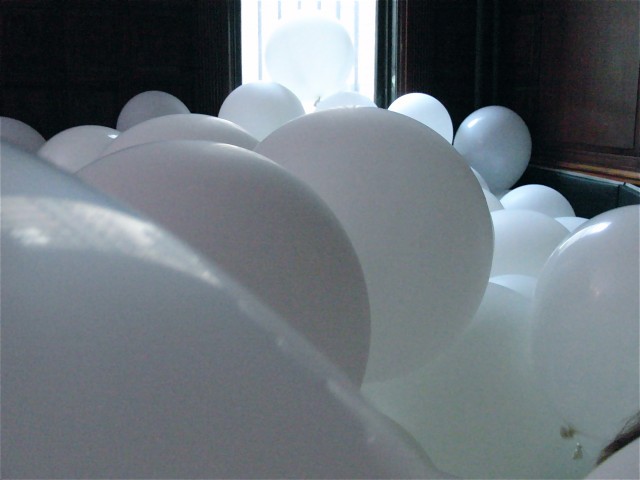
Esteban del Valle installation at Smack Mellon imagines a postapocalyptic political future (photo by twi-ny/mdr)

Esteban del Valle installation at Smack Mellon imagines a postapocalyptic political future (photo by twi-ny/mdr)

Smack Mellon
92 Plymouth St. at Washington St.
Opening reception: June 18, free, 5:00 – 8:00
Wednesday – Sunday through July 31, free, 12 noon – 6:00
718-834-8761
smackmellon.org

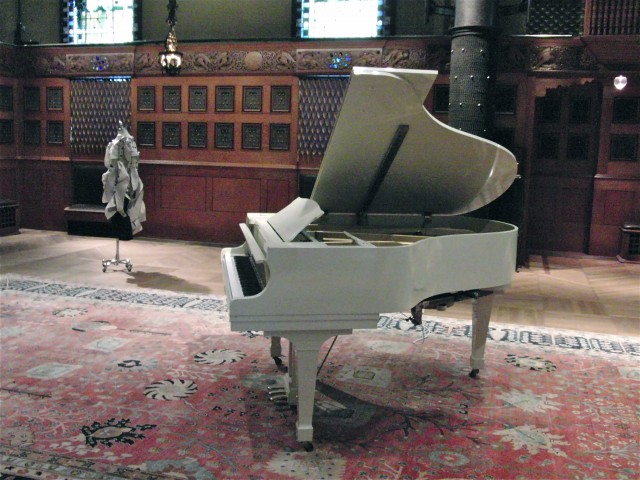
On June 17, Alicia Grullon kicked off the new political exhibit at Smack Mellon with a full reenactment of Bernie Sanders’s 2010 eight-and-a-half-hour Bush tax cuts filibuster, setting the stage for what will be happening at the Dumbo gallery over the next six weeks. Through July 31, Smack Mellon will be home to “Of the people,” a multidisciplinary show curated by Erin Donnelly that examines the current state of political discourse in America as presumptive presidential nominees Hillary Clinton and Donald J. Trump prepare to do battle, both under the threat of contested conventions. Sheryl Oring’s “I Wish to Say” consists of hundreds of index cards and Polaroids for which ordinary citizens have dictated brief personal letters to the presidential candidates. Daniel Bejar’s “Rec-elections (Let’s Make America Great Again, Isabel González)” are lenticular campaign buttons promoting the Puerto Rican activist. Ben Pinder IV’s small pamphlet “A Brief and Mythic History of Super PACs” turns the birth of the super PACs into comic-book legend. Leah Wolff’s “Political Buttons” declare “Don’t Do It” and are not for the taking.

Sheryl Oring’s “I Wish to Say” gives voice to the people (photo by twi-ny/mdr)

Sheryl Oring’s “I Wish to Say” gives voice to the people (photo by twi-ny/mdr)

Brittany M. Powell’s “Debt Portraits” detail the stories of four Americans, photographed in their homes, facing serious financial problems. Guy Ben-Ari’s “Oval Office Interior” painting imagines the White House room taken over by women. On Saturdays and Sundays (and July 7 evening), anyone can come to Smack Mellon and present their own case to be president in Jeremy D. Olson’s multimedia “Campaign Office.” Esteban del Valle’s untitled corner installation depicts a kind of postapocalyptic scenario with black balloons, a falling presidential podium, and a bull rising in the background. Peggy Diggs’s “Heirloom” includes a large-scale “Ideal Ballot” you can take home The show also features works by Isabella Cruz-Chong, Emily Greenberg, Brooklyn Hi-Art Machine (Mildred Beltre and Oasa DuVerney), Kate Sopko, and Lauren Frances Adams. On July 27 at 7:00, Hrag Vartanian, Miriam M. Basilio, and Bejar will participate in a panel discussion on propaganda; on July 28 at 5:30, Brooklyn Hi-Art Machine will present a silkscreen workshop in which attendees can make their own political posters; on July 30-31, t.Rutt will display Trump’s actual old campaign bus, which they bought late last year on Craiglist; and on July 31, Martha Wilson will be at Smack Mellon for “Martha Wilson as Donald Trump — Politics and Performance Art Are One and the Same,” followed by the panel discussion “Community Practices: Art and Intervention” with Cruz-Chong, Oring, and Sopko, moderated by Donnelly. The exhibition also has information on all of the registered political parties in New York State, useful websites, and voter registration forms, so you have no excuse not to get involved in this rather vitriolic and critically important election year.

MUSEUM MILE FESTIVAL 2016

Crowds take to the streets for annual Museum Mile Festival, beginning at the Met

Crowds take to the streets for annual Museum Mile Festival, beginning at the Met

Multiple locations on Fifth Ave. between 82nd & 105th Sts.
Tuesday, June 14, 6:00 – 9:00 pm
Admission: free
www.museummilefestival.org

The Metropolitan Museum of Art, now known as the Met Fifth Avenue with the addition of the Met Breuer in the old Whitney space, is the host of the thirty-ninth annual Museum Mile Festival, in which seven arts institutions along Fifth Avenue between 82nd and 105th Sts. open their doors for free between 6:00 and 9:00. (Met prez Daniel H. Weiss will deliver his opening remarks at 5:45.) There will be live outdoor performances by Dusan Tynek Dance Theatre, DJ Mickey Perez, Sammie & Trudie’s Imagination Playhouse, Mariachi Flor de Toloache, Silly Billy the Very Funny Clown, Miss 360, Alsarah and the Nubatones, Magic Brian, Kim David Smith, and Justin Weber Yo Yo in addition to face painting, art workshops, chalk drawing, and more. The participating museums (with at least one of their current shows listed here) are El Museo del Barrio (“Antonio Lopez: Future Funk Fashion”), the Museum of the City of New York (“Roz Chast: Cartoon Memoirs”), the Jewish Museum (“Isaac Mizrahi: An Unruly History,” “The Television Project: Some of My Best Friends”), the Cooper-Hewitt, National Design Museum (“Beauty — Cooper Hewitt Design Triennial,” “Pixar: The Story of Design”), the Guggenheim (“Moholy-Nagy: Future Present”), the Neue Galerie (“Munch and Expressionism”), and the Metropolitan Museum of Art (“Manus x Machina: Fashion in an Age of Technology,” “Court and Cosmos: The Great Age of the Seljuqs”), along with presentations by the New York Academy of Medicine, the 92nd St. Y, and Asia Society. Don’t try to do too much, because it can get rather crowded; just pick one or two exhibitions in one or two museums and enjoy.

DUKE RILEY: FLY BY NIGHT

Pigeons swirl across the night sky over Brooklyn Navy Yard (photo by Tod Seelie)

Pigeons swirl across the night sky over Brooklyn Navy Yard (photo by Tod Seelie)

Brooklyn Navy Yard
Sands St. at Navy St.
Friday through Sunday through June 19, free with advance RSVP
creativetime.org
www.dukeriley.info

Look! Up in the sky! It’s a bird! It’s a pigeon! It’s . . . two thousand pigeons with lights swirling in the Brooklyn dusk like dancing constellations? In winter 2013-14, Boston-born, Brooklyn-based artist Duke Riley sent camera-carrying homing pigeons from Cuba to Key West, transporting illegal cigars. Now Riley, who in 2012 restaged a centuries-old boat race featuring zodiac animals on a canal in Zhujiajiao, China, and in 2007 reenacted the Revolutionary War mission of the one-manned primitive submarine known as the Turtle in New York harbor, has trained two thousand pigeons, each fitted with a remote-controlled LED light strapped to one of its legs, to soar through the sky above the Brooklyn Navy Yard every Friday, Saturday, and Sunday night shortly past sunset. Attendees first follow a winding path through the fascinating navy yard, where military ships were built from 1806 to 1966, leading to the water, where the pigeons reside on the Baylander, a decommissioned Vietnam-era Navy ship now outfitted with eighty feet of coops. People take seats on the bleachers — the higher the better — or stand by the ship as Nick Cave music plays and the pigeons start to gather atop the Baylander.

As the sun sets over the East River waterfront, the music fades and sounds of live cooing rise, and then three operatives start waving flags that signal a wide variety of pigeons, from Homers, Egyptian Swifts, Satinettes, German Beauties, and Russian High Flyers to Tipplers, Damascenes, Fantails, Roller/Tumblers, and New York Flights, to head up into the air, where they perform an improvisational dance, flying in groups in seemingly choreographed patterns, soaring east, then west, or taking off on a solo trip, like a lost balloon floating away. (Don’t worry; they all eventually return to their individual lofts aboard the ship.) It’s utterly thrilling watching them billowing above, a torrent of shooting stars, looking like they’re having at least as much fun as the audience. Occasionally one of the pigeons might actually take a break and dive-bomb into the crowd, soliciting shrieks and cheers. We suggest trying to set your eyes on one — perhaps Tofu, Goldee Hawn, the Red Baron, Lucifer, Saturday Night Fever, or Pablo Escobar — and follow it like it’s a snowflake floating down from the heavens. After about forty-five minutes, the birds are called back to the Baylander, returning home to the sounds of, what else, Prince’s “When Doves Cry.” Presented by the outstanding nonprofit arts agency Creative Time, whose previous projects include Kara Walker’s “A Subtlety or the Marvelous Sugar Baby” at the Domino Sugar Factory in Williamsburg and “Drifting in Daylight” in Central Park, “Fly by Night” is an exhilarating experience that will make you think twice about these pervasive urban creatures.

MUNCH AND EXPRESSIONISM

Edvard Munch, “Puberty,” oil on canvas, 1914-16 (the Munch Museum, Oslo)

Edvard Munch, “Puberty,” oil on canvas, 1914-16 (the Munch Museum, Oslo)

Neue Galerie
1048 Fifth Ave. at 86th St.
Through June 13 (closed Tuesday & Wednesday)
212-628-6200
www.neuegalerie.org

In 2007, Neue Galerie New York presented “Van Gogh and Expressionism,” which examined the influence Dutch artist Vincent van Gogh had on German and Austrian Expressionism. Now the curator of that exhibit, Dr. Jill Lloyd, has teamed up with Dr. Reinhold Heller for a fascinating follow-up, “Munch and Expressionism,” creating a compelling back-and-forth dialogue between works by Norwegian painter Edvard Munch (1863-1944) with such German artists as Max Beckmann, Erich Heckel, Ernst Ludwig Kirchner, Gabriele Münter, and Emile Nolde and such Austrian artists as Richard Gerstl, Oskar Kokoschka, and Egon Schiele. “The radical qualities of Edvard Munch’s work — his extreme originality and inventiveness — have frequently led to him being linked to the art of the future,” Dr. Lloyd writes in her catalog essay “Edvard Munch and the Expressionists: Influence and Affinity.” She adds, “But whereas van Gogh . . . is justly deemed a precursor or ‘father’ of Expressionism, Munch, by contrast, both inspired and participated in the movement.” The splendidly curated exhibition groups a pair of Munch self-portraits, 1906’s “Self-Portrait with a Bottle of Wine” and 1923-24’s “The Night Wanderer,” with Beckmann’s 1938 “Self-Portrait with Horn” and Gerstl’s 1907 “Self-Portrait in Front of a Stove,” as if the men have come together for a chat. Munch landscapes “Winter, Elgersburg” and “White Night” feel right at home with Münter’s “The Blue Gable” and Karl Schmidt-Rottluff’s “Footpath,” in both color and abstraction. Munch’s glorious “Puberty,” seen in both an 1894 drawing and an exciting 1914-16 oil painting, takes on added meaning alongside Heckel’s “Standing Child”; the apparent communication continues through Heckel’s “Bathers in a Pond” and a quartet of bathing paintings by Munch, including the bold, extraordinary “Standing Nude Against Blue Background.”

Edvard Munch, “The Artist and His Model,” oil on canvas, 1919-21 (the Munch Museum, Oslo)

Edvard Munch, “The Artist and His Model,” oil on canvas, 1919-21 (the Munch Museum, Oslo)

A small room is dedicated to Munch’s most iconic work, “The Scream,” with its spectacular color palette and powerful emotion. The 1895 favorite is joined by several print editions as well as a trio of self-portraits by Schiele and Heckel’s woodcut “Man in the Forest.” Other standout groupings include Munch’s “Mountain Road” with Kirchner’s “Women on Potsdamer Platz,” Munch’s “The Book Family” with Kirchner’s “Street, Dresden, 1908,” and Munch’s “Two Human Beings (The Lonely Ones)” with Schiele’s “Man and Woman I (Lovers I).” An exploration of Munch’s printmaking methods is another aspect of this show, with multiple woodcuts of “Towards the Forest II,” “Angst,” “The Kiss,” “Evening. Melancholy,” “Old Fisherman,” and “Madonna,” echoed by Nolde’s “Young Danish Woman,” Hermann Max Pechstein’s “Lovers,” and Kirchner’s “Head of a Sick Man.” However, the dialogue occurred only in their art and not in person. “There is plenty of evidence that the Brücke artists sought out Munch, inviting him, for example, to send work to their group exhibitions in 1906, 1908, and 1909, although Munch carefully sidestepped these overtures,” Dr. Lloyd notes in her essay. “Nolde and the Brücke artists apparently confronted a brick wall when they tried to enlist Munch to their cause, despite his stated admiration for their work.” Even if these artists from Norway, Germany, and Austria never broke bread together or sat down and discussed art, this exhibit creates quite an intriguing visual conversation between them.

FIRST SATURDAY: PRIDE AND AGITPROP!

L. J. Roberts, “Sisters Are Doing It for Themselves,” Jacquard-woven cotton and Lurex, hand-dyed fabric, crank-knit yarn, thread, 2011 (photo by Mario Gallucci)

LJ Roberts, “Sisters Are Doing It for Themselves,” Jacquard-woven cotton and Lurex, hand-dyed fabric, crank-knit yarn, thread, 2011 (photo by Mario Gallucci)

Brooklyn Museum
200 Eastern Parkway at Washington St.
Saturday, June 4, free, 5:00 – 11:00
212-864-5400
www.brooklynmuseum.org

Pride Month is the centerpiece of the Brooklyn Museum’s June edition of its vastly popular free First Saturday program. The evening will feature live performances by New York City Gay Men’s Chorus and DJ Mursi Layne; storytelling by Queer Memoir; screenings of Jake Witzenfeld’s Oriented, followed by a talkback with Tarab NYC, and Asurf Oluseyi’s Hell or High Water, followed by a talkback with activists Kehinde Bademosi, Noni Salma Lawal, Ekene Okuwegbunam, and Adejoke Tugbiyele; a movement workshop inspired by domestic workers, by Studio REV-; pop-up gallery talks on “Disguise: Masks and Global African Art”; a hands-on workshop in which participants can make their own Pride-based iron-on patch; a curator talk by Catherine J. Morris and Stephanie Weissberg on “Agitprop!”; the talk “Women, Art, AIDS, and Activism,” with Joy Episalla, Kia Labeija, Jessica Whitbread, Egyptt Labeija, Sue Schaffner, and Carrie Moyer, hosted by Visual AIDS and moderated by LJ Roberts; a printmaking workshop about immigration and undocumented youth; and outdoor projections by the Illuminator. In addition, you can check out such other exhibitions as “This Place,” “Tom Sachs: Boombox Retrospective, 1999–2016,” and “Stephen Powers: Coney Island Is Still Dreamland (to a Seagull).”

QUEENS INTERNATIONAL 2016 PERFORMANCES

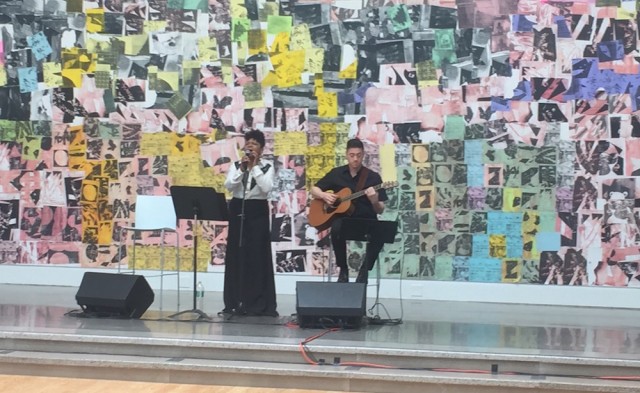
 Janks Archive: Belfast, September 6-7, 2013, Belfast, Northern Ireland (curated by Alissa Kleist as part of FIX Live Art biennale, 2013, photo by Jessica Langley)


Janks Archive: Belfast, September 6-7, 2013, Belfast, Northern Ireland (curated by Alissa Kleist as part of FIX Live Art Biennial, 2013, photo by Jessica Langley)

Who: Janks Archive, Jesus Benavente and Felipe Castelblanco, Trouble (Sam Hillmer and Laura Paris), Patrick Higgins, E.S.P. TV
What: Live performances in conjunction with “Queens International 2016” exhibition
Where: Queens Museum, New York City Building, Flushing Meadows Corona Park
When: Saturday, June 4, free – $8, 12 noon – 5:00 pm
Why: As part of the Queens Museum biennial, there will be a trio of special events held in and around the institution on June 4. From 12 noon to 3:00, Janks Archive, which collects oral insults from around the world, will be in Flushing Meadows Corona Park interviewing passersby about some of their favorite regional snaps, disses, slams, burns, jibes, digs, cut-downs, rippins, and slaggings. From 1:00 to 2:30, Jesus Benavente and Felipe Castelblanco will hold an open rehearsal of “Las Reinas,” their project with two Mariachi bands, one from Queens (Mariachi Real de Mexico), the other from Colombia, in which they collaborate to create a new song, “Las Reinas” (“The Queens”), via online chats and that will be distributed by word of mouth to mariachi bands across North and South America. And from 3:30 to 5:00, artist duo Trouble (Sam Hillmer and Laura Paris) will present “The Stood Maze” in the museum atrium as part of Trans-Pecos’s “Action Fortress” installation; “The Stood Maze” is an interactive pop-up labyrinth held up by thirty-three performers while experimental guitarist Patrick Higgins plays a sonic composition and E.S.P. TV supplies live visuals. In addition to “Queens International 2016,” the museum also currently has on view “Hey! Ho! Let’s Go: Ramones and the Birth of Punk,” “Bearing Witness: Drawings by William Gropper,” and “Nonstop Metropolis: The Remix” in addition to long-term exhibitions.

METFRIDAYS — THE MAXIMUM OUT OF THE MINIMUM: RECONSIDERING NASREEN MOHAMEDI

Nasreen Mohamedi, Untitled, ink and graphite on paper, ca. 1975 (Sikander and Hydari Collection)

Nasreen Mohamedi, Untitled, ink and graphite on paper, ca. 1975 (Sikander and Hydari Collection)

The Met Breuer
945 Madison Ave. at 75th St.
Friday, June 3, free with suggested museum admission, 6:00
Exhibition continues through June 5
212-731-1675
www.metmuseum.org

The Met Breuer instantly established its own identity in March, when it opened in the old Whitney space with an experimental performance residency by jazz great Vijay Iyer and an eye-opening exhibition on little-known Indian artist Nasreen Mohamedi, along with the major show “Unfinished: Thoughts Left Visible,” which more than hinted at further changes to come at this new outpost. On Friday, June 3, the Met Breuer will host the MetFridays lecture “The Maximum Out of the Minimum: Reconsidering Nasreen Mohamedi,” with University of Washington associate professor Sonal Khullar, artist Seher Shah, and Sheena Wagstaff, Met chairman of the Departments of Modern and Contemporary Art. “It’s an odyssey of an artist who, despite all the difficulties, was intent on creating work that really made a difference, and that is both personally very impressive but was artistically, well, you can see for yourself,” Wagstaff says in the exhibition trailer. The Indian artist’s first U.S. museum retrospective features more than 130 drawings, paintings, photographs, and diaries by Mohamedi, who died in 1990 at the age of fifty-three but continued working to the end of her life despite battling a rare neurological disorder. Mohamedi favored sharp horizontal and diagonal lines, polygonal shapes, and grids that explored light and space. The progression of her career took her from abstract ink-and-watercolor works on paper to gelatin silver prints of outdoor locations with unique linear angles to extraordinary ink-and-graphite drawings that eventually took on a scientific, futuristic quality, very different from what her contemporaries were doing in South Asia and beyond.

Nasreen Mohamedi, Untitled, gelatin silver print, ca. 1972 (Kiran Nadar Museum of Art, New Delhi)

Nasreen Mohamedi, Untitled, gelatin silver print, ca. 1972 (Kiran Nadar Museum of Art, New Delhi)

All of the works are untitled, allowing viewers to supply labels in their own thought processes if they choose. Mohamedi’s creativity and imagination are so compelling, you’re likely to wonder why you’re hearing about her only now, more than a quarter century after her death, although a critical reevaluation has been building over the last ten years. She was inspired by the writings of Rainer Maria Wilke and Albert Camus and the architectural work of Le Corbusier as well as by Kasimir Malevich and Wassily Kandinsky and fellow Indian artists M. F. Husain, Tyeb Mehta, and V. S. Gaitonde but amassed an oeuvre that was uniquely her own. In her 2014 poetic essay “Elegy for an Unclaimed Beloved,” the artist’s friend Geeta Kapur wrote, in conjunction with a show at the Tate, “Remember Nasreen’s frail limbs, ascetic face, ungendered artist persona. Remember her calling as an unrequited beloved, her narcissistic engagement with her body and the stigmata she barely cared to hide. And always her departing gesture, her return, her masochism and its reward of absurdity and grace. Her continual tracking of a mirage.” You can experience all this more at this beautiful exhibition, with the June 3 panel discussion a happy bonus. “A precise specularity, the flight of an angel shearing space. Then, in the dark night of the soul, where the ejected body persists, Nasreen was content to work with a poverty of means,” Kapur, an influential art critic, adds. “To counter the spectacle of love and of spiritual ambition, she was willing to break apart. She would simply survive, and let the calligraph, the graphic sign, speak.”