this week in art

DRAGON BOAT FAMILY FESTIVAL

dragon boat family festival

Museum of Chinese in America
215 Centre St.
Saturday, August 13, $10 (advance RSVP required), 12 noon – 4:00
855-955-MOCA
www.mocanyc.org

If you missed last weekend’s Hong Kong Dragon Boat Festival in Flushing Meadows Corona Park, you still have a chance to capture much of the flavor of the traditional event on Saturday when the Museum of Chinese in America hosts the Dragon Boat Family Festival. The afternoon includes paper cutting with Shu-Shia Sanborn; a zongzi workshop with Sophia Hsu about the delicious traditional food, after which participants can create their own zongzi noisemaker; a workshop led by Shana Fung about how dragon boats function and what each crew members is responsible for; arts and crafts consisting of making dragon-inspired crowns, good-luck fabric sachets, and threaded symbolic bracelets; and storytelling about Qu Yuan and the history of the Dragon Boat Festival. In addition, you can check out the exhibitions “With a Single Step: Stories in the Making of America” and “Stage Design by Ming Cho Lee.”

SUMMER STREETS 2016

Giant slide is a highlight of Summer Streets program on Saturday mornings in August (photo by twi-ny/ees)

Giant slide is a highlight of Summer Streets program on first three Saturday mornings in August (photo by twi-ny/ees)

Park Ave. & 72nd St. to Foley Square
Saturday, August 6, 13, 20, free, 7:00 am – 1:00 pm
www.nyc.gov

Now in its seventh year, Summer Streets takes place the next three Saturday mornings, as Park Ave. will be closed to vehicular traffic from 72nd St. to Foley Square and the Brooklyn Bridge from 7:00 am to 1:00 pm, encouraging people to walk, run, jog, blade, skate, slide, and bike down the famous thoroughfare, getting exercise and enjoying the great outdoors without car exhaust, speeding taxis, and slow-moving buses. There are five rest stops along the route (Uptown at 52nd St., Midtown at 25th, Astor Pl. at Lafayette St., SoHo at Spring & Lafayette, and Foley Square at Duane & Centre), where people can stop for some food and drink, live performances, fitness classes, site-specific art installations, dog walks, bicycle workshops, and other activities, all of which are free. Below are some of the highlights.

Foley Square Rest Stop
Beachside Slide (advance preregistration required,) Adaptive Obstacle Challenge, “On Display / CitiSummerStreets” living sculpture by Heidi Latsky, “M2B, Beijing-New York” mobile bike sculpture by Niko de la Fey, historical reenactors, Department of Design and Construction: The Art and Construction of NYC’s Water Supply, Bronx Museum of the Arts workshop (August 20)

SoHo Rest Stop
Fitness classes, free bike repair and rentals, parkour fitness demonstrations, Museum of Chinese in America “Dragon Boat Crown Making” (August 6 & 20), Storefront for Art and Architecture “Manhattanisms” (August 13)

Astor Place Rest Stop
“Make It Here” interactive programs (athletics, social media vending machines, fashion showcases, Paws and Play Dog Park, “Los Trompos (Spinning Tops)” by Hector Esrawe and Ignacio Cadena

Midtown Rest Stop
A Taste of Summer Sampling Zone, Kid Bike Park, pop-up yoga, hand-cycle demonstration, helmet fittings, free bike rentals and repair, “GrowNYC Zero Waste Programs,” live dance, theater, and musical performances

August 6
Connor Larkin, Kelly Wright, the Other Brothers, Moondrunk

August 13
JHEVERE, Phone Home, Music with a Message, Evolfo

August 20
Orin Kurtz, Backtrack Vocals, Darrah Carr Dance, Drew and Joanne

Uptown Rest Stop
DOT Safety Zone, Zipline, “Unlimited NYC” athletics, Hallmark “Sounds of Shore” installation, “Make It Here” interactive programs (live performances, food tastings, sharing love stories), bike art party, Municipal Art Society tours, tai chi, Museum of the City of New York’s “Pushing Buttons: NYC Activism”

August 6
American Folk Art Museum’s “Families & Folk Art,” Publicolor’s “Color and Creativity, Sirens of Gotham, Receta Secreta, the Afro-Latineers, Robert Anderson Band, Stiletta, Washington Square Winds, Society of Illustrators’ “Draw and Groove Party,” Materials for the Arts’ “Found Object Flowers”

August 13
Risa Puno’s interactive “Win or Lose” game, ArchForKids’ “The Big Build,” Design Trust for Public Space’s “Under the Elevated,” National Museum of the American Indian’s “Inspired by Native/Indigenous Design,” Taliah Lempert’s “Street Smart Bike Art,” BumbleBee Jamboree, DreamStreet Theatre Company, Niall O’Leary School of Irish Dance, City Stompers, dancing classrooms

August 20
National Museum of the American Indian’s “Inspired by Native/Indigenous Design,” Taliah Lempert’s “Street Smart Bike Art,” “Poets House Imagination Station,” Art Gowanus workshop, Groundswell’s “Visualize Your Artist Skills,” New York Violinist Susan Keser, Opera Collective, Art of Stepping, Exit 12 Dance Group

CaribBEING IN BROOKLYN

Brooklyn Museum’s First Saturday program includes screening of Todd Kessler’s new film, BAZODEE, followed by a Q&A

Brooklyn Museum’s First Saturday program includes screening of Todd Kessler’s new film, BAZODEE, followed by a Q&A

Brooklyn Museum
200 Eastern Parkway at Washington St.
Saturday, August 6, free, 5:00 – 11:00
212-864-5400
www.brooklynmuseum.org

The Brooklyn Museum is getting ready for Labor Day weekend’s West Indian American Day Carnival with an August First Saturday presentation filled with Caribbean energy and culture. The free events, some of which require advance tickets that night, will feature the live performance “Ganggang: Creative Misunderstanding Series” by disguise artist Alejandro Guzman, with Abigail Deville, Christopher Manzione, Clifford Owens, Elan Jurado, Geraldo Mercado, Jessica Gallucci, Marcus Willis, Sam Vernon, Tré Chandler, and William Villalongo; children’s storytelling with Linda Humes; a performance and reading by ethnomusicologist Danielle Brown from her memoir, East of Flatbush, North of Love: An Ethnography of Home; screenings of Bazodee (Todd Kessler, 2016), followed by a Q&A with actor and soca star Machel Montano, writer Claire Ince, and producers Susanne Bohnet and Ancil McKain, as well as the classic reggae flick Rockers (Theodoros Bafaloukos, 1978); Rusty Zimmerman discussing his “Free Portrait Project: Crown Heights”; a hands-on workshop in which participants can make their own Caribbean-inspired instruments; pop-up gallery talks in the excellent “Disguise: Masks and Global African Art” exhibition; a Backyard Bashment dancehall workshop and party with choreographer Blacka Di Danca, actor-comedian Majah Hype, and DJ MeLo-X; and the interactive mobile art center caribBEING House, featuring Ruddy Rove’s “Fine Art of Daggering” photos, a participatory wall map, and the opportunity to share your own Caribbean tale. In addition, you can check out such exhibitions as “Who Shot Sports: A Photographic History, 1843 to the Present,” “Tom Sachs: Boombox Retrospective, 1999–2016,” “Stephen Powers: Coney Island Is Still Dreamland (to a Seagull),” and “Agitprop!”

MARTIN CREED: THE BACK DOOR / UNDERSTANDING

(photo by twi-ny/mdr)

A piano makes a different kind of music in “Martin Creed: The Back Door,” at the Park Ave. Armory through August 7 (photo by twi-ny/mdr)

THE BACK DOOR
Park Ave. Armory
643 Park Ave. between 66th & 67th Sts.
Through August 7, $15 (free with IDNYC card)
212-933-5812
www.armoryonpark.org
www.martincreed.com

UNDERSTANDING
Pier 6, Brooklyn Bridge Park
Through October 23, free, 6:00 am – 11:00 pm
www.publicartfund.org
understanding slideshow

Upon going through the front door of the Park Ave. Armory and entering the lobby to see “Martin Creed: The Back Door,” visitors are greeted by Creed’s recent music video “Understanding,” which features the multidisciplinary British artist playing multiple characters. “We were arguing / And I was saying, ‘I’m a victim’ / And you were saying, ‘I’m a victim’ / And I was saying, ‘I’m a victim,’” Creed sings to a bouncy pop tune. Meanwhile, to the right, a vertical white neon sculpture hangs from the ceiling, slowly turning, with the word “Other” on one side and “People” on the reverse. The pair of works serves as an excellent introduction to Creed, who over the course of his thirty-year career has worn numerous hats (and hairstyles), building an oeuvre that includes painting, sculpture, film, installation, music recordings, performance, and more that challenge the status quo and call into question political and social convention around the world. Given full rein in the first floor of the historic armory, Creed and big-time curators Tom Eccles and Hans-Ulrich Obrist have created a masterful display, emphasizing Creed’s wide diversity and whimsical nature. Doors and curtains open and close, lights go on and off, an object partially blocks entrance to a space, and a piano isn’t used quite as expected. A marching band leads a small procession, an abandoned bar invites curiosity, and short films show people puking, defecating, and, despite physical disabilities, crossing a New York City street without canes, crutches, walkers, or wheelchairs. One room is half-filled with balloons, while another features a wall of abstract portraits that call to mind the dignified paintings of military men that can be found throughout the armory; Creed’s sensibility so takes over that you might find yourself wondering whether certain of the military portraits aren’t pranks made by Creed. In the library, Creed has surreptitiously placed objects in the cabinets that display historical artifacts, exploring the very nature of labels and identification. Also in the library are small vitrines that contain exactly what their names explain they are or where they are: “Work No. 218: A sheet of paper crumpled into a ball,” “Work No. 158: Something on the left, just as you come in, not too high or low,” and “Work No. 74: As many 1″ squares as are necessary cut from 1″ masking tape and piled up, adhesive sides down, to form a 1″ cubic stack.”

(photo by twi-ny/mdr)

Martin Creed’s “Work No. 2497: Half the air in a given space” allows visitors to play in a room half-filled with white balloons (photo by twi-ny/mdr)

In the Wade Thompson Drill Hall, Creed projects his “Mouth” series onto a massive screen, short videos of people (including his mother) chewing, followed by a surprise at the back of the hall that references, among other things, what eventually happens after one eats. In the bunkers to the side, eighteen of Creed’s videos are on constant loop in different spaces, including “Let Them In” and “Border Control,” which deal with immigration and basic human rights; “Flower Kicking,” in which a man kicks a plant as if it were a soccer ball; the romantic “You’re the One for Me,” in which Creed frolics on a beach and in the ocean; and “Fuck Off,” eighty-one seconds of Creed screaming the title words. “Martin Creed: The Back Door” is an endlessly inventive intervention that confirms once again that the armory is one of the city’s most unusual and exciting places to see exhibitions that can’t be held anywhere else. (On Thursday and Friday nights, the exhibition is open till 10:00, with a bar in one of the period rooms.)

(photo by twi-ny/mdr)

Martin Creed asks for “Understanding” in Brooklyn Bridge Park (photo by twi-ny/mdr)

In a companion piece in Brooklyn Bridge Park, the Turner Prize-winning Creed, who was born in England, raised in Glasgow, and currently lives and works in London, has installed a giant revolving neon sign that very simply declares, “Understanding.” The ten-foot-tall letters, which sit atop a fifty-foot-long steel I-beam, spin around at varying speeds, sometimes coming to a brief stop, giving viewers a chance to reflect on the meaning of the word, whether seen frontward or backward. The kinetic sculpture, a project of the Public Art Fund, is visible from far away, mimicking an advertising sign, or can be viewed up close and personal, with steps that allow you to walk right up to it. As with most of Creed’s works, “Understanding” succeeds on numerous levels, particularly in a world torn apart by xenophobia, racism, hatred, and war. It is also the name of Creed’s most recent single and video, which, as noted above, can be seen in “The Back Door” (and here) and deals with victimhood. (“Understanding” can be found on Creed’s latest album, Thoughts Lined Up, which also includes such songs as “I’m Going to Do Something Soon,” “Everybody Needs Someone to Hate,” “Let’s Come to an Arrangement,” and “Difficult Thoughts.”) In addition, Lower Manhattan is visible through the letters and across the East River, where One World Trade Center has risen in the ashes of the Twin Towers. “Understanding” might seem somewhat quaint and obvious, but that’s part of the point, another thought-provoking work from an iconoclastic virtuoso who is finally getting his due.

ISAAC MIZRAHI: AN UNRULY HISTORY

(photo by Will Ragozzino/SocialShutterbug.com)

Jewish Museum exhibition highlights Isaac Mizrahi’s fashion design sense and colorful personality (photo by Will Ragozzino/SocialShutterbug.com)

The Jewish Museum
1109 Fifth Ave. at 92nd St.
Daily through August 7, $15 (free admission Saturday, pay-what-you-wish Thursday 5:00 – 8:00)
212-423-3200
www.thejewishmuseum.org
www.isaacmizrahi.com

“I feel like a filmmaker/playwright trapped in the body of a fashion designer . . . seriously,” Isaac Mizrahi says on the audioguide accompanying the sensational exhibition “Isaac Mizrahi: An Unruly History,” continuing at the Jewish Museum through August 7. Exhibition organizers Chee Pearlman and Kelly Taxter have done a fabulous job of creating a compelling narrative arc to the show, brilliantly bathing visitors in Mizrahi’s intense love of color (“Color is the biggest luxury there is.”), wild sense of humor (“I think that the ability to laugh at myself sets me apart. I don’t understand people without humor, and I just don’t like certain things because they have no humor.”), and proud dedication to both high and low culture, from movies and television to opera, theater, and art, from Woody Allen, Fred Astaire, and Bette Davis to The Red Shoes, Lucille Ball, and Egyptian hieroglyphics. The show also explores the Brooklyn-born-and-raised Mizrahi’s creative expression in a number of different media. Splendid fashion drawings, which are works of art on their own, cover two walls; the designer works out ideas for potential outfits in these small sketches of tall, thin models, their bodies filling the paper from top to bottom. Another room is like a runway through his career as a costume designer for choreographers Mark Morris and Twyla Tharp and as designer and director for the Opera Theatre of St. Louis, for whom he created playful, fantastical costumes and a dazzling blue satin dress with one of the longest trains you’re ever likely to see, wrapping around a staircase and across the floor (for the Queen of the Night in The Magic Flute). Another section sits the audience down for a montage of his numerous television and movie appearances, including hosting several programs of his own, competing on Celebrity Jeopardy!, guest judging on Project Runway, starring in his own one-man show (Les MIZrahi), selling his clothes at Target and on QVC, and making cameos galore. “Isaac is a polymath of many talents and does not take himself too seriously in that he doesn’t see himself as a grand fashion figure. What he is . . . is what you see,” Pearlman says on the audioguide. “There is an instant, infectious warmth to him. He channels a light, happy, joyous spirit which he unleashes in his clothing.”

Dozens of mannequins are adorned with Mizrahi’s unique designs, which reveal his personality, style, and endless ingenuity, which was first brought to the general public’s attention in the innovative 1995 documentary Unzipped. “Baby Bjorn Ballgown” is a striking red dress with a place for an infant in the front (“The birth of a child should be integrated into a woman’s social life.”). “The Real Thing” is a pailette dress made from flattened Coke cans, a sly riff on consumerism. “Desert Storm” celebrates camouflage in a new way. “Extreme Kilt” reimagines the Scottish traditional garb in cashmere flannel (“There’s a million rules about kilts, and about plaids, and I thought it was hilarious and I liked knowing everything about it and then being able to absolutely destroy this knowledge.”) “Kitchen Sink Pink Dress” was influenced by neon-light artist Dan Flavin, “Exploded Tulip” was based on an Irving Penn photograph, and “Grand Pupa” takes its name from its cocoonlike shape and the name of the leader of Fred Flintsone’s lodge. The exhibition also includes a series of photographs Nick Waplington took of Mizrahi at work from 1989 to 1993, clips from dance and theater performances that Mizrahi designed, directed, and/or appeared in, and a room of such accessories as “Lobster Epaulet,” “Cardboard Boater,” “Fox Piece,” “Spring Heeled Heels,” and “Campaign Box Clutch.” At the center of it all, Mizrahi’s love of life and fashion shine through, highlighting a fascinating rebel who has always insisted on doing things his own way. “I’m just going to be myself,” he says. To give as many people as possible a chance to see this superb midcareer retrospective, the Jewish Museum will be open on Wednesday (when it’s usually closed) and has extended viewing hours to 8:00 on Saturday (when it’s free) and Sunday.

LAST CHANCE — HEY! HO! LET’S GO! RAMONES AND THE BIRTH OF PUNK / QUEENS INTERNATIONAL 2016

Danny Fields, Ramones in alley behind CBGB, 1977 (photo courtesy the artist)

Danny Fields, “Ramones in alley behind CBGB,” 1977 (photo courtesy the artist)

Queens Museum
New York City Building
Flushing Meadows Corona Park
Sunday, July 31, suggested admission $8, 11:00 am – 5:00 pm
718-592-9700
www.queensmuseum.org

“The Ramones all originate from Forest Hills and kids who grew up there either became musicians, degenerates or dentists. The Ramones are a little of each. Their sound is not unlike a fast drill on a rear molar,” Tommy Erdelyi, aka Tommy Ramone, wrote in in the Ramones’ first press release. That artifact serves as the perfect introduction to “Hey! Ho! Let’s Go: Ramones and the Birth of Punk,” which closes at the Queens Museum on Sunday, July 31, along with the Queens International 2016. The Ramones celebration is being held in conjunction with the fortieth anniversary of the band’s debut album, Ramones, which featured lead singer Joey (Jeffrey Hyman), guitarist Johnny (John Cummings), bassist Dee Dee (Douglas Colvin), and drummer Tommy pumping out fourteen songs in less than half an hour, a nonstop barrage that included “Blitzkrieg Bop,” “I Wanna Be Your Boyfriend,” “Now I Wanna Sniff Some Glue,” and “53rd & 3rd,” on their way to changing the shape of music and underground culture around the world. The exhibition consists of memorabilia galore, from photographs, videos, and artwork to handwritten lyrics, letters, T-shirts, and concert posters, as well as a few of their classic leather jackets and instruments (and the Schlitzie mask used during “Pinhead”). In a back room, the Ramones’ 1977 New Year’s Eve concert at the Rainbow in London plays continuously on the big screen. It’s the first of a two-part exhibition; the second iteration begins in September at the Grammy Museum in L.A. Gabba gabba hey!

Abby Dobson and Sam Vernon will perform in front of Vernon’s “Louis & Sam” collage at the Queens Museum on July 31 (photo by QM Curatorial Staff, courtesy the artists)

Abby Dobson and Sam Vernon will perform in front of Vernon’s “Louis & Sam” collage at the Queens Museum on July 31 (photo by QM Curatorial Staff)

Sunday is also your last chance to catch “Queens International 2016,” the museum’s biennial exhibition focusing on artists who live and/or work in the borough, this time looking at the concept of thresholds. We’re particularly fond of Kate Gilmore’s “Beat It” video (don’t read about it in advance and simply experience it), the Janks Archive’s “The Internal Insults,” a collection of razzes in multiple languages; Alan Ruiz’s “Western Standards,” a different kind of Mexican wall; Melanie McLain’s “Prepersonal” installation, which you are supposed to touch; Shadi Harouni’s “The Lightest of Stones,” a video in which she pulls down rocks in a pumice quarry in Iranian Kurdistan; and Brian Caverly’s “Studio Abandon,” a miniature re-creation of his Ridgewood studio. The closing festivities on Sunday start at 1:00 with “Las Reinas,” a performance by Jesus Benavente and Felipe Castelblanco involving the creation of a new song by two mariachi bands, one in Queens and one in Colombia. At 2:30, “When You’re Smiling . . . The Many Faces of the Mask” is a site-specific performance by singer Abby Dobson and guitarist Sam Vernon in response to the latter’s wall collage “Louis & Sam.” And at 3:00, there will be a screening of “A Frame Apart: Short Films Showcase,” followed by a Q&A with the filmmakers.

GENESIS BREYER P-ORRIDGE: TRY TO ALTAR EVERYTHING

“Crucifom” is one of many unusual ritualistic artworks in Genesis Breyer P-Orridge exhibit at the Rubin Museum (courtesy Invisible-Exports)

“Cruciform” is one of many unusual ritualistic artworks in Genesis Breyer P-Orridge exhibit at the Rubin Museum (courtesy Invisible-Exports)

Rubin Museum of Art
150 West 17th St. at Seventh Ave.
Through August 1, $10-$15
212-620-5000
rubinmuseum.org

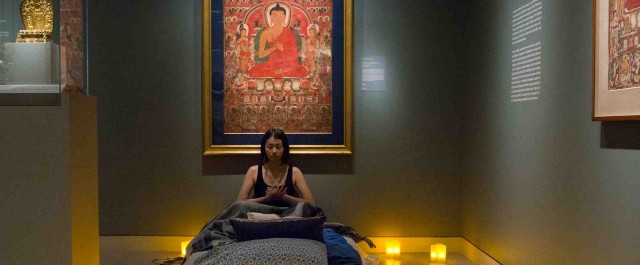
There are only three days left to see Genesis Breyer P-Orridge’s intriguing and captivating site-specific, interactive-exchange exhibition “Try to Altar Everything.” Born Neil Andrew Megson in 1950 in Manchester, England, Genesis cofounded the influential industrial bands Throbbing Gristle and Psychic TV as well as the art collective COUM Transmissions. Five years ago, Marie Losier’s documentary, The Ballad of Genesis and Lady Jaye: A Film of Transformation, detailed the love story between Genesis and Lady Jaye, both of whom went through various forms of plastic surgery to become one pandrogynous unit known as Breyer P-Orridge. (Pandrogeny stands for “positive androgeny.”) Lady Jaye passed away in 2007, and h/er death is evident throughout “Try to Altar Everything.” (The artist prefers such gender-neutral pronouns as “s/he,” “h/er,” or the plural “they” and “their.”) The exhibit explores occult ritual, faith and devotion, and the nature of objects; throughout the run of the show, visitors are encouraged to bring a small offering that will be placed in the circular containers in the walls on the sixth floor.

Genesis P-Orridge will take calls as part of Try to Altar Everything (photo courtesy Rubin Museum)

Genesis Breyer P-Orridge will take calls as part of “Try to Altar Everything” (photo courtesy Rubin Museum)

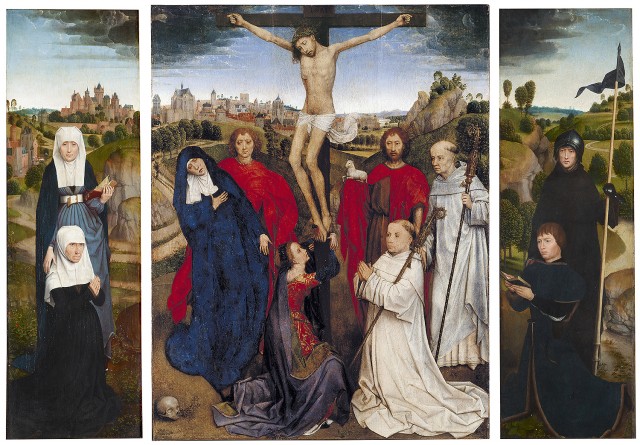
Genesis employs the cut-up method, popularized by Bryon Gysin and William S. Burroughs (whom she knew), to create sculptures and mixed-media collages that reference religion, from Christianity to Hindu and Tantric Buddhism. Each work is filled with strange and fascinating details that are worth investigating, including “Cruciform (Sigil Working),” in which a naked Lady Jaye adopts Christ’s pose on the cross; “Feeding the Fishes,” a shrine with fish, a mandala, and a sphere resting on a mold of gums and teeth; and “Reliquary,” a wooden box with sting ray skin, plastic eggs, a mirror, and photos. There are also illuminated standing coffins, a medicine chest, a bronze hand you’re supposed to touch, a stiletto shoe with bones and fur, and a cabinet of curiosities. And for “Listen Here,” Genesis will occasionally stop by the museum, take a seat in the regal red chair, and answer visitors’ phone calls. It’s a bold, wild, yet deeply personal exhibit that feels right at home at the Rubin. “Once you let go of all the different reasons to not do something, it leaves you with the freedom to do everything, and that was the path we chose,” Genesis says about taking risks in the Artist Extras section of the Rubin website. “Let’s go out and look for revelation, look for creation.” In addition, Genesis has curated a related Friday-night Cabaret Cinema series that continues through August 26 with Fellini Satyricon, Peter Collinson’s Up the Junction, John Schlesinger’s Billy Liar, and Liliana Cavani’s The Night Porter, introduced by Simon Critchley.