Edmund Clark, “Camps I — Isolation Unit in Camp 1,” chromogenic colour print, 2009 (© 2009 by Edmund Clark)
Flowers Gallery
529 West 20th St. between Tenth & Eleventh Aves.
Through January 12, free
212-439-1700
www.flowersgallery.com
www.edmundclark.com
The act of organized torture — especially what went on at Guantanamo, as depicted in news accounts and such documentaries as Michael Winterbottom’s The Road to Guantanamo — is meant to disorient, dislocate, disillusion, and dehumanize its victims. Award-winning British photographer Edmund Clark turns the tables in intriguing ways in “Guantanamo: If the Light Goes Out,” which continues through January 12 at Flowers gallery in Chelsea. Clark seeks to rehumanize everyone on Guantanamo by taking photos that include no people, refusing to give a public face to the men and women who work there and those who were tortured there. Instead, he focuses on three aspects of home: the naval base where the military and their families live, the prison camp itself, and the houses and apartments (primarily in the UK and Asia) where former detainees moved after being released. Clark does not arrange the photos geographically, which disorients viewers, who can’t quite be exactly sure what they’re looking at. The photos themselves are striking, showing the bright green interior of an isolation unit, a children’s slide inside a former detainee’s new home, a three-level boxed shelf containing soldiers’ hats, a mobile force-feeding chair, and the prison exercise cage. One of the most compelling shots is of a dark night with the only barely visible element being the long fence that separates the naval base from Cuba. The second part of the exhibit, “Letters to Omar,” collects xeroxes of postcards that one prisoner, Omar Deghayes, received during his years in Guantanamo; the military never allowed him to see the originals, instead making copies and then redacting much of the text. Finally, an audiovisual slideshow combines images of those postcards with an audio track melding a man describing how he was tortured with a woman reading the official camp procedures. “When you are suspended by a rope you can recover but every time I see a rope I remember. If the light goes out unexpectedly in a room, I am back in my cell,” says Binyam Mohamed, aka Prisoner #1458, whose quote lends the exhibition and accompanying book — named Best Photographic Book at the 2011 New York Photo Awards — their title. “Guantanamo: If the Light Goes Out” indeed sheds new light on a dark moment in U.S. history.
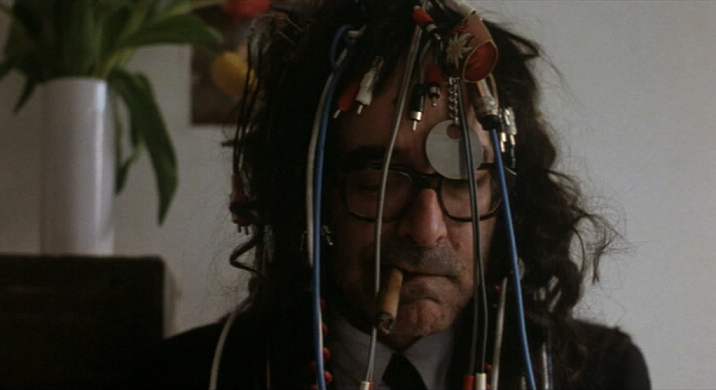
 At the 1985 Cannes Film Festival, producer Menahem Golan, who would go on to make several movies nominated for the Golden Raspberry (Cannonball Run, Cobra), somehow got French auteur Jean-Luc Godard to agree to direct a new version of King Lear, signing the contract on a napkin. Unfortunately, things didn’t go quite as planned, resulting in Godard’s incomprehensible, unintelligible, extremely hard-to-follow Shakespeare flick. Theater director Peter Sellars — he of the Eraserhead-like hairdo — stars as William Shakespeare Jr. the Fifth, a descendant of the Bard’s who is trying to put his famous ancestor’s plays back together in a post-Chernobyl world. After Norman and Kate Mailer get in an argument about turning the script into a gangster picture, Sellars meets Learo (a muttering Burgess Meredith) and his daughter, Cordelia (a monotone Molly Ringwald). Also on hand for this twisted fairy tale are French director Leos Carax (Pola X, Holy Motors) as Edgar, Julie Delpy as Virginia, Woody Allen as Mr. Alien, and Godard himself as the wacky Professor Pluggy. Elements of the play occasionally show up, but it is nearly impossible to figure out just what the hell is going on. By the time it all starts making the least bit of sense and even becomes intriguingly poetic, it’s over. In his inimitable style, Godard subversively defies all expectations, making a film that is about everything, nothing, and no thing. He takes on virtue and power, art and nature, text and image, and storytelling itself, but in this case he ends up with an unwatchable mess. Still not available on DVD, King Lear is having a rare screening January 11 at 7:00 and 9:30 at 92YTribeca, with the early show followed by a Q&A with critics Simon Abrams, Bilge Ebiri, and Richard Brody. When he selected the film for the 2009 New Yorker Festival, Brody wrote, “I consider Godard’s King Lear to be his greatest artistic achievement; in a Y2K poll, I ranked it among the ten best movies ever made.” It should be quite interesting hearing him defend that choice on Friday night.
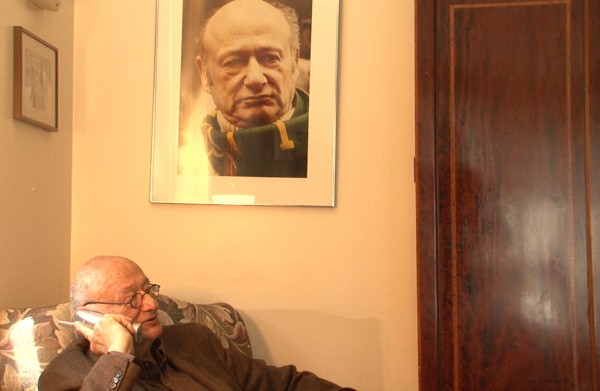
 A bunch of people have a whole lot to say about Ed Koch in a new documentary about the charming yet irascible former three-term mayor of New York City, but none of them goes on quite so eloquently as Hizzoner himself. Longtime journalist and first-time filmmaker Neil Barsky delves into the man behind the legend, the upstart politician who helped save New York from the debt- and crime-ridden 1970s through, among other things, the sheer force of his immense will. Barsky combines new interviews with such political journalists as Michael Goodwin, Sam Roberts, and Wayne Barrett, along with former comptroller Carl McCall and the Rev. Calvin O. Butts, to paint a portrait of Koch as both mensch and meanie, a bully who always speaks his mind and never backs down from a challenge. Barsky and editor Juliet Weber include archival photographs and old film footage of Koch in the 1960s and early 1970s as he first takes on Democratic Party boss Carmine DeSapio, then runs for city council and Congress before getting into a heated seven-person race for mayor in 1977. The present-day Koch is filmed tinkering around in his small kitchen, breaking the Yom Kippur fast with his family, and relaxing in his office, sharing his views on his legacy, his battles with the black community over Sydenham Hospital, and even questions of his sexuality — but only up to a point — that have followed him throughout his career. Although Barsky claims in his director’s statement that “with the exception of one former governor and one former mayor, virtually everyone we reached out to agreed to be interviewed,” the film suffers in that it does not exactly boast an all-star lineup of pundits talking about Koch– but it of course has Koch himself, and that is more than enough. Koch, which opens theatrically February 1, is screening January 10 and 13 at the twenty-second annual New York Jewish Film Festival, presented by the Jewish Museum and the Film Society of Lincoln Center, with Barsky on hand for the January 10 show and the now-eighty-nine-year-old Koch in attendance January 13.