FIVE DEDICATED TO OZU is screening as part of tribute to Abbas Kiarostami at Lincoln Center
FIVE DEDICATED TO OZU (Abbas Kiarostami, 2003)
Film Society of Lincoln Center, Walter Reade Theater
165 West 65th St. at Amsterdam Ave.
Thursday, February 14, $13, 8:45
Series continues through February 17
212-875-5601
www.filmlinc.com
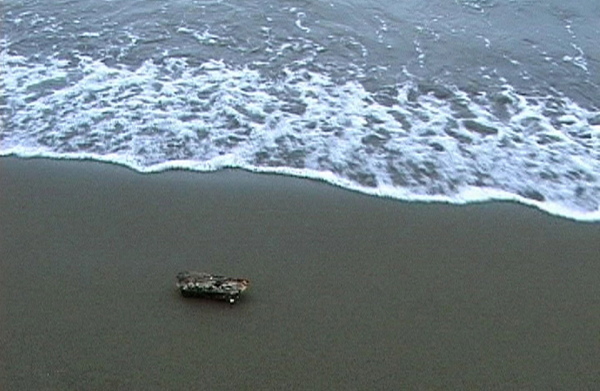
 We first saw Abbas Kiarostami’s gorgeous five-part film Five Dedicated to Ozu at the Iranian director’s 2007 multidimensional MoMA exhibit, “Image Maker,” where all five segments ran continuously and simultaneously in five semiprivate partitioned spaces, each with its own comfy bench. The film as a whole, which is composed of static shots on a beach in Galicia, are dedicated to Japanese director Yasujiro Ozu, whose films attempted to catch the reality of human existence in all its simplicity. In the first episode, the coming waves threaten a piece of driftwood; we dare you not to create your own narrative in your head once the wood is split apart. (By the way, this is the only part of the film that includes any camera movement at all, as Kiarostami opts to follow the driftwood for one short moment.) For the second scene, the camera is moved to the boardwalk, with people passing to the right and left as the surf continues to crash onto the shore; this is the least compelling of the five pieces. Back on the beach for the third part, the camera finds a group of stray dogs in the distance, nestled together by the water; again, as one dog gets up and moves away, left to himself, you’ll create your own ideas about what is really happening. Next is the funniest section of the movie, as a long line of ducks don’t know whether they’re coming or going, but they do so determinedly. Finally, the last scene takes place at night, as the moon glistens in a dark sky as the sounds of frogs and nature envelop this small part of the earth. Relax and let your mind wander during this fascinating and fun cinematic experience that we found exhilarating as a single work — but we also loved how it was installed at MoMA, where you could sit down with any of the films at any time and just let them take you away. Five Dedicated to Ozu is screening Thursday, February 14, at 8:45 with Kiarostami’s 2006 short Roads of Kiarostami at the Walter Reade Theater as part of the Film Society of Lincoln Center series “A Close-Up of Abbas Kiarostami,” which continues through February 17 with such other films as 10 on Ten, Fellow Citizen, Life and Nothing More, Through the Olive Trees, and more works by the master Iranian director in celebration of his latest, Like Someone in Love, which opens theatrically February 15.
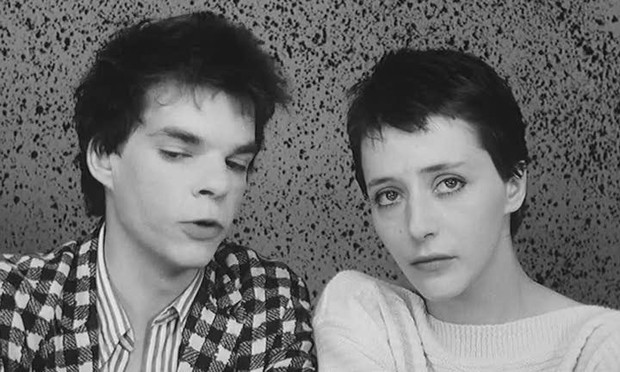
 French auteur Leos Carax learned a lot about making movies during his stint as a critic for Cahiers du cinéma, the magazine that came to represent the Nouvelle Vague movement of the 1950s. Born Alexandre Oscar Dupont in a Paris suburb in 1960, Carax released his first feature-length film in 1984, Boy Meets Girl, a black-and-white homage to the legacy of Jean-Luc Godard, François Truffaut, and Claude Chabrol as well as King Vidor, Buster Keaton, and Ingmar Bergman. Yet despite its obvious influences, Boy Meets Girl triumphs as a uniquely told tale of a strange young man named Alex (Carax’s onscreen alter ego, Denis Lavant) and his oddball adventures in search of love and truth. Dumped by Florence (Anna Baldaccini), he fakes his way into a party, where he finds Mireille (Mireille Perrier), a suicidal model who is intrigued by him. Carax, who would go on to make such well-received films as Mauvais Sang, Pola X, and Holy Motors, fills Boy Meets Girl with wonderful little touches, beautifully photographed in long takes by Jean-Yves Escoffier, from a repeating black-and-white clothing pattern and a battle with a pinball machine to a sudden burst of tap-dancing and a mysterious meeting along the Seine. Alex is a warped version of Jean-Pierre Léaud’s Antoine Doinel, but even though Alex as a lead character is no match for Truffaut’s seminal figure in the history of twentieth-century cinema, it’s still impossible to take your eyes off him as he continues to do and say a a whole lot of very weird and unpredictable things. Boy Meets Girl is screening on February 12 at Florence Gould Hall as part of the French Institute Alliance Française CinémaTuesdays series “When Boy Meets Girl: The Cinema of Leos Carax” and will be preceded by Merde, Carax’s contribution to the three-part omnibus