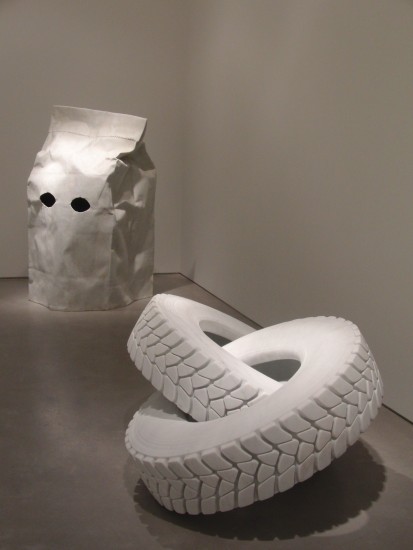
Fabio Viale, “Thank you and Goodbye,” detail, white marble, 2012, and “Infinite,” white marble, 2011 (photo by twi-ny/mdr)
Sperone Westwater
257 Bowery
Tuesday – Saturday through February 23, free
212-999-7337
www.speronewestwater.com
stargate slideshow
A child prodigy, Italian sculptor Fabio Viale has been working in marble since he was sixteen years old. Now thirty-seven, the Cuneo-born Viale is having his first solo show in New York, “Stargate,” a diverse collection of marble works on two floors of Sperone Westwater that are all about juxtaposition and recontextualization, combining the modern world with the art historical. Upon entering the vestibule, visitors are greeted by “Souvenir Gioconda,” a marble casting of Leonardo da Vinci’s Mona Lisa that appears to be made out of Styrofoam and looking like pieces have been picked off of it. The sculpture is part of Viale’s Souvenir series, which references people’s desire to own great works of art, either in replica, like a souvenir from a gift shop, or by actually taking part of the original, a practice that has become widespread in Italy, with the nose being a particularly favorite target. The gallery’s main space on the first floor contains three statues that form a kind of Pop art trio: “Ahgalla III” is a life-size canoe that Viale has actually taken out on the water; “Stargate” is made up of stacked fruit crates that form a larger crate standing on its side, almost as if a doorway into the commercial world; and “Linea schiacciata” is a twenty-foot-long I-beam that calls into question the very structure of objects. In the back room, bathed in a religious glow, is “Souvenir (Pietá) III,” a gorgeous sculpture of Jesus removed from the arms of his mother, based on Michelangelo’s iconic “Pietá,” instead now spread across a black platform, to be experienced in a completely different way. “I never look back to the past. If you want to run fast, you must never turn around,” the Torino-based Viale tells interviewer Alessandra Galasso in the exhibition catalog. “My main aim is to go beyond tradition. As they are, my sculptures can be interpreted as being academic or nostalgic because they are made of marble, and it is therefore fundamental that I avoid any nostalgic references to the past. For example, when I look at the ‘Pietá,’ I am interested in understanding how Michelangelo managed to achieve certain effects using marble — rather than what this work represents in art history — in order to represent the same semantic values.”
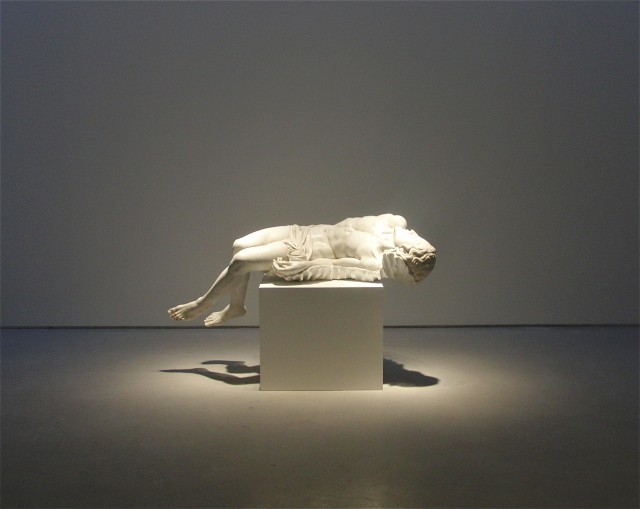
Fabio Viale, “Souvenir (Pietá) III,” white marble, 2006 (photo by twi-ny/mdr)
The works upstairs continue Viale’s goal of transcending tradition. “Infinite” is a pair of impossibly interlocked white marble Michelin tires cast in great detail. “Anchor” is a fifty-five-inch anchor screw turned into a totem pole. And “Thank you and Goodbye” — made using a computer-controlled robot, while all the other sculptures were made by Viale’s own extremely talented hands — consists of two giant paper bags, one with a pair of eyeholes, the other with a circle for a mouth, on situated on either side of “Infinite,” taking an everyday mundane object and transforming it into something that recalls KKK hoods as well as Klan-like figures found in the work of Philip Guston. A paper bag is also something people use to carry items in, perhaps referencing bags from gift shops where one can buy iconic souvenirs of the Mona Lisa, the “Pietá,” and other classic works of art and take them home, but alas, there are no such objects for sale at Sperone Westwater. “Stargate” is on view through February 23, joined by “A Picture Gallery in the Italian Tradition of the Quadreria (1750 – 1850),” which includes paintings and drawings from the Italian figurative tradition, providing an interesting complement to Viale’s thrilling show.
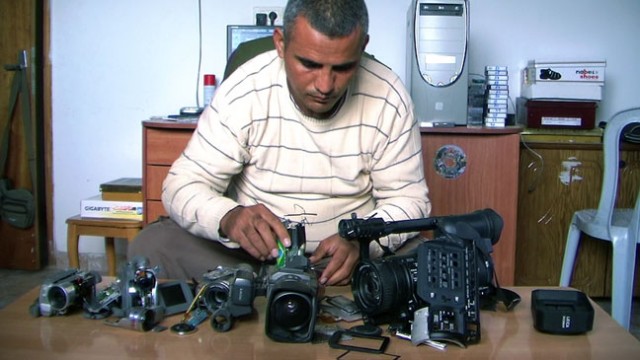
 In February 2005, Palestinian farmer Emad Burnat bought a camera to capture the birth of his fourth son, Gibreel. But he also began filming the dangerous events taking place in and around his home in Bil’in, one of many West Bank villages that were being separated from much of their land by a fence and then a wall, as Israeli settlers moved into newly constructed buildings. Over the course of the next five years, Burnat went through five cameras as he documented the mostly peaceful demonstrations, led by two of his friends, Adeeb Abu-Rahma and Phil, against the Israeli military, with many of the scuffles turning violent on the part of the soldiers. Burnat follows the growth of his children, particularly Gibreel, who gets lessons on how to be careful at the protests from his mother, Burnat’s Brazilian-born wife, Soraya. Much of what he exposes is disturbing, as Israeli soldiers burn down olive trees, lob in tear gas, and shoot an unarmed captive in the leg. However, there is an overriding feeling that Burnat, who teamed up in 2009 to structure the film with Israeli codirector Guy Davidi, has cut out some essential parts, deleting valuable information that might better explain some of what was going on. (More than five hundred hours of footage were edited down to ninety minutes for the final film.) At one point Burnat is arrested for throwing rocks; although he never shows himself taking such action, he also does not claim he was wrongly imprisoned. And another scene in which Soraya begs for him to stop filming because it is hurting the family feels staged. Still, the footage does exemplify the intense battle going on between Palestinians and Israelis over the West Bank settlements, resulting in so much unnecessary violence and destruction. The fight even continues over the film itself, as Palestinians are boycotting it because of the involvement of Israeli financing, while Israelis consider it a pro-Palestinian film and are avoiding it as well. In the end, the Oscar-nominated 5 Broken Cameras is a deeply personal look at one man’s experience of a political crisis that has no resolution in sight.

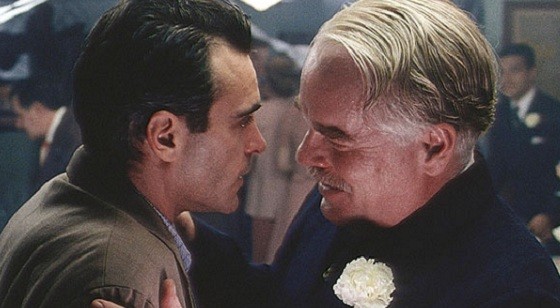
 One of America’s most daring and adventurous filmmakers, California native Paul Thomas Anderson, who has dazzled, amazed, challenged, and confused audiences with such previous gems as Boogie Nights, Magnolia, Punch-Drunk Love, and There Will Be Blood, has done it again with his latest, The Master. The film is built around the fascinating relationship between Freddie Quell (Joaquin Phoenix), a WWII vet struggling to fit into the real world after seeing so much violence and death overseas, and the Master (Philip Seymour Hoffman), the leader of a cultlike organization known as the Cause that believes in past-life regression and invasive questioning known as Processing to help people deal with personal trauma. The Master essentially adopts Quell, intrigued by his distorted outlook on life, making him a member of the family, which also includes his wife, Peggy (Amy Adams), his son, Val (Jesse Plemons), and his daughter, Elizabeth (Ambyr Childers). Inspired by the real-life tale of L. Ron Hubbard and Scientology — and incorporating war stories he was told by Jason Robards on the set of Magnolia, elements from the life of John Steinbeck, and discarded scenes from the script for There Will Be Blood — Anderson crafts a, dare we say, masterful cinematic experience built around a pair of extraordinary performances. Phoenix absolutely inhabits the role of Quell, staggering about with an awkward gait, with impossibly deep lines on his face and eyes that seem to be able to look through lead. Hoffman is his equal as the much cooler and calmer spiritual leader, until he is faced with sudden turmoil. The scenes in which the two men sit across from each other, going through a Processing session, are mesmerizing, the most powerful moments to be found onscreen last year. (Both Phoenix and Hoffman received Oscar nods, along with Adams.) But despite the title, the focus remains on Quell, a lost soul searching for somewhere to belong in a changing postwar America. Anderson’s first film in four years, The Master is a bold, audacious work that is as unsettling as it is exhilarating.