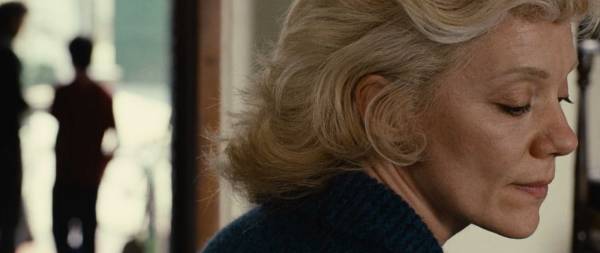
María Onetto is lost deep in thought through most of Lucrecia Martel’s Argentine drama
THE HEADLESS WOMAN (LA MUJER SIN CABEZA) (Lucrecia Martel, 2008)
Museum of the Moving Image
35th Ave. at 36th St., Astoria
Saturday, April 6, free with museum admission, 6:00
Series runs April 4-7
718-777-6800
www.movingimage.us
www.strandreleasing.com
 Inspired by nightmares she has in which she commits murder, Lucrecia Martel’s The Headless Woman details a woman’s emotional and psychological reaction after having possibly killed someone. María Onetto gives a mesmerizingly cool, distant performance as Veronica, a middle-aged, upper-class wife and mother whose biggest worry appears to be the turtles that have infested the new pool built behind a veterinary office. But one afternoon, while out driving carelessly in her Mercedes along a twisting, barren road, she hits something. Not sure if it was a child, an adult, or an animal, she decides to continue on, telling no one what she has done. But when a poor, local boy goes missing, she begins to suspect that she might have killed him. An intriguing mix of Buñuel’s class-consciousness and Poe’s flair for suspense, The Headless Woman is an unusual kind of murder mystery. In Veronica, Argentine writer-director Martel (La Cienaga, The Holy Girl) has created a compelling protagonist/villain, played with expert calm and faraway eyes by Onetto.
The Headless Woman is screening April 6 at 6:00 as part of the Museum of the Moving Image series “The Life of Film: Celebrating a Decade of Reverse Shot,” featuring four days of screenings, Q&As, and a panel discussion paying tribute to the tenth anniversary of the quarterly online film magazine founded by editors Michael Koresky and Jeff Reichert (who curated this series) and writers Erik Syngle and Neal Block. In issue thirty-two, Eric Hynes reviewed The Headless Woman, writing, “In the films of Lucrecia Martel you’re challenged to pay attention well before you’re ready, to play catch-up, figuring out who’s related to whom and what is relevant. But as with the protagonist’s subsequent disorientation, your heightened yet bewildered state isn’t a set-up or effect — it’s the point. Martel sharpens your senses — and celebrates and rewards them — while compelling you to distrust them.” The screening will be introduced by Chris Wisniewski, Reverse Shot contributor and Moving Image deputy director for education and visitor experience. The series runs April 4-7, also presenting Shane Carruth’s Primer (with the director present), a preview screening of Terrence Malick’s To the Wonder, Miguel Gomes’s The Face You Deserve, Douglas Gordon and Phillippe Parreno’s Zidane: A 21st Century Portrait (introduced by Hynes and followed by a roundtable discussion), and “Deborah Stratman and Dani Leventhal: Avant-Garde Voices,” featuring Stratman’s O’er the Land and Leventhal’s Draft 9 and Shayne’s Rectangle (introduced by Genevieve Yue).
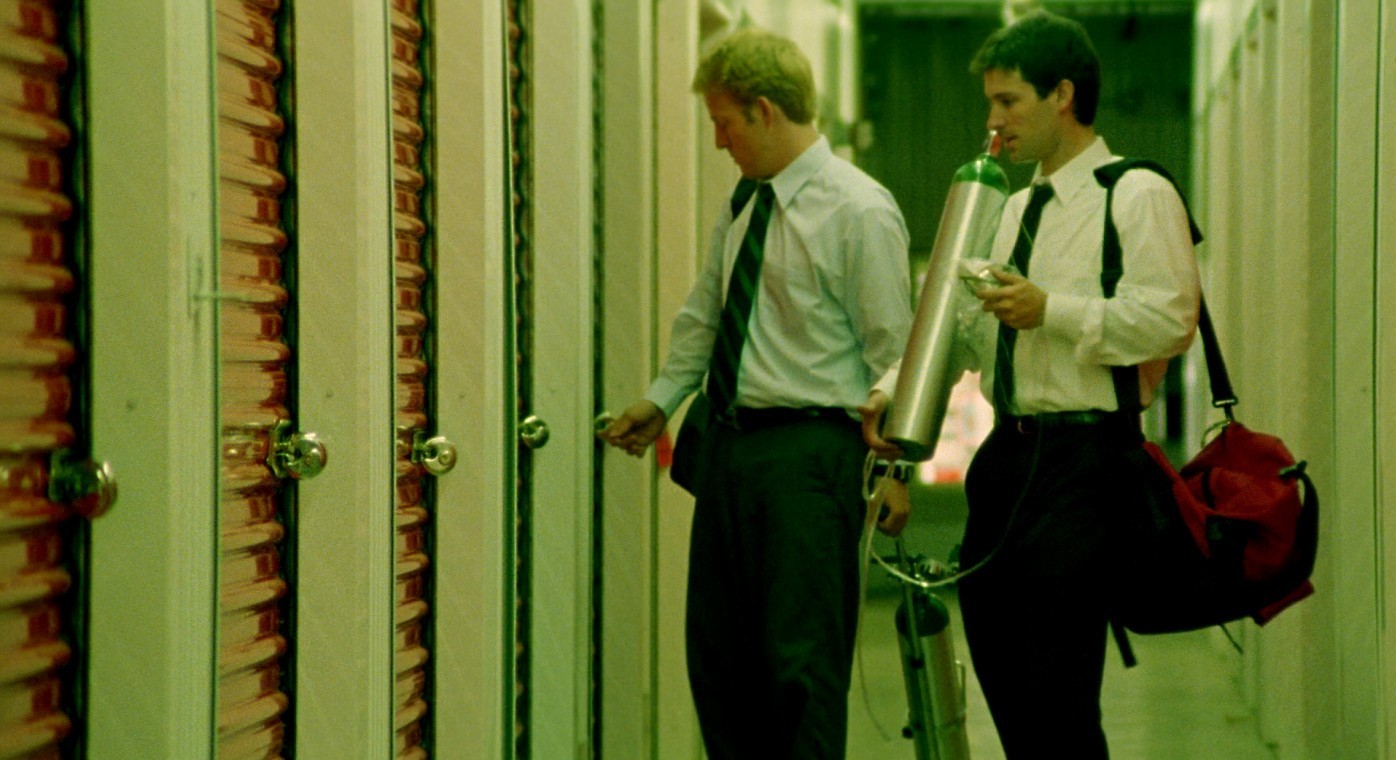
 Former engineer and first-time filmmaker Shane Carruth wrote, directed, edited, scored, and stars in Primer, an utterly confusing, confounding, and ultimately uninvolving tale of two engineers (Carruth and David Sullivan) who accidentally develop a machine that breaks through the time-space continuum and can create doubles of — well, it’s better not to get too specific, because we’re not really sure what it’s all about and what really happens. That can sometimes be a good thing, but not this time around, we’re afraid. Carruth, who made the film for a mere seven grand, is purposefully vague, but it’s to his own detriment, resulting in a story that plays more like an episode of a mediocre sci-fi series than the intriguing, unique, imaginative movie he wanted to make, even if it did win the Grand Jury Prize at Sundance. Carruth wouldn’t make another film for nine years, the romantic thriller Upstream Color, which he wrote, directed, produced, and stars in and opens in New York City on April 5. Primer kicks off the Museum of the Moving Image series “The Life of Film: Celebrating a Decade of Reverse Shot” on April 4, with Carruth on hand to talk about his work. The festival consists of four days of screenings, Q&As, and a panel discussion paying tribute to the tenth anniversary of the quarterly online film magazine founded by editors Michael Koresky and Jeff Reichert (who curated this series) and writers Erik Syngle and Neal Block. We might not have cared much for Primer, but Reverse Shot’s Matthew Plouffe had this to say about it in the autumn 2004 issue: “Irrespective of Shane Carruth’s heroic story or the film’s potential effect on American cinema, Primer ranks among the brightest beacons of uncompromised creative light to hit the silver screens of Utah in recent history. It’s hard to believe. The posh festival that has steadily spiraled into a mire of mediocrity over the last decade finally got it right. Shane Carruth deserves every accolade thrown his way, and if Primer signals what we’ve got to look forward to, his Sundance honors won’t be the last.”