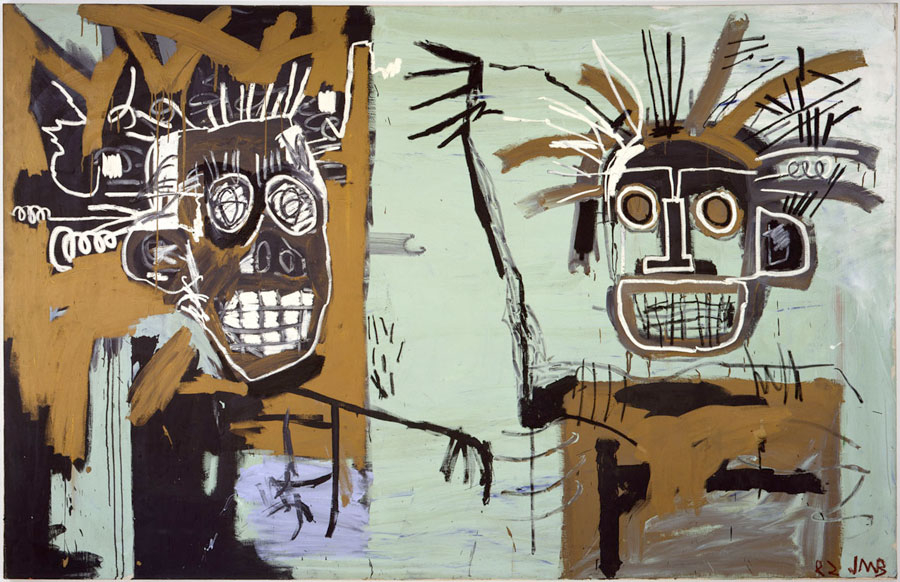
Jean-Michel Basquiat, “Untitled (Two Heads on Gold),” acrylic and oil paintstick on canvas, 1982 (© the Estate of Jean-Michel Basquiat/ADAGP, Paris, ARS, New York 2013)
Gagosian Gallery
555 West 24th St. between Tenth & Eleventh Aves.
Through April 6, free, 10:00 am – 6:00 pm
212-741-1111
www.gagosian.com
You can expect tremendous crowds Friday and Saturday at Gagosian’s West 24th St. space as the blockbuster “Jean-Michel Basquiat” exhibition comes to a close. Eight years ago, the Brooklyn Museum presented the revelatory, chronological “Basquiat,” which cast the street-artist-turned-Warhol-progeny in a whole new spotlight, displaying his awe-inspiring talent from his early days as a graffiti artist to his drug-addled, rambling final canvases prior to his overdose death in 1988 at the age of twenty-seven. This show comes as financial interest in Basquiat is reaching new peaks, with an untitled 1981 work selling for $16.3 million at Phillips de Pury & Company last year and the Wall Street Journal reporting that the Brooklyn-born artist’s 1982 “Dustheads” will be auctioned at Christie’s next month for an expected $25-$35 million. The Gagosian show consists of nearly fifty paintings, hung conceptually, with each work getting plenty of breathing room, the better to be enjoyed both on its own merits and in context of the glam punk’s greater oeuvre. The museum-quality exhibition highlights Basquiat’s bold, brash sense of color and often violent brushstrokes along with his intriguing use of words and language, his love of jazz and boxing, and such repeated imagery as crowns, halos, and the copyright symbol.
There’s both an anger and a primitivism in his work that continues to draw a diverse, still-growing audience: We feel his pain; we understand his desperate need to express himself. Basquiat is that rare street artist whose work still manages to come alive in a gallery or museum setting, whether on canvas, a door, or a wooden fence. In pieces such as “La Hara” and “Untitled (Two Heads on Gold),” the abstract characters seem to jump off the canvas as if living, breathing figures. Words instantly imbued with meaning leap out at us in such canvases as “In Italian” (“sangre,” “liberty,” “blood,” “teeth,” “corpus”) and “Revised Undiscovered Genius of the Mississippi Delta” (“Mark Twain,” “Negroes,” “Udder,” “Cotton,” “The Deep South,” “El Raton”). Sneaker prints hover in the background of “Eyes and Eggs,” as if Basquiat stepped over his depiction of a short-order cook. All these years later, we still see Basquiat as one of us, speaking for the disenfranchised, the forgotten, the poor, the trod upon, someone who rose out of the streets, perhaps like any of us can, despite his tragic end. The Gagosian show presents Basquiat as a graffiti poet and a jazz musician, emitting dazzling sounds and rhythms that move the heart and soul.
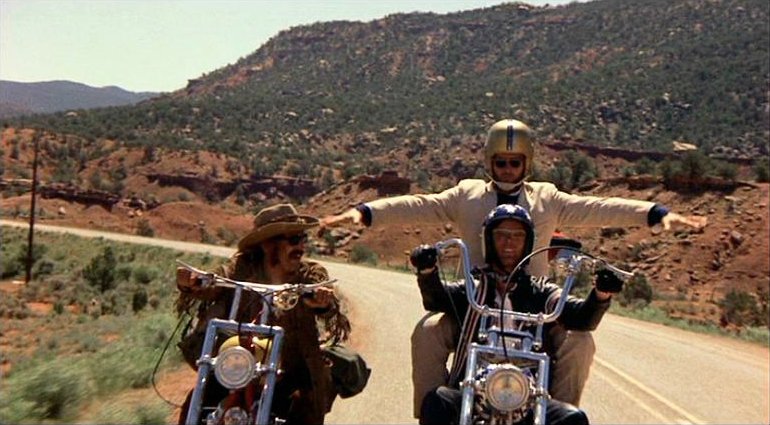
 No mere relic of the late 1960s counterculture movement, Easy Rider still holds up as one of the truly great road movies, inviting audiences to climb on board as two peace-loving souls search for freedom on the highways and byways of the good ol’ U.S. of A. Named after a pair of famous western gunslingers, Wyatt (producer and cowriter Peter Fonda), as in Earp, and Billy (director and cowriter Dennis Hopper), as in “the Kid,” make some fast cash by selling coke to a fancy connection (Phil Spector!), then take off on their souped-up bikes, determined to make it to New Orleans in time for Mardi Gras. Along the way, they break bread with a rancher (Warren Finnerty) and his family, hang out in a hippie commune, pick up small-town alcoholic lawyer George Hanson (an Oscar-nominated Jack Nicholson), don’t get served in a diner, and eventually hook up with friendly prostitutes Karen (Karen Black) and Mary (Toni Basil) in the Big Easy. “You know, this used to be a helluva good country. I can’t understand what’s gone wrong with it,” George says to Billy as they start discussing the concept and reality of freedom. “Oh, yeah, that’s right. That’s what it’s all about, all right. But talkin’ about it and bein’ it, that’s two different things. I mean, it’s real hard to be free when you are bought and sold in the marketplace. Of course, don’t ever tell anybody that they’re not free, ’cause then they’re gonna get real busy killin’ and maimin’ to prove to you that they are. Oh, yeah, they’re gonna talk to you, and talk to you, and talk to you about individual freedom. But they see a free individual, it’s gonna scare ’em.” The always calm Wyatt, who is also known as Captain America, and the nervous and jumpy Billy make one of cinema’s coolest duos ever as they personally experience the radical changes going on in the country, leading to a tragic conclusion. The Academy Award–nominated script, written with Terry Southern, remains fresh and relevant as it examines American capitalism and democracy in a way that is still debated today. And the soundtrack — well, it virtually defined the era, featuring such songs as Steppenwolf’s “The Pusher” and “Born to Be Wild,” Jimi Hendrix’s “If 6 Was 9,” the Electric Prunes’ “I Had Too Much to Dream (Last Night),” the Chambers Brothers’ “Time Has Come Today,” Thunderclap Newman’s “Something in the Air,” and Roger McGuinn’s “Ballad of Easy Rider.”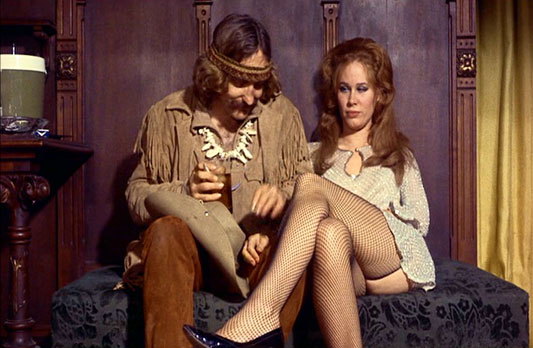
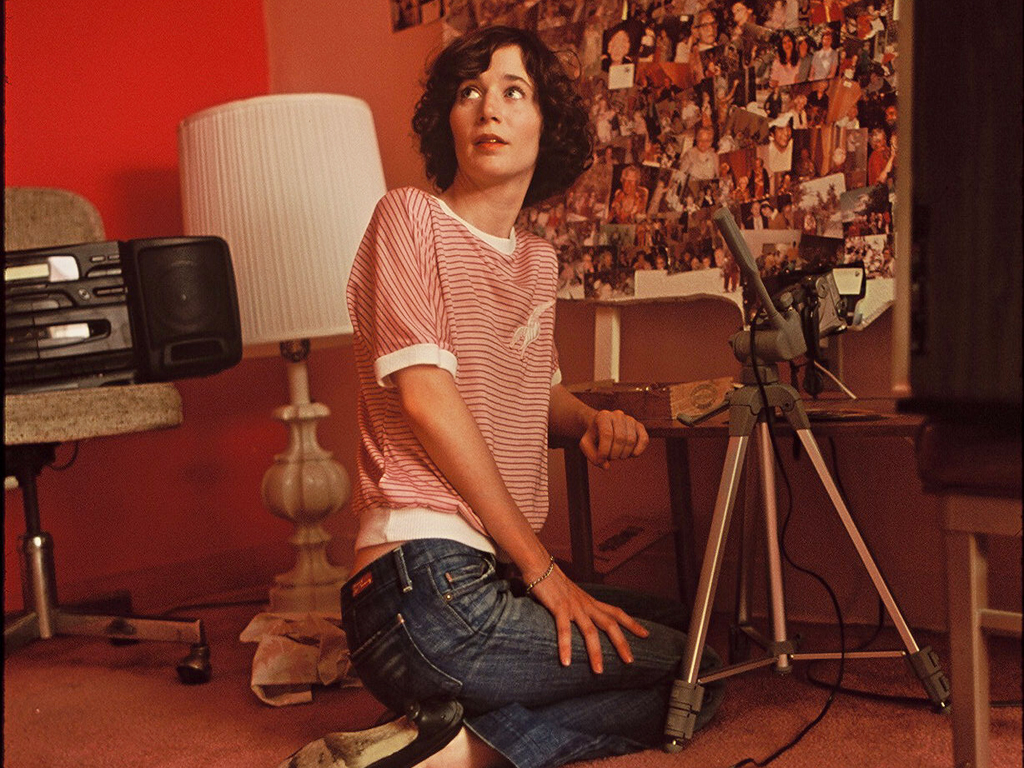
 Winner of a Special Jury Prize at Sundance “for originality of vision,” performance artist Miranda July’s feature-film directorial debut is a success from start to finish, an original, engaging, and utterly charming romantic comedy that is as unique as it is familiar. July, who also wrote the screenplay, stars as a quirky young performance artist who is looking for a relationship in her rather mundane life. She immediately falls for a shoe salesman (John Hawkes) who is separating from his wife and trying to understand his kids (Brandon Ratcliff and Miles Thompson), who are having a strange online dalliance with a mystery e-mailer. Meanwhile, two high school girls (Najarra Townsend and Natasha Slayton) are sexually tormenting a bizarre loner (Brad Henke) who is sexually tormenting them right back, both humorously and dangerously. It’s nearly impossible to take your eyes off of July, whose innovative audio and visual installations and short films have been shown at the Andy Warhol Museum, the Whitney Biennial, the Kitchen, Lincoln Center, the Museum of Modern Art, Union Square Park, and the Rotterdam International Film Festival, among many other prestigious places. Me and You and Everyone We Know is screening at MoMA on April 5 & 10 as part of “Carte Blanche: Scott Macaulay and 20 Years of Filmmaker Magazine,” which celebrates the continuing success of the IFP publication that focuses on independent film from the filmmakers’ point of view. Curated by the magazine’s editor in chief, Scott Macaulay, the series runs April 4-15 and also includes such gems as Darren Aronofsky’s Pi, Nick Gomez’s Laws of Gravity, Errol Morris’s Fast, Cheap and Out of Control, Laura Poitras’s The Oath, and Todd Haynes’s Safe. “Me and You and Everyone We Know is a tremendously winning collection of interlocking stories dealing with love, longing, and the ways children and adults connect in our modern age, and it adeptly imports the concerns of July’s visual art to the world of feature films,” Macaulay writes on the MoMA website. “July was selected by Filmmaker as one its 25 New Faces of Independent Film in 2004, and the film was on the cover of the magazine’s Spring 2005 issue.”