twi-ny recommended events

THE BIG KNIFE

THE BIG KNIFE

Marion (Marin Ireland) and Charlie Castle (Bobby Cannavale) face some tough decisions about their future together in revival of THE BIG KNIFE (photo by Joan Marcus)

American Airlines Theatre
227 West 42nd St. between Broadway & Eighth Ave.
Through June 2, $42-$127
212-719-1300
www.roundabouttheatre.org

Clifford Odets skewers Hollywood and the studio system in The Big Knife, a sharply drawn tale of greed, temptation, and ambition that ultimately dulls as it reaches its melodramatic conclusion. Bobby Cannavale stars as Charlie Castle, a studio-era B-movie star whose twelve-year contract with Hoff-Federated is up and who needs to decide whether he is going to sign on for another fourteen years. The strong first act focuses on Charlie’s relationship with his wife, Marion (Marin Ireland), who threatens to leave him if he signs, wanting the company out of their life. But studio head Marcus Hoff (Richard Kind) and his right-hand man, Smiley Coy (Reg Rogers), are essentially blackmailing Charlie, ready to tell the truth about a scandal they helped cover up that could ruin him. Meanwhile, gossip columnist Patty Benedict (Brenda Wehle) wants the inside scoop on the Castles’ potential divorce, Charlie’s fast-talking agent, Nat Danziger (Chip Zien), is caught in the middle, and family friend and writer Hank Teagle (C. J. Wilson) wants Marion if she leaves Charlie. “Well, get seven of Hollywood’s intellectual hillbillies at one nightclub table and you’re in titanic trouble,” Hank tells Marion. “Men of a thousand causes and quips, not one unpopular or human. And then to be so dull — success has made them all so dull.” In the second act, the play becomes repetitive and predictable, the characters less likable, and many of the situations less believable, taking twists and turns that grow frustrating. The Roundabout Theatre production — the first Broadway revival since the play’s 1949 debut on the Great White Way, directed by Lee Strasberg and starring John Garfield as Charlie (Robert Aldrich’s 1955 Silver Lion-winning film featured Jack Palance as Charlie, Ida Lupino as Marion, Rod Steiger as Hoff, Shelley Winters as Dixie, and Everett Sloane as Nat) — is less successful than Lincoln Center’s recent revival of Odets’s Golden Boy, which also deals with such themes as career ambition and artistic integrity. Fluidly directed by Doug Hughes (An Enemy of the People, Born Yesterday,), the show features a solid cast highlighted by Kind’s marvelous portrayal of the sleazy, powerful Hoff, from how he walks around with hunched shoulders to how he confidently relaxes in an armchair on John Lee Beatty’s lovely Beverly Hills living-room set. The Big Knife might lose its edge as it approaches its grand finale, but is has plenty of cutting moments as it asks the age-old question, What price Hollywood?
CEDAR LAKE: JOYCE 2013 SEASON

HORIZONS

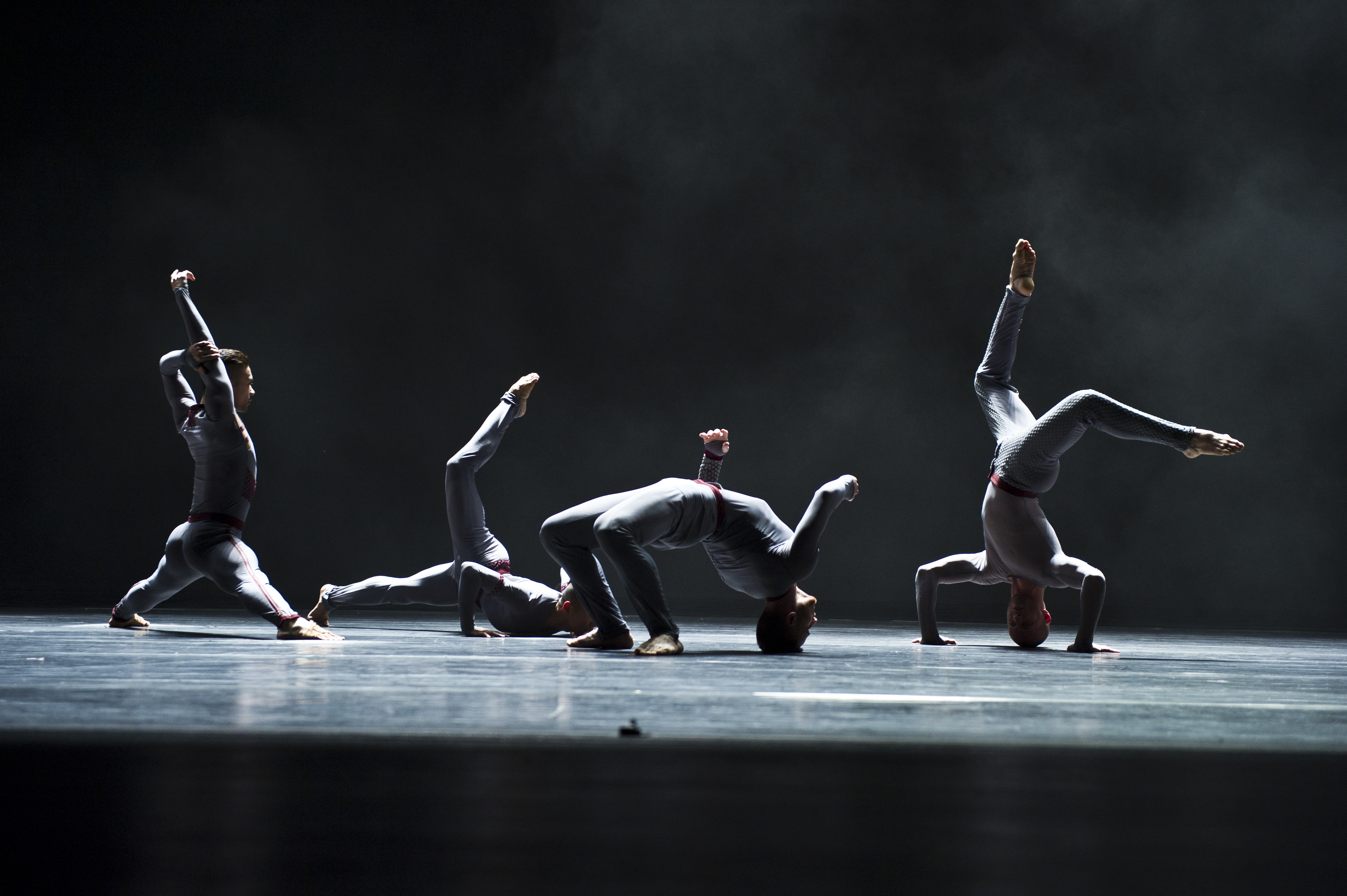
Cedar Lake will present world premiere of Andonis Foniadakis’s HORIZONS as part of Joyce season (photo by Paula Lobo)

Joyce Theater
175 Eighth Ave. at 19th St.
May 7-12, $10-$59
212-645-2904
www.joyce.org
www.cedarlakedance.com

The supremely talented Cedar Lake Contemporary Ballet is celebrating its tenth anniversary with three wide-ranging works at the Joyce from May 7 to 12. The strong, highly physical company, led by artistic director Benoit-Swan Pouffer, ballet master Alexandra Damiani, and spectacular dancer Jason Kittelberger, will present the New York premiere of Jiří Kylián’s Indigo Rose, which the Dutch choreographer originally created for the twentieth anniversary of Nederlands Dans Theater 2 in 1998; the piece includes a long sheet that casts shadows and silhouettes as the dancers move to music by J. S. Bach, John Cage, Robert Ashley, and others. The evening also includes the world premiere of Horizons by Greek dancer and choreographer Andonis Foniadakis, which examines the personal and the public, action and reaction, with a score by composer and visual artist Julien Tarride. And the company looks back at its past with Canadian choreographer Crystal Pite’s Ten Duets on a Theme of Rescue, a 2008 piece in which five dancers rotate into ten duets that examine the theme of rescue through movement, visuals, music, and narrative. There will be a Dance Chat with members of the company after the May 8 show, a Joyce Pre-Show discussion led by Susan Thomasson prior to the May 9 performance, and Joris Jan Bos will lead a DANY Master Class (open level, $15) on May 10 at 10:00 am. Cedar Lake, which is based in a warehouse-like space on Twenty-Sixth St. in Chelsea, rarely fails to thrill, combining inventive staging with amazingly athletic dancers, highlighted by Kittelberger along with Jon Bond, Acacia Schachte, and Nickemil Concepcion.

MoMA FREE TUESDAYS IN MAY

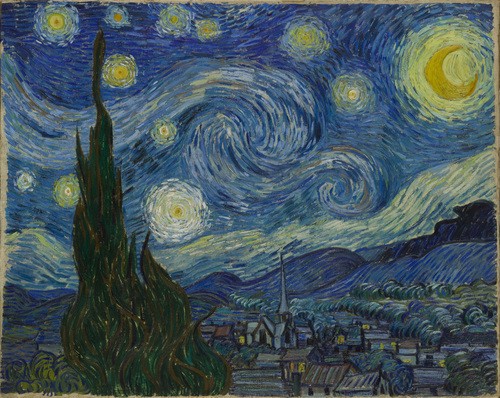
Visitors can now see such works as Vincent van Gogh’s “The Starry Night” at MoMA seven days a week, with the first one hundred visitors getting in free every Tuesday in May (photo courtesy MoMA / Acquired through the Lillie P. Bliss Bequest)

Visitors can now see such works as Vincent van Gogh’s “The Starry Night” at MoMA seven days a week, with the first one hundred visitors getting in free every Tuesday in May (photo courtesy MoMA / Acquired through the Lillie P. Bliss Bequest)

Museum of Modern Art
11 West 53rd St. between Fifth & Sixth Aves.
Tuesday, May 7, 14, 21, 28, 10:30 am – 5:30 pm
Free admission for the first one hundred visitors
212-708-9400
www.moma.org

Every Friday afternoon, there is a long line at the Museum of Modern Art, when admission is free from 4:00 to 8:00. Meanwhile, on Tuesdays, stray people gather at the entrances, frantically searching their guidebooks to confirm that the museum is actually closed on that day. That latter situation is about to change, as MoMA has just announced that they now will be open seven days a week, with Tuesday hours, 10:30 am – 5:30 pm, that match the rest of the week except Friday, which is of course open later. MoMA is actually getting the jump on the Met, which earlier announced that it will also open its doors every day, adding Monday to its schedule, but that begins in July. To celebrate the new policy, MoMA will be offering free admission Tuesdays in May to the first one hundred visitors, an ample savings of $25 per adult, $18 per senior, and $14 per student. (Children sixteen and under who are not part of a group are always free.) Among the many exhibitions currently on view are “Claes Oldenburg: The Street and the Store” and “Claes Oldenburg: Mouse Museum / Ray Gun Wing,” “Artist’s Choice: Trisha Donnelly,” “Wait, Later This Will Be Nothing: Editions by Dieter Roth,” “Henri Labrouste: Structure Brought to Light,” “9 + 1 Ways of Being Political: 50 Years of Political Stances in Architecture and Urban Design,” “Bill Brandt: Shadow and Light,” and “Hand Signals: Digits, Fists, and Talons.” It’s first come, first served, so you better start lining up soon to take advantage of this temporary offer.

AN EVENING WITH MARK PELLINGTON: U2 3D

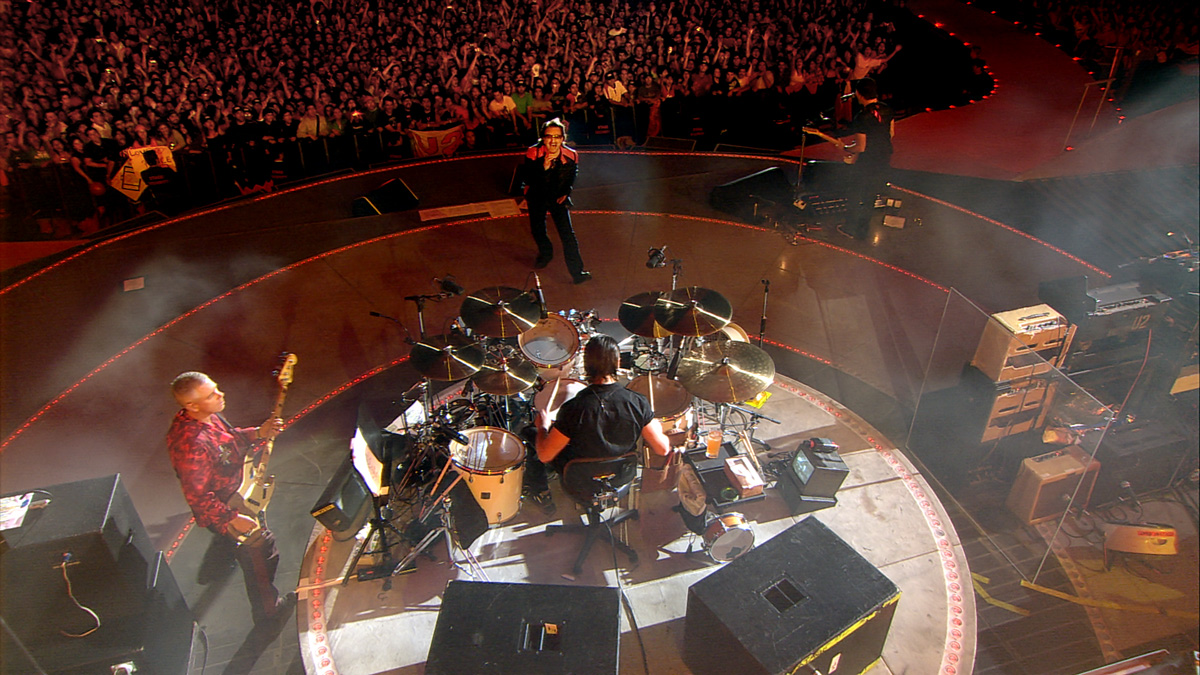
Bono, the Edge, Adam Clayton, and Larry Mullen Jr. are practically in your lap in U2 3D

Bono, the Edge, Adam Clayton, and Larry Mullen Jr. are practically in your lap in U2 3D

SONOS AND VEVO PRESENT: THE DIRECTOR’S STUDIO
PLAY IT LOUD! U2 3D (Catherine Owens & Mark Pellington, 2008)

Museum of the Moving Image
35th Ave. at 36th St., Astoria
Tuesday, May 7, $15, 7:00
718-777-6800
www.movingimage.us
www.U23Dmovie.com

When we caught U2’s Vertigo Tour at the Garden in June 2006, we were up in the rafters, looking down at tiny dots that just happened to be drummer Larry Mullen Jr., bass player Adam Clayton, guitarist the Edge, and singer Bono. But the World’s Most Important Band is front and center for everyone to see in U2 3D, the first-ever full-length film shot in Digital 3-D, directed by Catherine Owens and Mark Pellington. Using as many as eighteen specially equipped digital cameras and recording decks, Owens, who has been U2’s visual content director since ZooTV, captures the Irish band during stadium shows in South America and Mexico, focusing on the March 1-2 concerts at Estadio la Plata in Buenos Aires. The new technology, previously used for sporting events, has a fascinating layered effect that sucks in viewers — yes, who are wearing special glasses (not unlike the specs Bono used to wear as the Fly) — placing them right in the middle of the action as the band powers through an exultant setlist that, if not quite ideal, includes “Vertigo,” “New Year’s Day,” and “Pride (In the Name of Love).” You can’t help but reach out for Bono as he seemingly jumps out of the screen while singing “Touch me” during “Beautiful Day,” and then you’ll swear he’s reaching out only to you when he stares into the camera during “Sunday Bloody Sunday” and promises to “wipe your tears away.” And when tens of thousands of fans all bop up and down in unison to “Where the Streets Have No Name,” forming a propulsive wave, you’ll feel a rush beneath your seat that moves up into your gut. Owens and Pellington (Arlington Road) incorporate the band’s hypertextual stage show into the new format, as digitized figures, words, symbols, and letters from the large screens behind the band seem to float right in front of your face. The concert footage is supplemented with extreme close-ups shot onstage without an audience, and the energy level severely drops at these times, although Mullen’s drum kit looks amazing in 3-D. As straight-ahead concert movies go, U2 3D is among the best ever made, a unique theatrical experience that will blow you away. U2 3D is screening in Dolby Digital 3-D at the Museum of the Moving Image on May 7 at 7:00 as part of the series “Play This Movie Loud!” and “Sonos and VEVO Present: The Director’s Studio” and will be preceded by a discussion with Pellington and chief curator David Schwartz.

THE MODERN SCHOOL OF FILM: THE HAPPINESS OF THE KATAKURIS

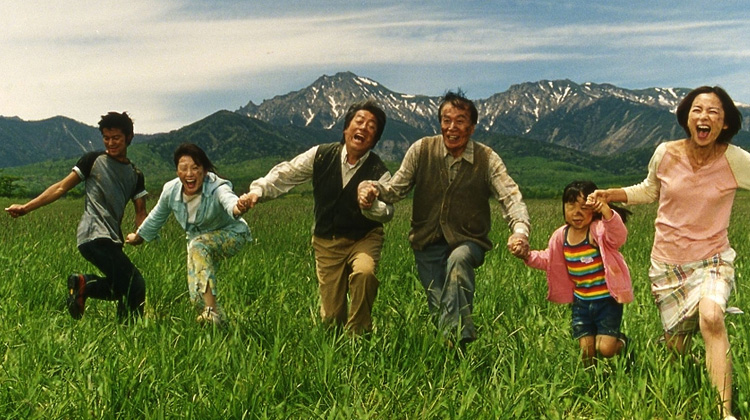
Takashi Miike riffs on multiple genres in the endlessly delightful HAPPINESS OF THE KATAKURIS

Takashi Miike riffs on multiple genres in the endlessly delightful HAPPINESS OF THE KATAKURIS

THE HAPPINESS OF THE KATAKURIS (Takashi Miike, 2001)
IFC Center
323 Sixth Ave. at West Third St.
Tuesday, May 7, 8:15
212-924-7771
www.ifccenter.com

Japanese genre king Takashi Miike, who has made more than one hundred films in his twenty-two-year career, outdoes himself in The Happiness of the Katakuris, an endlessly inventive tale of the Katakuris, a family that moves to the middle of nowhere to run a country inn. The only problem is that when guests finally arrive, they all end up dead — in bizarre, ridiculous ways — and the father decides to bury them instead of reporting the incidents, in order to protect the inn and the family’s future. Miike (Ichi The Killer, Audition, Thirteen Assassins) masterfully mixes comedy, romance, Claymation, music, murder, and mayhem in this enormously entertaining and highly original movie that is filled with a never-ending bag of surprises. The Happiness of the Katakuris is screening in a 35mm print May 7 at 8:15 as part of the IFC Center series “The Modern School of Film” and will be followed by a discussion with Brooklyn-based choreographer Mark Morris; the series continues May 9 with John M. Stahl’s 1945 melodrama Leave Her to Heaven, with Neil LaBute on hand to talk about it, May 13 with Andrei Tarkovsky’s The Mirror and Bill T. Jones, and May 28 with Vittorio De Sica’s Miracle in Milan and Laurie Anderson.
INSIDE OUT NEW YORK CITY

(photo by twi-ny/mdr)

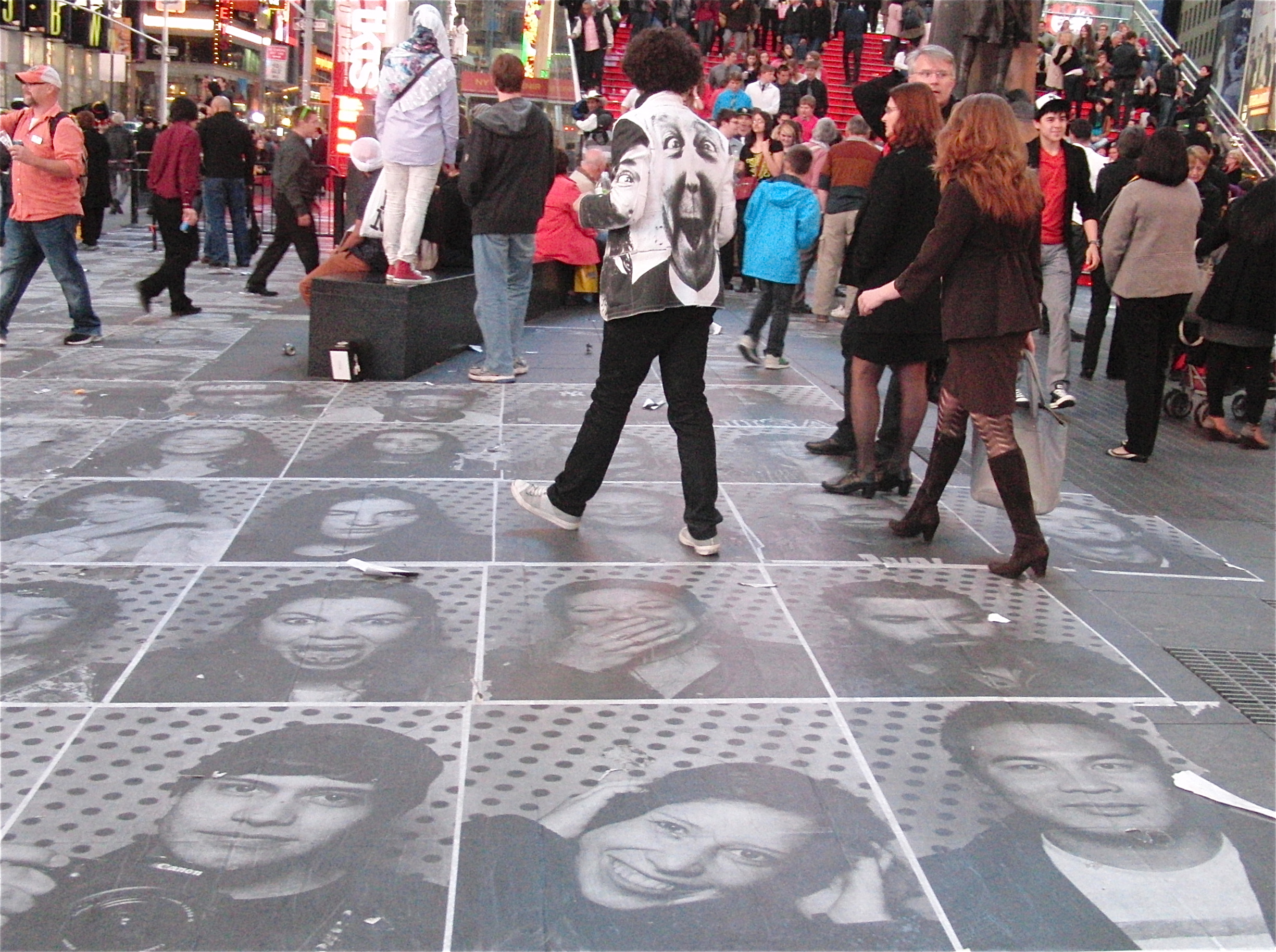
Photos line the ground at Duffy Square as part of JR’s Inside Out art project (photo by twi-ny/mdr)

INSIDE OUT: THE PEOPLE’S ART PROJECT
Duffy Square, 46th St. & Broadway
Daily through May 10, free, 12 noon – 8:00 pm
Midnight Moment nightly at 11:57 through May 31
www.timessquarenyc.org
www.insideoutproject.net
inside out new york city slideshow

“Tell me what you stand for and together we’ll turn the world inside out,” French artist JR says about his work, an interactive project in which ordinary citizens from around the world get to express themselves in large-scale photographs that are pasted up on walls, buildings, streets, rooftops, trailers, and other locations, reclaiming their personal identity as well as public space, often in response to crime, poverty, natural disasters, and governmental abuse. Winner of the 2011 TED Prize, “awarded to an extraordinary individual with a creative and bold vision to spark global change,” JR used the $100,000 TED grant to create Inside Out, for which he and his small team have taken and/or printed some 130,000 photographs from more than 100 countries and helped paste them up in appropriate locations with special meaning, from Haiti, Tunisia, and Sierra Leone to Colombia, Mexico, and North Dakota. People are encouraged to make any kind of face they want, the vast majority ending up being playful, filling the world with smiles while revealing the power of paper and glue in a kind of peaceful protest against tyranny as well as a celebration of life.

Participants can pose with their photo before its added to Duffy Square exhibition (phto by twi-ny/mdr)

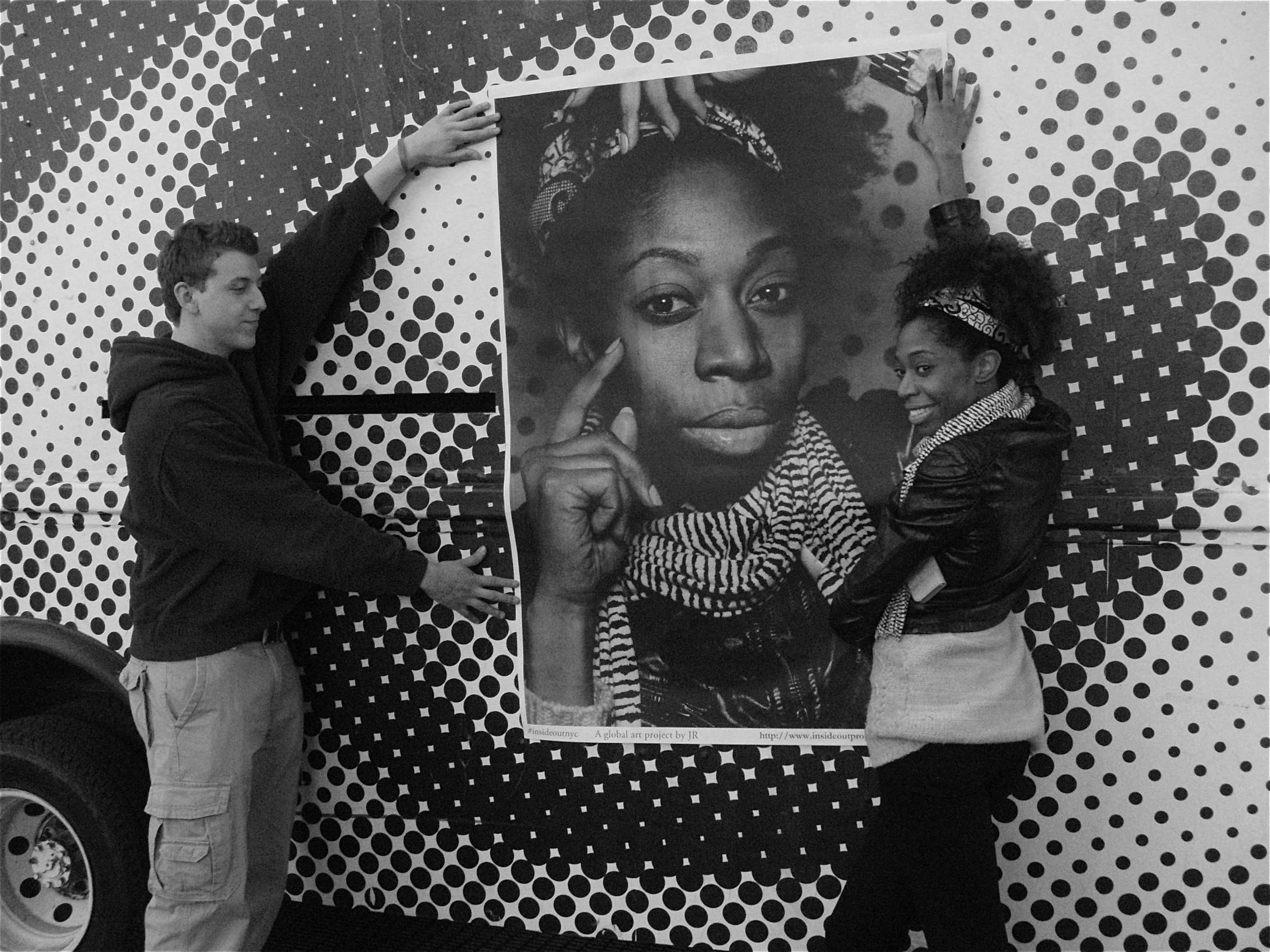
Participants can pose with their photo before it’s added to Duffy Square exhibition (photo by twi-ny/mdr)

JR, whose story is told in Alastair Siddons’s compelling documentary, Inside Out: The People’s Art Project, which was recently shown at the Tribeca Film Festival and debuts on HBO on May 20, is currently in New York, where he has brought his Inside Out mobile photo-booth truck to Times Square. Every day from 12 noon till 8:00 through May 10, visitors can get their photo taken, then watch as it’s added to the highly trampled ground in Duffy Square. Participants can take a picture of themselves with the three-foot-by-four-foot printout, and it’s all free. “The streets are the best gallery I could imagine,” JR says in the film. In addition, JR has also instituted the project’s first electronic pasting, as a three-minute video incorporating footage from the documentary and the photo shoots will be shown every night in May at 11:57 across numerous digital screens in Times Square as part of “Midnight Moment,” which has previously displayed short works by Robert Wilson, Tracey Emin, Björk, Yoko Ono, and others. Inside Out is a twenty-first-century project that cleverly uses modern technology to give power back to the people in these difficult, changing times.

THE ASSEMBLED PARTIES

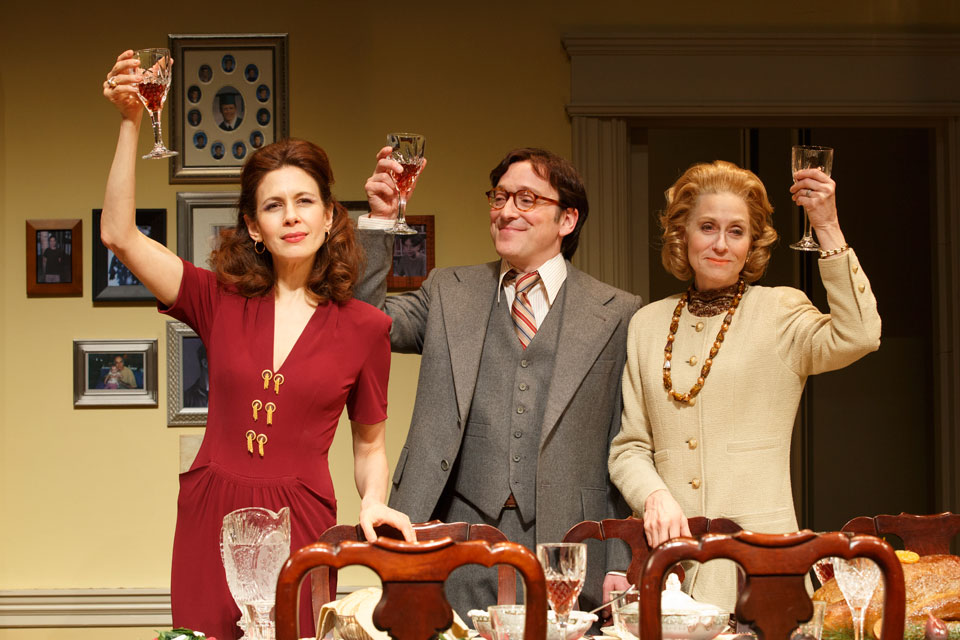
Julie (Jessica Hecht), Jeff (Jeremy Shamos), and Faye (Judith Light) share a Christmas toast in THE ASSEMBLED PARTIES (photo by Joan Marcus)

Julie (Jessica Hecht), Jeff (Jeremy Shamos), and Faye (Judith Light) share a Christmas toast in THE ASSEMBLED PARTIES (photo by Joan Marcus)

Manhattan Theatre Club at the Samuel J. Friedman Theatre
261 West 47th St. between Broadway & Eighth Aves.
Tuesday – Sunday through June 16, $67-$120
www.theassembledpartiesbroadway.com

Throughout Richard Greenberg’s splendid new play, The Assembled Parties, characters comment on how easy it is to get lost in the Bascovs’ fourteen-room Upper West Side apartment. It is also easy for the audience to get lost in Greenberg’s compelling story and well-drawn characters as the Jewish clan celebrates Christmas first in 1980, then twenty years later, with things having substantially changed. Jessica Hecht (A View from the Bridge, After the Fall) is captivating as the family matriarch, Julie, speaking in an elegant, drawn-out voice that instantly reveals her character’s unique take on the world. As the play opens, she is joined by Jeff (Jeremy Shamos), her son Scotty’s (Jake Silberman) college friend, who appears smitten with her as he helps chop vegetables in the kitchen. Soon Julie’s older sister, Faye (Judith Light), arrives, with her gruff husband, Mort (Mark Blum), and their somewhat simple daughter, Shelley (Lauren Blumenfeld). “What is all this goyisha hazarai?” Faye declares upon seeing the spread in the living room, firmly establishing her character in a mere six words. As Santo Loquasto’s superb revolving set roams from room to room (to room to room), Faye tries to set Jeff up with Shelley; Jeff throws around a basketball with Scotty while discussing Scotty’s gorgeous, unseen girlfriend; Faye demands a pill from Julie to help her get through the evening; Jeff can’t break free of the telephone-umbilical cord, obsessed with calling his mother; and Mort has quite a surprise for Julie’s husband, Ben (Jonathan Walker). “God is bogus,” Julie says over dinner, “and religion a scourge. Still, I believe in something, though I’m not sure what.”

Twenty years later, things are vastly different, the only constant being Jeff’s unending dedication to Julie. Although so much of the story is built around Julie and her Jewish family, the centerpiece of the story is really Jeff, who serves as the onstage proxy for the audience. He interacts with all the characters but often does so from an observational distance, so glad to be among such unique and intriguing people. The audience is likely to feel the same way, glad to be among such unique and intriguing characters in Greenberg’s highly entertaining and extremely clever play.