twi-ny recommended events

THE NANCE

(photo by Joan Marcus)

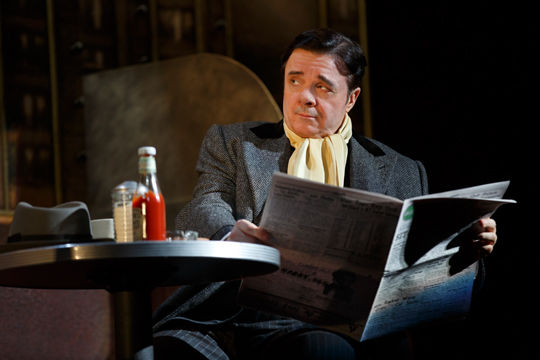
Nathan Lane is devilishly delightful as a burlesque performer in THE NANCE (photo by Joan Marcus)

Lyceum Theatre
149 West 45th St. between Sixth & Seventh Aves.
Through June 17, $37- $132
www.lct.org

As Douglas Carter Beane’s enjoyable new play, The Nance, opens, Chauncey (Nathan Lane) is sitting in a Greenwich Village Automat, looking for someone to go home with. He sets his sights on an attractive young man, Ned (Jonny Orsini), but they have to hide their potential rendezvous for fear of being arrested — because, yes, being or acting gay in public could land you in jail in 1930s New York City. But after their very funny one-night stand, Chauncey, a local burlesque performer who stars as the Nance (short for Nancy Boy) in a show at the Irving Place Theatre, cannot seem to shake the mysterious Ned, who keeps hanging around, which both delights and annoys Chauncey, a conservative Republican who cherishes his privacy. But as the cops close in on them, they both have to examine who they really are deep down and what they want out of life. Playwright Beane (The Little Dog Laughed, Xanadu) and award-winning director Jack O’Brien (The Coast of Utopia, Hairspray) keep the action moving across John Lee Beatty’s rotating set, which turns from Chauncey’s apartment to backstage and then onstage at the Irving Place Theatre, where Chauncey performs naughty sketches with his partner, Efram (Lewis J. Stadlen), that are filled with deliciously devious and supremely silly double entendres. The troupe also includes bawdy strippers Carmen (Andréa Burns), Joan (Jenni Barber), and Sylvie (Cady Huffman), who tantalize the audience with yet more haughtiness. The play is at its best when Chauncey delves into the political implications of his personal life and career, particularly in an inventively staged courtroom scene. But while the play celebrates the boundary-defying, envelope-pushing burlesque defended so eloquently by Chauncey, it actually features far too many examples; while several of the skits are memorable, at certain points it would have been more interesting to continue with what was going on behind the scenes rather than depicting yet another burlesque bit. The Nance was written with Lane in mind, and Lane is terrific in the role that, well, was tailor made for him. Huffman, who won a Tony playing opposite Lane in The Producers, is also outstanding as a stripper who is smarter than she initially lets on. If you love old-fashioned burlesque, you’re likely to love The Nance, while if you don’t care much for that type of entertainment, you’re still in for a solid night of quality theater.
STEPHEN PETRONIO COMPANY: LIKE LAZARUS DID (LLD 4/30)

Joyce Theater
175 Eighth Ave. at 19th St.
April 30 – May 5, $10-$59
212-645-2904
www.joyce.org
www.stephenpetronio.com

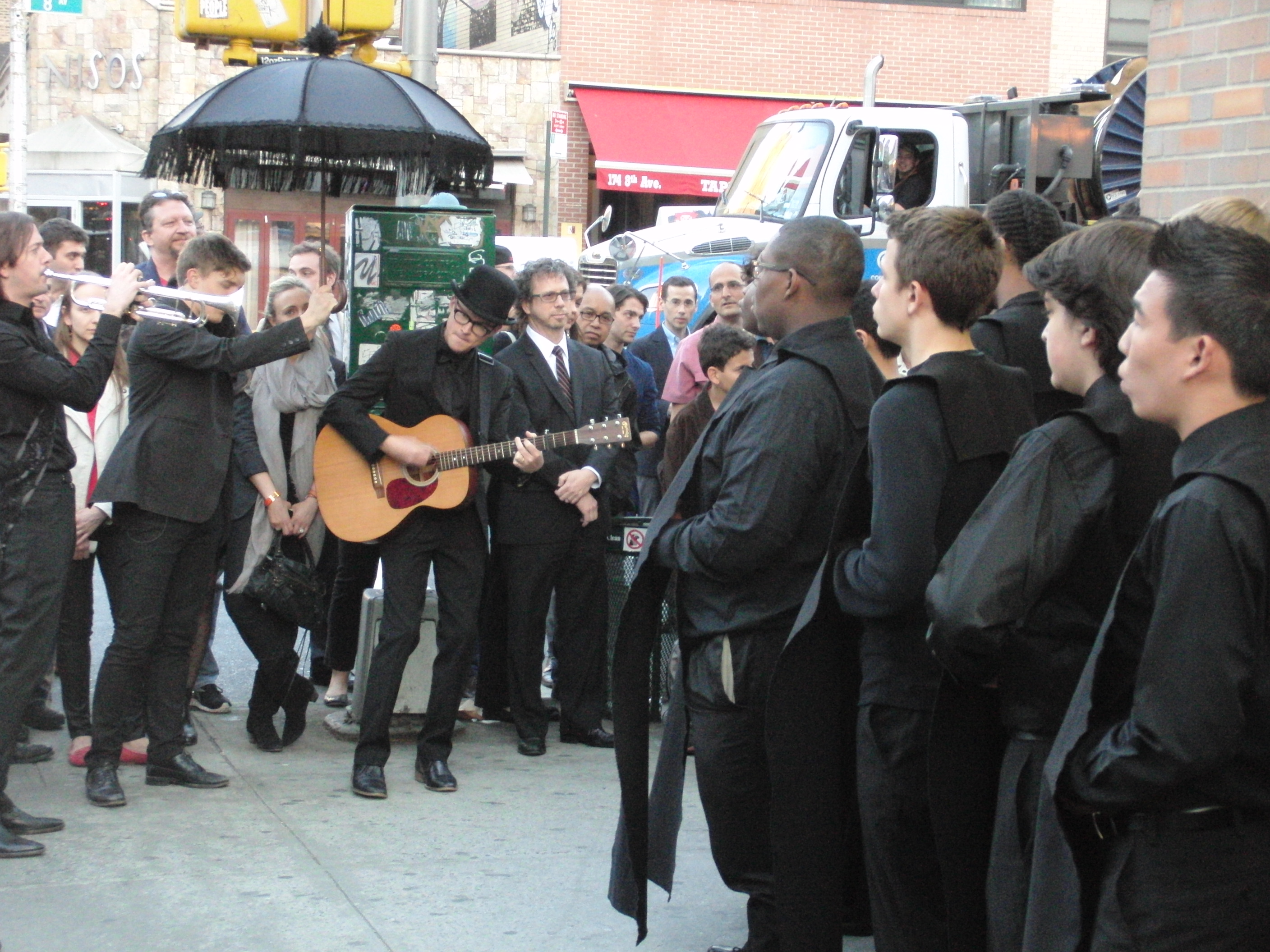
Born in Newark and based in New York City, choreographer Stephen Petronio is taking to the streets for his latest evening-length piece, Like Lazarus Did (LLD 4/30). The creator of such works as Underland, The Architecture of Loss, and I Drink the Air Before Me examines religion and resurrection in LLD, which will begin at Nineteenth St. and Ninth Ave., where composer Son Lux, trumpeter C. J. Camerieri (yMusic, Sufjan Stevens), violinist Rob Moose (Bon Iver, yMusic), and four choristers will lead a procession into the lobby of the Joyce, where they will make an invocation, all before the “official” dance starts inside onstage. Inside the theater, visual artist Janine Antoni will be suspended in a helicopter stretcher hanging over the audience. “Almost every religion promises some kind of rebirth or resurrection,” Petronio says in a promotional video for the show, “and how odd that the only thing that you can’t prove is the thing that drives the marketplace of all these religions.” A major collaborative effort that will have unique, site-specific elements at each venue it plays, LLD will be performed by the Stephen Petronio Company — Julian De Leon, Davalois Fearon, Joshua Green, Gino Grenek, Barrington Hinds, Natalie Mackessy, Jaqlin Medlock, Nick Sciscione, Emily Stone, and Joshua Tuason — in addition to thirty members of the Young People’s Chorus of New York City (directed by Francisco Núñez), Son Lux, and members of Bon Iver and yMusic, with costumes by H. Petal and lighting by Ken Tabachnick. The April 30 and May 1 shows will include a preshow musical performance in front of the Joyce as well. Ticket holders are encouraged to come early every night to experience Antoni’s unique installation. The May 2 show will be preceded by a talk led by Susan Thomasson at the neighboring Sushi Masaru restaurant and followed by a Dance Chat with members of the cast and crew.

Stephen Petronio’s LIKE LAZARUS DID begins with a funeral procession outside the Joyce (photo by twi-ny/mdr)

Stephen Petronio’s LIKE LAZARUS DID begins with a funeral procession outside the Joyce (photo by twi-ny/mdr)

Update: Stephen Petronio throws himself quite a New Orleans-style funeral in his latest evening-length piece, the site-specific Like Lazarus Did. The show begins outside the Joyce as musicians C. J. Camerieri, Son Lux, and Rob Moose play the slave song “Like Lazarus Did,” which features the oft-repeated refrain “I want to die / like Lazarus did.” Inside the theater, the curtain is lifted slightly above the stage, revealing a barefooted Petronio in a black suit, lying flat on his back as if dead. Meanwhile, performance artist Janine Antoni hangs over the audience, remaining stock-still in a helicopter stretcher surrounded by body parts, holding a light as if beckoning Petronio to rise up and join her in an ascent to the unknown. What follows is sixty minutes of bold and beautiful movement, with small hints at a narrative involving birth, death, and rebirth and heaven and hell, particularly when the back wall is illuminated in red with a stark, disinviting entrance and later when cords fall from above like the hands of God. Son Lux’s memorable score ranges from the traditional to the avant-garde, from pure gospel to cutting-edge experimental, with glorious contributions from the Young People’s Chorus of New York City, conducted by Francisco Núñez. The dancers are uniformly excellent, with a standout performance by Davalois Fearon, but they do so in some very silly costumes (loose-fitting smocks and skirts) by H. Petal and Tara Subkoff that actually detract from the overall impact of the show. Otherwise, Like Lazarus Did is a dazzling funeral procession that is well worth being a part of.

MATILDA THE MUSICAL

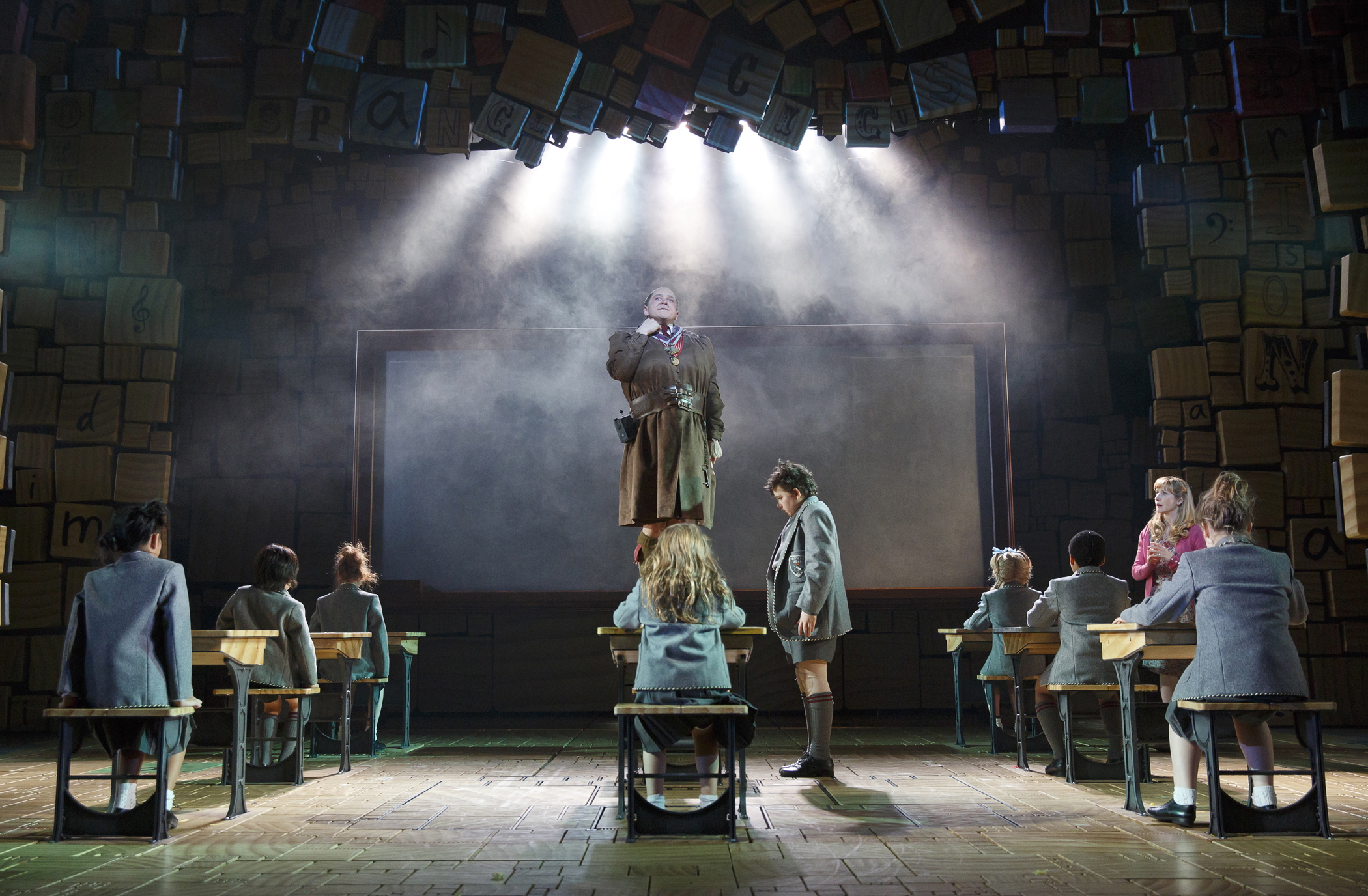
MATILDA (photo © 2013 by Joan Marcus)

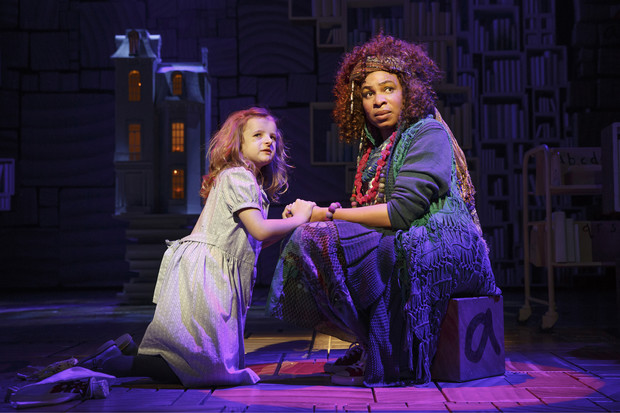
Miss Trunchbull (Bertie Carvel) declares that “children are maggots” in MATILDA (photo by Joan Marcus)

Shubert Theatre
225 West 44th St. between Broadway & Eighth Aves.
Tuesday – Sunday through April 6, 2014, $32-$157
www.matildathemusical.com

The best musical to hit the Great White Way since The Book of Mormon, the Royal Shakespeare Company production of Matilda is a dazzling spectacle, a sensational gift from across the pond. Based on Roald Dahl’s 1988 children’s novel, Matilda follows the trials and tribulations of young Matilda Wormwood (played alternately by Sophia Gennusa, Oona Laurence, Bailey Ryon, and Milly Shapiro), an extraordinarily gifted nine-year-old who loves to read books and tell stories. But her sleazy car-salesman father (Gabriel Ebert), who is involved in a shady deal with some Russians, and her self-obsessed mother (Lesli Margherita), who is training for a dance competition with hot-to-trot partner Rudolpho (Phillip Spaeth), want her to give up books and instead be more like her older brother, the dim-witted Michael (Taylor Trensch), who spends his days watching TV and grunting. At school, her teacher, Miss Honey (Lauren Ward), recognizes Matilda’s promise and wants to escalate her education, but the headmistress, Miss Trunchbull (Bertie Carvel in magnificent drag), prefers to punish kids — by sending them off to the terrifying Chokey — rather than promote learning. Meanwhile, Matilda tells an intriguing story to Mrs. Phelps (Karen Aldridge), the school librarian, about a doomed relationship between an acrobat (Samantha Sturm) and an escapologist (Ben Thompson) that is a metaphor for Matilda’s awful family life. But with the help of her remarkable self-possession and unending determination, Matilda is not about to give up her unquenchable thirst for knowledge.

Matilda (Molly Shapiro) tells illuminating, and very adult, stories to Mrs. Phelps the librarian (Karen Aldridge) in MATILDA (photo by Joan Marcus)

Matilda (Molly Shapiro) tells illuminating, and very adult, stories to Mrs. Phelps the librarian (Karen Aldridge) in MATILDA (photo by Joan Marcus)

Winner of seven Olivier Awards, Matilda is a complete triumph from start to finish, from the opening “Miracle” scene, in which the kids are all introduced at a birthday party, to the closing ensemble piece, “Revolting Children.” Every detail is filled with magic, from Rob Howell’s letter-laden sets, which spell out various words that appear during the course of the show, and his inventive, very funny costumes, particularly for Miss Trunchbull and Matilda’s father, to Peter Darling’s choreography, which reaches jaw-dropping proportions when the stage turns into a three-dimensional Scrabble board. Shapiro is extraordinary as the title character, employing just the right mix of wry cynicism and childhood wonder, as Dennis Kelly’s book and Tim Minchin’s music and lyrics capture Dahl’s unique tone and spirit. “So you think you’re able to survive this mess / by being a prince or a princess / you will soon see / there’s no escaping tragedy,” the kids sing in the bouncy but ominous “School Song,” continuing, “And even if you put in heaps of effort / you’re just wasting energy / ’cause your life as you know it / is ancient history.” The large cast also includes Frenie Acoba as Lavender, who develops a delightfully devilish little plan, and Jack Broderick as Bruce, who has a thing for chocolate cake, but even with all the cute and talented kids around, it’s Carvel as the hunchbacked Miss Trunchbull who steals the show, declaring that “children are maggots” as she takes delight in destroying even the tiniest bits of happiness they might find. Impressively directed by Matthew Warchus (God of Carnage, Boeing-Boeing), Matilda creates a world of pure imagination, yet one with darkness hovering around every corner, the must-see musical of the season.

PEN WORLD VOICES FESTIVAL OF INTERNATIONAL LITERATURE

pen world voices

Multiple venues
April 29 – May 5, free – $30
www.worldvoices.pen.org

“Without literature, it’s all just words,” PEN America president Peter Godwin writes in his opening letter to the ninth annual PEN World Voices Festival of International Literature. The organization that fights for freedom and first amendment rights this year celebrates the idea of bravery in art, politics, and personal everyday life during the weeklong festival comprising more than fifty readings, live performances, discussions, workshops, master classes, and more. Below are just some of the many highlights for this annual tribute to the power of the written word and how it can and does make a difference throughout the world, featuring such participants as Martin Amis, Joy Harjo, Paul Auster, Ai Weiwei (via Skype), Salman Rushdie, Sapphire, Sonia Sotomayor, Lewis Lapham, Amy Wilentz, Naomi Wolf, Fiona Shaw, Oskar Eustis, Fran Lebowitz, Edna O’Brien, Colm Tóibín, Lynne Tillman, and many more at such venues as Joe’s Pub, the New School, the Standard, and NYU.

Monday, April 29

Opening Night Reading: Bravery, with A. Igoni Barrett, David Frakt, Darrel Vandeveld, Joy Harjo, Jamaica Kincaid, Ursula Krechel, Earl Lovelace, Vaddey Ratner, Mikhail Shishkin, and Najwan Darwish, hosted by Baratunde Thurston, the Great Hall of the Cooper Union, $20, 7:00

Tuesday, April 30

2013 PEN Literary Gala, with Philip Roth, American Museum of Natural History, $1,000, 7:00

An Evening with McSweeney’s, with Francisco Goldman, Clancy Martin, Wyatt Mason, José Luís Peixoto, Francesco Pacifico, and others, Joe’s Pub, $15, 9:00

Wednesday, May 1

Bravery in Poetry, with Hilton Als, Paul Auster, Henri Cole, Edward Hirsch, Mary Karr, Yusef Komunyakaa, Eileen Myles, Sapphire, and others, Tishman Auditorium, the New School, $30, 7:30

Speaking in Languages on the Edge, with Gillian Clarke, Joy Harjo, Natalio Hernandez, Bob Holman, and others, Joe’s Pub, $15, 9:30

Thursday, May 2

Master/Class: Jamaica Kincaid with Ru Freeman, Tishman Auditorium, the New School, $20, 6:30

Master/Class: Sapphire with Nicole Sealey, Tishman Auditorium, the New School, $20, 8:30

Obsession: Andrew Solomon on Sleep, with Andrew Solomon and Joan Golden-Alexis, hosted by Katie Halper, the Standard, East Village Hotel, $20, 9:00

Friday, May 3

African Writers Workshop with Igoni Barrett, NYU Africa House, 10:00 am

The Literary Mews: Outdoor Indie Book Fair (with readings by Epiphany magazine, Four Way Books, St. Petersburg Review, Gigantic magazine, and Open Letter Books), presentation by photographer Nancy Crampton, Irish Song Workshop with Pádraig Ó Cearúill, Magically Grimm: German Folk Songs with Tine Kindermann & Band, Kasperl-Puppet Theater, The Griot: African Storytelling, and Chapbook Binding, Washington Mews, NYU, free, 10:00 am – 4:00

The Testament of Mary: A Discussion on the Broadway Show, with star Fiona Shaw, writer Colm Tóibín, and director Deborah Warner, moderated by Jeremy McCarter, Tishman Auditorium, the New School, free, 1:30

The Novelist as Truthteller: The Achievement and Legacy of Vasily Grossman, with Agata Tuszynska and Martin Amis, moderated by Edwin Frank, the Public Theater, $15, 6:30

A Literary Safari, with Michal Ajvaz, Nadeem Aslam, Loree Burns, Dror Burstein, Gillian Clarke, Mia Couto, Eduardo Halfon, Natalio Hernandez, Nick Holdstock, Randa Jarrar, John Kenney, Tararith Kho, Jaime Manrique, Margie Orford, Jordi Punti, Noemi Szecsi, Padma Venkatraman, Gerbrand Bakker, James Kelman, Téa Obreht, and others, Westbeth Center for the Arts, $15, 6:30

Master/Class: Fran Lebowitz with A. M. Homes, Tishman Auditorium, the New School, $20, 6:30

Saturday, May 4

Asia Society Presents: Monkey Business, with Paul Auster, Mina Ishikawa, Genichiro Takahashi, and Charles Simic, facilitated by translators Motoyuki Shibata and Ted Goossen, Asia Society, $12, 2:00

Revitalizing Endangered Languages, with Gillian Clarke, Natalio Hernandez, Daniel Kaufman, and Lorna Williams, moderated by Nick Holdstock, the Public Theater, $15, 3:00

An Evening with Lapham’s Quarterly, with Lewis Lapham, Oskar Eustis, Maryann Plunkett, Jay O. Sanders, and others, Joe’s Pub, $15, 7:00

Obsession: Naomi Wolf on Truth, with Naomi Wolf and Ben Schrank, hosted by Katie Halper, the Standard, East Village Hotel, $20, 9:00

Sunday, May 5

Granta: 2013 Best of Young British Novelists, with Hari Kunzru, Sigrid Rausing, John Freeman, and several 2013 Best Young British Novelists, Joe’s Pub, $15, 2:00

Burma: Bones Will Crow, with Khin Aung Aye, James Byrne, and Zeyar Lynn, moderated by Phillip Howze, the Public Theater, $15, 3:00

Arthur Miller Freedom to Write Lecture: Sonia Sotomayor, the Great Hall of the Cooper Union, $30, 5:00

FRAGMENTS

FRAGMENTS

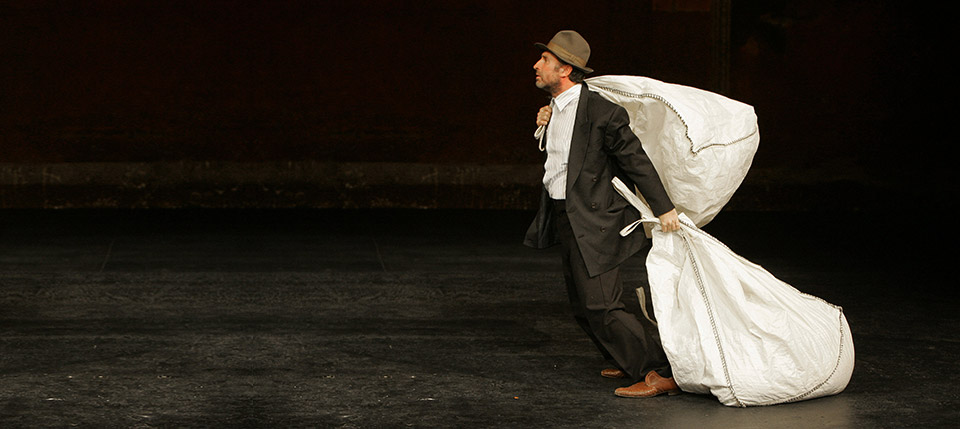
Marcello Magni deals with a disappointing existence in ACT WITHOUT WORDS II, one of five short Beckett plays that make up FRAGMENTS at BAC

Baryshnikov Arts Center, Jerome Robbins Theater
450 West 37th St. between Ninth & Tenth Aves.
Tuesday – Sunday through May 5, $75
866-811-4111
www.bacnyc.org
www.bouffesdunord.com

If you missed C.I.C.T. / Théâtre des Bouffes du Nord’s widely praised production of Fragments at the Baryshnikov Arts Center back in fall 2011, you have another chance, as the show has returned for a splendid encore run through May 5. The Theatre for a New Audience presentation is directed by theater masters Peter Brook and Marie Hélène Estienne, whose entertaining version of The Suit ran at BAM this past winter. Fragments consists of five extremely short minimalist plays by Samuel Beckett, each one an existential gem in its own right. Totaling a mere fifty minutes, they flow into one another effortlessly as they examine loneliness and despair with a wicked sense of humor. In Rough for Theatre I (1979), original Complicité members Marcello Magni and Jos Houben play a pair of destitute souls, the former a blind and rather bad violinist, the latter a one-legged man who pushes himself about on a box and believes that maybe, if they team up, they can make more money, but their prospects don’t look good. In Rockaby (1981), Kathryn Hunter, who was so outstanding in Hideki Noda’s experimental The Bee at Japan Society last year, is dazzling as a woman citing initially repetitive nonsensical text that soon begins to take shape as she contemplates the death of her mother and her own impending demise, the words coming together in a virtuosic display of poetic grandeur.

In Act without Words II (1956), Houben and Magni play two men who live in large white sacks and are individually awakened by a goad that comes down from above; in turn, each man puts on the same suit, socks, hat, and shoes, but while Houben does it with a kick in his step, Magni is disappointed in the world, releasing a series of hysterical sighs as nothing goes his way. Hunter, in fine, deep, gravelly voice, returns for the solo Neither, originally an operatic collaboration between Beckett and Morton Feldman that begins, “to and fro in shadow from inner to outer shadow / from impenetrable self to impenetrable unself by way of neither.” Come and Go (1965) concludes the evening, with Houben, Hunter, and Magni wearing fabulous dresses as they gather on a park bench; one by one, they walk away for a moment, giving the other two the opportunity to gossip about her until all three have been the target of playful maliciousness. Fragments is a delightful collection of absurdist pieces that combine to form a wonderful whole. “When [Beckett] discovered theater,” Brook writes in a program note, “it became a possibility to strive for unity, a unity in which sound, movement, rhythm, breath, and silence all come together in a single rightness.” Such a unity of rightness can be found in this stellar production.

DAY OF HEAVEN: THE NEW WORLD

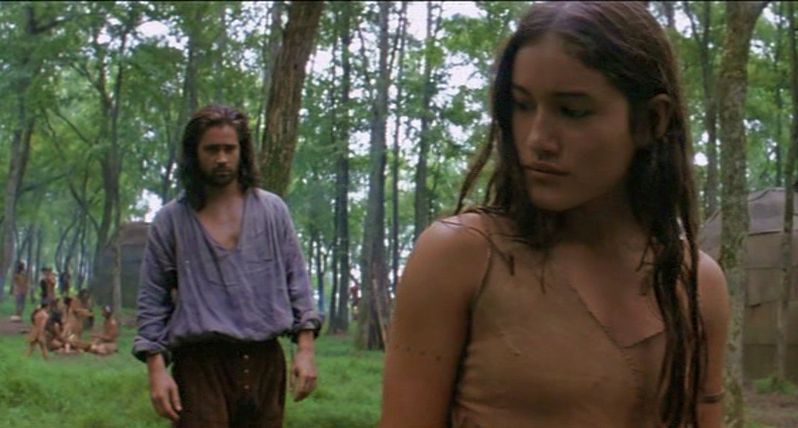
THE NEW WORLD is part of daylong tribute to Terence Malick at BAM

THE NEW WORLD is part of daylong tribute to Terence Malick at BAM

THE NEW WORLD (Terrence Malick, 2005)
BAMcinématek, BAM Rose Cinemas
30 Lafayette Ave. between Ashland Pl. & St. Felix St.
Sunday, April 28, 8:00
212-415-5500
www.bam.org

When The New World was released in 2005, it was only iconoclastic American auteur Terrence Malick’s fourth film in a forty-year career that also included the gems Badlands (1973), Days of Heaven (1978), and The Thin Red Line (1998). Now, following the success of 2011’s The Tree of Life and its polarizing follow-up, To the Wonder, the very next year, BAMcinématek is presenting a daylong tribute to Malick that is appropriately titled “Day of Heaven.” Spectacularly photographed by Malick’s longtime cinematographer, Emanuel Luzbeki, The New World reimagines the story of Captain John Smith (Colin Farrell) and Pocahontas (Q’orianka Kilcher) as an epic tale of unrequited desire, a fiercely passionate, if not completely accurate, love story for the ages. In 1607, a crew led by Captain Christopher Newport (Christopher Plummer) has landed in what will come to be known as Jamestown. The disgraced Smith, who was nearly hanged for mutiny, is ordered to meet with “the naturals” in order to develop a favorable relationship. But Smith falls deeply for Chief Powhatan’s (August Schellenberg) beautiful young daughter, who shares his feelings, leading to a dangerous love that threatens to leave death and destruction in its wake. Large stretches of the film feature no dialogue, instead consisting of gorgeously framed shots with gentle, poetic narration from Smith, Pocahontas, and, later, John Rolfe (Christian Bale). The scenes between Farrell and Kilcher nearly ignite the screen, their eyes burning into each other. Malick and Luzbeki focus on lush, rolling fields and rushing rivers that are more than just beautiful scenery; the gorgeous landscape of this new world is filled with promise, with hope, even though we know what eventually, tragically happens. The film bogs down considerably when Smith’s place in the newly named Rebecca’s life is taken over by Rolfe, but it all builds to a heart-wrenching conclusion. The New World is screening at BAM on April 28 at 8:00, preceded by Days of Heaven at 2:00 and The Thin Red Line at 4:15.
THE WEIMAR TOUCH: THE STRANGER

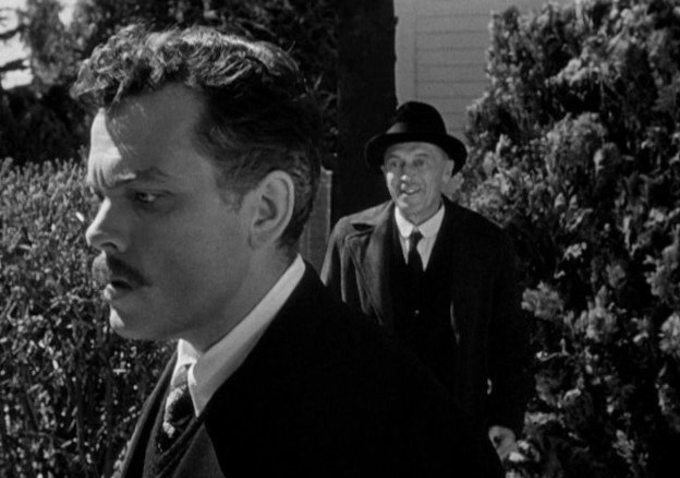
Orson Welles is a Nazi on the run in THE STRANGER

Orson Welles is a Nazi on the run in small-town America in THE STRANGER

THE STRANGER (Orson Welles, 1946)
MoMA Film, Museum of Modern Art
11 West 53rd St. between Fifth & Sixth Aves.
Saturday, April 27, 2:00, and Sunday, April 28, 5:30
Tickets: $12, in person only, may be applied to museum admission within thirty days, same-day screenings free with museum admission, available at Film and Media Desk beginning at 9:30 am
212-708-9400
www.moma.org

A mere warm-up to The Third Man, Orson Welles’s 1946 noir thriller, The Stranger, is still a gripping examination of postwar paranoia and Fascism. Welles, who directed the film to show studio heads that he could be a team player, stars as Dr. Charles Rankin, a seemingly bright and charming teacher who shows up in a small town and wins the heart of Mary Longstreet (Loretta Young), daughter of the town judge (Philip Merivale). However, right behind Rankin is Mr. Wilson (Edward G. Robinson, somewhat reprising his role as insurance investigator Barton Keyes in Double Indemnity), who is hot on the trail of Nazi murderer Franz Kindler. What follows is a highly theoretical battle of wits between Wilson and Rankin/Kindler that is more than a little out of place in the simple perfection of small-town Harper, Connecticut. “The German’s dream world comes alive when he takes his place in shining armor beneath the banners of the Teutonic knights,” Rankin says during a family dinner reminiscent of Alfred Hitchcock’s Shadow of a Doubt. “Mankind is waiting for the Messiah,” he continues, “but for the German, the Messiah is not the Prince of Peace. No, he’s . . . another Barbarossa . . . another Hitler.” In addition to philosophizing, Rankin is obsessed with trying to fix the clock in the town tower, with his efforts trying to control time leading to a memorable finale. Rankin is no Harry Lime — of course, who is? — but he’s yet another intriguing character in Welles’s pantheon of intriguing characters. There are several amateurish moments that bring the film down a notch from greatness, but The Stranger remains a compelling tale with more than its fair share of Wellesian delight. After years of late-night television airings of a dilapidated print, the film was restored about ten years ago and looks much better on the big screen, where it can be seen April 27 & 28 as part of MoMA’s “The Weimar Touch” series, which includes such other films as Jacques Tourneur’s Berlin Express, Max Ophuls’s Letter from an Unknown Woman, Alfred Hitchcock’s I Confess, Charles Laughton’s The Night of the Hunter, and Billy Wilder’s Some Like It Hot, all of which relate visually or thematically to the German cinema of F. W. Murnau, Carl Th. Dreyer, G. W. Pabst, and Weimar Expressionism.