twi-ny recommended events

DOIN’ IT IN THE PARK: PICK-UP BASKETBALL, NEW YORK CITY

DOIN’ IT IN THE PARK

Bobbito Garcia and Kevin Couliau celebrate New York City street ball in DOIN’ IT IN THE PARK

DOIN’ IT IN THE PARK: PICK-UP BASKETBALL, NEW YORK CITY (Bobbito Garcia & Kevin Couliau, 2012)
Maysles Cinema
343 Malcolm X Blvd. between 127th & 128th Sts.
May 22-28, $10
212-582-6050
www.mayslesinstitute.org
www.doinitinthepark.com

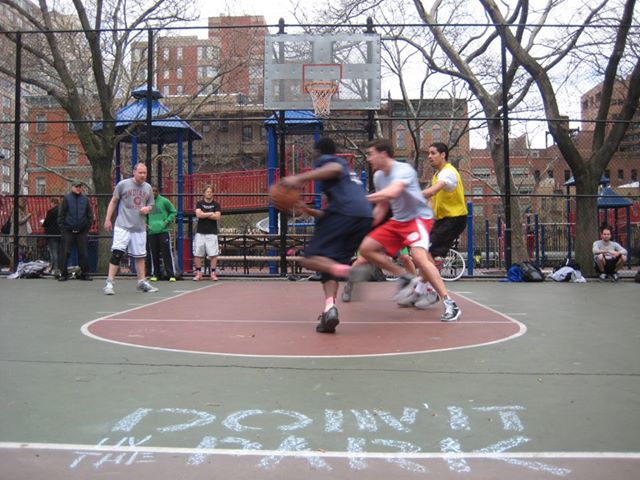
Some of the Big Apple’s best basketball doesn’t take place inside Madison Square Garden or the Barclays Center. Over the course of two summers, journalist, announcer, and native New Yorker Bobbito “Kool Bob Love” Garcia and French photographer and video director Kevin Couliau biked to 180 outdoor courts throughout the five boroughs, detailing the history of the social and cultural phenomenon of street hoops in the fast-paced, celebratory documentary Doin’ It in the Park: Pick-up Basketball, New York City. Garcia (Where’d You Get Those Shoes? NYC’s Sneaker Culture: 1960-1987) and Couliau (“Heart & Soul of New York City”) meet with many of the playground’s biggest stars, from those who made it to the NBA (Julius “Dr. J” Erving, Kenny “the Jet” Smith, Geoff Huston) to those whose legends remain on the street (James “Fly” Williams, Corey “Homicide” Williams, Niki “Lil’ Ratchet” Avery, Ed “the Sundance Kid” Davis, Andre “the Latin Assassin” Ortiz). Featuring a soundtrack that combines original music by Eddie Palmieri with songs by Donald Byrd & the Blackbyrds, Quantic, the Budos Band, Jurassic 5, and others, the film captures the rhythm and beat of street hoops, from three-on-three, half court, and full court to Horse and 21, with guys even shooting into garbage cans, milk crates, and monkey bars if no courts were available.

Garcia, who narrates the movie in worshipful tones, and Couliau hang out at such key spots as Rucker Park, King Towers, Dean St., LeFrak City, and the Cage at West Fourth St., where they film games and let the current and former players wax poetic about their dedication to the sport. “This is what we did, man. It’s in my blood,” explains George “White Chocolate” Ganley about playing in the rain, snow, or sleet. Ganley is one of two Caucasians highlighted in a sport dominated by blacks and Hispanics; the other is Jack “Black Jack” Ryan, who recalls the first time he got on the court and proved he got game by dunking. “It’s been heaven ever since,” he says. The filmmakers also pay tribute to such late legends of the street as Wilt Chamberlain and Earl “the Goat” Manigault, who many consider one of the best basketball players in the history of the sport. The codirectors also show the game’s positive impact on inmates behind bars. “It was about your pride, it was about who you was, it was about who you was trying to become,” says Richard “Pee Wee” Kirkland, who once scored 135 points in a prison game. After the credits, Garcia and Couliau add footage of themselves going one-on-one, unable to stop playing the game they clearly love so much. Indeed, Doin’ It in the Park is a love letter to a cultural touchstone that is uniquely New York. The film is having its official U.S. theatrical release May 22-28 at Maysles Cinema in Harlem, with five screenings followed by Q&As with Garcia, Couliau, and such special guests as Wild Style director Charlie Ahearn, photographer Charlie Samuels, executive producer Nick Quested, Ryan, Avery, and others, after which it moves to Harlem’s MISTcinema from May 31 to June 6.

BOOED AT CANNES: TROPICAL MALADY

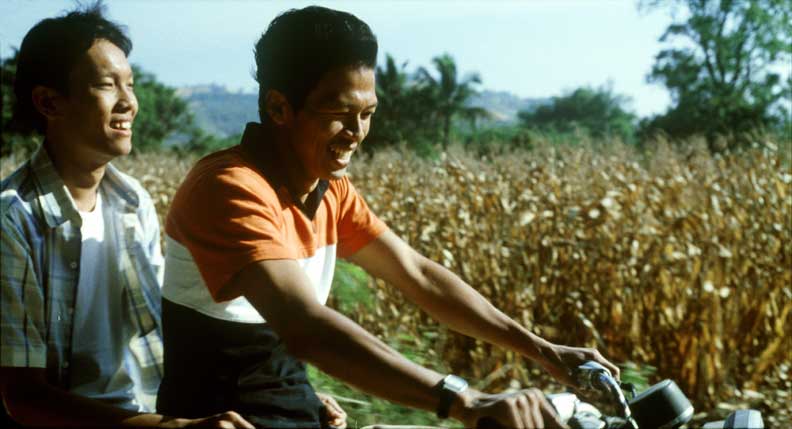
Apichatpong Weerasethakul’s TROPICAL MALADY was both booed and celebrated at the 2004 Cannes Film Festival

Apichatpong Weerasethakul’s TROPICAL MALADY was both booed and celebrated at the 2004 Cannes Film Festival

TROPICAL MALADY (SUD PRALAD) (Apichatpong Weerasethakul, 2004)
BAMcinématek, BAM Rose Cinemas
30 Lafayette Ave. between Ashland Pl. & St. Felix St.
Thursday, May 23, 4:30, 7:00 & 9:30
Series runs through May 23
718-636-4100
www.bam.org
www.kickthemachine.com

Thai director Apichatpong Weerasethakul won the Jury Prize at Cannes for this beautiful, mystical work that will thoroughly engage you — if you allow it to. Part tender love story between a country boy (Banlop Lomnoi) and a soldier (Dakda Kaewbuadee), part folktale set in the deep forests of Thailand, Tropical Malady is a like a visual poem in which details are not as important as the overall effect, which is intoxicating. The unorthodox film features ghosts, a shape-shifter, unusual characters, and a playful sense of humor that come together to form a subtle meditation on life and love. Weerasethakul once again displays the gentle, captivating narrative technique that lies at the heart of his oeuvre, which also includes such works as Blissfully Yours, Syndromes and a Century, and Uncle Boonmee Who Can Recall His Own Lives. Tropical Malady is screening on May 23 at BAM, concluding the BAMcinématek series “Booed at Cannes,” consisting of films that did not exactly thrill the Cannes glitterati but have gone on to gain their own unique reputations. In the case of Tropical Malady, while some people at Cannes walked out on the film and others stuck around to boo it, Quentin Tarantino headed the group that awarded it the Jury Prize.

OLD DOG

OLD DOG

An old man (Lochey) would rather sell himself than his canine companion in Pema Tseden’s OLD DOG

OLD DOG (LAO GOU/KHYI RGAN) (Pema Tseden, 2011)
IndieScreen
289 Kent Ave. at South Second St.
May 21-27, 7:00
347-227-8030
www.indiescreen.us

Pema Tseden’s Old Dog is a beautifully told, slowly paced meditation on Buddhism’s four Noble Truths — “Life means suffering”; The origin of suffering is attachment”; “The cessation of suffering is attainable”; and “There is a path to the cessation of suffering” — that ends with a shocking, manipulative finale that nearly destroys everything that came before it. In order to get a little money and to save the family’s sheep-herding dog from being stolen, Gonpo (Drolma Kyab) sells their Tibetan nomad mastiff to Lao Wang (Yanbum Gyal), a dealer who resells the prized breed to stores in China, where they’re used for protection. When Gonpa’s father (Lochey) finds out what his son has done, he goes back to Lao Wang and demands the return of the dog he’s taken care of for thirteen years. “I’d sell myself before the dog,” he tells his son. And so begins a gentle tale of parents and children, set in a modern-day Tibet that is ruled by China’s heavy hand. Gonpa’s father doesn’t understand why his son, a lazy man who rides around on a motorized bike and never seems to do much of anything, doesn’t yet have any children of his own, so he pays for Gonpa and his wife Rikso, (Tamdrin Tso), to go to the doctor to see what’s wrong. Meanwhile, the old man keeps a close watch on his dog, wary that Lao Wang will to try to steal it again. Writer-director Pema Tseden (The Silent Holy Stones, The Search) explores such themes as materialism, family, and attachment in a lovely little film that sadly is nearly ruined by its extreme final scene. If you missed Old Dog last week as part of the MoMA series “Chinese Realities/Documentary Visions,” you have another chance to catch it, as it’s being shown nightly May 21-27 at 7:00 at IndieScreen in Williamsburg.

CHINESE REALITIES/DOCUMENTARY VISIONS: 24 CITY

Su Na (Zhao Tao) looks out at a changing China in Jia Zhangke’s 24 CITY

Su Na (Zhao Tao) looks out at a changing China in Jia Zhangke’s 24 CITY

24 CITY (ER SHI SI CHENG SI) (Jia Zhang-ke, 2008)
MoMA Film, Museum of Modern Art
11 West 53rd St. between Fifth & Sixth Aves.
Wednesday, May 22, 7:00, and Wednesday, May 29, 8:00
Series runs through June 1
Tickets: $12, in person only, may be applied to museum admission within thirty days, same-day screenings free with museum admission, available at Film and Media Desk
212-708-9400
www.moma.org
www.cinemaguild.com

With the imminent closing of a once-secret munitions plant known as Factory 420 in Chengdu, eight workers relate their unique stories in another fascinating look at capitalism in a changing China by Sixth Generation writer-director Jia Zhang-ke, who has previously investigated the transformations in his native country in such excellent works as Platform, Unknown Pleasures, The World, Useless, and Still Life. While five of the tales are told by actual male workers in their own words, three are fictional stories recited by female actors, including Joan Chen as Little Flower, Lv Liping as Hao Dali, and Jia regular Zhao Tao as Su Na. Jia sees the factory, which is being torn down to make way for a luxury apartment complex called 24 City, as a symbol of contemporary China, as the past is ripped away in favor of capitalist-based technological modernization and the celebration of wealth. By intermingling fact and fiction, as he does in most of his work, Jia creates a fascinating pseudo-documentary that also subtly touches upon women’s changing role in Chinese industry and society. 24 City is screening at MoMA May 22 & 29 as part of “Chinese Realities/Documentary Visions,” which continues through June 1 with such other examinations of contemporary China as Li Ning’s Tape, Ying Liang’s When Night Falls, Wu Wenguang’s Bumming in Beijing: The Last Dreamers, and Ai Weiwei’s Disturbing the Peace.

CANCELED: PHÈDRE LES OISEAUX

(photo © Ayodele Casel)

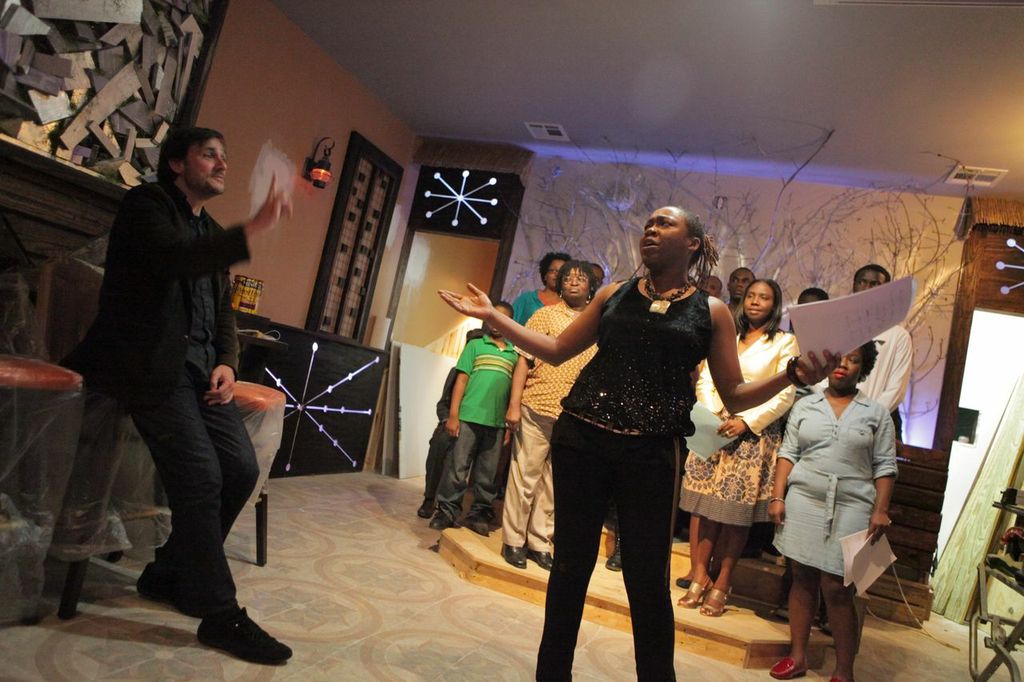
French theater director Jean-Baptiste Sastre rehearses Haitian-American chorus for New York premiere of PHÈDRE LES OISEAUX (photo © Ayodele Casel)

PHÈDRE LES OISEAUX (PHAEDRA THE BIRDS)
Baryshnikov Arts Center, Howard Gilman Performance Space
450 West 37th St. between Ninth & Tenth Aves.
May 21-24, 28-29, $20, 7:30
866-811-4111
www.bacnyc.org

French director Jean-Baptiste Sastre describes his production of Phèdre les oiseaux (Phaedra the birds), which makes its New York premiere May 21-29 at the Baryshnikov Arts Center, as “a poem,” while Palestinian star Hiam Abbass calls it a “moment of pleasure, and of poetry, and of theater.” The seventy-five-minute show, which relates the Greek myth of Phaedra, a tale of forbidden love, betrayal, rejection, and revenge, will be performed by Abbass (Paradise Now, Lemon Tree) as Phaedra and American-Ugandan actor Ntare Guma Mbaho Mwine (Heroes, Treme) as Hippolytus, joined by approximately thirty members of the Brooklyn-based organization Haïtian-Americans in Action serving as the chorus. The text is by Frédéric Boyer, with English translation by Cole Swensen and dramaturgy by Ellen Hammer. The international project, which features a local chorus at every stop on its tour, has been reconfigured for the Howard Gilman Performance Space, will be told in English, French, and Haitian Creole at BAC. [ed. note: This event has now been canceled. We apologize for any inconvenience.]

INSECT MUSIC

(photo by Charles Lindsay)

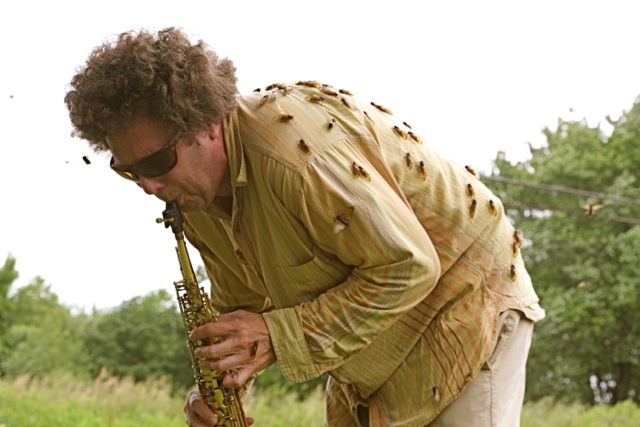
David Rothenberg will jam with humans and insects at special Ear to the Earth program at Judson Church (photo by Charles Lindsay)

INSECT MUSIC
Judson Church
Wednesday May 22, suggested donation $15, 7:30
www.bugmusicbook.com
www.davidrothenberg.net

You better watch out, because Brood II is on its way, ready to strike at any minute. It’s been seventeen years since Magicicadas have hit New York City, but they’re preparing to emerge, buzzing the metropolitan area with their 7 kHz mating call. The nymphs, which will grow quickly into adult cicadas, will appear once the temperature hits a steady sixty-four degrees, but David Rothenberg is already set for the onslaught. The self-described musician, composer, author, and philosopher-naturalist has just released Bug Music: How Insects Gave Us Rhythm and Noise (St. Martin’s, April 2013, $26.99) and the accompanying Bug Music CD (Terra Nova), completing the trilogy that began with Why Birds Sing: A Journey into the Mystery of Birdsong and Thousand Mile Song: Whale Music in a Sea of Sound. “Each shrill, whining, or whooshing song is a call to the endless nature of love,” he writes in the new book. “However fast love goes we know it will return, the one sure thing that will never be exhausted as all the rest of nature gets spent, used up, or destroyed. Cicadas on the branches, eternal optimists, lovers of the moment.” Rothenberg will headline the special program “Insect Music” on May 22 at Judson Church, presented by Ear to the Earth, consisting of an introduction by Cicada Mania founder Dan Mozgai, the world premiere of Richard Knox Robinson’s half-hour film Song of the Cicadas, a panel discussion with Rothenberg, Robinson, performance artist and former political prisoner Tim Blunk, and David’s son, Umru Rothenberg, moderated by Radiolab founder Robert Krulwich, and a live performance by David Rothenberg on clarinets and laptop, Pauline Oliveros on accordion, Harmonic Choir member Timothy Hill providing overtone vocals, and Garth Stevenson on double bass, along with recordings of cicadas, crickets, katydids, leafhoppers, water bugs, and other insects.

VANYA AND SONIA AND MASHA AND SPIKE ON BROADWAY

(photo by Carol Rosegg)

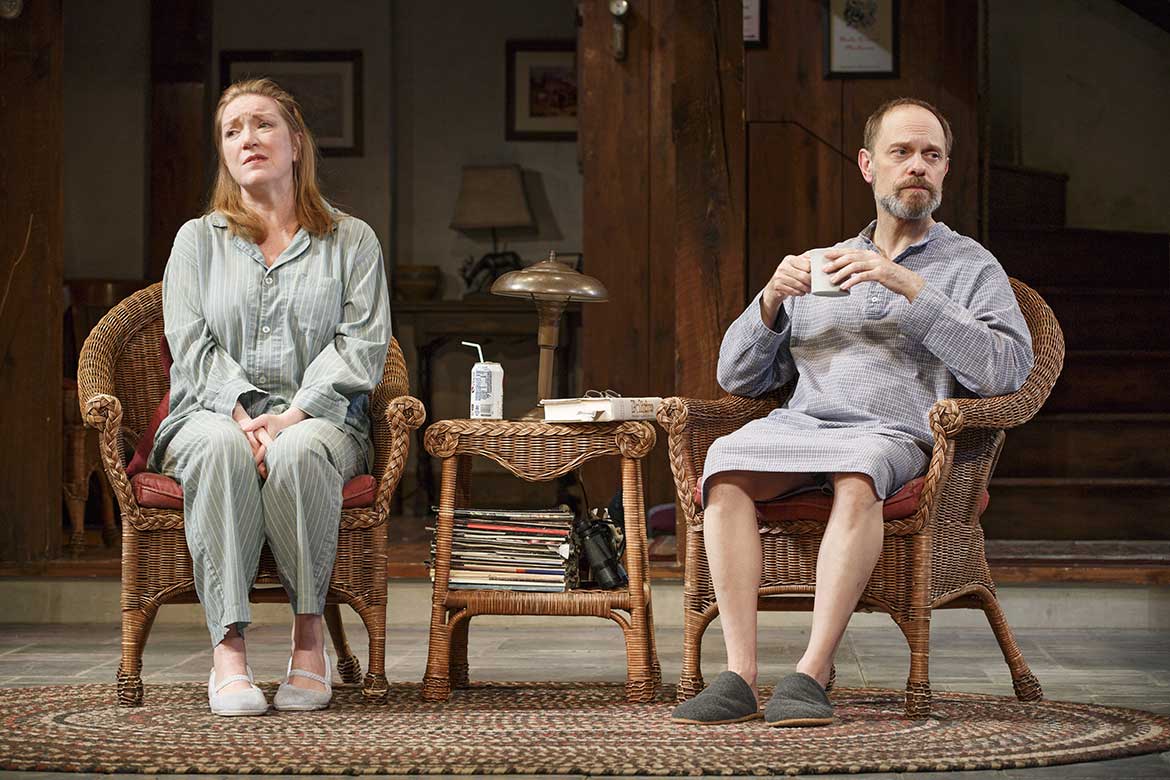
Vanya (David Hyde Pierce) and Sonia (Kristine Nielsen) look back at their sad lives in Christopher Durang’s Chekhovian mashup (photo by Carol Rosegg)

Golden Theatre
252 West 45th St. between Broadway & Eighth Ave.
Tuesday – Sunday through July 28, $62 – $142
www.vanyasoniamashaspike.com

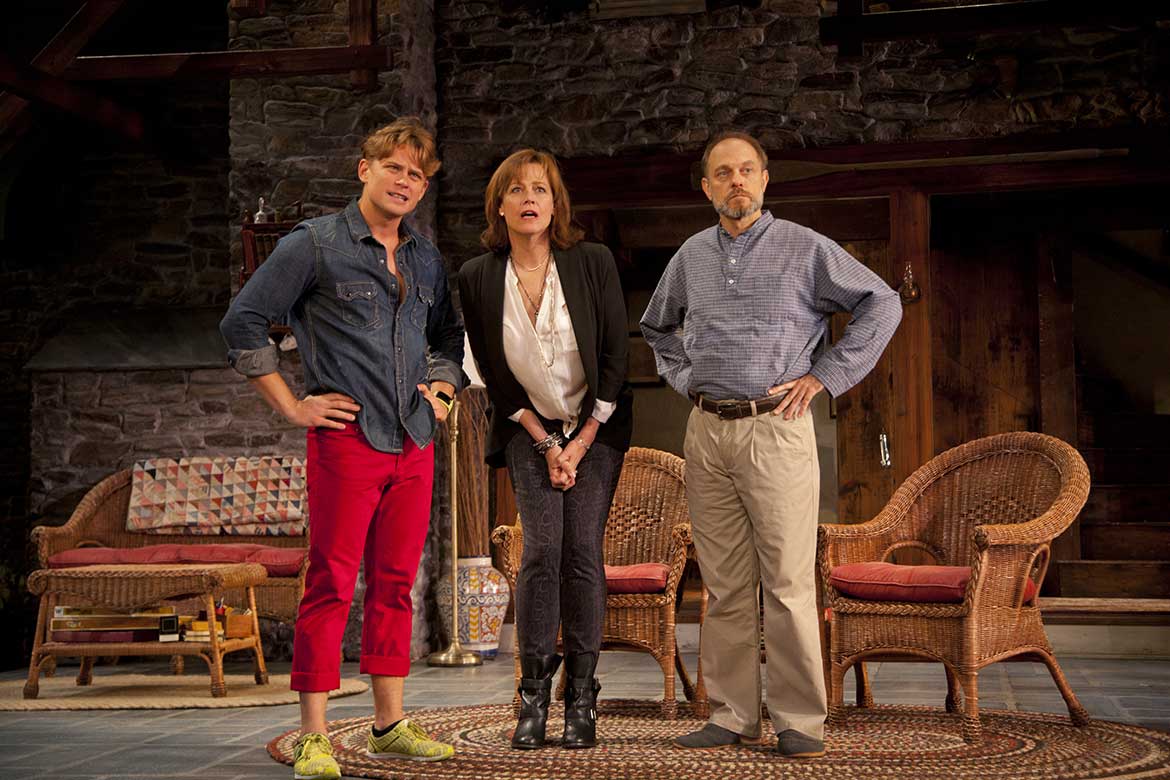
When he was at Yale in the 1970s, Christopher Durang teamed with Albert Innaurato and Jack Feldman on The Idiots Karamazov, a musical about a Russian translator that begins with a song titled “O, We Gotta Get to Moscow,” as the translator confuses Dostoevsky with Chekhov and other writers. Going to Moscow shows up again in Durang’s delightful satire, Vanya and Sonia and Masha and Spike, which has made a successful transition from Lincoln Center’s Mitzi E. Newhouse to Broadway’s Golden Theatre. Durang sets his latest play in a Bucks County farmhouse by a lake where a blue heron stops by daily, based on the Bucks County farmhouse by a lake with a blue heron where Durang and his partner reside. Living in the fictional house are Vanya (David Hyde Pierce) and Sonia (Kristine Nielsen), a pair of fiftysomething siblings (one adopted) who have essentially sacrificed what lives they might have had by taking care of their ill, elderly parents while their sister, Masha (Sigourney Weaver), became a famous movie star gallivanting around the world with five husbands. Clearly, their parents had a thing for Chekhov; Masha is named after characters from The Seagull and Three Sisters, Vanya and the adopted Sonia from Uncle Vanya. Invited to a neighbor’s costume party, Masha arrives at the house in grand diva fashion, overemoting and unable to keep her hands off her hot new boy toy, Spike (Billy Magnussen), who enjoys taking off most of his clothes at a moment’s notice and striking muscular poses. Masha quickly grows jealous when Spike meets young, pretty ingénue Nina (played at Lincoln Center by Genevieve Angelson and now by Leisel Allen Yeager, the only cast change from the original production), a wannabe actress named after the young, innocent actress in The Seagull. Meanwhile, the cleaning lady, Cassandra (Shalita Grant), makes dire predictions that keep coming true, just like her namesake, the Greek mythological figure with second sight. As Vanya, Sonia, Masha, Spike, and Nina prepare for the party — Masha insists they all go as characters from Snow White, with Masha as the beautiful protagonist, slyly referencing Weaver’s portrayal of the evil stepmother in the 1997 television movie Snow White: A Tale of Terror — jealousy, fear, deception, childhood resentment, and more bubble to the surface and threaten to erupt, albeit in primarily wacky, hysterical ways.

(photo by Carol Rosegg)

Spike (Billy Magnussen), Masha (Sigourney Weaver), and Vanya (David Hyde Pierce) spend a crazy weekend together in Bucks County (photo by Carol Rosegg)

You don’t need to know anything about Chekhov and his searing dramas about seriously dysfunctional families to get a huge kick out of Vanya and Sonia and Masha and Spike, which has a unique family feel itself — Weaver has been working with Durang since the Yale days, Hyde Pierce starred in the Broadway production of the playwright’s Beyond Therapy (as well as Peter Brook’s The Cherry Orchard), and Nielsen is Durang’s acknowledged muse, having appeared in many of his shows, in parts specifically written for her. Director Nicholas Martin, who previously helmed Durang’s Why Torture Is Wrong, and the People Who Love Them at the Public, keeps things relatively natural and grounded even with Weaver, Magnussen, and Grant playing things deliciously way over the top, as the story’s tender heart is wonderfully captured by the amazing Nielsen and Hyde Pierce, who agonize over their loneliness and advancing age, the importance of family, and, perhaps most Chekhovian, a world that seems to be passing them by. Vanya and Sonia and Masha and Spike is a thoroughly enjoyable if often goofy and now, on Broadway, even bigger and broader mashup from one of America’s most engaging satirists at the top of his game. (And be sure to go here to read the fall 2012 issue of Lincoln Center Review, which includes Durang’s “My Life with Chekhov,” an essay detailing seven encounters he had with the Russian playwright, dating back to when he was fourteen.)