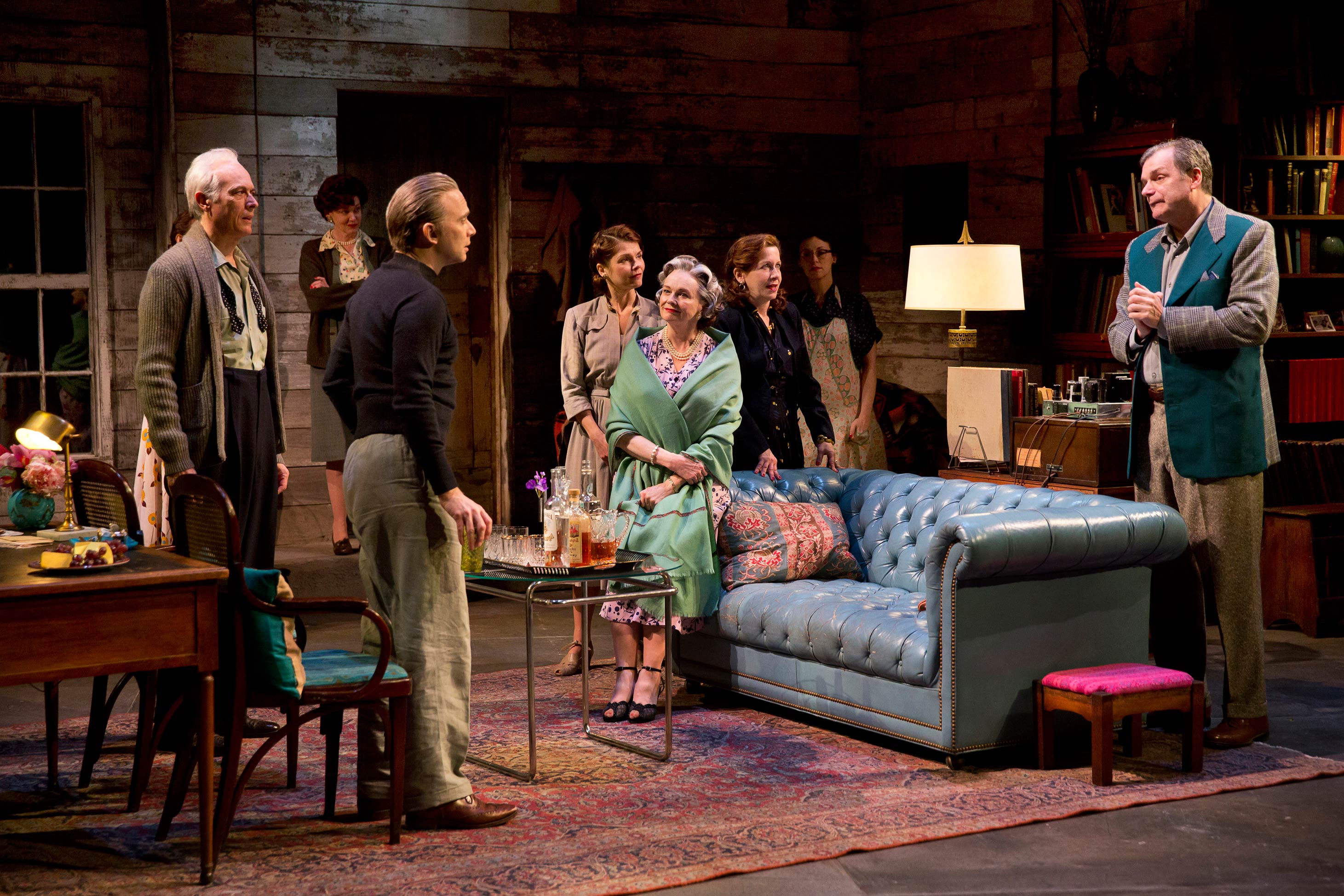
A group of Russian émigrés form an extended artistic family in Richard Nelson’s new play (photo by Paul Kolnik)
Lincoln Center Theater at the Mitzi E. Newhouse
150 West 65th St. between Broadway & Amsterdam Ave.
Tuesday – Saturday through June 16, $85
212-362-7600
www.lct.org
Over the last few years, Richard Nelson has been detailing the exploits of the Rhinebeck-based Apple family in such decidedly American, politically tinged works as That Hopey Changey Thing, Sweet and Sad, and Sorry. Nelson examines a very different kind of extended American family in the intelligent and engaging Nikolai and the Others, running at Lincoln Center’s Mitzi E. Newhouse Theater through June 16. It’s the spring of 1948, and a group of Russian immigrants has gathered at the Westport farmhouse of Vera and Igor Stravinsky (Blair Brown and John Glover) to honor elderly set designer Sergey Sudeikin (Alvin Epstein). Among the guests are choreographer George Balanchine (Michael Cerveris), actor Vladimir Sokoloff (John Procaccino) and his wife, Lisa (Betsy Aiden), Balanchine confidant and Stravinsky friend and translator Lucia Davidova (Haviland Morris), piano teacher Aleksi Karpov (Anthony Cochrane) and his fiancée, Natasha Nabokov (Kathryn Erbe), and composer Nikolai “Nicky” Nabokov (Stephen Kunken), Natasha’s first husband and a man who helps out his fellow Russian émigrés through secret connections. The men and women discuss life and love, art and politics while eating and drinking delicacies from the old country, proud of their heritage as well as having become American citizens. The evening’s centerpiece is to be the presentation of a pas de deux from Balanchine and Stravinsky’s upcoming ballet, Orpheus, performed by Balanchine’s wife, Maria Tallchief (Natalia Alonso), and Nicholas Magallanes (Michael Rosen), but the arrival of conductor Serge Koussevitsky (Dale Place) with U.S diplomat Charles Bohlen (Gareth Saxe) throws everything out of balance as suspicion and fear hover in the country air.
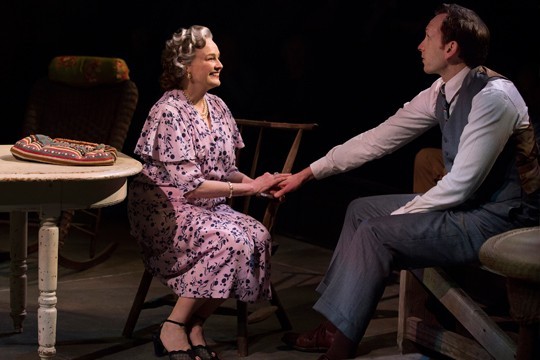
Vera Strainsky (Blair Brown) and others reach out for help from Nikolai Nabokov (Stephen Kunken) during weekend in Westport (photo by Paul Kolnik)
Though featuring real characters and referencing many actual events, Nikolai and the Others is a fascinating creation of Nelson’s, an imaginary weekend that delves into the very nature of the creative process in a quickly changing world. (For example, Sudeikin died in 1946, two years before the play takes place.) But Nelson does an excellent job capturing the powerful emotions these Russian immigrants are experiencing as they attempt to continue their careers in America at the start of the Cold War, in search of personal and professional freedom that comes at a price. Nelson and director David Cromer (Tribes, When the Rain Stops Falling) have the characters speak unaccented English when they are conversing in their native Russian tongue, then in thickly accented English when they are talking in English itself, a conceit that is confusing at first but ultimately works very well. Glover, Brown, and Cerveris lead a strong cast that feels like they have formed a warm family of their own while inviting in the audience, which wraps around Marsha Ginsberg’s intimate set. The show takes on added meaning since it is in the midst of its world premiere at Lincoln Center, where Balanchine and Lincoln Kirstein (who is mentioned often but is never seen) ultimately moved the New York City Ballet after founding the troupe in 1948 and including Orpheus in its inaugural season.
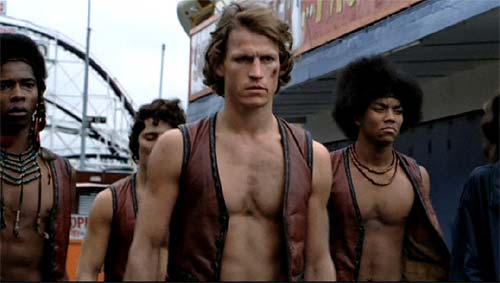
 At a huge gang meeting in the Bronx (actually shot in Riverside Park), the Warriors are wrongly accused of having killed Cyrus (Roger Hill), an outspoken leader trying to band all the warring factions together to form one huge force that can take over the New York City borough by borough. The Warriors then must make it back to their home turf, Coney Island, with every gang in New York lying in wait for them to pass through their territory. This iconic New York City gang movie is based on Sol Yurick’s novel, which in turn is loosely based on Xenophon’s Anabasis, which told of the ancient Greeks’ retreat from Persia. Michael Beck stars as Swan, who becomes the de-facto leader of the Warriors after Cleon (Dorsey Wright) gets taken down early. Battling Swan for control is Ajax (Sex and the City’s James Remar) and tough-talking Mercy (Too Close for Comfort’s Deborah Van Valkenburgh). Serving as a Greek chorus is Lynne (Law & Order) Thigpen as a radio DJ, and, yes, that young woman out too late in Central Park is eventual Oscar winner Mercedes Ruehl. Among the cartoony gangs of New York who try to stop the Warriors are the roller-skating Punks, the pathetic Orphans, the militaristic Gramercy Riffs, the all-girl Lizzies, the ragtag Rogues, and the inimitable Baseball Furies. Another main character is the New York City subway system itself. There’s nothing quite like The Warriors; be sure to come out and play at these Memorial Day weekend midnight screenings.

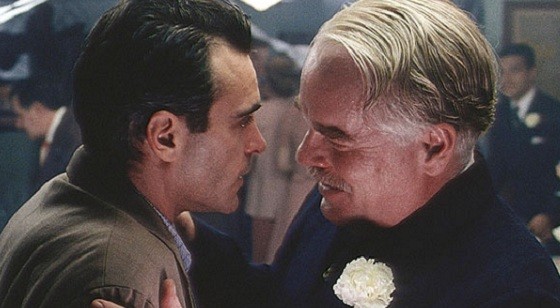
 One of America’s most daring and adventurous filmmakers, California native Paul Thomas Anderson, who has dazzled, amazed, challenged, and confused audiences with such previous gems as Boogie Nights, Magnolia, Punch-Drunk Love, and There Will Be Blood, has done it again with his latest, The Master. The film is built around the fascinating relationship between Freddie Quell (Joaquin Phoenix), a WWII vet struggling to fit into the real world after seeing so much violence and death overseas, and the Master (Philip Seymour Hoffman), the leader of a cultlike organization known as the Cause that believes in past-life regression and invasive questioning known as Processing to help people deal with personal trauma. The Master essentially adopts Quell, intrigued by his distorted outlook on life, making him a member of the family, which also includes his wife, Peggy (Amy Adams), his son, Val (Jesse Plemons), and his daughter, Elizabeth (Ambyr Childers). Inspired by the real-life tale of L. Ron Hubbard and Scientology — and incorporating war stories he was told by Jason Robards on the set of Magnolia, elements from the life of John Steinbeck, and discarded scenes from the script for There Will Be Blood — Anderson crafts a, dare we say, masterful cinematic experience built around a pair of extraordinary performances. Phoenix absolutely inhabits the role of Quell, staggering about with an awkward gait, with impossibly deep lines on his face and eyes that seem to be able to look through lead. Hoffman is his equal as the much cooler and calmer spiritual leader, until he is faced with sudden turmoil. The scenes in which the two men sit across from each other, going through a Processing session, are mesmerizing, the most powerful moments to be found onscreen last year. (Both Phoenix and Hoffman received Oscar nods, along with Adams.) But despite the title, the focus remains on Quell, a lost soul searching for somewhere to belong in a changing postwar America. Anderson’s first film in four years, The Master is a bold, audacious work that is as unsettling as it is exhilarating. The Master is screening May 24 at 7:00 and May 25 at 2:00 as part of the Museum of the Moving Image series “See It Big!,” which continues into June with such other great films as Akira Kurosawa’s Ran, Roberto Rossellini’s Journey to Italy, and Nicholas Ray’s Bigger Than Life.