AMERICAN HARDCORE celebrates loud, fast, and angry music scene
AMERICAN HARDCORE: THE HISTORY OF AMERICAN PUNK ROCK 1980-1986 (Paul Rachman, 2006)
Nitehawk Cinema
136 Metropolitan Ave. between Berry St. & Wythe Ave.
Saturday, July 13, and Sunday, July 14, 12 noon
718-384-3980
www.nitehawkcinema.com
www.sonyclassics.com/americanhardcore
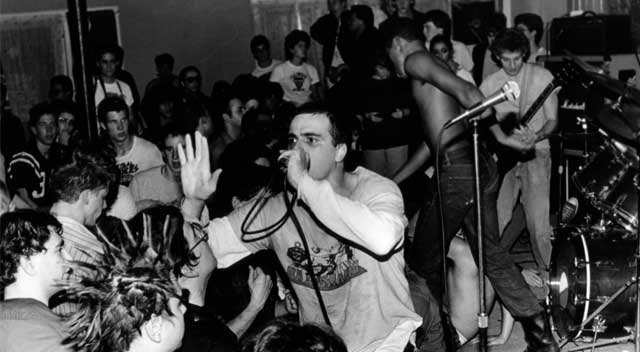
 A must-see for fans of loud, fast, angry music circa 1980-86, American Hardcore looks at one of the smaller but nonetheless influential movements in American music. A basic doc in the classic do-it-yourself sensibility that informed so much of the music scene it chronicles, American Hardcore features interviews with Henry Rollins, lead singer of Black Flag; H.R., the mercurial, difficult, but brilliant lead singer for the Bad Brains; Mike Watt of the Minutemen; and various personnel from the Circle Jerks, Minor Threat, and 7 Seconds. Tommy Stinson of the Replacements and Flea of the Red Hot Chili Peppers weigh in as well. The abundance of old concert footage is fabulous, but director Paul Rachman and writer Steven Blush discovered much of it in shoeboxes in basements during their low-budget cross-country trip while making the movie, so the overall production quality is not high ― which in some ways works better overall. The film does a good job of lovingly showing just how home-grown and amateurish the scene was and debating the importance of the scenes in Houston, Minneapolis, DC, Boston, and Southern California. The finale with a graphic artist and cover designer calling for the next generation of hardcore is a riot. American Hardcore is screening July 13 and 14 at 12 noon as part of the Nitehawk Cinema series “Music Driven”; the Saturday show will be followed by a Q&A with director Rachman, while Blush will be on hand for a Q&A after Sunday’s screening. (In addition to writing the American Hardcore book, Blush has also created one of the great music sites, 24 Hours of Hardcore, where visitors can stream hundreds of the best, and often hardest-to-find, songs from the movement he has so thoroughly explored.) The Nitehawk series continues August 10-11 with Peter Glantz and Nick Noe’s Lightning Bolt: The Power of Salad and September 14-15 with Shane Meadows’s This Is England.
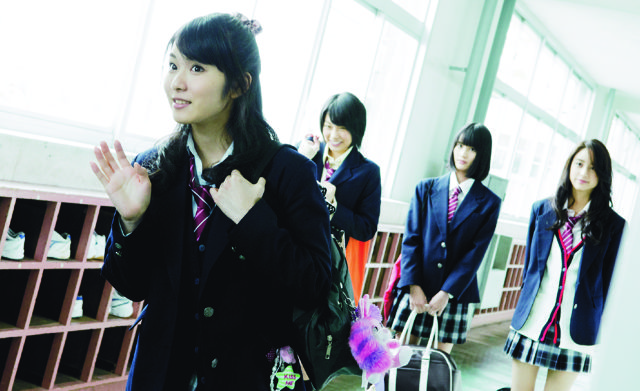
 Life goes completely out of whack when a massively popular student suddenly and mysteriously disappears in Daihachi Yoshida’s splendid examination of the trials and travails of high school, The Kirishima Thing. With no advance warning, superstar athlete and dreamy stud Kirishima can’t be found, missing class and volleyball practice, thoroughly confusing his friends and teammates. His girlfriend, the beautiful Risa (Mizuki Yamamoto), doesn’t know where he is. Risa’s clique of cool girls, including Sana (Mayu Matsuoka), Mika (Kurumi Shimizu), and Kasumi (Ai Hashimoto), start growing apart. The not extremely talented Koizumi (Taiga) is forced to replace Kirishima on the volleyball team. Aya (Suzuka Ohgo) plays sax on a rooftop while actually spying on her secret crush, the handsome Hiroki (Masahiro Higashide), who is Sana’s girlfriend and Kirishima’s best friend. Another of Kirishima’s friends, Ryuta (Motoki Ochiai), shows up to school with ridiculously curly hair. And Kasumi begins spending more time with nerd-geek Ryoya (Ryunosuke Kamiki), who decides to defy his film teacher by going ahead and making the zombie flick Student Council of the Living Dead. Tensions heat up, fears rise to the surface, and standard hierarchical relationships go significantly off kilter as Kirishima’s unexplained absence affects everyone’s position in high school society and makes them reexamine the purpose of their young lives. Based on the omnibus novel Kirishima, Bukatsu Yamerutteyo (“Did You Hear Kirishima Quit?”) by Ryo Asai, The Kirishima Thing cleverly deals with genre clichés as Yoshida (Permanent Nobara, The Wonderful World of Captain Kuhio) and cowriter Kohei Kiyasu tackle the myriad issues that face teenagers on a daily basis, evoking both Beckett and Kurosawa through a John Hughes-like lens with scenes that are retold from multiple viewpoints but don’t provide any firm answers. Winner of Best Picture, Best Director, Most Popular Film, and Outstanding Achievement in Editing at the 2013 Japan Academy Prize awards show, The Kirishima Thing is screening July 14 at 7:30 at Japan Society as part of the Japan Cuts series, a copresentation with the New York Asian Film Festival.