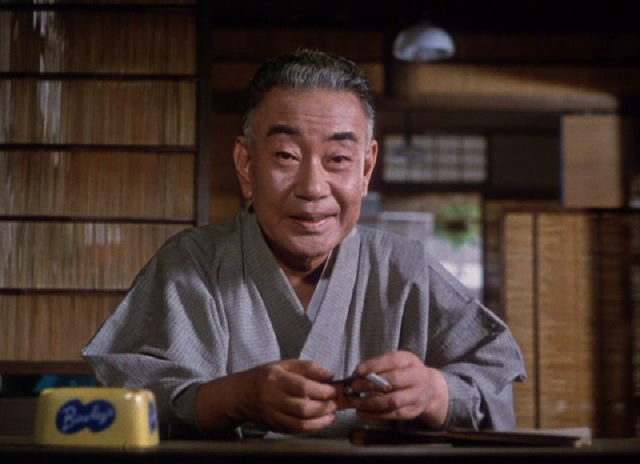
Ganjirō Nakamura is a sheer delight as the unpredictable patriarch of the Kohayagawa family in THE END OF SUMMER
THE END OF SUMMER (KOHAYAGAWA-KE NO AKI) (Yasujirō Ozu, 1961)
Film Forum
209 West Houston St.
Tuesday, July 16, 1:00, 3:15, 5:30, 7:40, 9:50, and Wednesday, July 17, 1:00, 3:15, 5:30
Series runs through July 25
212-727-8110
www.filmforum.org
 Yasujirō Ozu’s next-to-last film, 1961’s The End of Summer, is a poignant examination of growing old in a changing Japan; Ozu would make only one more film, 1962’s An Autumn Afternoon, before passing away on his sixtieth birthday in December 1963. Ganjirō Nakamura is absolutely endearing as Manbei Kohayagawa, the family patriarch who heads a small sake brewery. The aging grandfather has been mysteriously disappearing for periods of time, secretly visiting his old girlfriend, Sasaki (Chieko Naniwa), and her daughter, Yuriko (Reiko Dan), who might or might not be his. In the meantime, Manbei’s brother-in-law, Kitagawa (Daisuke Katō), is trying to set up Manbei’s widowed daughter-in-law, Akiko (Setsuko Hara), with businessman Isomura Eiichirou (Hisaya Morishige), while also attempting to find a proper suitor for Manbei’s youngest daughter, Noriko (Yoko Tsukasa), a typist with strong feelings for a coworker who has moved to Sapporo. Manbei’s other daughter, Fumiko (Michiyo Aratama), is married to Hisao (Keiju Kobayashi), who works at the brewery and is concerned about Manbei’s suddenly unpredictable behavior. When Manbei suffers a heart attack, everyone is forced to look at their own lives, both personal and professional, as the single women consider their suitors and the men contemplate the future of the business, which might involve selling out to a larger company. “The Kohayagawa family is complicated indeed,” Hisao’s colleague tells him when trying to figure out who’s who, an inside joke about the complex relationships developed by Ozu and longtime cowriter Kôgo Noda in the film as well as in the casting.
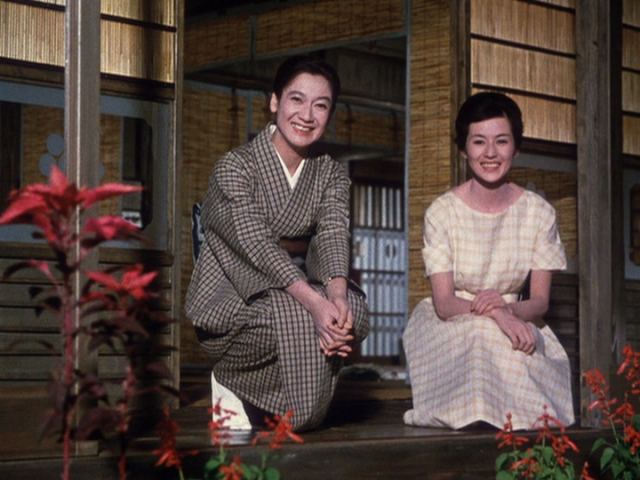
Akiko (Setsuko Hara) and Noriko (Yoko Tsukasa) represent old and new Japan in Ozu’s penultimate film
The End of Summer tells a far more serious story than Late Spring and many other Ozu films that deal with matchmaking and middle-class Japanese life, both pre- and postwar. The perpetually smiling Hara, who played unrelated women named Noriko in three previous Ozu films, once again plays a young widow named Akiko here, as she did in Late Autumn, while Tsukasa, who played Hara’s daughter in Late Autumn, now takes over the name of Noriko as Akiko’s sister. Late Autumn also featured a character named Yuriko Sasaki, played by Mariko Okada, who went on to play a woman named Akiko in Ozu’s final film, An Autumn Afternoon. Got that? Ozu’s fifth film in color, The End of Summer uses several beautiful establishing shots that incorporate flashing light and bold hues — including a neon sign that declares “New Japan” — photographed by Asakazu Nakai (Seven Samurai, Throne of Blood, Ran), as well as numerous carefully designed set pieces that place the old and the new in direct contrast, primarily when Akiko and Noriko are alone, the former in a kimono, the latter in more modern dress. But at the center of it all is Nakamura, who plays Manbei with a childlike glee, as if Ozu is equating birth and death, the beginning and the end. The film is screening July 16 & 17 at Film Forum, which is holding a “Reprise Presentation” of its earlier, extensive Ozu series with encore screenings of eight of the works, continuing with The Flavor of Green Tea over Rice, Early Summer, Tokyo Twilight, Equinox Flower, and Late Autumn.

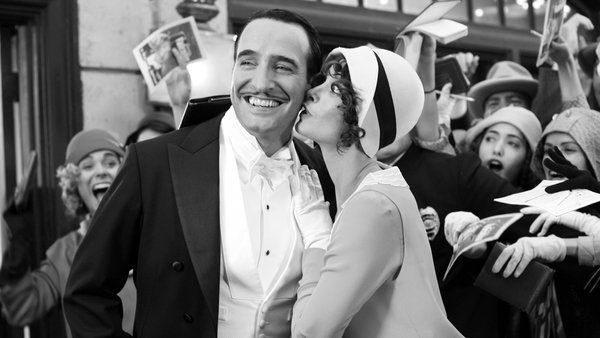
 French director Michel Hazanavicius has followed his two OSS 117 espionage parodies, Cairo, Nest of Spies and Lost in Rio, with another genre exercise, this time taking on silent film in the charming international hit The Artist. Reteaming Jean Dujardin and Bérénice Bejo from Cairo, Nest of Spies, Hazanavicius tells the story of the end of silent cinema through the clever use of the genre’s own familiar conventions. Dujardin stars as George Valentin, a silent-film idol who believes that talking pictures will just be a passing fad. Bejo, who is married to Hazanavicius, plays Peppy Miller, a young, peppy Hollywood hopeful who embraces the arrival of the sound era, rising as fast as Valentin is falling. It’s a different take on the classic A Star Is Born theme, with plenty of inside jokes and cute references about the movies, although purposefully using clichés doesn’t excuse the film from often being too clichéd itself; many of the scenes are far too predictable, offering few genuine surprises as the plot unfolds. However, Hazanavicius and his crew nail the period both aurally and visually, with splendid costumes by Mark Bridges, production design by Laurence Bennett, set decoration by Robert Gould, cinematography by Guillaume Schiffman, and music by Ludovic Bource. Excellent support is supplied by James Cromwell as Valentin’s loyal valet, John Goodman as cigar-chomping producer Al Zimmer, and Uggie as Valentin’s ever-faithful dog, Jack. Nominated for ten Academy Awards and winning seven, including Best Picture, Best Actor, Best Original Screenplay, Best Cinematography, Best Costume Design, and Best Original Score, The Artist is a fabulously made though flawed and overrated film that is a charming celebration of the movies — and a great way to get people into theaters to experience the myriad pleasures of black-and-white silent cinema. The film is screening for free on July 15 in East River State Park as part of the “Williamsburg Summer Nights, Movies in the Park” series, which continues with Up on July 22 before concluding with Skyfall on July 29.