twi-ny recommended events

THE OLD FRIENDS

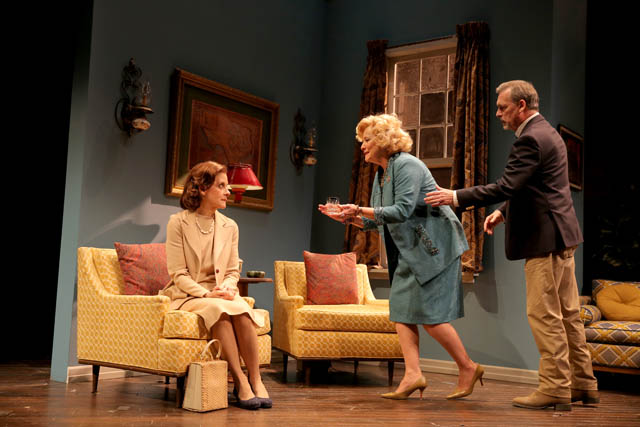
(photo by Joan Marcus)

Sybil (Hallie Foote), Gertrude (Betty Buckley), and Howard (Cotter Smith) desperately try to find happiness in Horton Foote’s THE OLD FRIENDS (photo by Joan Marcus)

The Pershing Square Signature Center
The Irene Diamond Stage
480 West 42nd St. between Tenth & Eleventh Aves.
Through October 13, $75
212-244-7529
www.signaturetheatre.org

The world premiere of The Old Friends at the Signature Theatre gathers together some old friends indeed. The play was written by Horton Foote, stars his daughter Hallie Foote, and is directed by longtime Foote collaborator Michael Wilson (The Trip to Bountiful, Talley’s Folly). In addition, the play, which began life as The Dispossessed in the mid-1960s, had a staged reading at the Signature in 2002. After that long gestation, it finally is having its first full-scale production, which has been extended at the Signature’s Irene Diamond Stage through October 13. Set in 1965 in Harrison, Texas, The Old Friends is a stark tale of greed, disloyalty, selfishness, envy, drunkenness, and infidelity that is part Tennessee Williams, part Dallas. Lois Smith stars as family matriarch Mamie Borden, who lives with her bon vivant daughter, Julia Price (Veanne Cox), and her oversized, very wealthy husband, Albert (Adam LeFevre). They are joined by the brash, blustery, and extremely rich Gertrude Hayhurst Sylvester Ratliff (Betty Buckley) and her companion, the gentle Howard Ratliff (Cotter Smith), as they await the arrival of prodigal daughter Sybil (Hallie Foote), who has spent the last decade with her husband, Hugo, in Venezuela. Sybil shows up alone, setting into motion jealousy, flirtations, lies, deception, gunshots, and lots and lots of drinking while they all battle over the family farm and other matters, mostly involving love and money.
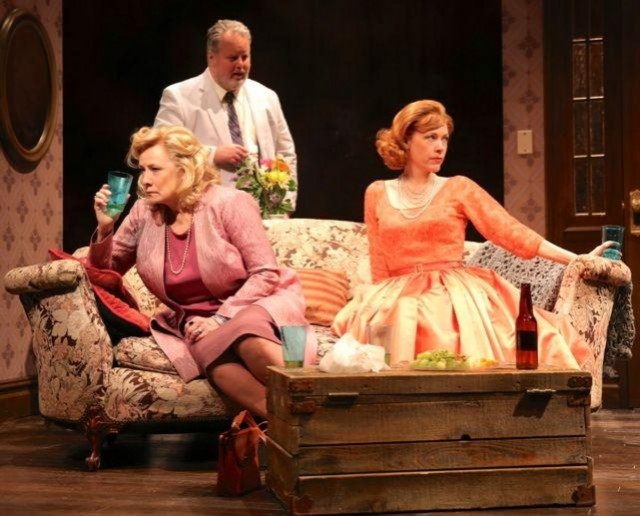
Gertrude (Betty Buckley), Albert (Adam LeFevre), and Julia Price (Veanne Cox) don’t exactly see eye-to-eye in dysfunctional family drama (photo by Joan Marcus)

Gertrude (Betty Buckley), Albert (Adam LeFevre), and Julia Price (Veanne Cox) don’t exactly see eye-to-eye in dysfunctional family drama (photo by Joan Marcus)

Buckley beautifully chews up the scenery as Gertrude, a deeply unhappy, lonely woman who uses her power and money to get what she wants, which includes Howard, her former brother-in-law, and young stud Tom Underwood (Sean Lyons), whom she fights over with her former sister-in-law, the pseudo-elegant Julia. Smith (The Trip to Bountiful onstage, East of Eden on film) has a weak first act as Mamie, but she gets much stronger in the far superior second act, as long-held secrets emerge and relationships get even more explosive. At the center of it all is Foote’s solid portrayal of the complex Sybil, a quiet woman who is disappointed in how her life has turned out and tries her best to avoid getting caught up in the others’ nonsense, but she has a plan of her own as well. Wilson, who helmed Horton Foote’s epic Orphans’ Home Cycle with Hallie Foote at Signature in 2009, never lets things slow down as the characters make their way through a trio of lovely sets by Jeff Cowie, leading to a powerful ending that changes everyone’s lives. In this poignant Signature production, The Old Friends feels like, well, an old friend.
DUMBO DANCE FESTIVAL

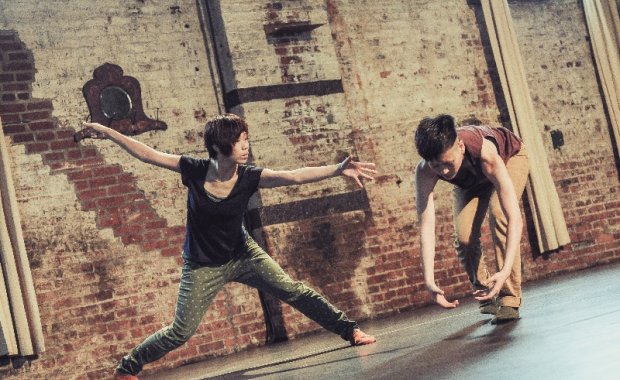
(photo by Mei Yamanaka)

WHITE WAVE Young Soon Kim Dance Company hosts the thirteenth annual DUMBO Dance Festival this week (photo by Mei Yamanaka)

John Ryan Theatre
25 Jay St.
September 26 gala, $100-$250
September 27-29, free
www.whitewavedance.com

The DUMBO Dance Festival returns for its thirteenth year, helping promote up-and-coming dance companies and choreographers from the United States, Korea, England, and Canada, with a particular focus on New York City, but it almost didn’t happen. The waterfront warehouse that host company WHITE WAVE Young Soon Kim Dance Company transformed into the John Ryan Theater was severely damaged by Hurricane Sandy, but a successful GoFundMe campaign made this year’s festival possible, though more donations are needed. Things get under way with a gala fundraiser ($100-$250) on September 26 at the John Ryan Theater featuring performances by Antonio Brown, OUI DANSE/Brice Mousset, Kuperman Brothers, Billy Bell /Lunge Dance Collective, Buglisi Dance Theatre, and WHITE WAVE Young Soon Kim Dance Company, along with opening remarks by John Ryan himself. More than fifty companies will then present short works and excerpts September 27-29 for free, including Maya Orchin’s Recipe, gamin’s Metamorphose, Vangeline Theater’s White Fencing, z3movement project’s I hold nothing, though I embrace the world, Catherine Lawrence’s State of Mind, John J Zullo Dance/Raw Movement’s How Brief Eternity, and Bianca Dancers & Company’s The Woodman Project: Untitled 4. There will be family-friendly programs and classes on September 27, with the grand finale Sunday night at 8:00 consisting of Antonio Brown’s Unwritten, Amalgamate Dance Company’s Inside Aphasia, Jacobs Campbell Dance’s The Box, Alyson Laury’s Lurid, Tiffany Rea-Fisher / Elisa Monte Dance Company’s Identity, and an excerpt from WHITE WAVE Young Soon Kim Dance Company’s Eternal Now. The DUMBO Dance Festival runs concurrently with the DUMBO Arts Festival; WHITE WAVE will be back October 23 – November 10 with its annual Wave Rising Series.

WOMEN OR NOTHING

(photo by Joan Marcus)

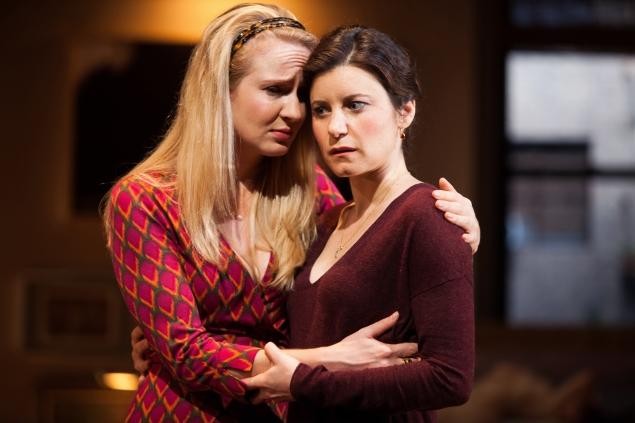
Gretchen (Halley Feiffer) and Laura (Susan Pourfar) come up with a crazy way to have a child in Ethan Coen’s WOMEN OR NOTHING (photo by Joan Marcus)

Atlantic Theater Company
Linda Gross Theater
336 West 20th St. between Eighth & Ninth Aves.
Extended through October 13, $20-$65
866-811-4111
www.atlantictheater.org

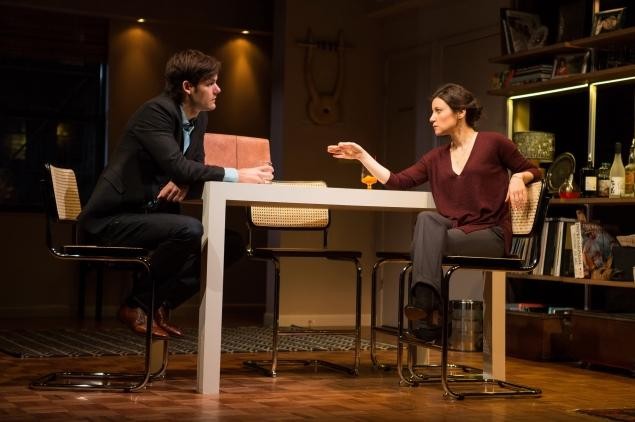
Despite a sitcom-y plot and a trio of severely affected female characters who take a while to warm up to, Ethan Coen’s first full-length play, Women or Nothing, manages to be mildly entertaining and pleasantly amusing. Lawyer Gretchen (Halley Feiffer) and concert pianist Laura (Susan Pourfar) want to have a baby, but they don’t want to adopt or go to a clinic and use an anonymous sperm donor; instead, Gretchen has researched a coworker, Chuck (Robert Beitzel), and decided that Laura, a gold-star lesbian who has never been with a man, should sleep with him in order to get inseminated by someone with desirable genes. “Believe me, this man’s semen is superb,” Gretchen tells her girlfriend. “You’re a wine taster now?” Laura responds. Gretchen comes up with a wacky, somewhat devious, and fairly ridiculous plan that she is positive will land the unknowing Chuck in bed with Laura; unfortunately for the audience, things don’t seem so crystal clear, one of many leaps of faith that Coen and director David Cromer (who directed Pourfar in Tribes, Beitzel in Our Town, and Feiffer in The House of Blue Leaves) ask the audience to accept in this uneven but ultimately likable production. The scene between the easygoing Chuck and the pent-up, elitist, and self-deprecating Laura is a gem, with razor-sharp dialogue and outstanding performances as she tries to get him drunk and not give away the reason behind their carefully arranged meeting. The following morning, Laura’s nosy mother, Dorene (Deborah Rush in a star turn), arrives, and the situation gets even more complicated, as each woman learns surprising things about the other.

Chuck (Robert Beitzel) has no idea what Laura (Susan Pourfar) has in store for him in WOMEN OR NOTHING (photo by Joan Marcus)

Chuck (Robert Beitzel) has no idea what Laura (Susan Pourfar) has in store for him in WOMEN OR NOTHING (photo by Joan Marcus)

But unanswered questions abound, preventing Women or Nothing from reaching the next level. There are no mentions of condoms or ovulation, and there are numerous red herrings, from a poorly hidden group of family photos to a fancy piano on an upper platform that is never brought into play in any manner whatsoever, toying with the audience’s expectations. Coen, who with his brother, Joel, has made such award-winning films as Barton Fink, Fargo, and No Country for Old Men, has also published a book of short stories and a collection of poetry and has written several one-act plays, including Talking Cure, which was one of three works, along with Elaine May and Woody Allen, that made up the 2011 Broadway flop Relatively Speaking. Thus, on his own, Ethan Coen specializes in the short form, and he has trouble sustaining Women or Nothing for its one-hundred-minute running time, with a brief intermission (even though the program says there will not be one). He and Cromer just can’t quite get past the R-rated Three’s Company set-up, though they try their best, resulting in an amiable, if not wholly satisfying, rendezvous, which has been extended through October 13 at the Atlantic Theater Company’s Linda Gross Theater.

LAST CHANCE: BILL TRAYLOR

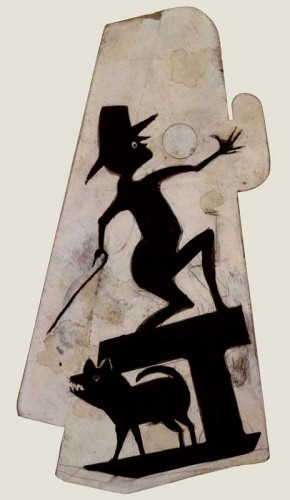
Bill Traylor, “Untitled (Man with Cane on Construction, with Dog),” poster paint, pencil, and colored pencil on cardboard, 1939-42 (Louis-Dreyfus Family Collection)

Bill Traylor, “Untitled (Man with Cane on Construction, with Dog),” poster paint, pencil, and colored pencil on cardboard, 1939-42 (Louis-Dreyfus Family Collection)

American Folk Art Museum
2 Lincoln Square, Columbus Ave. at 66th St.
Sunday, September 22, suggested donation $5, 12 noon – 6:00 pm
212-595-9533
www.folkartmuseum.org

Today is the last day to see a pair of splendid exhibitions on self-taught superstar Bill Traylor at the American Folk Art Museum. “Bill Traylor: Drawings from the Collections of the High Museum of Art and the Montgomery Museum of Fine Arts” and “Traylor in Motion: Wonders from New York Collections” together feature more than one hundred works by Traylor, who was born into slavery on an Alabama plantation in the mid-1850s, where he continued to work after being freed. The drawings date from 1939 to 1942, when he began looking back at his life after moving to Montgomery. He developed a unique visual style involving dark silhouetted figures on cardboard, with occasional blues and reds, that form a kind of memory dance of the black experience in America. They are both charming and frightening, evoking today a kind of mix of Jacob Lawrence and Kara Walker. Seeing so many of Traylor’s works filling the walls at the museum immerses you in his fascinating artistic world, which included between 1,200 and 1,500 drawings made in that whirlwind three-year period. Traylor died in 1949, but his reputation as a fine artist continues to grow, as ably shown by these two exemplary exhibitions.

BROOKLYN BOOK FESTIVAL 2013

brooklyn book festival

Brooklyn Borough Hall and Plaza (and other venues)
209 Joralemon St.
Sunday, September 22, free, 10:00 am – 6:00 pm
www.brooklynbookfestival.org

The eighth annual Brooklyn Book Festival arrives in the world’s best borough September 22 with more than a hundred panel discussions, readings, signings, live performances, workshops, and other special literary events. Below are our can’t-miss picks for a festival that is growing in popularity every year; among the myriad other participants are Sonia Sanchez, Hilton Als, Edwidge Danticat, Pete Hamill, Meg Wolitzer, Claire Messud, Colum McCann, Francesca Lia Block, David Levithan, William C. Rhoden, Touré, Alan Light, Katherine Applegate, Phillip Lopate, Jane Friedman, Jonathan Ames, Sapphire, Tao Lin, Francine Prose, Leonard Lopate, Nicholson Baker, Ben Katchor, Anders Nilsen, A. M. Homes, Meg Cabot, Rebecca Miller, Lemon Andersen, Quincy Troupe, Katherine Applegate, and Donald and Nina Crews.

10:00 am, “Love to Laugh? Loud and Long and Clear?,” with Jeff Smith, Sherri Winston, and Michael Buckley moderated by Eric Luper, Youth Stoop, Borough Hall Plaza / Columbus Park

11:00 am, “Who? New!,” with debut novelists A. X. Ahmad, Caleb Crain, Ursula DeYoung, Michele Forbes, and Ayana Mathis, Borough Hall Courtroom

12 noon, “The World (According to Cartoonists): Border Crossing Comics,” with Adrian Tomine, Rutu Modan, Dash Shaw, and David Prudhomme, moderated by Kent Worcester, St. Francis Auditorium

1:00, “Sin City,” with K’wan Foye, Albert “Prodigy” Johnson, Ivy Pochoda, and Miasha, moderated by S. J. Rozan, Borough Hall Courtroom

2:00, “Love, Villainy, Ethics, and Karaoke: Chuck Klosterman and Rob Sheffield in Conversation,” moderated by Ed Park, Borough Hall Plaza Main Stage

3:00, “The Secret Lives of Girls,” with Lauren Myracle, Meg Cabot, and Sharon M. Draper, moderated by Mitali Dave, Youth Stoop, Borough Hall Plaza / Columbus Park

4:00, “Art Spiegelman and Jules Feiffer in Conversation,” moderated by Benjamen Walker, St. Francis Auditorium

5:00, “Let’s Talk About (Writing) Sex,” with Sam Lipsyte, Amy Grace Loyd, and Susan Choi, moderated by Angela Ledgerwood, Borough Hall Plaza Main Stage

THE COMPASS ROSE

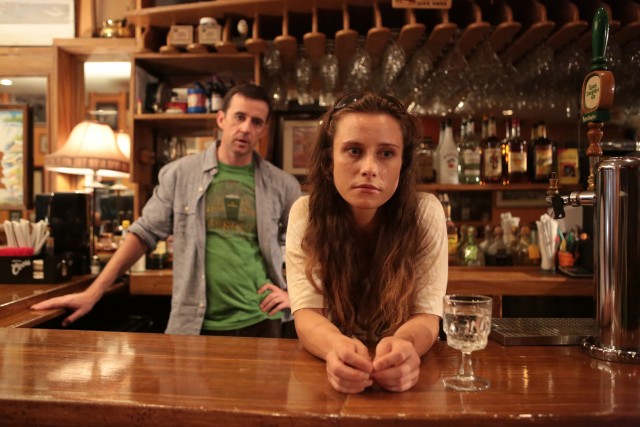
Donall (David Mitchell) and Tiffany (Olivia Horton) wonder what could have been in THE COMPASS ROSE (photo by Steven Schreiber)

Donall (David Mitchell) and Tiffany (Olivia Horton) wonder what could have been in THE COMPASS ROSE (photo by Steven Schreiber)

Ryan’s Daughter
350 East 85th St. between First & Second Aves.
Thursday – Sunday through September 29, $18
212-868-4444
www.fatviolettheater.com
www.1stirish.org

Two lonely souls look back at what might have been in Ronan Noone’s sensitively drawn two-character drama The Compass Rose. The site-specific seventy-minute play takes place in the upstairs pub at Ryan’s Daughter on the Upper East Side, doubling for the Compass Rose on Martha’s Vineyard, as the audience sits at small tables, on stools, or on chairs at the bar. (Drinks are available before and after the show but not during it.) The story begins as Tiffany (Olivia Horton) walks into the Compass Rose, surprising the bartender, Donal (David Mitchell). “What are you doing here?” he says with a combination of anger and trepidation. The play shifts between the present and ten years in the past, when a free-spirited Tiffany invites Donal to accompany her on a cross-country trip to San Francisco, merely for company because her father does not want her to drive so far by herself. Each has a significant other, and they are not interested in starting a relationship, something Tiffany makes clear immediately, and repeatedly. But as they journey through Maine, New York City, Washington, DC, Tennessee, Texas, Las Vegas, and other locations, they share intimate secrets, tell lies, and get to know each other better than they ever thought possible.

the compass rose 2

The time shifts occur instantaneously, signaled by the blink of an eye, a shift of a body, or the movement of sunglasses. It’s a bit jarring at first but ends up working smoothly as the play, directed by David Sullivan, goes on and the changes in time and place more clearly relate to elements of the story. Mitchell (Fair City) and Horton (Tiny Dynamite) have an alluring chemistry that builds to a sizzle, his character dark, moody, cynical, and brooding, hers flirtatious, idealistic, and sometimes brutally cold. They walk all around the bar, stopping right next to members of the audience, but they are careful never to make eye contact with anyone, maintaining the invisible wall between performer and viewer. The natural setting is enhanced by noises going on outside; the night we attended, there was a whole lot of horn blowing from cars on the street, but it had no effect on the actors and added an extra dose of reality to the proceedings. A tender-hearted, insightful, and involving play about, as Donal says, “creating your own myth,” The Compass Rose continues at Ryan’s Daughter through September 29 as part of Origin’s annual 1st Irish Theatre Festival, which also includes The Life & Sort of Death of Eric Argyle and I Can See Clearly Now at 59E59 and McGoldrick’s Thread, The Morons, and A Lady Is Waiting at the Cell in addition to other special music, poetry, and theatrical events.

WHO IS JACK GOLDSTEIN?

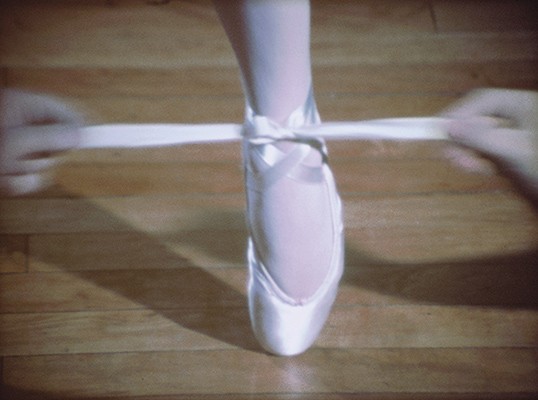
Jack Goldstein, A Ballet Shoe, 16mm film, color, silent, 1975 (Courtesy Galerie Daniel Buchholz, Berlin/Cologne and the Estate of Jack Goldstein)

Jack Goldstein, A BALLET SHOE, 16mm film, color, silent, 1975 (Courtesy Galerie Daniel Buchholz, Berlin/Cologne and the Estate of Jack Goldstein)

The Jewish Museum
1109 Fifth Ave. at 92nd St.
Sunday, September 22, $12, 12:30 – 4:30
Exhibition continues Thursday – Tuesday through September 29, $15 (free admission Saturday 11:00 am – 5:45 pm, pay-what-you-wish Thursday 5:00 – 8:00)
212-423-3200
www.thejewishmuseum.org
www.jackgoldstein-artist.com

In 1973, multimedia artist Jack Goldstein made the short film Jack, in which he, as cameraman, backs away from a man in a desolate landscape who repeatedly calls out, “Jack,” over and over and over again as he fades into the distance. It’s a critical piece in the first American museum retrospective of Goldstein’s work, “Jack Goldstein x 10,000,” which continues through September 29 at the Jewish Museum. The self-destructive Goldstein was known for disappearing during the course of his career, both in his art and in his life, and the Jewish Museum has been examining the iconoclastic figure in a series of programs that have included the exhibition walk-through “What Is Jack Goldstein?” and the panel discussions “Where Is Jack Goldstein?” and “How Is Jack Goldstein?” The museum has saved the best for last, as the final program takes place on September 22, the afternoon symposium “Who Is Jack Goldstein?,” which features a prestigious collection of artists and historians talking about Goldstein’s influence and legacy: Morgan Fisher, Robert Longo, Matt Mullican, Troy Brauntuch, Kathryn Andrews, and Paul Pfeiffer, moderated by Julia Robinson and Claire Bishop. The exhibition itself comprises many of Goldstein’s films in addition to sculpture, sound installations, paintings, and writings. The works display Goldstein’s unique mix of wit and anxiety: In the eight-minute video A Spotlight, Goldstein runs around a room trying to avoid a spotlight, while in the “Burning Window” installation, flickering candles make it seem like a fire is raging behind a window, and there’s nothing anyone can do to stop it.

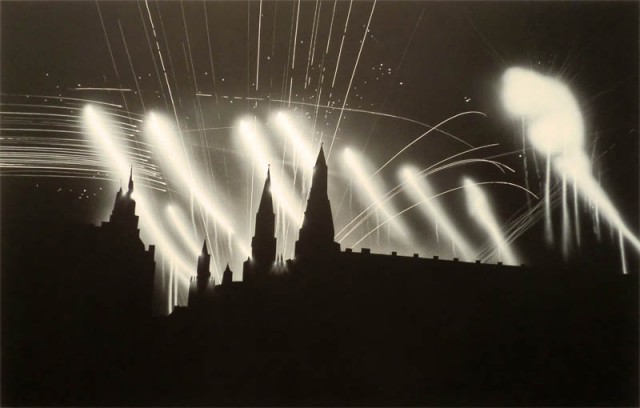
Jack Goldstein, “Untitled,” acrylic on canvas, 1981 (collection Melva Bucksbaum and Raymond J. Learsy)

Jack Goldstein, “Untitled,” acrylic on canvas, 1981 (collection Melva Bucksbaum and Raymond J. Learsy)

Goldstein strips things down to their bare elements in such shorts as Shane, in which a German shepherd barks for three minutes, and A Ballet Shoe, in which two hands tie a ballet shoe on a ballerina’s foot. A series of instructions explains how others can stage some of Goldstein’s performances and installations, once again adding to his theme of the artist’s disappearance. In the mid-to-late-1980s, Goldstein, a heroin addict who was born in Canada in 1945 and spent time in New York before moving to California, where he studied with John Baldessari and became associated with the Pictures Generation, created colorful abstract canvases using appropriated images, the works melding science, computer technology, and psychedelia. The exhibit ends with extracts from Goldstein’s writing — influenced by his penchant for reading philosophy books backward — in which he experimented with new word-processing techniques and repurposed words from other writers in order to form his own personal narrative. In a 1985 interview with the Tate’s Chris Dercon, Goldstein, who hanged himself in his backyard in 2003 at the age of fifty-eight, said, “You wake up in the morning and look at yourself and go, ‘Who is that?’ and ‘What is that?’ and ‘What do you call it?’ and ‘What’s my name?,’” later adding, “My name, it’s the name of a name. It’s not my name. . . . Imagine, if you look in the telephone book, there must be ten thousand Jack Goldsteins.” This revealing survey goes a long way toward establishing just who this Jack Goldstein is, although all of the mysteries are likely never to be solved.