Documentary tells the engaging story of a pair of Japanese artists and the life they have made for themselves in Brooklyn
CUTIE AND THE BOXER (Zachary Heinzerling, 2013)
IndieScreen
289 Kent Ave.
October 5 (5:00 & 7:00), 8 (7:00), 9 (7:00)
347-227-8030
www.indiescreen.us
www.facebook.com/cutieandtheboxer
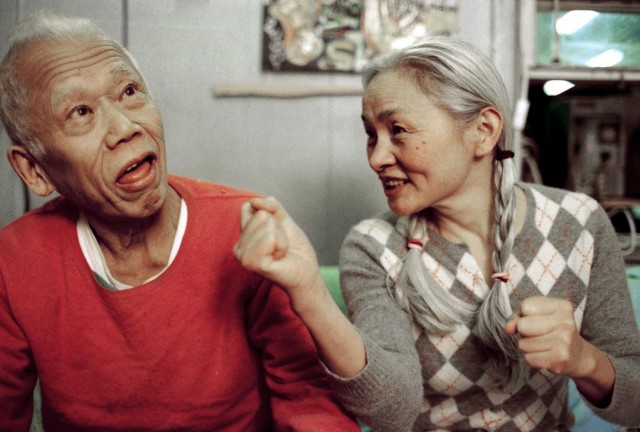
 Zachary Heinzerling’s Cutie and the Boxer is a beautifully told story of love and art and the many sacrifices one must make to try to succeed in both. In 1969, controversial Japanese Neo Dada action painter and sculptor Ushio Shinohara came to New York City, looking to expand his career. According to the catalog for the recent MoMA show “Tokyo 1955-1970: A New Avant-Garde,” which featured four works by Ushio, “American art had seemed to him to be ‘marching toward the glorious prairie of the rainbow and oasis of the future, carrying all the world’s expectations of modern painting.’” Four years later, he met nineteen-year-old Noriko, who had left Japan to become an artist in New York as well. The two fell in love and have been together ever since, immersed in a fascinating relationship that Heinzerling explores over a five-year period in his splendid feature-length theatrical debut. Ushio and Noriko live in a cramped apartment and studio in DUMBO, where he puts on boxing gloves, dips them in paint, and pounds away at large, rectangular canvases and builds oversized motorcycle sculptures out of found materials. Meanwhile, Noriko, who has spent most of the last forty years taking care of her often childlike husband and staying with him through some rowdy times and battles with the bottle, is finally creating her own work, an R. Crumb-like series of drawings detailing the life of her alter ego, Cutie, and her often cruel husband, Bullie. (“Ushi” means “bull” in Japanese.) While Ushio is more forthcoming verbally in the film, mugging for the camera and speaking his mind, the pig-tailed Noriko is far more tentative, so director and cinematographer Heinzerling brings her tale to life by animating her work, her characters jumping off the page to show Cutie’s constant frustration with Bullie.
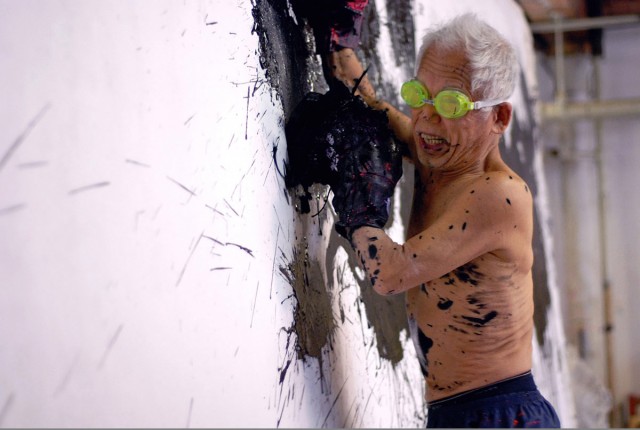
Ushio Shinohara creates one of his action paintings in CUTIE AND THE BOXER
During the course of the too-short eighty-two-minute film — it would have been great to spend even more time with these unique and compelling figures — the audience is introduced to the couple’s forty-year-old son, who has some issues of his own; Guggenheim senior curator of Asian Art Alexandra Munroe, who stops by the studio to consider purchasing one of Ushio’s boxing paintings for the museum; and Chelsea gallery owner Ethan Cohen, who represents Ushio. But things never quite take off for Ushio, who seems to always be right on the cusp of making it. Instead, the couple struggles to pay their rent. One of the funniest, yet somehow tragic, scenes in the film involves Ushio packing up some of his sculptures — forcing them into a suitcase like clothing — and heading back to Japan to try to sell some pieces. Cutie and the Boxer is a special documentary that gets to the heart of the creative process as it applies both to art and love, focusing on two disparate people who have made a strange yet thoroughly charming life for themselves. Cutie and the Boxer is currently showing in Ushio and Noriko’s home borough of Brooklyn, where it will continue at IndieScreen through October 9.
Academy Award Nomination: Best Documentary Feature
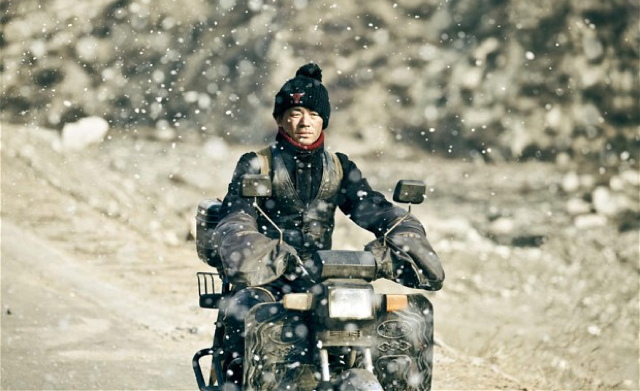
 During his sixteen-year career, Sixth Generation Chinese filmmaker Jia Zhangke has made both narrative works (The World, Platform, Still Life) and documentaries (Useless, I Wish I Knew), with his fiction films containing elements of nonfiction and vice versa. Such is the case with his latest film, the powerful A Touch of Sin, which explores four based-on-fact outbreaks of shocking violence in four different regions of China. In Shanxi, outspoken miner Dahai (Jiang Wu) won’t stay quiet about the rampant corruption of the village elders. In Chongqing, married migrant worker and father Zhao San (Wang Baoqiang) obtains a handgun and is not afraid to use it. In Hubei, brothel receptionist Ziao Yu (Zhao Tao, Jia’s longtime muse and now wife) can no longer take the abuse and assumptions of the male clientele. And in Dongguan, young Xiao Hui (Luo Lanshan) tries to make a life for himself but is soon overwhelmed by his lack of success. Inspired by King Hu’s 1971 wuxia film A Touch of Zen, Jia also owes a debt to Max Ophüls’s 1950 bittersweet romance La Ronde, in which a character from one segment continues into the next, linking the stories. In A Touch of Sin, there is also a character connection in each successive tale, though not as overt, as Jia makes a wry, understated comment on the changing ways that people connect in modern society. In depicting these four acts of violence, Jia also exposes the widening economic gap between the rich and the poor and the social injustice that is prevalent all over contemporary China — as well as the rest of the world — leading to dissatisfied individuals fighting for their dignity in extreme ways. A gripping, frightening film that earned Jia the Best Screenplay Award at Cannes this year, A Touch of Zen opens October 4 at Lincoln Plaza and the IFC Center, with Jia and Zhao appearing at Lincoln Plaza for a Q&A following the 4:55 screening and to introduce the 7:25 show, after which they will head over to IFC for a Q&A following the 7:00 screening and to introduce the 9:35 show.