Formed at the spur of the moment when lead singer and lyricist Meredith Graves was asked to perform a song in the upcoming Scott Coffey movie Adult World (starring John Cusack and Emma Roberts), Syracuse-based punks Perfect Pussy are out on the road in support of their demo/EP, April’s fearsome four-track, thirteen-minute I have lost all desire for feeling. Her voice buried in the mix, well-read art aficionado Graves channels early Sonic Youth as she screams, “I’m a real piece of shit / I’m a real lost cause / Dare to act like you’re surviving and get thrown to the dogs,” in “IV,” continuing, “Every dog deserves forgiveness / no matter who he bit / I’m a real lost cause / I’m a real piece of shit.” But Perfect Pussy is no lost cause, tearing through vicious songs that even feature an occasional synth line and, of course, lots of feedback. Yes, as in Graves’s previous band, Shoppers, the songs are titled with sequential Roman numerals, although she claims it is not for artistic reasons this time around but just that she couldn’t decide what to call the deeply personal confessions. Well, we call them fuckin’ awesome. Graves, guitarist Ray McAndrew, noise synthesist Shaun Sutkus, bassist Greg Ambler, and drummer Garrett Koloski will be at 285 Kent on November 22 with Beach Fossils and on November 23 with Shannon and the Clams, then the band will be back for a show at NYU’s Kimmel Center on December 5 with Ceremony, White Lung, and Sleepies.
twi-ny recommended events
DOC NYC CLOSING NIGHT: IS THE MAN WHO IS TALL HAPPY?
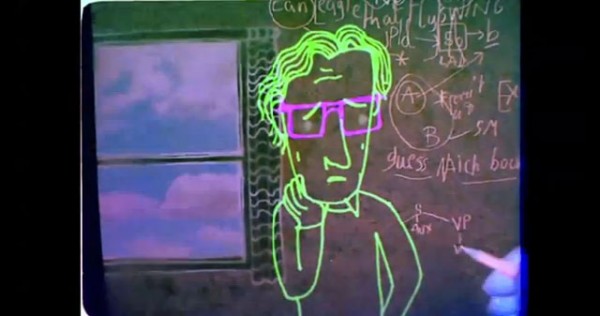
Michel Gondry details a series of animated conversations with Noam Chomsky in brilliant new documentary
IS THE MAN WHO IS TALL HAPPY? AN ANIMATED CONVERSATION WITH NOAM CHOMSKY (Michel Gondry, 2013)
Thursday, November 21, SVA Theatre, 333 West 23rd St. between Eighth & Ninth Aves., 7:00
IFC Center
323 Sixth Ave. at West Third St.
Opens Friday, November 22
212-924-7771
www.docnyc.net
www.ifccenter.com
 As it turns out, Michel Gondry’s exciting new documentary, Is the Man Who Is Tall Happy? An Animated Conversation with Noam Chomsky, is animated in more ways than one. The fifty-year-old French director initially set out to go toe-to-toe with the controversial octogenarian linguist and philosopher, but he realized early on that the battle was lost. So when editing the series of interviews he had with Chomsky over the course of several months in 2010, he decided to illustrate the film with animated cartoon drawings, only occasionally showing the live-action Chomsky, often in a small box or circle within a colorfully rendered scene. After an attempt to impress Chomsky — the author of such books as Syntactic Structures; Cartesian Linguistics: A Chapter in the History of Rationalist Thought; Studies on Semantics in Generative Grammar; and The Logical Structure of Linguistic Theory — with his own views on image and representation, Gondry becomes embarrassed. “As you can see,” he says while the handwritten words appear on the screen, “I felt a bit stupid here. Let me explain: I think I couldn’t get my point through to Noam. Misuse of words and heavy accent aggravated my attempt.” Chomsky and Gondry go on to explore such concepts as generative grammar, language acquisition, and psychic continuity as Gondry, the director of such offbeat films as Eternal Sunshine of the Spotless Mind, The Science of Sleep, Human Nature, and Be Kind, Rewind, makes his endearing, often childlike drawings, a genius counterpoint to Chomsky’s cool and calm super-intellectualism.
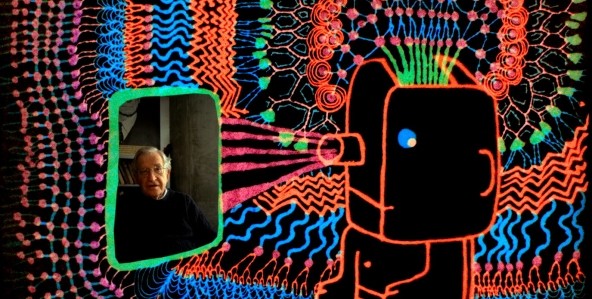
Michel Gondry comes up with a unique way to depict Noam Chomsky in IS THE MAN WHO IS TALL HAPPY?
Gondry does get Chomsky to open up a little about his personal life, especially his relationship with his late wife, and they wisely avoid politics. The film eventually takes a hysterical turn when Gondry realizes that he better finish it soon, since it’s been three years since he conducted the talks with Chomsky and he wants to make sure he finishes it before Chomsky dies. In the end, Gondry manages to level the playing field as the two men diagram the title question. Is the Man Who Is Tall Happy? is an absolute treat, a fun and fascinating examination of human intelligence, the creative process, the manipulative relationship between director and viewer, and the essence of film and storytelling itself. Is the Man Who Is Tall Happy? is the closing-night selection of DOC NYC, screening November 21 at 7:00 at the SVA Theatre, and will be followed by a discussion with Gondry and Chomsky, moderated by Anthony Arnove. The film then opens on Friday, November 22, at the IFC Center, with Gondry participating in Q&As following the 6:10 and 8:15 shows on Friday and Saturday.
THE BERLIN SCHOOL — FILMS FROM THE BERLINER SCHULE: BARBARA
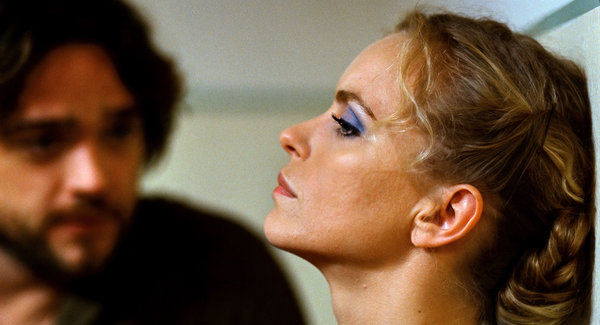
Andre (Ronald Zehrfeld) and Barbara (Nina Hoss) try to retain their humanity under difficult conditions in 1980 East Germany
BARBARA (Christian Petzold, 2012)
MoMA Film, Museum of Modern Art
11 West 53rd St. between Fifth & Sixth Aves.
Saturday, November 23, 7:30, and Friday, December 6, 7:00
Series runs November 20 – December 6
Tickets: $12, in person only, may be applied to museum admission within thirty days, same-day screenings free with museum admission, available at Film and Media Desk beginning at 9:30 am
212-708-9400
www.moma.org
www.adoptfilms.net
 Christian Petzold’s Barbara is a gripping, eerily slow-paced psychological thriller that explores fear, paranoia, and responsibility. Nina Hoss, in her fifth film with writer-director Petzold, gives a subtly powerful performance as Barbara Wolff, an East German doctor who has been shipped off by the government to a country hospital run by Andre (Ronald Zehrfeld). It is 1980, and Barbara has done something to get on the GDR watch list, causing her to be under near-constant surveillance. She carefully looks around everywhere she goes, wondering if the woman on the bus, the man out for a smoke, or the person on the pay phone is working for the Stasi. She is most suspicious of Andre as he attempts to get close to her, asking her personal questions and trying to spend more and more time with her. Meanwhile, Barbara has secret meetings with various people, including her West German lover, Jörg (Mark Waschke), who wants to get her out of the east. But as much as Barbara wants to live a free and open life, she is also a dedicated doctor who has become attached to two patients: Stella (Jasna Fritzi Bauer), a pregnant woman who does not want to be sent back to a labor camp, and Mario (Jannik Schümann), who has suffered a potentially fatal head injury following a suicide attempt.

Barbara (Nina Hoss) has to watch her every move in powerful cold war drama
Petzold (Something to Remind Me, Wolfsburg, Yella), inspired by the likes of Claude Chabrol, To Have and Have Not, and The French Connection, drapes Barbara in a compulsive feeling of paranoia and dread, creating a blanketing atmosphere of mystery and imminent danger in which one wrong move can result in capture, imprisonment, or worse. Wrapped in a cloak of suspicion, Barbara evokes for the viewer what living in 1980 East Germany might have been like. The complex relationship between Barbara and Andre is handled with great skill by Petzold, balancing their individual needs with their responsibilities to their profession and the state. Germany’s official submission for the 2012 Best Foreign Language Film, Barbara is a tense tale that examines the cold war in unique and fascinating ways. Barbara is screening on November 23 at 7:30 and December 6 at 7:00 as part of the MoMA series “The Berlin School: Films from the Berliner Schule,” with Petzold and Hoss on hand to introduce the November 23 show. The series continues through December 6 with such other works by directors associated with the Berlin School as Thomas Arslan’s Brothers and Sisters and Gold, Ulrich Köhler’s Sleeping Sickness, and Christoph Hochhäusler’s The City Below.
HOT DERN! SILENT RUNNING
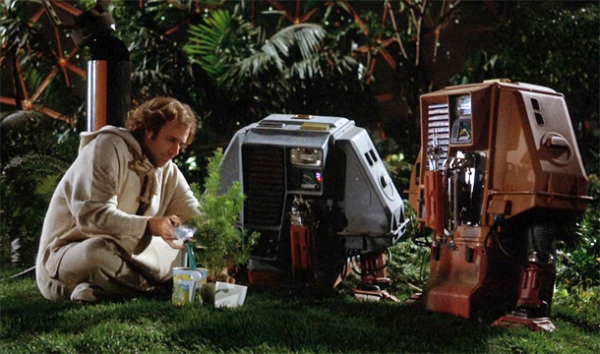
Freeman Lowell (Bruce Dern) and drones Dewey and Huey tend to a space garden in SILENT RUNNING
SILENT RUNNING (Douglas Trumbull, 1972)
BAMcinématek, BAM Rose Cinemas
30 Lafayette Ave. between Ashland Pl. & St. Felix St.
Thursday, November 21, 4:30, 7:00, 9:30
Series runs through November 27
718-636-4100
www.bam.org
 Special effects master Douglas Trumbull, who worked on such sci-fi classics as 2001: A Space Odyssey, Close Encounters of the Third Kind, and Blade Runner, made his feature directorial debut with the environmentally prescient Silent Running. Bruce Dern stars as Freeman Lowell, one of four men stationed on the space terrarium Valley Forge, which is charged with protecting forests that can no longer grow on Earth. While it’s just another assignment for John Keenan (Cliff Potts), Marty Barker (Ron Rifkin), and Andy Wolf (Jesse Vint), it’s become an obsession for Lowell, who sleeps under a “Conservation Pledge” on the wall next to his bed and only eats food from his massive garden. But when the captain of the Berkshire (voiced by Joseph Campanella) informs them that the forests must be destroyed and they are to return home, Lowell takes matters into his own hands, fighting to protect what he has helped create. Soon he is alone on the Valley Forge, tending to the forest with drones Huey (Cheryl Sparks) and Dewey (Mark Persons), as Louie (Steven Brown) is no longer with them. At first Lowell thinks he is in his own private paradise, but extreme loneliness awaits him, along with some other shocks. Written by Deric Washburn and Michael Cimino (The Deer Hunter) and Steven Bochco (Hill Street Blues, L.A. Law), the low-budget Silent Running is a deserving cult classic, a worthy influence on such films and television shows as WALL-E, Moon, Mystery Science Theater 3000, and Red Dwarf. Emerging from the late-1960s Flower Power movement, the film’s ecological theme is boosted by environmentally friendly folk songs sung by Joan Baez, with overly melodramatic music by Peter Schickele. Dern gives a beautifully nuanced performance as Lowell, going from calm and meditative to distressed and angry in a heartbeat, and his paternal relationship with Huey and Dewey is both heartwarming and heartbreaking. A film that could only be made in the 1970s, with bright, bold colors and cheesy futuristic sets, Silent Running is screening on November 21 as part of the BAMcinématek series “Hot Dern!” which pays tribute to the seventy-seven-year-old Dern, the father of Laura Dern and former husband of Diane Ladd, on the occasion of the U.S. theatrical release of Alexander Payne’s Nebraska, for which Dern was named Best Actor at Cannes. The series continues through November 27 with such other wide-ranging Dern films as Psych-Out, Wild Bill, The Laughing Policeman, and Smile. In addition, Dern will be at BAM on December 4 for “An Evening with Bruce Dern,” which will include a screening of Nebraska followed by an extended Q&A with the actor.
THE MIDDLE AGES ON FILM — SHAKESPEARE: THRONE OF BLOOD
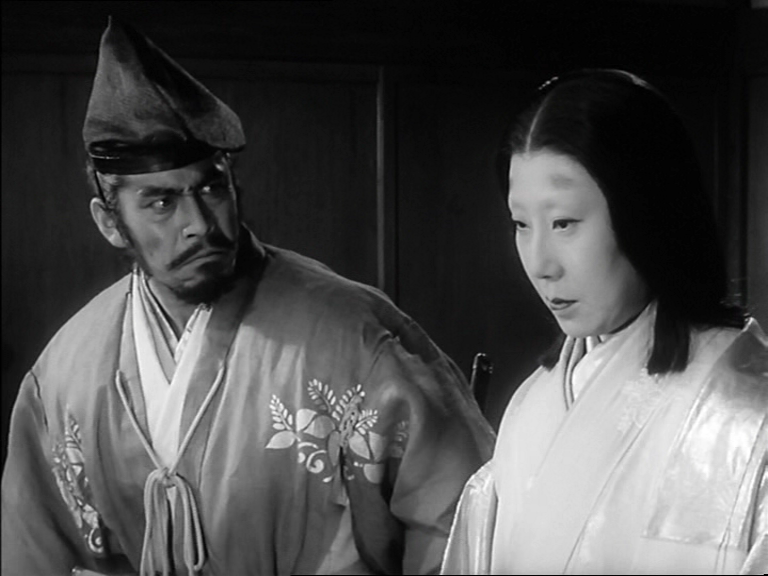
Washizu (Toshirô Mifune) and his wife, Asaji (Isuzu Yamada), reimagine Shakespeare’s MACBETH in Kursosawa classic THRONE OF BLOOD
THRONE OF BLOOD, AKA MACBETH (KUMONOSU JÔ) (Akira Kurosawa, 1957)
Anthology Film Archives
32 Second Ave. at Second St.
Thursday, November 21, 9:15; Sunday, November 24, 3:45; and Sunday, December 1, 5:30
Series runs November 20 – December 1
212-505-5181
www.anthologyfilmarchives.org
 Akira Kurosawa’s marvelous reimagining of Macbeth is an intense psychological thriller that follows one man’s descent into madness. Following a stunning military victory led by Washizu (Toshirô Mifune) and Miki (Minoru Chiaki), the two men are rewarded with lofty new positions. As Washizu’s wife, Asaji (Isuzu Yamada, with spectacular eyebrows), fills her husband’s head with crazy paranoia, Washizu is haunted by predictions made by a ghostly evil spirit in the Cobweb Forest, leading to one of the all-time classic finales. Featuring exterior scenes bathed in mysterious fog, cinematographer Asakazu Nakai’s interior long shots of Washizu and Asaji in a large, sparse room carefully considering their next bold move, and composer Masaru Sato’s shrieking Japanese flutes, Throne of Blood is a chilling drama of corruptive power and blind ambition, one of the greatest adaptations of Shakespeare ever put on film Throne of Blood is screening November 21, November 24, and December 1 as part of the Anthology Film Archives series “The Middle Ages on Film: Shakespeare,” consisting of ten cinematic adaptations of several of the Bard’s history plays, set in the Middle Ages, including Laurence Olivier’s Henry V, Roman Polanski’s Macbeth, Orson Welles’s Chimes at Midnight, and Peter Brook’s King Lear. The twelve-day festival was curated in collaboration with professor and scholar Martha Driver, who notes, “Through film, Shakespeare’s Middle Ages are not lost but revived and revitalized in translation. And much of what we think we know about the medieval period has been shaped by Shakespeare, the plays and film adaptations living on in our memories more vividly perhaps than the history books’ accounts.”
THE MUTILATED
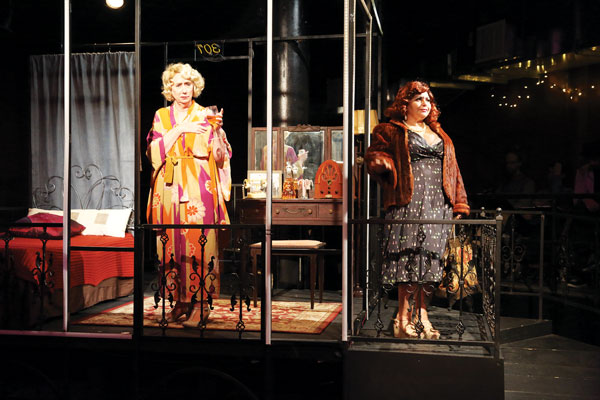
Trinket (Mink Stole) and Celeste (Penny Arcade) are looking for love and friendship on Christmas Eve in Tennessee Williams one-act (photo by Scott Wynn)
New Ohio Theatre
154 Christopher St.
Tuesday – Sunday through December 1, $35
888-596-1027
www.newohiotheatre.org
“We all have our mutilations,” Celeste Delacroix Griffin says in Tennessee Williams’s The Mutilated. The ninety-minute one-act, which flopped on Broadway in 1966 as part of a double bill with The Gnädiges Fräulein collectively titled Slapstick Tragedy, is currently playing to sold-out audiences at the intimate New Ohio Theatre, its first New York revival in thirty-eight years. An ample dose of slapstick and tragedy, the play features Warhol Factory star Penny Arcade (B*TCH!DYKE!FAGHAG!WH*RE!) as Celeste and John Waters muse Mink Stole (Pink Flamingos, Female Trouble) as her best friend / feared enemy, Trinket Dugan. With those leads — in roles originated by Kate Reid and Margaret Leighton, respectively — one might expect director Cosmin Chivu’s version to be a camp fest, but this adaptation ends up taking things fairly seriously. It’s Christmas Eve in 1940s New Orleans, and Celeste has just gotten out of the hoosegow only to find herself locked out of her room at the low-rent Silver Dollar Hotel. A buxom broad in a torn mink wrap, she’s more than down on her luck, but she’s tireless, setting her sights on burying the hatchet with Trinket, a lonely oil heiress (of sorts) with a shameful secret only Celeste knows about. But it’s clear that Celeste and Trinket belong together, despite their bitter feud; in fact, the play is very much about how two is more desirable than one. “In life there has to be two!” Trinket declares in a long soliloquy. When a pair of sailors (Niko Papastefanou and Patrick Darwin Williams) come around looking for some fun, both Celeste and Trinket jump at the opportunity to have male company on Christmas Eve, but love is not exactly in the cards for these two very different yet oddly similar women.
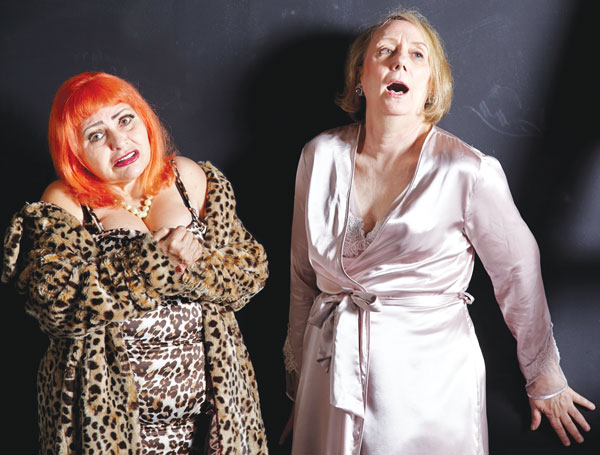
Downtown legends Penny Arcade and Mink Stole team up in Tennessee Williams’s THE MUTILATED (photo by Cosmin Chivu)
The Mutilated actually gets going about twenty minutes before its official start time, with trumpeter Jesse Selengut and his Tin Pan band (Sam Kulik, Adam Brisban, and Anders Zelinski) serenading the arriving audience with raunchy New Orleans–style jazz and blues; they also accompany a group of carolers throughout the show who sing original songs as well as Williams’s own carol, which begins, “I think the strange, the crazed, the queer / Will have their holiday this year / And for a while, a little while / There will be pity for the wild / A miracle, a miracle! / A sanctuary for the wild.” Anka Lupes’s open set includes lighted doorless entries to the hotel, the Bohème nightclub (aptly named, as Celeste and Trinket are a kind of alternate Mimi and Francine), and Trinket’s tiny apartment. Whatever other scenery there might have been has apparently been chewed up by Arcade, who overplays her part with relish, looking like Roseanne Barr gone on a rampage. But Stole provides a gentle counterpoint as Trinket, the two coming together to find a necessary balance, their own version of Blanche and Stella. They also bring to mind a tragic Laurel and Hardy or Abbott and Costello duo, with Stole tall and thin and Arcade short and stout. Even their real names are opposites: “Mink Stole” evoking the rich and fashionable, “Penny Arcade” suggesting the cheap and old-fashioned. (And, furthering the actor-character integration, it’s Arcade who is wearing the mink in the show.) There’s been an abundance of Williams on and off Broadway over the last few years, including the current dazzling production of The Glass Menagerie at the Booth with Cherry Jones and Zachary Quinto, but it’s a treat that such lesser-known yet compelling and integral works as The Two-Character Play and The Mutilated are getting their due as well.
JFK/NYC/OMG: EXAMINING CONSPIRACIES ON THE 50th ANNIVERSARY OF THE ASSASSINATION OF JFK

THREE ROOMS PRESS PRESENT THE MONTHLY @ CORNELIA STREET CAFE
Cornelia Street Cafe
29 Cornelia St. between Bleecker & West Fourth Sts.
Friday, November 22, $20, 6:00
212-989-9319
www.corneliastreetcafe.com
www.threeroomspress.com
Fifty years ago this Friday, the United States, and the world, suffered a tragic loss, as President John F. Kennedy was assassinated as his motorcade traveled through Dealey Plaza in Dallas. For the last five decades, people have been arguing about what actually happened that day. On November 22, 2013, a group of artists will gather at the Cornelia Street Cafe to consider some of those theories for “JFK / NYC / OMG: Examining Conspiracies on the 50th Anniversary of the JFK Assassination.” Part of the ongoing Three Rooms Press series “The Monthly @ Cornelia Street Cafe: A Monthly Blend of Voices in Literature, Art & Politics Exploring Contemporary Ideas,” the JFK presentation brings together poet, novelist, and publisher Charles Plymell (Zap Comix), who was with Neal Cassady and Allen Ginsberg at the time of the shooting; Ginsberg protégé Peter Hale, who will read his mentor’s poem “Thanksgiving,” written the wee after the assassination; X vocalist Exene Cervenka, who, as Christine Notmyrealname posts conspiracy therapist sessions on YouTube; former Hüsker Dü drummer Grant Hart, who will discuss the impact of the JFK assassination on his generation; music journalist Legs McNeil ( Please Kill Me: The Uncensored Oral History of Punk), whose next book will be Tomorrow Is Cancelled: The Oral History of the JFK Assassination; and Peter Carlaftes, the codirector (with Kat Georges) of Three Rooms Press and star of the one-man show Lenny Bruce: Dead and Well. The Three Rooms Press series continues December 6 at Cornelia Street Cafe with “The Best Things Come in Threes: Prose! Poetry! Party!” featuring three sets of three writers reading from their works.