twi-ny recommended events

THREE BY DAVID O. RUSSELL: THE FIGHTER

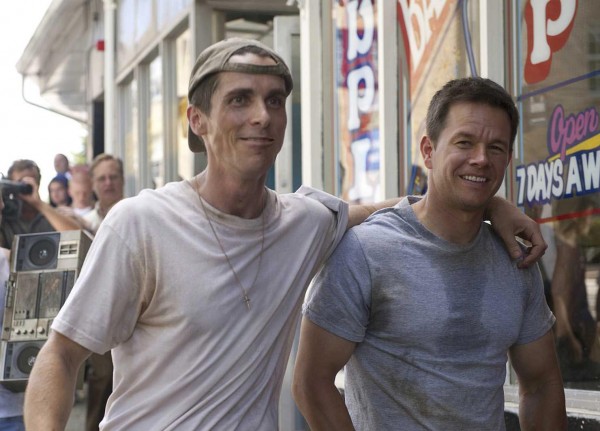
Brothers Dicky Eklund (Christian Bale) and “Irish” Micky Ward (Mark Wahlberg) go through good times and bad in THE FIGHTER

Brothers Dicky Eklund (Christian Bale) and “Irish” Micky Ward (Mark Wahlberg) go through good times and bad in David O. Russell’s THE FIGHTER

THE FIGHTER (David O. Russell, 2010)
Museum of the Moving Image
35th Ave. at 36th St., Astoria
Saturday, November 23, free with museum admission, 7:00
Series continues through December 19
718-777-6800
www.movingimage.us
www.thefightermovie.com

A lot of professional fighters face adversity in and out of the ring, but “Irish” Micky Ward took it to a whole new level on his quest to be welterweight champion of the world, as documented in the winning motion picture The Fighter. Ward (Mark Wahlberg) surrounded himself with his family, with his mother, Allice Eklund (Melissa Leo), as his manager, his half-brother, the Pride of Lowell (for once knocking down Sugar Ray Leonard), Dicky Eklund (Christian Bale), as his trainer, and his many big-haired sisters, including Tar (Erica McDermott), Little Alice (Melissa McMeekin), Pork (Bianca Hunter), Red Dog (Dendrie Taylor), and Beaver (Kate O’Brien), part of the team as well. Despite getting pummeled over and over again and continually finding his brother at a condemned crack house, Micky stands by the family until Dicky is back in prison and Micky finally decides to go with a new promoter. As his stock begins to rise again, he is deeply affected by his separation from his family, who are blaming the parting on his new girlfriend, local bartender Charlene (Amy Adams). Based on the true story of the Ward/Eklund clan of Lowell, Massachusetts, The Fighter is a poignant tale of fighting and family, of love and responsibility. Bale is a whirlwind as the effusive, drug-addicted Dicky, who dreams of helping his brother get a title shot even as he misses training sessions because of his dependence on crack. Leo, who nearly steals the show, is virtually unrecognizable as Alice, who can’t understand why Micky would go with a new crew and has quite a few battles of her own with Charlene. And Walhlberg, who trained for several years to get himself in shape for the film, is strong and solid as the conflicted yet determined potential boxing champion. Director David O. Russell (Three Kings) gives The Fighter a realistic feel, at times echoing the documentary that HBO made about Dicky in the movie, and even hiring Ward’s trainer, Mickey O’Keefe, to play himself. In fact, much of the cast got to meet their real-life counterparts, all of whom loved how they were portrayed onscreen, which is actually quite funny once you see how some of them come off. You don’t have to love boxing to love The Fighter, although fans of the sweet science will be impressed by the carefully choreographed fight scenes, complete with the original HBO commentary (and shot by some of the same cameramen). Nominated for six Academy Awards including Best Picture, Best Director, and Best Original Screenplay, with Leo winning Best Supporting Actress and Bale taking home the trophy for Best Supporting Actor, The Fighter is screening November 23 at the Museum of the Moving Image, kicking off the series “Three by David O. Russell” in anticipation of the December release of his latest film, American Hustle. The series continues December 7-8 with Silver Linings Playbook, followed by a special presentation of American Hustle on December 19, with Russell on hand to discuss it.


WORKS BY HANNA SCHAICH AND JANET BIGGS

EVELYN

Hanna Schaich’s EVELYN is one of three of her works that will mark her New York debut on November 23

Microscope Gallery
4 Charles Pl. at Myrtle Ave.
Saturday November 23, free (suggested donation $6), 7:00
347-925-1433
www.microscopegallery.com

Earlier this year, Brooklyn-based visual artist Janet Biggs teamed up with French-born Montréal installation artist Aude Moreau on a dual show at Smack Mellon as part of the “Brooklyn/Montréal” cultural exchange. Now Biggs is collaborating with German artist Hanna Schaich on a one-night-only project November 23 at Microscope Gallery in Bushwick. The evening will consist of three short films by Schaich, in her New York debut, and two by Biggs, selected by Schaich, followed by an in-depth conversation. The two works by Biggs, Brightness All Around and In the Cold Edge, were both shot during trips to the Arctic and investigate individual identity amid unique, dangerous environments. “There is clearly a performative side to my work that has to do with me physically and psychologically pushing myself or assuming some kind of risk in order to capture the images and action needed for a piece,” Biggs told us in a 2011 twi-ny talk. “I didn’t realize I was such a thrill seeker until I set out to make this kind of work. This part of my process is compelling enough that I often find myself looking for new challenges, although my exploration of the addictive nature of risky behavior is primarily as a witness to someone else’s action and off-camera.”

IN THE COLD EDGE

Janet Biggs fires a warning shot in the frozen north in her short film IN THE COLD EDGE

Schaich, who was born and raised in Berlin but is now based in Brooklyn as well, will be showing Evelyn, a portrait of an elderly woman going for a swim in a pool; Taking Over, which involves an ice-cream truck and an ice-skating rink; and Falling Into, which also deals with ice skating (and the Central Park Zoo). The latter two films evoke Biggs’s journeys to freezing zones, finding a common language between the filmmakers. “My artistic work focuses on body-related video performances and installations,” Schaich explains in her official artist statement. “My body is my tool in my artwork and takes up a large and important part of my conceptual work. Paradoxical action sequences and storylines, and playing with gender and gender roles, are key to my work.” Schaich and Biggs met earlier this year and have become fast friends, so this should be an intimate, fun, and fascinating evening.

NARCO CULTURA

NARCO CULTURA

Narcocorrido star Edgar Quintero contemplates his next big hit in NARCO CULTURA

NARCO CULTURA (Shaul Schwarz, 2013)
AMC Empire 25
234 West 42nd St. between Seventh & Eighth Aves.
Opens Friday, November 22
212-398-2597
www.narcoculture.com
www.amctheatres.com

“They say that it’s safe on the other side, that people don’t kill over there. But the narcos are over here,” a young boy says at the beginning of Shaul Schwarz’s startling documentary, Narco Cultura. The child is standing on the Mexican side of the fence that separates one of the most dangerous cities in the world, Juárez, where 3,622 murders occurred in 2010, from the safest in the United States, El Paso, Texas, which had only five murders that same year. In the film, Israeli-born, New York-based photojournalist Schwarz (The Block) examines the exploding narco culture, in which a growing number of men, women, and children in Mexico and America cheer on guns and violence and turn drug lords into heroes. Serving as director and cameraman, Schwarz follows Juárez native Richi Soto, a crime scene investigator who covers his face when on the job to hide his identity, as colleagues keep getting targeted for assassination, and LA-based narcocorrido singer-songwriter Edgar Quintero, who pens individually commissioned tunes for drug cartel members and later performs them with his popular group, BuKnas de Culiacan. While Soto lives in fear, continuing to do his duty even though some ninety-seven percent of murder cases end up not getting investigated by the police, Quintero is famous, appearing at sold-out concerts and starring in quickie films that glorify violence and drug culture. Schwarz, who served in the Israeli Air Force and has covered conflicts in Haiti, the Gaza Strip, and other hot spots around the world, gets right on the front lines, showing horrific scenes of violence while avoiding any talking-head experts, letting the staggering numbers and the rivers of blood speak for themselves, the real-life results of the failed war on drugs.

THE BERLIN SCHOOL — FILMS FROM THE BERLINER SCHULE: THE ROBBER

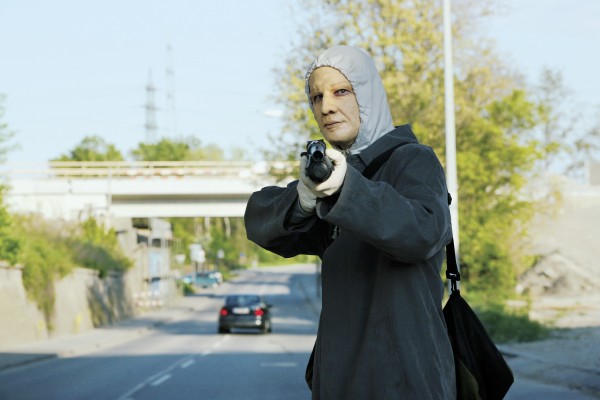
Marathon champion can’t stop his thieving ways in THE ROBBER

Marathon champion can’t stop his thieving ways in THE ROBBER

DER RAÜBER (THE ROBBER) (Benjamin Heisenberg, 2010)
MoMA Film, Museum of Modern Art
11 West 53rd St. between Fifth & Sixth Aves.
Sunday, November 24, 2:00, and Friday, November 29, 7:00
Series runs November 20 – December 6
Tickets: $12, in person only, may be applied to museum admission within thirty days, same-day screenings free with museum admission, available at Film and Media Desk beginning at 9:30 am
212-708-9400
www.moma.org
www.kinolorber.com

Director Benjamin Heisenberg and star Andreas Lust take viewers on a breathless thrill ride in The Robber. Adapted from Martin Prinz’s novel about real-life 1980s Austrian marathon champion and bank robber Johann Kastenberger, The Robber focuses on Johann Rettenberger (Lust), a grim, ultra-serious man who has just been released from prison after serving six years for armed robbery. Although he tells his parole officer (Markus Schleinzer) that his thieving days are over, Rettenberger seems unable to stop grabbing his shotgun, donning his trademark facemask, and stealing cars and robbing banks. But his motives remain unclear, as he merely stashes the cash under his bed, not using it for himself or giving it away. He initially does not appear prone to violence either, but his cold-blooded stares and inability to really connect with others signal a man threatening to explode at any moment. When not robbing banks, Rettenberger is either training for or running in marathons, a skill that also helps him avoid the police. Despite Rettenberger’s intensely secretive personality, a social worker named Erika (Franziska Weisz) falls for him, putting him up in her house while she imagines he is looking for work and trying to get his life back together. But not even love can warm the frigid heart of this stone-cold thief.

German drama is part of “Berlin School” series at MoMA

German drama is part of “Berlin School” series at MoMA

The Robber features several exciting, stunningly shot and edited chase scenes (courtesy of cinematographer Reinhold Vorschneider and Heisenberg, who also served as editor and cowrote the screenplay with Prinz) with Rettenberger on foot, especially the long finale, evoking such films as Marathon Man and The Bourne Ultimatum. (Bonus fact: Kastenberger’s story also inspired Kathleen Bigelow’s Point Break.) Lust turns Rettenberger into a complex antihero; even though there is nothing likable about the character, audiences will not be able to stop rooting for him to get away with it all. The Robber is screening on November 24 at 2:00 and November 29 at 7:00 as part of the MoMA series “The Berlin School: Films from the Berliner Schule,” with Heisenberg and Vorschneider on hand for a discussion following the November 24 show. The series continues through December 6 with such other works by directors associated with the Berlin School as Valeska Grisebach’s Longing, Maria Speth’s Madonnen, and Angela Schanelec’s Orly.

BERNARD AND IRENE SCHWARTZ CLASSIC FILM SERIES: PATHS OF GLORY

Kirk Douglas discovers that war is indeed hell in PATHS OF GLORY (courtesty Photofest)

Kirk Douglas discovers that war is indeed hell in PATHS OF GLORY (courtesty Photofest)

PATHS OF GLORY (Stanley Kubrick, 1957)
New-York Historical Society
The Robert H. Smith Auditorium
170 Central Park West at 77th St.
Friday, November 22, free, 7:00
212-873-3400
www.nyhistory.org

Stanley Kubrick’s harrowing Paths of Glory, based on the novel by Humphrey Cobb, is quite simply the best English-language antiwar film ever made. Kirk Douglas stars as Colonel Dax, a French military man who disagrees with his superiors’ insistence on sending his men into certain annihilation in order to take a worthless hill during World War I. Dax’s verbal battles with Generals Broulard (Adolphe Menjou) and Mireau (George Macready) are unforgettable, as are the final scenes, in which three random men are chosen to pay the price for what the generals call cowardice. Filmed in stunning black and white, Paths of Glory puts you right on the front lines of the folly of war. Kubrick, who wrote the unrelenting script with Calder Willingham and Jim Thompson, also made the best film about the cold war (Dr. Strangelove, or How I Learned to Stop Worrying and Love the Bomb), the Roman slave revolt (Spartacus), and, arguably, the Vietnam War (Full Metal Jacket). One of the most emotional, powerful stories ever put on celluloid, Paths of Glory is screening for free on November 22 at 7:00 as part of the New-York Historical Society’s Bernard and Irene Schwartz Classic Film Series and will be introduced by author Michael Korda (Ike: An American Hero, With Wings Like Eagles: A History of the Battle of Britain) with a focus on “WWI and Its Legacy in Film.”

HOT DERN! THE KING OF MARVIN GARDENS

Bruce Dern stars as Jack Nicholson’s wildly unpredictable brother in THE KING OF MARVIN GARDENS

Bruce Dern stars as Jack Nicholson’s wildly unpredictable brother in THE KING OF MARVIN GARDENS

THE KING OF MARVIN GARDENS (Bob Rafelson, 1972)
BAMcinématek, BAM Rose Cinemas
30 Lafayette Ave. between Ashland Pl. & St. Felix St.
Saturday, November 23, 3:00, 6:00, 9:45
Series runs through November 27
718-636-4100
www.bam.org

Steeped in 1970s Vietnam War-era angst, Bob Rafelson’s The King of Marvin Gardens examines nothing less than the impending demise of the American dream. Rafelson’s follow-up to Five Easy Pieces stars Jack Nicholson as David Staebler, a Philly DJ who is introduced in a long, dark scene, shot in one take, in which he delivers a fascinating monologue about his grandfather (Charles Lavine) choking on fish bones, setting the stage for this unusual tale about family. David is contacted by his older brother, Jason (Bruce Dern), a small-time hustler caught in a jam in a decaying Atlantic City. Jason has big plans for them, hoping to open a resort casino in Hawaii, along with his girlfriend, Sally (Ellen Burstyn), and younger companion, Jessica (Julia Anne Robinson), whom they are grooming to become Miss America. But a local gangster, Lewis (Scatman Crothers), might have something to say about their future. Nicholson plays David with a calm, introspective, intensely creepy demeanor that provides fine contrast to Dern’s Jason, a loud, up-front, far more outgoing figure. But as brash as Jason is, Dern sometimes has him make major statements with just a quick move of his eyes. Written by Rafelson and journalist and lyricist Jacob Brackman, the film is beautifully shot by master cinematographer László Kovács, who bathes the Atlantic City boardwalk in luridly depressing colors as four unique characters come together in rather strange ways. The King of Marvin Gardens is screening on November 23 as part of the BAMcinématek series “Hot Dern!” which pays tribute to the seventy-seven-year-old Dern, the father of Laura Dern and former husband of Diane Ladd, on the occasion of the U.S. theatrical release of Alexander Payne’s Nebraska, for which Dern was named Best Actor at Cannes. The series continues through November 27 with such other wide-ranging Dern films as The Trip, The Driver, The Laughing Policeman, and Smile. In addition, Dern will be at BAM on December 4 for “An Evening with Bruce Dern,” which will include a screening of Nebraska followed by an extended Q&A with the actor.

THE MIDDLE AGES ON FILM — SHAKESPEARE: RAN

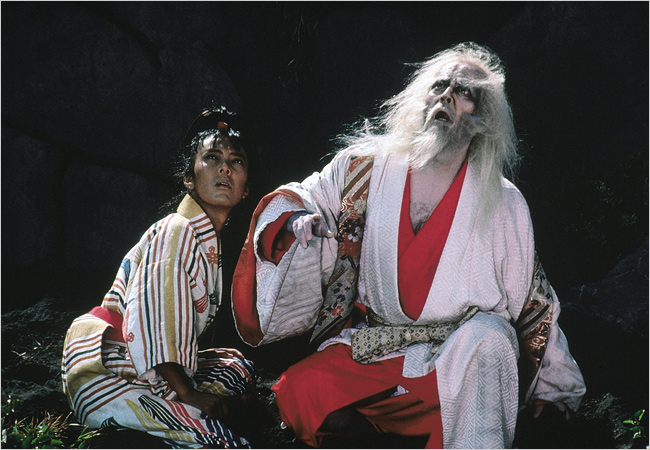
The Fool (Peter) sticks by Hidetaro (Tatsuya Nakadai) as the aging lord descends into madness in Kurosawa masterpiece

The Fool (Peter) sticks by Hidetaro (Tatsuya Nakadai) as the aging lord descends into madness in Kurosawa masterpiece RAN

RAN (Akira Kurosawa, 1985)
Anthology Film Archives
32 Second Ave. at Second St.
Saturday, November 23, 6:15; Wednesday, November 27, 9:15; Friday, November 29, 9:15
Series runs November 20 – December 1
212-505-5181
www.anthologyfilmarchives.org

Inspired by the story of feudal lord Mori Motonari and Shakespeare’s King Lear, Akira Kurosawa’s Ran is an epic masterpiece about the decline and fall of the Ichimonji clan. Aging Lord Hidetora (Tatsuya Nakadai) is ready to hand over his land and leadership to his three sons, Taro (Akira Terao), Jiro (Jinpachi Nezu), and Saburo (Daisuke Ryû). But jealousy, misunderstandings, and outright deceit and treachery result in Saburo’s banishment and a violent power struggle between the weak eldest, Taro, and the warrior Jiro. Hidetaro soon finds himself rejected by his children and wandering the vast, empty landscape with his wise, sarcastic fool, Kyoami (Peter), as the once-proud king descends into madness. Dressed in white robes and with wild white hair, Nakadai (The Human Condition), in his early fifties at the time, portrays Hidetaro, one of the great characters of cinema history, with an unforgettable, Noh-like precision. Kurosawa, cinematographers Asakazu Nakai, Takao Saitô, and Masaharu Ueda, and Oscar-winning costume designer Emi Wada bathe the film in lush greens, brash blues, and bold reds and yellows that marvelously offset the white Hidetaro. Kurosawa shoots the first dazzling battle scene in an elongated period of near silence, with only Tôru Takemitsu’s classically based score playing on the soundtrack, turning the film into a thrilling, blood-drenched opera. Ran is a spectacular achievement, the last great major work by one of the twentieth century’s most important and influential filmmakers. Ran is screening November 23, 27, and 29 as part of the Anthology Film Archives series “The Middle Ages on Film: Shakespeare,” consisting of ten cinematic adaptations of several of the Bard’s history plays, set in the Middle Ages, including Grigori Kozintsev’s King Lear, William Dieterle and Max Reinhardt’s A Midsummer Night’s Dream, and Orson Welles’s Macbeth. The twelve-day festival was curated in collaboration with professor and scholar Martha Driver, who notes, “Shakespeare’s world was closer to the Middle Ages than our own, not only in time and space but culturally and imaginatively. The plays draw extensively on medieval sources and themes.”