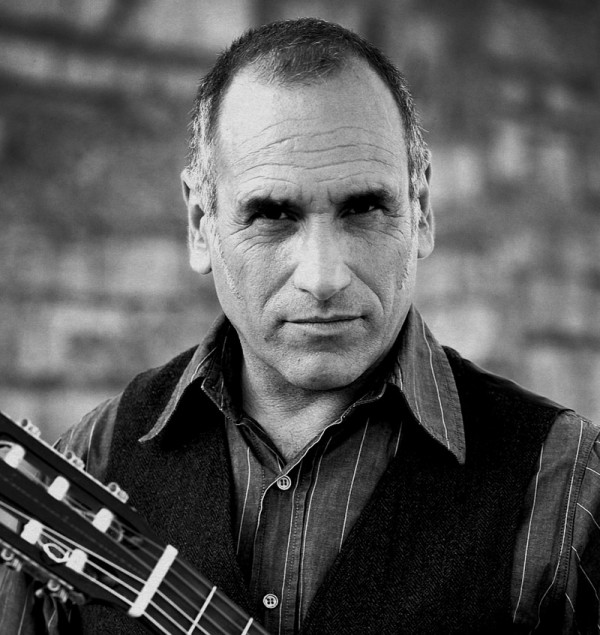
David Broza brings his mission of peace, love, and understanding to the Highline Ballroom on January 14
Highline Ballroom
431 West 16th St. between Ninth & Tenth Aves.
Tuesday, January 14, $25-$45, 8:00
212-414-5994
www.highlineballroom.com
www.davidbroza.net
“Don’t want to preach to no one tonight / Just want to tell my tale,” Israeli folk legend David Broza sings on “One to Three,” the opening track of his new album, East Jerusalem / West Jerusalem (S-Curve, January 14, 2014). Broza, who was raised in Israel, Spain, and England, has a rather simple goal: helping bring peace and love to the war-torn Middle East, as displayed in such previous songs as “Yihieh Tov (It Will Be Good).” For the new record, Broza brought together a diverse group of international musicians, who gathered for eight days in Palestinian composer Said Murad’s East Jerusalem studio, where they recorded a mix of covers and originals, live and without overdubs, including the first songs Broza has ever written in English. Produced by Steve Earle and Steve Greenberg, the album features collaborations with Wyclef Jean on the title song, Arab-Israeli singer Mira Awad on the gorgeous duet “Ramallah — Tel Aviv,” Palestinian hip-hop due G-Town, Hadag Nachash frontman Shaanan Streett, and Earle on “Peace Ain’t Nothing But a Word,” and the Jerusalem Youth Chorus on Cat Stevens’s “Where Do the Children Play” and Nick Lowe’s “(What’s So Funny ’bout) Peace Love & Understanding.” Broza’s cover of Elvis Costello’s “Everyday I Write the Book” is a sly comment on how the Israeli Jews and Palestinian Arabs follow different holy tomes, while he references “the holy book” again in “The Lion’s Den,” an adaptation of a poem written by Judea Pearl about his son, slain journalist Daniel Pearl.
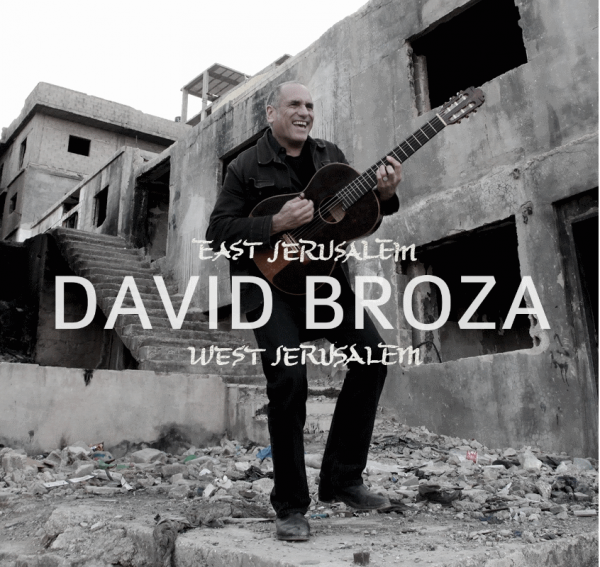
Although some of the music and lyrics, which often evoke such other singer-activists as Bruce Springsteen, Paul Simon, and George Harrison, occasionally border on the treacly, Broza boldly makes his point as clear as possible; he also covers Timmy Thomas’s “Why Can’t We All Live Together” as well as Pink Floyd’s “Mother.” He chose the latter as a message to Roger Waters, who has been outspoken in his support of the Palestinians and public demands for an Israeli boycott. “Regardless of his views on the issue of Israel and Palestine, Roger Waters has written one of the most anti-boycott, boundary-breaking songs ever in ‘Mother,’” Broza recently said. “So yes, not only have I recorded this extraordinary song, but I have recorded it in East Jerusalem using Israeli and Palestinian musicians. . . . Instead of shutting down communication, come to my country and engage in the open exchange of ideas that will make change happen.” The album’s centerpiece is “Key to the Memory,” with lyrics by Broza, Middle Eastern music by Murad, and verses sung in alternating Arabic, English, and Hebrew by Broza and Awad. “May the wind in your eyes / be the carrier of love / May the pain in your heart / turn into the will to survive,” they sing in three languages. Broza will be celebrating the release of East Jerusalem / West Jerusalem and sharing his dream of peaceful coexistence on January 14 at the Highline Ballroom, where he will be joined by Awad and other contributors to the record.
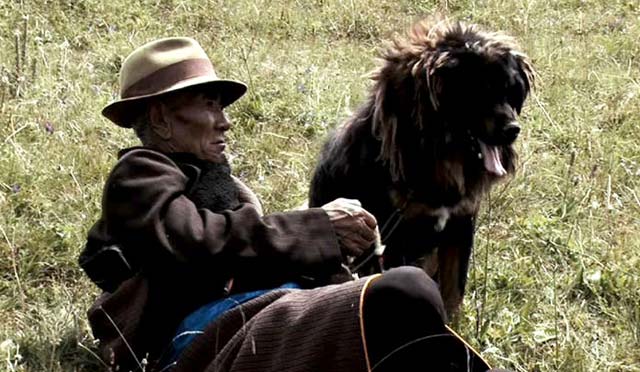
 Pema Tseden’s Old Dog is a beautifully told, slowly paced meditation on Buddhism’s four Noble Truths — “Life means suffering”; The origin of suffering is attachment”; “The cessation of suffering is attainable”; and “There is a path to the cessation of suffering” — that ends with a shocking, manipulative finale that nearly destroys everything that came before it. In order to get a little money and to save the family’s sheep-herding dog from being stolen, Gonpo (Drolma Kyab) sells their Tibetan nomad mastiff to Lao Wang (Yanbum Gyal), a dealer who resells the prized breed to stores in China, where they’re used for protection. When Gonpa’s father (Lochey) finds out what his son has done, he goes back to Lao Wang and demands the return of the dog he’s taken care of for thirteen years. “I’d sell myself before the dog,” he tells his son. And so begins a gentle tale of parents and children, set in a modern-day Tibet that is ruled by China’s heavy hand. Gonpa’s father doesn’t understand why his son, a lazy man who rides around on a motorized bike and never seems to do much of anything, doesn’t yet have any children of his own, so he pays for Gonpa and his wife Rikso (Tamdrin Tso), to go to the doctor to see what’s wrong. Meanwhile, the old man keeps a close watch on his dog, wary that Lao Wang will to try to steal it again. Writer-director Pema Tseden (The Silent Holy Stones, The Search) explores such themes as materialism, family, and attachment in a lovely little film that sadly is nearly ruined by its extreme final scene. If you missed Old Dog last year as part of the MoMA series “Chinese Realities/Documentary Visions,” you have another chance to catch it, as it’s screening January 12 at 3:30 as part of MoMA’s annual series “The Contenders,” consisting of exemplary films the museum believes will stand the test of time; upcoming entries include Jehane Noujaim’s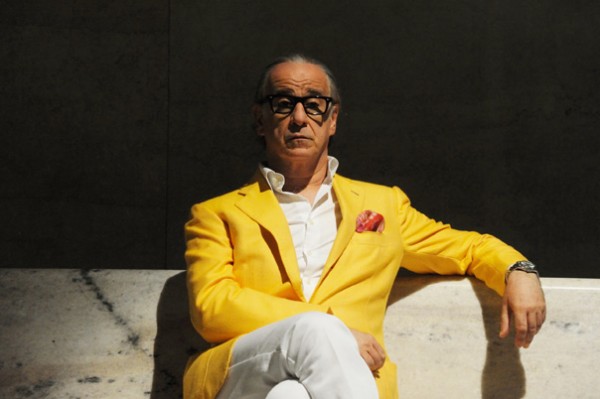
 Told with the surreal flair of Federico Fellini’s La Dolce Vita and 8½, the dark, witty cynicism of Woody Allen’s Stardust Memories and Deconstructing Harry, and the psychological intricacies of Ingmar Bergman’s Wild Strawberries and The Seventh Seal, Paolo Sorrentino’s The Great Beauty is a masterful epic about an Italian writer looking back at his life as he turns sixty-five, and not liking what he sees. Toni Servillo gives a sparkling deadpan performance as Jep Gambardella, a deeply sarcastic and intentionally hypocritical journalist in Rome who scored a huge success with his first novel, The Human Apparatus, but has been unable to write a follow-up for decades, instead spending his time attending wild parties, sleeping with woman after woman, and sharing his unique views on the sociocultural, political, and religious nature of modern-day Rome. He is surrounded by sycophants, jealous writers, a mysterious neighbor, a culinary cardinal, bizarre performance artists, an aging stripper, a magician, and many more hangers-on (played by Isabella Ferrari, Roberto Herlitzka, Sabrina Ferilli, Carlo Verdone, Massimo De Francovich, Pamela Villoresi, and others who appear to have come straight from a Fellini set), but the only person who truly understands him is his diminutive editor, Dadina (Giovanna Vignola). “You’re a spectacular woman,” he tells her. “You’ve had the career you deserve.” She responds, “But you haven’t had the career you deserve.”