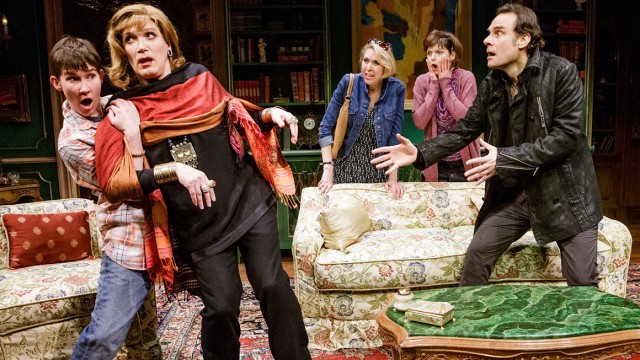
Things get more than a little wacky in Charles Busch’s latest romp, THE TRIBUTE ARTIST (photo by James Leynse)
59E59 Theaters
59 East 59th St. between Park & Madison Aves.
Tuesday – Sunday through March 29, $70
212-279-4200
www.59e59.org
Twenty years ago, writer, actor, and female impersonator Charles Busch donned pants for the first time in his career in his debut Primary Stages production, You Should Be So Lucky, to play a gay electrologist. In his latest work for Primary Stages and third overall (following 2011’s Olive and the Bitter Herbs), The Tribute Artist, Busch pulls off another personal first, portraying a female impersonator instead of a female character. Busch (Vampire Lesbians of Sodom, The Tale of the Allergist’s Wife) stars as Jimmy, a middle-aged Vegas “tribute artist” whose time impersonating Bette Davis, Marlene Dietrich, Marilyn Monroe, Judy Garland, et al., is coming to an end. Jimmy and his friend Rita (longtime Busch colleague Julie Halston), a sarcastic lesbian Realtor, have been staying at the gorgeous Greenwich Village home of wealthy widow and former fashion designer Adriana (Cynthia Harris), but when the grande dame suddenly dies, Jimmy and Rita concoct a plan to hide the body and give Jimmy his biggest role yet, playing Adriana long enough for Rita to sell the townhouse, with the two of them pocketing the potential $12 million windfall. But their scam hits a roadblock when Adriana’s niece, Christina (Mary Bacon), shows up with her transgender daughter, Oliver (Keira Keeley), and the wickedly bitter, woe-is-me Christina claims that in fact she is now the owner of her aunt’s estate. Jimmy soon has to dig even deeper into his bag of tricks when Oliver contacts Adriana’s onetime flame, Rodney (Busch mainstay Jonathan Walker), a man’s man up to some no good of his own.
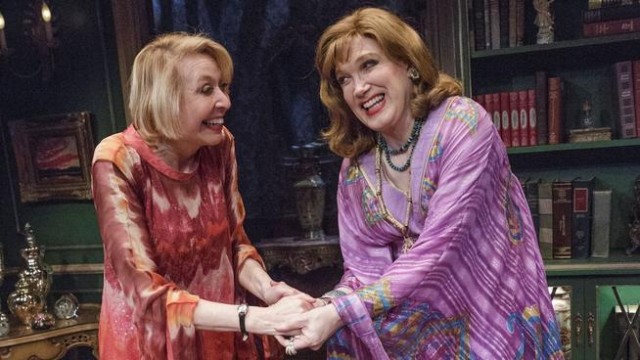
Longtime collaborators Julie Halston and Charles Busch team up again in caftan-laden farce (photo by James Leynse)
The Tribute Artist is a wonderfully entertaining homage to the classic screwball comedies and films noir of the 1930s and ’40s, as Jimmy throws in riotous references to movies from Hollywood’s Golden Age as the plot, which in part recalls Joe Orton’s Loot as well as You Should Be So Lucky, unfolds on Anna Louizos’s elegant living-room set. Busch (Die Mommie Die!) is a hoot as Jimmy, chewing up the scenery in Gregory Gale’s fab costumes and Katherine Carr’s wacky wigs while mixing in the wacky slapstick of Lucille Ball and the grace of Katharine Hepburn, and Halston (Red Scare on Sunset, The Lady in Question) has a field day as his loud, acerbic, quick-witted sidekick. Busch veteran Walker (The Assembled Parties, The Third Story) supplies a big dose of testosterone to the proceedings, including a scene-stealing monologue late in the second act. Director Carl Andress, who has worked with Busch, Halston, and Walker previously on The Divine Sister and other Busch productions, keeps things breezing along, embracing the cast’s familiarity with one another without letting it get out of hand while also keeping the more melodramatic moments in check, although the plot sometimes threatens to go off the deep end and it takes too long to warm up to Christina. A worthy addition to his canon, The Tribute Artist also succeeds as an homage to Busch himself and his, and our, love of all things camp.
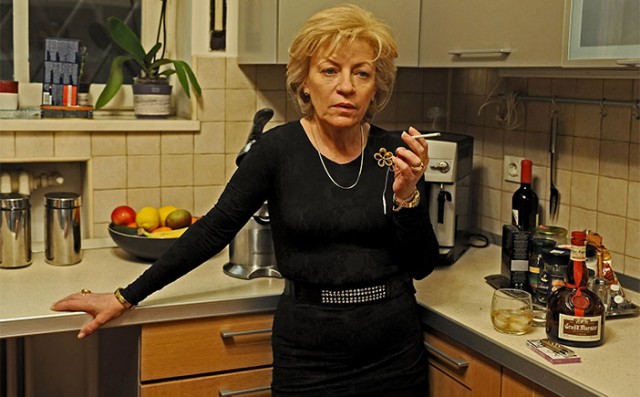
 Luminita Gheorghiu, grand dame of the Romanian New Wave, was nominated for Best Actress at the European Film Awards for her devastating portrayal of a domineering mother in Călin Peter Netzer’s Child’s Pose. Gheorghiu (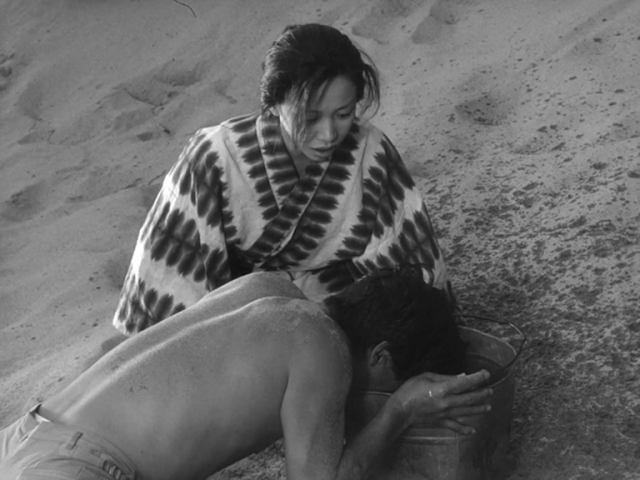
 On an insect-gathering expedition across a vast landscape of desert sand by the ocean, an entomologist (Eiji Okada) suddenly finds himself trapped in a kind of Sisyphean hell in Hiroshi Teshigahara’s Kafka-esque Woman in the Dunes, based on Kōbō Abe’s marvelous novel. The man — his name is given only at the very end — is tricked into moving in with a woman (Kyōko Kishida) who is living in a ramshackle house built deep in a sand dune; the only way out is via a rope ladder that local villagers use to give them their sparse supplies. At first the man thinks it’s all some kind of joke, but as he discovers that there’s no way out — trying to climb the walls of sand just makes more work for him and the woman — he has to reevaluate his surreal situation. Woman in the Dunes is a brutal statement on the futility, desperation, and emptiness of simple human existence. The man is reduced to one of the insects he collects in jars — glass is made of sand, of course — while the woman, whose husband and son died in this ditch, does the cooking and cleaning, their unique identities gone, stripped away by their pointless toil. They are left with seemingly no purpose in life except to serve the strange villagers who occasionally peer down at them as if they were animals in a zoo. “Are you shoveling to survive, or surviving to shovel?” the man asks the woman, who has clearly resigned herself to her fate. Cinematographer Hiroshi Segawa often shoots the black-and-white film in near darkness, the characters virtually disappearing for brief periods of time, while Tōru Takemitsu’s ominous avant-garde score adds to the intensity. Abe and Teshigahara also collaborated on The Pitfall, The Ruined Map, and The Face of Another, but Woman in the Dunes is their masterwork, a shattering look at the meaninglessness of life. The 123-minute version of Woman in the Dunes (there’s also a recently restored 147-minute director’s cut) is screening February 19-21 at 1:30 as part of MoMA’s ongoing series “An Auteurist History of Film,” which continues February 26-28 with Peter Emmanuel Goldman’s Echoes of Silence and March 5-7 with Joseph Losey’s The Servant.