Northern Irish singer-songwriter Steafán Hanvey was born in 1972, right in the midst of the Troubles. Both of his parents were musicians; his father, Bobbie, was a photojournalist and radio host as well. On his second album, last winter’s Nuclear Family, the follow-up to his 2006 debut with his band, the Honeymoon Junkies, Hanvey, “a man whose bad dreams have already come true,” explores the complications of relationships on such songs as “Secrets and Lies,” “Marta’s Always Coming Home,” “Darling Please,” and “Leaving What You Know.” He has combined his past with the present in his deeply personal and political traveling show, “Look Behind You! A Father and Son’s Impressions of the Troubles in Northern Ireland through Photograph and Song,” which is profiled by NPR in the above video. On March 8, Hanvey will be giving a rare solo performance for “Belfast Rocks the Craic” at Mercury Lounge, part of the sixteenth annual Craic Fest; Duke Special and Rams’ Pocket Radio are also on the bill.
twi-ny recommended events
A MARRIAGE: 2 (WEST-ER)
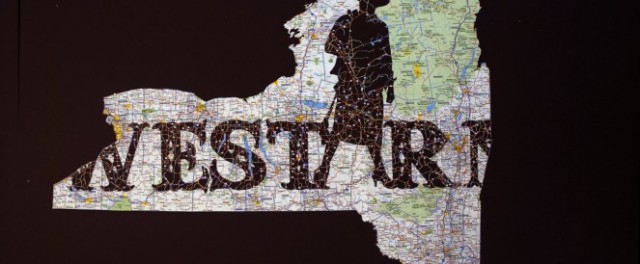
Nick Vaughan and Jake Margolin head west to explore same-sex relationships in follow-up to “A Marriage: 1 (Suburbia)”
A MARRIAGE: 2 (WEST-ER)
Invisible Dog Art Center
51 Bergen St.
March 8 – April 12
www.theinvisibledog.org
www.nickandjakestudio.com
Last spring, married multimedia artists Nick Vaughan and Jake Margolin staged “A Marriage: 1 (Suburbia)” at HERE downtown, delving into the American Dream in the twenty-first century through language, video, sculpture, literature, cut maps, and live performance. “Even growing up in a hyperliberal place,” Jake told twi-ny last spring, “I had a sense of gay people as being abnormal – a deviance from the norm that are tolerated because Berkeleyites are tolerant and open-minded people, but still a group of people who are in some way going to have to live on the outside of mainstream society. As many things about gay culture have been accepted into the mainstream since we were kids, now that set of aspirations that were traditionally exclusively for heterosexuals, aspirations towards suburbia, the nuclear family, and all of that – are on the table.” The third part of Nick and Jake’s continuing series heads out west for “A Marriage: 2 (West-er),” running at the Invisible Dog in Brooklyn through April 12. In the show, they reference Scottish adventurer Sir William Drummond Stuart, Hollywood hunk John Wayne, and partners Robert Campbell and William Sublette as they investigate homosexuality and social mores across the vast frontier. Their preparation took them to such states as Wyoming, Nebraska, Kansas, Missouri, and Colorado as they incorporated their own relationship into the narrative as well. The exhibit will be open Thursdays through Saturdays from 1:00 to 7:00 and Sundays till 5:00, with daily durational actions in addition to artist talks on March 25 and April 8 at 6:00. The opening reception takes place March 8 from 6:00 to 10:00, while closing day, April 12, will feature a live spray performance.
SATURDAY AFTERNOON MOVIE: CAPOTE
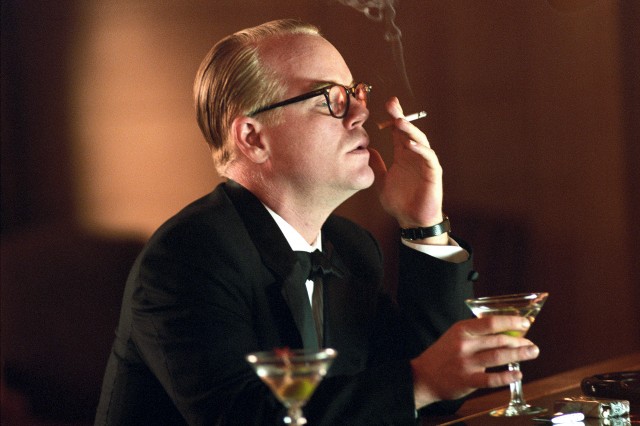
Philip Seymour Hoffman won an Oscar for his intense portrayal of Truman Capote
CAPOTE (Bennett Miller, 2005)
St. Agnes Library
444 Amsterdam Ave. between 82nd & 83rd Sts.
Saturday, March 8, free, 2:00
212-621-0619
www.nypl.org
www.sonyclassics.com
 In November 1959, Richard Hickock (Mark Pellegrino) and Perry Smith (Clifton Collins Jr.) brutally murdered a Kansas family. After reading a small piece about the killings in the New York Times, New Yorker writer Truman Capote (Philip Seymour Hoffman) sets out with his research assistant, Harper “Nell” Lee (Catherine Keener), to cover the story from a unique angle, which soon becomes the workings of the classic nonfiction novel In Cold Blood. Capote tells police chief Alvin Dewey (Chris Cooper) right off the bat that he cares only about the story, not what happens to the killers, which does not endear him to the local force. But when the murderers are captured, Capote begins a dangerous relationship with Smith, who comes to think of the writer as a true friend, while Capote gets caught up deeper than he ever thought possible. Based on the exhaustive biography by Gerald Clarke, Capote is a slow-moving character study featuring excellent acting and some interesting surprises, even for those who thought they knew a lot about the party-loving chronicler of high society and high living. Hoffman, who just died from a drug overdose, earned an Oscar for portraying the socialite author, who was played the following year by Toby Jones in Douglas McGrath’s Infamous, which was based on a book by George Plimpton. Capote, which was also nominated for Best Picture, Best Director (Bennett Miller), Best Supporting Actress (Keener), and Best Adapted Screenplay (Dan Futterman), is screening for free on March 8 at 2:00 at the NYPL’s recently renovated St. Agnes branch on the Upper West Side in a special tribute to Hoffman, a native New Yorker who left us well before his time, playing a longtime New Yorker who also died too young.
LOVE AND INFORMATION
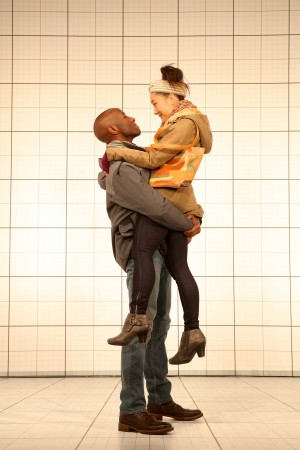
Lovers contemplate sharing secrets in Caryl Churchill’s sparkling new play (photo © Joan Marcus)
Minetta Lane Theatre
18 Minetta Lane between MacDougal St. & Sixth Ave.
Extended through April 6, $65-$85
www.nytw.org
The theater community has learned to expect the unexpected from British playwright Caryl Churchill, whose cutting-edge works have been showing up without warning in the in-boxes of artistic directors and company producers for decades. The seventy-five-year-old writer of such award-winning plays as Cloud Nine, Top Girls, and Serious Money redefines live storytelling yet again with her latest, Love and Information, just extended through April 6 at the Minetta Lane. The New York Theatre Workshop production is a series of snapshots relating the state of the world today, examined through the gathering, processing, and utilization of information among married couples, lovers, family members, professional colleagues, and best friends. The 110-minute intermissionless play consists of seven thematic sections, each one made up of funny, poignant, abstract, surreal, visceral, and potently recognizable vignettes that last between five seconds and five minutes; although the script gives them such mostly one-word titles as “Lab,” “Message,” “Secret,” “Torture,” “Irrational,” “Dream,” and “Recluse,” they are not identified onstage or in the program notes. The short dialogues take place in a white cube with a grid of some twenty-five thousand squares on five sides (calling to mind a human brain), opening only to the audience. In between each of the fifty-seven bits, in which fifteen actors portray one hundred different characters, the stage goes completely dark, bordered by a row of very bright lights around the edge, as the performers change costumes at lightning speed and the sets, which usually include a single element, from a chair or a bed to a table or a couch, are magically switched. It’s a kind of short attention span theater that evokes a more serious, though still playful, Laugh-In and Robot Chicken as the skits just keep on coming, seamlessly directed by longtime Churchill cohort James Macdonald, separated by the pitch-black accompanied by sounds, from familiar tunes to random found noises, that further one of the central themes, memory.
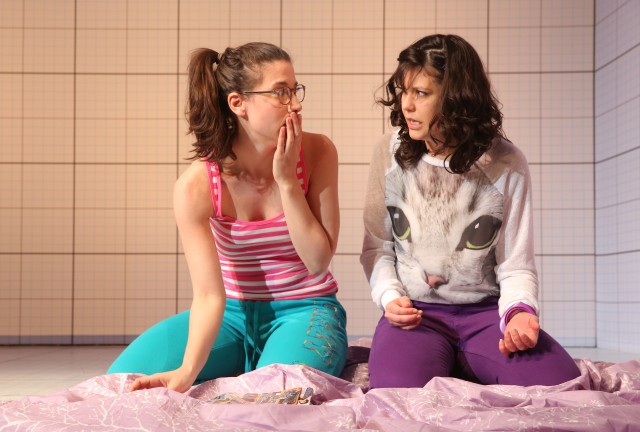
Two friends argue over who knows more about their favorite celebrity in LOVE AND INFORMATION (photo © Joan Marcus)
The tone is set from the very first vignette, in which a man is begging a woman to tell her a secret she is hiding from him. “Please please tell me,” he implores. “I’ll never tell, no matter what,” she responds, but eventually she whispers it in his ear so the audience can’t hear it. “Now what?” he repeats several times, a question that not only leads to the rest of the play but gets right to the point of what people do with information — first they want it, then they’re not always sure what to do with it. Later, a woman gets technical with her partner, saying, “What sex evolved to do is get information from two sets of genes so you get offspring that’s not identical to you. . . . So sex essentially is information.” He replies, “You don’t think that while we’re doing it, do you?” to which she says, “It doesn’t hurt to know it. Information and love.” Churchill and the immensely talented cast, which includes standout performances by Karen Kandel, John Procaccino, Kellie Overbey, Phillip James Brannon, Zoë Winters, and Randy Danson, take on science, religion, emotions, fanaticism, censorship, mathematics, pain, technology, and human relationships of all sorts in clever ways, constantly surprising the audience with each new piece, although the show is probably too long by about twenty minutes, but that’s only a minor quibble. In one of the longer sketches, a man and a woman are on a picnic date, and she describes in graphic detail how her job involves cutting the head off a chicken and slicing its brain for study, a worthy metaphor for what Churchill is doing on multiple levels with Love and Information.
OVERDUE — RICHARD FLEISCHER: VIOLENT SATURDAY
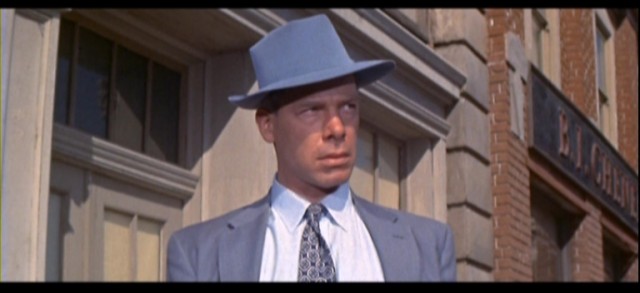
Lee Marvin prepares for big trouble in Richard Fleischer’s VIOLENT SATURDAY
VIOLENT SATURDAY (Richard Fleischer, 1955)
Anthology Film Archives
32 Second Ave. at Second St.
Saturday, March 8, 9:00, and Thursday, March 13, 7:00
Series runs March 7-17
212-505-5181
www.anthologyfilmarchives.org
It’s been a half dozen years since the Film Society of Lincoln Center paid tribute to director Richard Fleischer with a Spotlight at its annual Film Comment Selects series (including screenings of 10 Rillington Place and Mandingo) and Film Forum presented a brand-new 35mm print of Fleischer’s 1955 CinemaScope noir flick Violent Saturday for a special one-week run. So it’s time for another look at the Brooklyn-born director who also made such diverse films as Doctor Dolittle, Fantastic Voyage, Compulsion, and Soylent Green (as well as The Jazz Singer remake with Neil Diamond and Amityville 3-D) and whose father was Max Fleischer and uncle was Dave Fleischer, the two men behind the early Popeye and Betty Boop movies. Critics Nick Pinkerton and Nicolas Rapold of Overdue have joined forces with Anthology Film Archives for an eleven-day festival of nine of Fleischer’s lesser-known works that show off his wide range.
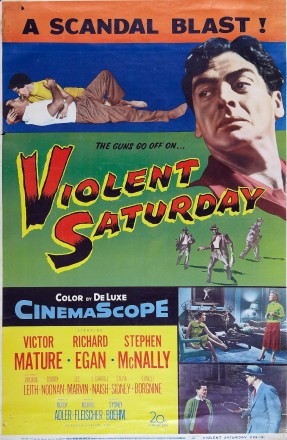
On March 8 and 13, the 35mm print of Violent Saturday will be screened; “Fleischer, an ace with the long frame,” Pinkerton wrote in his 2008 Village Voice review, “composes scrolling studies in horizontality, grabbing one of the most ravishing train shots in cinema.” All is not as it seems in the small town of Bradenville, Arizona. The mousy librarian (Sylvia Sidney) is stealing to pay off her debts, the married bank manager (Tommy Noonan) walks his dog late at night so he can peep on a hot-to-trot single woman (Virginia Leth), the mine boss’s son (Richard Egan) is a drunk who suspects his ritzy wife (Margaret Hayes) of cheating on him with a country-club playboy (Brad Dexter), an Amish family (led by Ernest Borgnine!) that lives nearby tries to keep to themselves, and a young boy (Billy Chapin) is embarrassed that his father (Victor Mature) worked in the copper mines instead of becoming a war hero like his best friend’s dad. But when three bank robbers (Stephen McNally, J. Carrol Naish, and Lee Marvin, puffing on an inhaler like Frank Booth in Blue Velvet) come to town to rid the safe of all its cash, all hell soon breaks loose and things do indeed get rather violent. In Violent Saturday, Fleischer reveals the subtle underbelly of a postwar America undergoing radical change while still standing by its old values, at least on the surface. And it’s great seeing Borgnine and Marvin together, in lovely CinemaScope; twelve years later they would reunite for Robert Aldrich’s classic WWII flick, The Dirty Dozen. “Overdue: Richard Fleischer” runs March 7-17 and also includes Trapped, Armed Car Robbery, Barabbas, See No Evil, The New Centurions, Conan the Destroyer, The Girl in the Red Velvet Swing, and 20,000 Leagues under the Sea.
SUNSHINE AT MIDNIGHT: SPIRITED AWAY
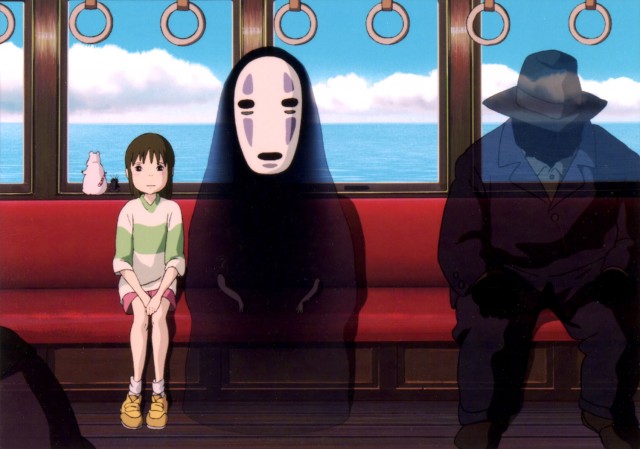
Hayao Miyazaki’s masterful SPIRITED AWAY will be screening as part of Sunshine at Midnight series this weekend
SPIRITED AWAY (SEN TO CHIHIRO NO KAMIKAKUSHI) (Hayao Miyazaki, 2001)
Landmark Sunshine Cinema
143 East Houston St. between First & Second Aves.
Friday, March 7, and Saturday, March 8, 12 midnight
212-330-8182
www.landmarktheatres.com
www.nausicaa.net
 Prepare to have your spirits lifted up and away in this sensational animated feature from Japanese master Hayao Miyazaki. Ten-year-old Chihiro (Rumi Hiiragi) is unhappy about moving to a new home despite her parents’ best efforts to convince her otherwise. When her father (Takashi Naito) takes a wrong turn on the road, the family ends up in an oddly deserted village that Chihiro soon finds out is a lot more than it seems. Chihiro’s adventures through this dreamlike, surreal, magical place filled with bizarre characters and evil beings are unforgettable, with nuances and references from such diverse works as The Wizard Of Oz and The Seventh Seal. The sheer visual beauty of the animation is staggering; many of the backgrounds are reminiscent of Impressionism. Joe Hisaishi’s maudlin music is way overpraised, as usual, but this Japanese box-office champ deservedly won the Golden Bear at the Berlin International Film Festival and was named Best Asian Film at the Hong Kong Film Awards. As with the best animated films, you don’t have to be a kid to fall in love with Spirited Away, which explains why the Landmark Sunshine is screening the Japanese-language version, with English subtitles, on March 7-8 as part of its ongoing Sunshine at Midnight series, held in conjunction with the theatrical release of what might be Miyazaki’s swan song, The Wind Rises.
JAPAN WEEK 2014

Grand Central Terminal, Vanderbilt Hall
89 East 42 St.
March 6-8, free
www.japanweek.us
Just as Grand Central Terminal recently celebrated its centennial, Japan will commemorate the last one hundred years of its cultural heritage at the 2014 edition of Japan Week, held in GCT’s historic Vanderbilt Hall. Videos will take visitors to Kumamoto City, Emperor Nintoku’s Tomb in Sakai City, and the resort prefectures of Nagano and Niigata in addition to honoring the one hundredth anniversary of the Tokyo Philharmonic, which will be making its U.S. debut March 11 at Alice Tully Hall, conducted by Eiji Oue. There will also be a focus on Jewish refugees in Japan with the short documentaries Transit to Freedom, The Chiune Sugihara Story, and They Called It Heaven. A photo slideshow looks back one hundred years through the lens of T. Enami and others, and on Thursday at 2:25 and Friday at 2:15 you can try on traditional Japanese armor. Sake from fifteen regions will be available at a one-hundred-year-old Taisho-themed bar, an amezaiku artist will create folk sculptures out of candy, and exhibitors will be displaying the latest in Japanese watches, television, food, and tourism. Tribute will also be paid to Grand Central’s sister station, Tokyo Station, which turns one hundred this year. In conjunction with the festivities, Japanese Restaurant Week continues through March 16, with more than two dozen restaurants featuring special regional dishes, including Koi Soho (squid sashimi), Hakubai (Miyazaki beef), Megu New York (Kobe beef), Sakamai (black rice vinegar), Torishin (kishu bincho charcoal), Wasan (mizutaki), Sushiden (Edomae sushi), Restaurant Nippon (fugu), and Sushi Azabu (sea urchin).