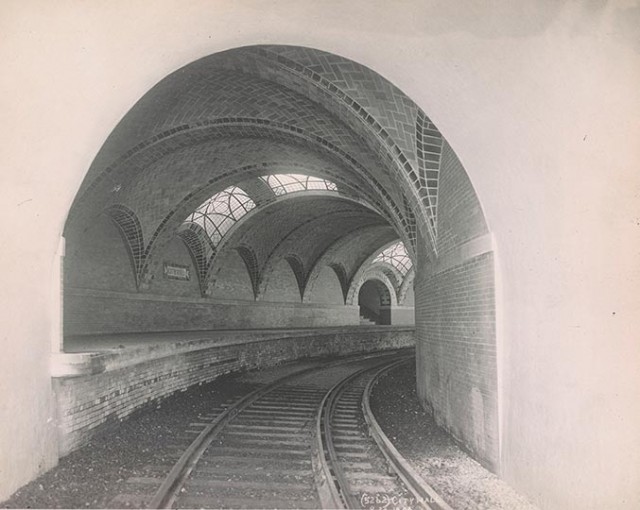
Attributed to Pierre Pullis, “City Hall Subway Station,” platinum print, 1904 (photo courtesy Morgan Library)
A COLLECTIVE INVENTION: PHOTOGRAPHS AT PLAY
Morgan Library & Museum
225 Madison Ave. at 36th St.
Daily through May 18, $12-$18 (free Fridays from 7:00 to 9:00)
212-685-0008
www.themorgan.org
THIRTY YEARS THIRTY-ONE PHOTOGRAPHERS
Laurence Miller Gallery
20 West 57th St. between Fifth & Sixth Aves.
Tuesday – Saturday through April 26, free, 11:00 am – 5:30 pm
212-397-3930
www.laurencemillergallery.com
A pair of current photography shows are both displaying a similar curatorial bent in celebratory exhibitions, but with significantly different results. For the first time in its ninety-year history, the Morgan Library has mounted a photography show, organized by Joel Smith, who became the institution’s inaugural photography curator in 2012. “A Collective Invention: Photographs at Play,” on view through May 18, brings together more than eighty works from the Morgan’s holdings and private collectors. The pictures are arranged in sequence, each linked by similarities to the previous photo and to the next one, in form, content, subject matter, geometrical patterns, or other elements. Some connections are easy to spot: Underwood & Underwood Studio’s 1908 photomontage of Theodore Roosevelt is next to George G. Rockwood’s 1898 portrait “Theodore Roosevelt in Rough Rider Uniform,” which is followed by the anonymous “Three-in-One Portrait of Johann Most, Peter Kropotkin, and Mikhail Bakunin” and Tomoko Sawada’s “ID400 (101-200),” multiple photographs Sawada took of herself in photobooths. But other combinations are not nearly as obvious, which is not necessarily a problem until you also realize that consecutive photos could have more than one similarity, and since the accompanying text identifies a single connection, visitors can get the feeling they are wrong if they see a different relationship. This aspect of the exhibition makes it a kind of guessing game and detracts from the overall impact of the show; however, Smith might have done it this way at least in part because the Morgan is relatively new to the world of photography and he didn’t have a lot to work with. I went back a second time to experience the show just focusing on the quality of the photographs themselves, and it still felt lacking. There are some gems here, including Acme Photography Bureau’s 1937 “Carving Lincoln on Rushmore Granite,” Heinz Hajek-Halke’s 1928-32 “Erotik—Ganz Groß! (Erotic—In a Big Way!),” Larry Sultan’s 1991 “Dad Looking into Pool,” and the anonymous 1963 “Montgomery Clift in Freud: The Secret Passion,” but not nearly enough for me to recommend the show. But hey, it’s only the Morgan’s first try. Hopefully they won’t take to heart the warnings of the final piece, Tim Davis’s 2013 “Photography Liberation Front,” an arrangement of found signs forbidding photography. (On April 15, the special program “Accumulated Wisdom: The Collector as Inventor” will feature talks and performances with Davis, Carrie Cooperider, Nina Katchadourian, Thomas Y. Levin, and others.)
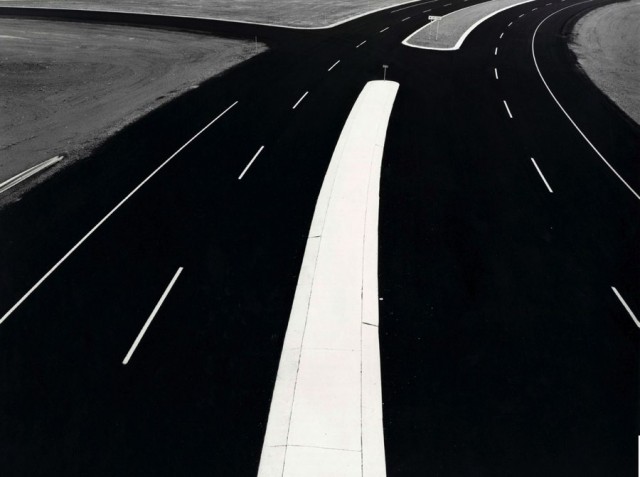
Burk Uzzle’s 1970 “New Mexico Highway” vintage gelatin silver print is part of Laurence Miller’s thirtieth anniversary exhibition (photo courtesy Laurence Miller Gallery)
Over in Midtown, Laurence Miller is celebrating his gallery’s thirtieth anniversary with “Thirty Years Thirty-One Photographers,” selecting works from approximately 250 exhibitions over the past three decades. Instead of just choosing its greatest hits, the gallery has put together an extremely well curated collection of photographs that subtly achieves precisely what the Morgan tried to do. Without announcing it or turning it into a game, Miller has organized the photos so that they organically flow one into another, both as a representation of the gallery’s sensibility as well as by theme, content, shape, subject, etc. Michael Spano’s 1978 “Vertical Subway” leads to Toshio Shibata’s 2008 “Okawa Village, Tosa County, Kochi Prefecture,” which is followed by Burk Uzzle’s 1970 “New Mexico Highway,” the thick white center line echoing Shibata’s horizontal bridge and Spano’s vertical composition in addition to the lights of the store and the road in the next photo, Uzzle’s 2007 “Desert Prada,” after which comes Lee Friedlander’s 1971 “Knoxville, Tennessee,” an empty street with a tilted triangular road sign in the middle. A rectangular light and title link Roger Mertin’s 1968 photo from his “Plastic Love Dream” series and Laurence Bach’s 1978 “Paros Dream Book #8,” while two photos each by Joan Colom and Helen Levitt depict anonymous people crowding the frame. But the connections alone are not what make the show, which runs through April 26, so successful; instead, it’s the high quality of the work — there are also photos by Emmet Gowin, Diane Arbus, Fred Herzog, Ray K. Metzker, Petah Coyne, Aaron Siskind, and Eadweard Muybridge, among others — arranged in such a way that you leave with an appreciation of the gallery’s unique identity, which centers on intriguing landscapes, street photography, fascinating experimentation, and a bold mix of black-and-white and color.
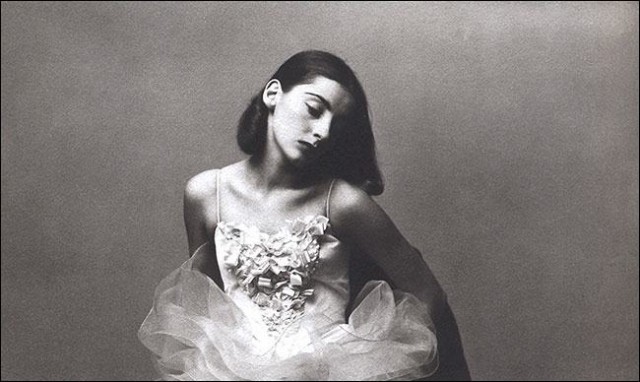
 “Tanny’s body created inspiration for choreographers,” one of the interviewees says in Nancy Buirski’s documentary Afternoon of a Faun: Tanaquil Le Clercq. “They could do things that they hadn’t seen before.” The American Masters presentation examines the life and career of prima ballerina Tanaquil Le Clercq, affectionately known as Tanny, who took the dance world by storm in the 1940s and ’50s before tragically being struck down by polio in 1956 at the age of twenty-seven. Le Clercq served as muse to both Jerome Robbins, who made Afternoon of a Faun for her, and George Balanchine, who created such seminal works as Western Symphony, La Valse, and Symphony in C for Le Clercq — and married Tanny in 1952. In the documentary, Buirski (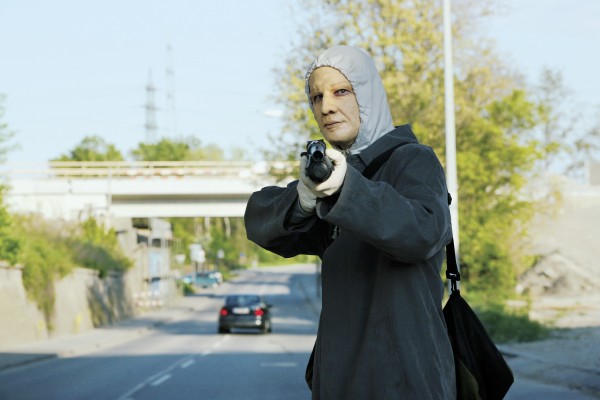
 Director Benjamin Heisenberg and star Andreas Lust take viewers on a breathless thrill ride in The Robber. Adapted from Martin Prinz’s novel about real-life 1980s Austrian marathon champion and bank robber Johann Kastenberger, The Robber focuses on Johann Rettenberger (Lust), a grim, ultra-serious man who has just been released from prison after serving six years for armed robbery. Although he tells his parole officer (Markus Schleinzer) that his thieving days are over, Rettenberger seems unable to stop grabbing his shotgun, donning his trademark facemask, and stealing cars and robbing banks. But his motives remain unclear, as he merely stashes the cash under his bed, not using it for himself or giving it away. He initially does not appear prone to violence either, but his cold-blooded stares and inability to really connect with others signal a man threatening to explode at any moment. When not robbing banks, Rettenberger is either training for or running in marathons, a skill that also helps him avoid the police. Despite Rettenberger’s intensely secretive personality, a social worker named Erika (Franziska Weisz) falls for him, putting him up in her house while she imagines he is looking for work and trying to get his life back together. But not even love can warm the frigid heart of this stone-cold thief.