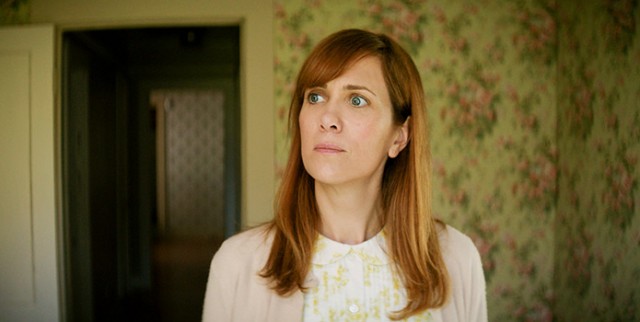
Kristen Wiig gives a breakout dramatic performance in Liza Johnson’s HATESHIP LOVESHIP
HATESHIP LOVESHIP (Liza Johnson, 2013)
Opens Friday, April 11
www.ifcfilms.com
www.lizajohnson.wordpress.com
Writer, director, teacher, artist, journalist, and filmmaker Liza Johnson has followed up her debut feature, 2011’s Return, with Hateship Loveship, a subtly beguiling and intimate drama based on a short story by Nobel Prize winner Alice Munro. In the film, Kristen Wiig gives a career-redefining performance as Johanna Parry, an odd, lonely caregiver hired by a widower (Nick Nolte) as a housekeeper for him and his granddaughter, Sabitha (Hailee Steinfeld), whose father, Ken (Guy Pearce), is trying to put his life back together after having served time for the accident that killed his wife. Johanna is misled by Sabitha and her best friend, Edith (Sami Gayle), into thinking she is having a romantic correspondence with Ken, as the two girls take advantage of Johanna’s innocence and simplicity.
An associate professor of art at Williams College, Johnson has been making short films for more than fifteen years, including several works (Good Sister / Bad Sister, South of Ten, In the Air that have been shown at prestigious international film festivals and in art museums. Hateship Loveship, which, like Return, is powerfully realistic, opens April 11 in theaters and on VOD.
twi-ny:. You’ve gone from making experimental short films that have included nonprofessional actors to now two feature films with impressive casts, including Linda Cardellini, Michael Shannon, and John Slattery in Return and Kristen Wiig, Guy Pearce, Jennifer Jason Leigh, Nick Nolte, and Christine Lahti in Hateship Loveship. What has that transition been like?
Liza Johnson: The biggest change really just has to do with the way the production runs. I made those short films in worlds where people lived extremely precarious, contingent lives — Mississippi after Katrina, the deindustrialized town I grew up in, indigenous Northern Australia. (Thematically this is also true of the characters in the features.) But within those real-world contexts, and working with almost zero money on the productions, it’s very hard to have a story that has cause and effect, because people can’t be absolutely certain that they can come back to perform for a second or third or sixth day. Even though Hateship/Loveship is a very small independent film, it still has a full crew and unionized actors who are all in a position to return to finish out the whole story!
I love working with nonprofessional actors, and it’s also a great thrill to work with people who have an incredibly trained sense of the craft of acting. It’s just a very different way of working.
twi-ny: In the 2008 Hugo Boss Prize catalog, you wrote about Patty Chang’s Flotsam Jetsam (which is currently on view at MoMA, where your work has also been shown), “The visual style of Flotsam Jetsam suggests a documentary relation to the real at the same time as revealing the conventions we use to produce ‘realness.’” In many ways, a similar thing might be said of Hateship Loveship, which has a very realistic feel to it, especially in regard to camera movement and the lead performances. Would you agree?
Liza Johnson: You are an amazing researcher! Patty Chang has been a close friend and a sustaining confidante for a long time, and I’m sure we influence each other even if we’re working in pretty different styles.
And yes, when I first met with Kristen on the project we talked about how important it was for the world of the film to feel real, and to be shot in the style of realism — which is definitely a style and not just how the world inherently looks! I had a great time working with Kasper Tuxen, the cinematographer, and we watched a lot of movies that use available light when we were preparing. He’s pretty amazing, and we really went to great lengths to use available light whenever possible, or to just supplement it if necessary. The production designer, Hannah Beachler, was also really supportive of my idea to try to build a world that is not overdesigned, and tries to maintain the feeling of accident and surprise that come with locations, even though she redesigned and reordered every surface that you see in the film.
twi-ny: Hateship/Loveship is based on a short story by Alice Munro, who just won the Nobel Prize. Her work has also been adapted by such directors as Sarah Polley, Anne Wheeler, and, next, Jane Campion. How familiar were you with Munro’s writing prior to making the film? Are you concerned at all about being branded as a woman director who makes “women’s films”? You’ve previously explored a more radical side of feminism in Good Sister / Bad Sister.

Artist, writer, teacher, and filmmaker Liza Johnson’s sophomore feature, HATESHIP LOVESHIP, opens April 11
Liza Johnson: I have loved Alice Munro’s writing for as long as I can remember. I was pretty thrilled when Mark Poirer brought his script to me. The story that the film is based on is an almost perfect story, and a very literary one filled with internal monologue and close, shifting points of view. The movie is inherently different from the story, because Munro is so brilliant at writing the inner life of characters in ways that sometimes can’t be photographed. (If you filmed the end of her story literally, you would see a picture of a teenage girl just standing there, whereas in the story it unfolds amazing revelations within her mind.) The film is truly a translation into another medium, and hopefully one that honors the tone of the original, which is unsentimental, non melodramatic, and really committed to the beautiful and complicated choices of its characters.
If you’re going to compare me to Sarah Polley and Jane Campion, that is a ghetto I’m more than happy to be a part of! But no, I’m not afraid of being branded as someone who makes “women’s films.” A lot of male directors that I like have also made beautiful movies with female protagonists. Personally I would want to invite John Cassavettes, William Wyler, Robert Altman, and Todd Haynes into the neighborhood.
I also think that Hateship is not just a movie for women. There’s no question that Kristen’s character is the spine of the story, but it also showcases performances by Guy Pearce and Nick Nolte, who are both powerhouse actors delivering complicated male characters.
twi-ny: In certain ways, Johanna, the character Kristen Wiig plays in Hateship Loveship, reminds me of Chantal Akerman’s Jeanne Dielman, maybe without quite so much doom and gloom. Is that way off base, or is there a direct or indirect influence there?
Liza Johnson: Direct! Kristen and I watched Jeanne Dielman when we were working on her character and thinking about domestic work. In both the story and the screenplay, her work as a caregiver and as a cleaner is really important to the way she sees the world and the way she reacts to everything. So of course we tried to look at whatever precedents we could find for the cinematic treatment of this kind of occupation. Obviously Akerman is making a different kind of sustained conceptual gesture there, one that I would be proud to have made, but my movie is more classical in its forms than the ones that she uses in the amazing, extreme experiment of her film.
twi-ny: You also teach art at Williams College. Has your relationship with your students changed at all now that you have two well-received feature films under your belt?
Liza Johnson: I don’t think so. They’re pretty engaged and attentive, but that was also true before. It’s really good to be the film professor — you get a lot more enthusiasm than when people are just taking your class to fulfill their premed requirements.
twi-ny: With Hateship Loveship only just opening theatrically, is it too early to ask what your next film project might be?
Liza Johnson: I’m writing something that I really like that is a drama about some unexpected things that happen to a group of teenage girls. And I also have a new project coming up with Michael Shannon, who is an incredible talent. (That is a movie about men, by the way, in case you are worried for me about the women thing!)
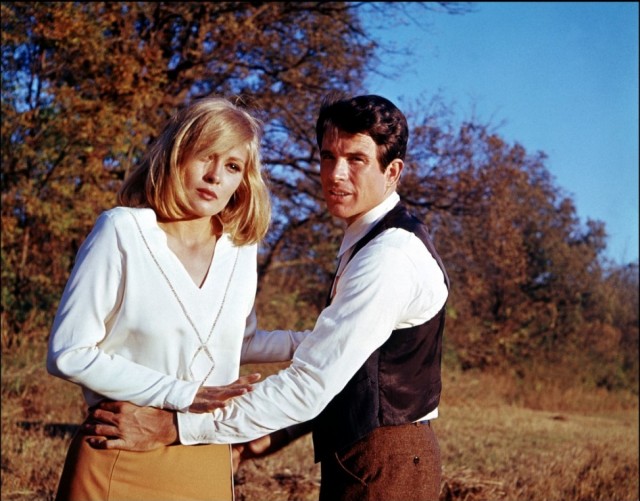
 Arthur Penn changed the course of Hollywood — and world cinema — in 1967 with Bonnie and Clyde, a film previously offered to such Nouvelle Vague luminaries as François Truffaut and Jean-Luc Godard. Cowritten by David Newman (Superman I-III) and Robert Benton (Kramer vs. Kramer), the film mythologizes the true story of depression-era bank robbers Clyde Barrow and Bonnie Parker, played magnificently by Warren Beatty and Faye Dunaway. At its heart, Bonnie and Clyde is a passionate yet unusual love story, filled with close-ups of the gorgeous Dunaway, who is first seen naked, running to her bedroom window confident and carefree, more a modern 1960s woman than a poor 1930s small-town waitress. Meanwhile, Barrow might know how to shoot a gun, but he’s a dud in bed; “I ain’t much of a lover boy,” he tells Bonnie early on, so their passion plays out in fast-moving car chases and shootouts rather than under the covers (while also playing off of Beatty’s already well-deserved reputation as a ladies’ man). They pick up an accomplice in gas-station attendant C. W. Moss (Michael J. Pollard) and are soon joined by Clyde’s brother, Buck (Gene Hackman), and his wife, Blanche (Estelle Parsons), and continue their rampage as heroic, happy-go-lucky hold-up artists, leading up to one of the most influential and controversial endings ever put on celluloid, an unforgettable finale of violent and poetic beauty. Penn, editor Dede Allen, and cinematographer Burnett Guffey redefined the gangster picture with their creative use of slow motion, long takes, and crowded shots, defying Hollywood conventions in favor of unique and innovative storytelling devices, allowing the film to work on multiple levels. Bonnie and Clyde is screening April 9-11 at 1:30 as part of MoMA’s ongoing series “An Auteurist History of Film,” which continues April 16-18 with John Boorman’s Point Blank and April 23-25 with Luis Buñuel’s Belle de Jour.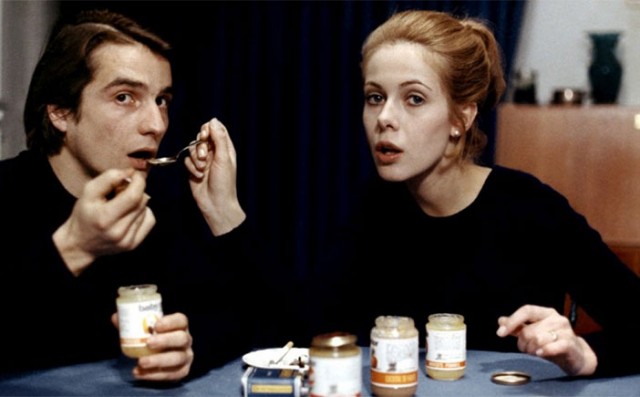
 When we first encounter Antoine Doinel (Jean-Pierre Léaud) in Bed and Board, he is running down stairs to dye flowers, complaining that one flower always remains unchanged. Of course, that unchanging flower is Antoine himself, who we’ve watched grow up in François Truffaut’s The 400 Blows, Antoine and Colette, and Stolen Kisses. (Bed and Board was supposed to be the final chapter, but Truffaut and Léaud teamed up again in 1979 for Love on the Run.) The upstart adolescent is far from being mature, even though he has now married Christine (Claude Jade) and is preparing to have a baby. Antoine is still very much a child, unable to face any serious responsibilities. When he gets a new job, it’s steering motorized boats on a pond at a hydraulics company, in a miniature version of a port; it’s like a doll’s house for men, a rehearsal for real, full-size life. He is still desexualized; when he’s in bed with his wife, he wants to nickname each of her breasts, which he claims are different sizes, instead of seeing them as beautiful erogenous zones. When they don’t have anything to eat in the apartment, he decides to dine on baby food with Christine. And when Christine’s parents (Claire Duhamel and Daniel Ceccaldi) come to see the baby, his father-in-law wants to make sure that Antoine doesn’t keep their present of a toy duck for himself. Antoine hasn’t grown out of his own fantasy world, and he still doesn’t understand that there are consequences to his actions, especially when he becomes interested in a beguiling Japanese woman named Kyoko (Hiroko Berghauer). He is surrounded by characters who live in the building and gather in the courtyard — a man (Jacques Rispal) who hasn’t stepped outside in decades, a waitress (Danièle Girard) who has the hots for Antoine, a gregarious bar owner (Jacques Jouanneau), and a new stranger (Claude Véga) everyone calls the Strangler — but he’s yet to really decide on his own character. Despite their monetary woes — Christine gives violin lessons in their home to make money — Antoine keeps lending more and more cash to a sponging friend (Jacques Robiolles) as if he’s made of francs. But Antoine clearly doesn’t know what he’s made of, at least not yet.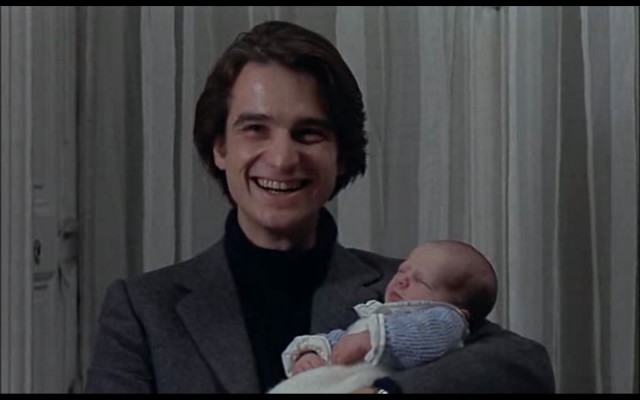
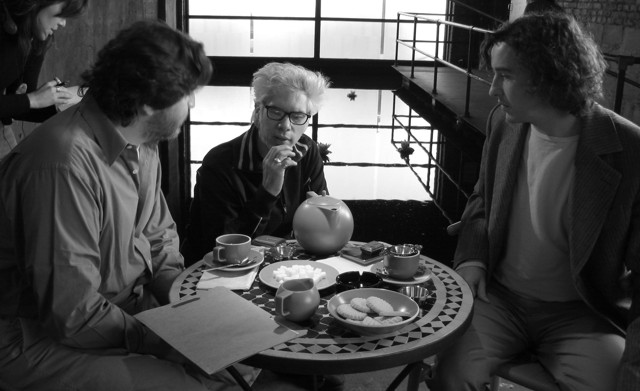
 Jim Jarmusch’s entertaining, offbeat, and often frustrating Coffee & Cigarettes consists of eleven vignettes, filmed over the course of more than fifteen years, that pair actors at bars, diners, and the like, drinking coffee, smoking cigarettes, and talking about drinking coffee and smoking cigarettes. Although the actors use their real names, they are put in fictional situations. While Steven Wright and Roberto Benigni are a hoot, Alex Descas and Isaach de Bankolé are annoying. Alfred Molina and Steve Coogan make the best team, while Iggy Pop and Tom Waits should have been better. So should GZA, RZA, and Bill Murray. Jack White and Meg White, despite a liking for Tesla, show they can’t act. Cate Blanchett with Cate Blanchett is okay but not as good as the riotous team of Joe Rigano and Vinny Vella. The film is a must-see for Jarmusch fans and those who need a nicotine/java jolt. All others beware. Coffee & Cigarettes is screening February 10 with The Garage Tapes, three shorts starring Waits, as part of the Film Society of Lincoln Center series “Permanent Vacation: The Films of Jim Jarmusch,” a tribute to the eclectic writer-director upon the occasion of the release of his latest work, Only Lovers Left Alive. The festival continues through April 10 with all of his feature films, which include such gems as Dead Man, Down by Law, Ghost Dog: The Way of the Samurai, Stranger than Paradise, Mystery Train, and Night on Earth.