twi-ny recommended events

THE CONNECTOR

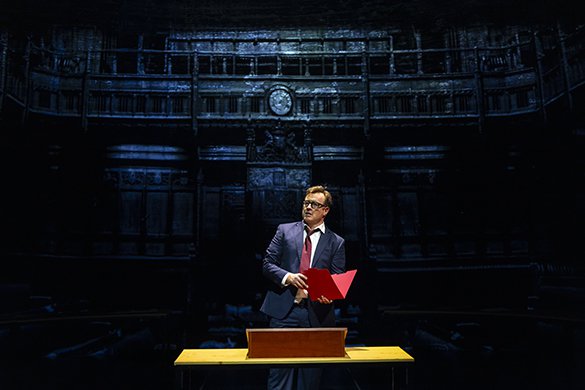
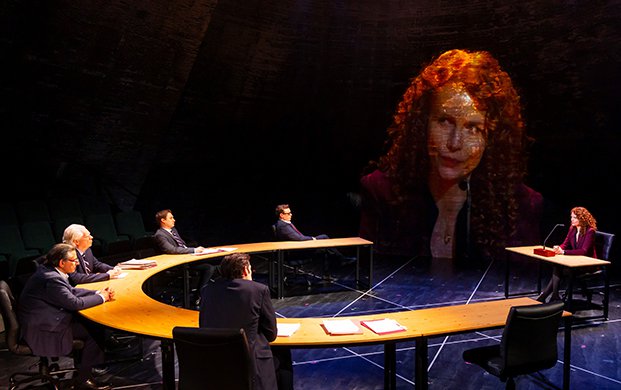
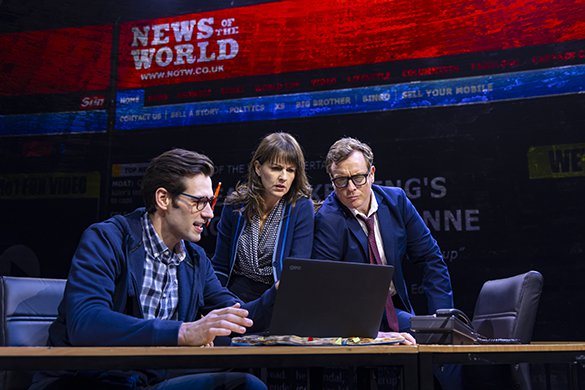
The Connector takes place at a New York City magazine publisher in the mid-1990s (photo by Joan Marcus)

THE CONNECTOR
The Robert W. Wilson MCC Theater Space
511 West Fifty-Second St. between Tenth & Eleventh Aves.
Tuesday – Sunday through March 17, $74-$139
mcctheater.org

Beowulf Boritt’s set is the star of The Connector, an otherwise hit-or-miss new musical conceived and directed by Daisy Prince, with a book by Jonathan Marc Sherman and music and lyrics by Tony winner Jason Robert Brown.

The show takes place in the offices of a well-respected magazine called the Connector. On the back wall is a rectangular grid of more than one hundred folded-over magazine spreads on which lighting designer Jeanette Oi-Suk Yew projects various images in addition to, for one fabulous scene, a Scrabble board; neon lights form multiple shapes in different colors on the black floor, also a grid. Off to the sides are mounds and mounds of paper. Tables, desks, and chairs are wheeled on an off to indicate trips to different offices and outdoors.

The magazine is run by Conrad O’Brien (Scott Bakula), who is determined to continue the legacy of the magazine’s founder, Aubrey Bernard, who started the Connector in 1946. It’s 1996, and the conglomerate VorschlagXE are their new partners. When enthusiastic young journalist Ethan Dobson (Ben Levi Ross) arrives, O’Brien is immediately impressed by the recent college grad and gives him a job. It isn’t long before Dobson is getting major stories published in the magazine, much to the chagrin of assistant copy editor Robin Martinez (Hannah Cruz), whose pieces keep getting rejected by O’Brien, and Tom Henshaw (Fergie Philippe), a dependable but unexciting writer.

As Dobson’s stories become more and more popular, fact checker Muriel (Jessica Molaskey) has more and more questions, as does loyal Connector reader Mona Bland (Mylinda Hull), who regularly sends in letters to the editor with praise and criticism, and Martinez, who is suspicious of how Dobson is writing so many articles so quickly.

Ethan Dobson’s first story is about the prowess of Scrabble mastermind Waldo Pine (Max Crumm) (photo by Joan Marcus)

The Connector was inspired by the fraud perpetrated by Stephen Glass at the New Republic in 1998. Much of the show rings true, but just as much doesn’t. From 2001 to 2004, I served as editor in chief of a free local New York City newsmagazine with a small staff, consisting of a news editor, a features editor, and a managing editor. We all proofread and fact-checked one another’s articles as best we could, right at the time that use of the internet exploded around the country. I just find it too difficult to buy how easily O’Brien falls under the spell of the overly cocky and annoying Dobson, ignoring all the warning signs, even as he is distracted by VorschlagXE executive Veronica (Ann Sanders).

One of the show’s aims is to relate its plot to the fake news that now dominates social media and overtly biased television programs and publications, but the connection doesn’t come through. When O’Brien makes a toast early on, proclaiming, “To our fabled history of writers and editors, who still search, reach, and fight for the truth. To our beloved, well-educated, politically active readers,” it’s as if they are already outliers, ill-prepared for what is to come. “Together, we shall thrive and grow for many more decades, pushing forward, staying true to the tenets Aubrey Bernard held so dear!” he adds.

The Connector is a musical, but it feels much more like a play with musical scenes, never quite cohering as a whole. Karla Puno Garcia’s choreography ranges from barely there in the introductory number to fun and fanciful in Waldo’s celebration to head scratching during Dobson’s visit to the Western Wall in Jerusalem. Brown’s (Parade, The Last Five Years) arrangements and orchestrations crackle, but the songs, performed by a small band behind the backdrop, lack consistency as they go from ballads to hip-hop to klezmer. Director Prince, who has previously helmed Brown’s The Last Five Years and Songs for a New World, is unable to get the scenes to smoothly flow into each other. And while there are laughs, a pair of cheap shots at Texas and New Jersey in “So I Came to New York” linger badly.

Ethan (Ben Levi Ross) and Robin (Hannah Cruz) become friends and rivals in The Connector (photo by Joan Marcus)

Bakula (Three Guys Naked from the Waist Down, Guys and Dolls), who was nominated for a Tony as Best Leading Actor in a Musical for 1988’s Romance/Romance, has a firm grasp of his character in his return to the New York stage, while Cruz (Only Gold, Suffs) excels as Martinez, Molaskey (A Man of No Importance, Sunday in the Park with George) is right on point as the fussy Muriel, and Crumm (Emojiland, Disaster!) nearly steals the show as Waldo.

The cast also includes Daniel Jenkins as Connector lawyer Zachary, Michael Winther as cable host Brian Lamb, Danielle Lee Greaves as Jersey City mayoral aide Sheryl Hughes, Ashley Pérez Flanagan as copy editor Florencia Moreno, and Eliseo Román as Nestor Fineman, the fictional head of the real-life New York Press, which was the archrival of the publication I ran twenty-plus years ago.

In the end, The Connector has some worthwhile articles but could use more editing to cut down on the excess.

[Mark Rifkin is a Brooklyn-born, Manhattan-based writer and editor; you can follow him on Substack here.]

THE HUNT

Tobias Menzies stars as a man accused of a horrible crime in The Hunt (photo by Teddy Wolff)

THE HUNT
St. Ann’s Warehouse
45 Water St.
Tuesday – Sunday through March 24, $64-$84
718-254-8779
stannswarehouse.org

In 2012, St. Ann’s Warehouse presented the US premiere of Grzegorz Jarzyna’s mesmerizing adaptation of Thomas Vinterberg and Tobias Lindholm’s 1998 Dogme 95 film, Festen (The Celebration), about a birthday party at which the adult son of the honoree suddenly accuses his father of having sexually abused him and his twin sister when they were children.

That same year, Danish writer-director Vinterberg released his terrifying Oscar-nominated drama Jagten (The Hunt), in which Mads Mikkelsen stars as a kindergarten teacher falsely accused of sexually abusing a six-year-old student in a small, tight-knit town.

Writer David Farr and director Rupert Goold’s adaptation of The Hunt for the Almeida Theatre is now having its US premiere at St. Ann’s; it’s a haunting tale of hunters and their prey.

Tobias Menzies makes a dazzling US stage debut as Lucas Bruun, a forty-year-old educator who is teaching at the Sunbeam Infants School in an isolated village in Northern Denmark after his previous employer closed. He has separated from his wife, Susanne, and is frustrated that he is not getting enough time to spend with their sixteen-year-old son, Marcus (Raphael Casey).

A teacher (Tobias Menzies) is given a surprise present by one of his students (Aerina DeBoer) in The Hunt (photo by Teddy Wolff)

After a special event, his favorite student, five-year-old Clara Kallstrom (alternately played by Aerina DeBoer or Kay Winard), tells school head Hilde (Lolita Chakrabarti) that Lucas exposed himself to her, which is not true. Soon the entire town, including Clara’s parents, Mikala (MyAnna Buring) and Theo (Alex Hassell), who are Lucas’s closest friends, has turned against him, branding him a pariah.

Curiously, as his world crumbles around him, the fiercely private Lucas doesn’t stand up for himself, never proclaiming his innocence, even though we saw the encounter in question and know he did not do anything wrong. He begs the school and Clara’s parents to let him talk to the girl in order to straighten everything out, but no one wants him near her or the school. Even his buddies in the Men of the Lodge, a group of hunters who love singing, shooting, and boozing it up, immediately ostracize him, making him the hunted. The only support he receives is from his dog, Max, and Marcus, who shows up unexpectedly at his doorstep.

“Talking to you is like scaling a fucking castle wall. You know that?” Mikala tells him.

But he’s not about to let anyone in, even with his life in danger.

The Hunt takes place on Es Devlin’s fascinating set, a house-shaped cube that switches from transparent to opaque in a flash; it rests on a turntable, so it occasionally spins, and there is a trapdoor so characters can appear and disappear. Neil Austin’s lighting includes neon lines on the floor, ceiling, and wall and in and on the cube itself, while Adam Cork’s sound is highlighted by songbirds who represent the freedom that is just out of Lucas’s reach.

Despite the plentiful open space, the cube gives the show a claustrophobic feeling, whether it’s being used as a church or the men’s lodge, stuffed with people, or for a lone antlered forest creature signaling potential doom.

Es Devlin’s set is a character unto itself in US premiere of Almeida production at St. Ann’s (photo by Teddy Wolff)

Ritual and social convention hover over the narrative. The show opens with Hilde directly addressing the audience, introducing the children’s harvest festival play. “Welcome, everyone. It’s lovely to see so many familiar faces,” she says. “We are a small community. The happiness of our children is everything. Our hopes and dreams rest in these tiny souls. And to spend each day with them is a kind of heaven.”

In the next scene, the Men of the Lodge are in bathing suits, going for a manly swim, belting out, “Oh, eight men they go swimming / In the water oh so cold / The eight men they are hunters / The eight men they are bold / The eight men they are heroes / They never will grow old / Their bodies made of iron / Their hearts are made of gold / The hunters undefeated / Are mighty to behold. They dance in unison to Kel Matsena’s testosterone-filled choreography, which takes a darker path as Christmas approaches.

Emmy winner Menzies, best known in America for his roles on Outlander and The Crown, is riveting as Lucas, a highly principled man who has too much faith in others. He remains soft-spoken even as his freedom is being stolen. Buring and Hassell excel as Lucas’s best friends, who are not sure what or whom to believe. The rest of the ensemble is strong, including Chakrabarti as the school head whose job it is to protect the children, Casey as the son who has faith in his father, Howard Ward as a school administrator and the local pastor, Rumi C. Jean-Louis or Christopher Riley as Clara’s school pal Peter, and Adrian Der Gregorian, Ali Goldsmith, Shaquille Jack, Danny Kirrane, and Jonathan Savage as the other Men of the Lodge.

Farr (Night Manager, The Homecoming) and Goold (Patriots, Ink) occasionally stray from the film’s story, with uneven results; a few scenes are awkward, but they right the ship for a poignant finale.

At two points, characters suddenly appear at the back of the audience and make their way to the stage, as if any one of us could be them. Would we be the accused, the accuser, or the townspeople who have to look deep inside themselves? None will like what they find.

[Mark Rifkin is a Brooklyn-born, Manhattan-based writer and editor; you can follow him on Substack here.]
FOREVER YOUNG: LA HAINE

La heine

Hubert (Hubert Koundé), Saïd (Saïd Taghmaoui), and Vinz (Vincent Cassel) experience a wild and dangerous day in La haine

LA HAINE (HATE) (Mathieu Kassovitz, 1995)
Metrograph
7 Ludlow St. between Canal & Hester Sts.
March 1, 2, 4, 7, 9
Festival runs March 1-24
212-660-0312
metrograph.com

On March 1, Metrograph kicks off the series “Forever Young,” featuring fifteen international works with unique perspectives on youth culture. Among the selections are Terry Zwigoff’s Ghost World, Tsai Ming-liang’s Rebels of the Neon God, and Luis Buñuel’s Los Olvidados.

One of the highlights is Mathieu Kassovitz’s underseen incendiary 1995 stunner, La haine, inspired by the real-life stories of Makome M’Bowole and Malik Oussekine, two young men who were killed by police in 1993 and 1986, respectively. Kassovitz’s second feature film (following Métisse), La haine, which means “hate,” is set in the immediate aftermath of Paris riots as three friends —the Jewish Vinz (Vincent Cassel), the Afro-French Hubert (Hubert Koundé), and the Arab Saïd (Saïd Taghmaoui) — spend about twenty hours wandering the mean streets of their banlieue (suburban projects) and Paris, causing minor mayhem as they encounter skinheads, stop off for some wine at an art opening, try to get into a hot club, and, over and over, become embroiled with the police.

La heine

Vinz (Vincent Cassel) sees trouble coming in Mathieu Kassovitz’s explosive La haine

The disaffected youths are fed up with a system that continues to treat them as outsiders, assuming they are criminals. Hubert wants to get out of the banlieue through hard work, but he keeps running into obstacles that are out of his control; at one point, when something goes wrong, he closes his eyes as if he can wish it away. Saïd is an immature schemer who thinks he can slide out of any untoward situation, especially with the help of his much more grounded older brother. But Vinz is a significant problem; one of their friends, Abdel (Abdel Ahmed Ghili), was arrested at the riots and has been severely injured while in police custody. Vinz has sworn to kill a policeman if Abdel dies, something that becomes more possible when he picks up a gun an officer dropped. “I’m fuckin’ sick of the goddam system!” Vinz proclaims, filled with resentment. The three young men pass by a few signs that say “The World Is Yours,” a reference to Scarface, but that seems far out of reach for them.

Photographed in gritty black-and-white by Pierre Aïm and edited with a caged fury by Kassovitz and Scott Stevenson, La haine is electrifying cinema, a powder keg of a film ready to explode at any second. The time is shown onscreen before each scene, going from 10:38 to 06:00, like a ticking time bomb. The film has a documentary-like quality, complete with actual news footage of riots and violence. Kassovitz shows up as a skinhead, while his father, director and writer Peter Kassovitz, is a patron at the art gallery. The soundtrack features songs by French hip-hoppers Assassin; Cassel’s brother, Mathias Crochon, is a member of the group. And look for French star Vincent Lindon’s riotous cameo as a very drunk man.

Several times Vinz appears to be looking straight into the camera, pointing his gun accusingly at the audience; his complete disdain for all types of authority is reckless and dangerous but also understandable, and Kassovitz is extending that rage beyond the screen. In fact, during the November 2005 riots in France, people looked to Kassovitz for a response, and the writer-actor-director eventually got into a blog battle with Minister of the Interior Nicolas Sarkozy, who would later become prime minister. Kassovitz wrote, “As much as I would like to distance myself from politics, it is difficult to remain distant in the face of the depravations of politicians. And when these depravations draw the hate of all youth, I have to restrain myself from encouraging the rioters.”

Sarkozy replied, “You seem to be acquainted with the suburbs well enough to know, deep inside you, that the situation has been tense there for many years and that the unrest is deep-rooted. Your film La haine, shot in 1995, already showed this unease that right-wing and left-wing governments had to deal with, with varying results. To claim this crisis is down to the Minister of the Interior’s sayings and doings is yet another way of missing the point. I attributed this to an untimely and quick-tempered reaction.”

Have things gotten better in the last thirty years, or are governments still missing the point?

[Mark Rifkin is a Brooklyn-born, Manhattan-based writer and editor; you can follow him on Substack here.]
TALKING BAND: EXISTENTIALISM

Husband-and-wife Ellen Maddow and Paul Zimet portray a married couple in Existentialism (photo by Maria Baranova)

EXISTENTIALISM
La MaMa Experimental Theatre Club
The Ellen Stewart Theatre
66 East Fourth St. between Second Ave. & Bowery
Wednesday – Sunday through March 10, $35-$40
212-475-7710
www.lamama.org
talkingband.org

Early on in Talking Band’s gorgeously poetic two-character play Existentialism, the man says, “Choice is possible. / What is impossible is not to choose. / If I decide not to choose, / That still constitutes a choice.”

It would be a mistake not to choose to see one of the best shows of the year.

Existentialism is created and directed by former SITI Company head Anne Bogart specifically for Ellen Maddow and Paul Zimet in celebration of the fiftieth anniversary of Talking Band, the troupe Maddow and Zimet cofounded with Tina Shepard in 1974. The duo, who have been married since 1986, portray an unnamed woman and man living in a home on the beach. Anna Kiraly’s set features a pair of house-shaped structures, open in the front, each with the same overhead lamp and a small table with a backless chair and typewriter. Short walkways lead out of and around the rooms, with a small planting bed on the woman’s side. Brian Scott’s lighting casts warm red, yellow, orange, blue, and green glows on the structures, while Darron L West’s sound ranges from loud music to soft nature elements to the actors’ crystal-clear enunciations. Kiraly’s projections of waves on the shore and birds flying freely come and go on a large screen in the back.

The woman waters her plants with panache, raising the watering can high above her as the liquid drips out. She does the shopping and is agonized by a speck of dirt she cannot get clean on the path. The two sit at their respective desks on opposite sides of a wall and type in unison.

He saunters to the front of the stage and speaks directly to the audience: “There is a wall between us, but it is a wall we build together. Each of us puts a stone in the gap left by the other. / I’m going to smile, and my smile will sink down into your pupils, and heaven knows what it will become,” he says, sharing an intimate, funny smile. “I am no longer sure of anything. / Something has to snap. / Words are loaded pistols. / There may be more beautiful times, but this one is ours.” Throughout the show’s seventy minutes, we all fill the gaps with figurative stones (and smiles) of our own.

The dialogue is based on the writings of life partners Simone de Beauvoir and Jean-Paul Sartre in addition to Albert Camus, Martin Heidegger, Maurice Merleau-Ponty, Sarah Bakewell, Maggie Nelson, Octavia Butler, bell hooks, and Betty Friedan. The words form an enticing and gentle meditation on gender and aging, delivered in a soft, plain-spoken, but not dispassionate style. The text is all the more compelling because Maddow is seventy-five and Zimet eighty-one; however, they are imbued with an infectious youthfulness.

“My life is set within a given space of time: / It has a beginning and an end, / It evolves in given places, / Always retaining the same roots, / It spins an unchangeable past, / Its future is limited,” the woman says. “No one else is as old as I am. / How young everyone is!”

The man says, “I was young once.”

The man turns on the radio and listens to Dave Brubeck’s “Broadway Bossa Nova” and Beethoven’s “Moonlight Sonata.” The duo dances to the Jim Carroll Band’s punk anthem “People Who Died” blasting out of the speakers, a furious song about how more than a dozen men and women meet untimely ends. “They were all my friends and they died,” Carroll belts out. A New York City native, Carroll himself died of a heart attack in 2009 at the age of sixty; his most well known works include the novel The Basketball Diaries and the LP Catholic Boy.

Time moves on, but the man and the woman continue their daily existence, discussing life in abstract terms.

“No one will ever make sense of this mystery,” she says.

Paul Zimet and Ellen Maddow take a spin in Existentialism (photo by Maria Baranova)

Last month Maddow and Zimet appeared in The Following Evening at PAC NYC, a show written and directed specifically for them by Abigail Browde and Michael Silverstone of 600 Highwaymen, two married creators in their early forties paying tribute to the older couple and what they have accomplished both personally and professionally.

With Existentialism, Bogart is also celebrating Maddow and Zimet. Bogart last worked with Talking Band in 1988, winning the first of her three Obies for directing No Plays No Poetry but Philosophical Reflections Practical Instructions Provocative Prescriptions Opinions and Pointers from a Noted Critic and Playwright, incorporating the writings of Bertolt Brecht; Maddow and Zimet were part of an ensemble cast that also included Louise Smith and Shepard. Bogart has said that when Maddow and Zimet suggested they work together again, she instantly knew it would be called Existentialism; it’s a fitting title for the show, which has its own built-in meta.

Maddow and Zimet are utterly charming in this new piece, which continues at La MaMa through March 10. Although not much is revealed about their characters, you can’t help but fall in love with their relationship. They know they are in the sunset of their lives, but that isn’t stopping them from enjoying every moment. “Do you think that I count the days? There is only one day left, always starting over. It is given to us at dawn and taken away from us at dusk,” he says.

Bogart captures the essence of long-term love, with all its bumps and bruises. When the woman hides behind the wall, listening intently to the man typing away, you can feel how much they adore and need each other. It’s a tender moment that I won’t soon forget.

But right in front of the houses is a rectangular gap in the walkway, a small but constant threat, reminding us how easy it is to fall off one’s path, something Bogart, Maddow, and Zimet don’t have to worry about with this wonderful collaboration.

“Why do we even exist? Hahaha . . . ,” the woman asks. One reasonable answer could be so we could experience such shows as Existentialism.

[Mark Rifkin is a Brooklyn-born, Manhattan-based writer and editor; you can follow him on Substack here.]
I LOVE YOU SO MUCH I COULD DIE

Mona Pirnot sits with her back to the audience throughout I Love You So Much I Could Die (photo by Jenny Anderson)

I LOVE YOU SO MUCH I COULD DIE
New York Theatre Workshop
79 East Fourth St. between Second & Third Aves.
Monday – Saturday through March 9, $65-$75
www.nytw.org

Almost forty years ago, I composed a eulogy for my father’s funeral but was unable to read it because I was too distraught; instead, one of my best friends read it for me. So I understand why Mona Pirnot performs her solo show, I Love You So Much I Could Die, about a family tragedy with her back to the audience and has a Microsoft text-to-speech tool read her story, interspersed with five songs she sings with an acoustic guitar without turning around. However, I’m not convinced that it’s the best way to share this specific narrative, which doesn’t live up to the technical aspects of the production.

The play starts with Pirnot walking down one of the aisles and onto Mimi Lien’s spare set, where she takes a seat on a ladderback chair at a folding table with a laptop, a water bottle, a microphone, and a lamp; a floor speaker and monitor are nearby. She opens the computer and pushes the space bar; a disconcerting, disembodied male AI voice begins, “I’ve been trying out different support groups. It has not been going well. I can’t seem to find the right group for me. And everything is on zoom. Which makes everything sadder than it already was. And everything was already sad.” The voice adds a moment later, “[The leader] asked if I wanted to share first. I did not. But I said okay. I shared my story and when I was done, the guy was like, oh my god that’s awful. And I was like, yep. And he was like, oh my god. And I was like . . . yeah.”

As the voice recites the text, audience members with sharp eyesight can follow along as each word is highlighted on the screen as it’s spoken, reminiscent of karaoke, especially when the amateur warbler might be a bit tipsy and/or tone deaf. The delivery is bumpy, with unexpected pauses and mispronunciations, particularly involving the name Shia LaBeouf.

Pirnot, wearing a comfortable jumpsuit (the costume is by Enver Chakartash), stops the program five times to perform melancholic songs, including “happy birthday whatever who cares,” “good time girl,” and “Home to You.” The tunes are slow, mournful, and self-deprecating; she introduces “good time girl” by explaining it is much better with a hardcore electric guitar solo, which she instead will perform with her mouth, and proceeds to sing, “I fell back into that hole I forgot was there / My ride drove off and left me in the middle of nowhere / mmm I’m gone / Don’t even know where I went.”

The story also goes back ten years, when Pirnot first met a playwright who “would later become quite famous. As famous as a playwright can get ha ha if playwrights can ever really get famous.” Although she never mentions him by name, it is the man she would eventually marry, Lucas Hnath, who has written such plays as Red Speedo, The Christians, A Doll’s House Part 2, and The Thin Place. Hnath is the director of I Love You So Much I Could Die and has noted in interviews that one of the reasons he opted for Pirnot to sit with her back to the audience because that is how he saw her when she was writing the piece. For added intimacy, the lamp on the table is from their home.

I Love You So Much I Could Die is part of an unofficial trilogy (with maybe more to come?) in which Hnath explores unique methods to tell stories using old and new sound technology in one-person shows. In Dana H., Deirdre O’Connell won a Tony without speaking a word, instead lip-synching to an interview Hnath’s mother gave about her abduction by a member of the Aryan Brotherhood. In A Simulacram, actor, magician, and illusion designer Steve Cuiffo discusses his life and career by using an in-ear device to communicate live with a cassette recording of Hnath, re-creating exact conversations they had over the course of more than fifty hours of workshopping.

Dana H. and A Simulacram were both fascinating plays with compelling, entertaining stories to tell; unfortunately, I Love You So Much I Could Die falls short in that respect. Perhaps Hnath is too close to this one; the play might be a great way for Pirnot (Private, the world is full on) to deal with her personal situation, but it’s not an unusual one, even though she does not give specific details of what happened. In addition, the final section feels manipulative, tossed in to elicit a last surge of emotional melodrama.

While the AI’s voice is clear and crisp, it is often difficult to make out everything Pirnot is singing in her slow, eerily quiet tunes. (The sound design is by Mikhail Fiksel, with music direction by Will Butler.) Throughout the play’s sixty-five minutes, Oona Curley’s lighting dims nearly imperceptibly throughout the theater, ending in complete darkness.

I was hoping that at the conclusion, Pirnot would get off the chair and make her way to the door at the back left of the theater, never showing herself to the audience, but instead she turned around and smiled as she bowed. It’s not that didn’t deserve applause, but I thought it was a lost opportunity to add a special coda to this very private play.

[Mark Rifkin is a Brooklyn-born, Manhattan-based writer and editor; you can follow him on Substack here.]
PUBLIC OBSCENITIES

Jakeem Dante Powell (Raheem) and Abrar Haque (Choton) uncover a family secret in Shayok Misha Chowdhury’s Public Obscenities (photo by Hollis King)

PUBLIC OBSCENITIES
Theatre for a New Audience, Polonsky Shakespeare Center
262 Ashland Pl. between Lafayette Ave. & Fulton St.
Tuesday – Sunday through February 25, $97-$132
866-811-4111
www.tfana.org

Shayok Misha Chowdhury’s bilingual Public Obscenities is the surprise hit of the season. Following its sold-out run at Soho Rep, it moved to Theatre for a New Audience’s Polonsky Shakespeare Center, where it’s been extended through February 25.

Writer-director Chowdhury immerses the audience in Indian culture from the very beginning, as commercials for Indian products are projected onto a large screen like ads before a movie. Behind the screen is Peiyi Wong’s set, the interior of a house in South Kolkata with a mattress on the floor to the left, a refrigerator in the back, a table and chairs at the right, and a curtained-off kitchen (one character calls it “a mausoleum”); you can almost smell the Indian spices simmering throughout the family drama.

Choton (Abrar Haque), a Bengali American PhD student, has returned to South Kolkata with his boyfriend, Raheem (Jakeem Dante Powell), a Black cinematographer from America. They are staying with Choton’s aunt Pishimoni (Gargi Muhkerjee) and uncle Pishe (Debashis Roy Chowdhury), who are caring for Choton’s ailing, bedridden paternal grandmother, Thammi; Jitesh (Golam Sarwar Harun) runs the household and cares for Thammi. Looming over everything is a stern-looking portrait of Choton’s late grandfather, Dadu.

Choton is in Kolkata because he is applying for a dissertation fellowship at the University of Chicago. He’s working on a queer archiving project, planning to interview people he finds over Grindr, eventually meeting with Tashnuva Anan (Shou), who is kothi, and Sebanti (NaFis), who is hijra, two types of nonbinary and/or transgender identities in India. Meanwhile, Pishe is secretly chatting with a much younger single mother who lives in Minnesota.

Acknowledging Raheem’s interest in photography, Pishimoni asks Jitesh to show Raheem an old Rolleicord camera owned by Dadu. Raheem notices that there is still film in the camera, and when they examine it, they make a shocking discovery.

Pishimoni (Gargi Muhkerjee) makes a point to Raheem (Jakeem Dante Powell) in Public Obscenities (photo by Hollis King)

The Soho Rep and NAATCO National Partnership Project’s production of Public Obscenities, copresented by TFANA and Woolly Mammoth, might be three hours long (including intermission), but it flies by; Chowdhury makes the audience feel like it’s part of the family, even when the Hindi is not translated into English.

The intergenerational drama not only smartly explores gender identity and sexual orientation but uses technology to advance the plot and define the characters. Choton has trouble operating Raheem’s camera on his own. Raheem uses the sixty-year-old Rolleicord to show us Thammi, while we see Choton’s father only over FaceTime. Old printed-out photos reveal another side of Dadu. Meanwhile, Johnny Moreno’s cinematic projections move the action from the house to a riverbank, and one scene plays out as a prerecorded film.

The ensemble is terrific, led by Haque in his impressive New York City debut, Muhkerjee (Women on Fire: Stories from the Frontlines, The Namesake) as the inquisitive Pishimoni, Harun (Marat-Sade, Mrichchakatikam) providing occasional comedy as Jitesh, and Anan, who is a revelation as Shou. Enver Chakartash’s costumes, Barbara Samuels’s lighting, and Tei Blow’s sound, which includes outdoor nature tones echoing through the theater, further immerses the audience into Indian culture.

Public Obscenities moved from Soho Rep to TFANA as part of the Under the Radar festival, but the secret is out; the show is no longer flying under the radar.

[Mark Rifkin is a Brooklyn-born, Manhattan-based writer and editor; you can follow him on Substack here.]
2024 MOVEMENT RESEARCH FESTIVAL

Salma AbdelSalam and Noura Seif Hassanein (nasa4nasa) are part of 2024 Movement Research Festival (photo by Rachel Keane)

MOVEMENT RESEARCH FESTIVAL: PRACTICES OF EMBODIED SOLIDARITY IN MOVEMENT(S)
122CC, 150 First Ave.
Judson Church, 55 Washington Square South
Danspace Project, 131 East Tenth St.
February 28 – March 9, free with advance RSVP
movementresearch.org

The theme of the 2024 Movement Research Festival is “Practices of Embodied Solidarity in Movement(s),” consisting of nine days of live performances, workshops, and talks at three downtown locations: 122CC, Judson Church, and Danspace Project. Curated by Marýa Wethers, director of the GPS/Global Practice Sharing Program at Movement Research, the program features dance artists who are part of GPS MENA, the Middle East and North Africa Exchange Program: Salma AbdelSalam and Noura Seif Hassanein (nasa4nasa) from Egypt, Sahar Damoni from Palestine, Lori Kharpoutlian and Charlie Prince from Lebanon, and F. M. Sayna from Iran; the festival will explore sociopolitical issues that reflect the state of the world today.

Below is the full schedule; all events are free with advance RSVP.

Wednesday, February 28, 6:30 pm
“GPS Chats: Solidarity, Displacement, and Inverted Process in Contemporary Practice,” with F. M. Sayna, Lori Kharpoutlian, and Charlie Prince, 122CC

Thursday, February 29, 10:00 am
“Workshop: back2back,” with nasa4nasa (Salma AbdelSalam and Noura Seif Hassanein), 122CC

Friday, March 1, 10:00 am
“Workshop: the body symphonic,” with Charlie Prince, 122CC

Saturday, March 2, 10:00 am
“Workshop: Lemon Water ma’a Nana (Moving in your own space, and out of it),” with Sahar Damoni, 122CC

Monday, March 4, 7:00 pm
“Performance: Movement Research at the Judson Church,” with solos and group improvisation by Lori Kharpoutlian, F. M. Sayna, Sahar Damoni, and Charlie Prince, Judson Church

Wednesday, March 6, 7:00 pm
“Studies Project: The Political Body in Solo and Collaborative Performance,” with Salma AbdelSalam, Sahar Damoni, and Noura Seif Hassanein, 122CC

Thursday, March 7, 7:30 pm
No Mercy, by nasa4nasa (Salma AbdelSalam and Noura Seif Hassanein), Danspace Project

Friday, March 8, 7:30 pm
Eat Banana and Drink Pills, by Sahar Damoni, Danspace Project

Saturday, March 9, 7:30 pm
Cosmic A*, by Charlie Prince, Danspace Project