twi-ny recommended events

“ONE DAY PINA ASKED…”

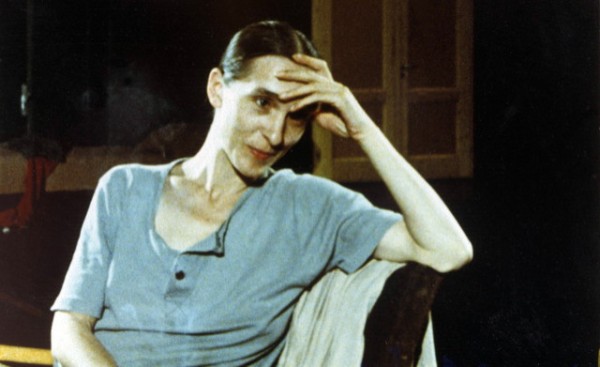
Pina Bausch

Rarely screened 1983 documentary delves into Pina Bausch’s creative process (photo courtesy Icarus Films)

“ONE DAY PINA ASKED…” (UN JOUR PINA A DEMANDÉ) (Chantal Akerman, 1983)
Film Society of Lincoln Center, Elinor Bunin Munroe Film Center
144 West 65th St. between Eighth Ave. & Broadway
June 6-12
212-875-5050
www.filmlinc.com

In 1982, Belgian filmmaker Chantal Akerman followed Pina Bausch’s Tanztheater Wuppertal on a five-week tour of Europe as the cutting-edge troupe traveled to Milan, Venice, and Avignon. “I was deeply touched by her lengthy performances that mingle in your head,” Akerman says at the beginning of the resulting documentary, “One Day Pina Asked…,” continuing, “I have the feeling that the images we brought back do not convey this very much and often betray it.” Akerman (Jeanne Dielman, 23 Quai du Commerce, 1080 Bruxelles; Je tu il elle) needn’t have worried; her fifty-seven-minute film, made for the Repères sur la Modern Dance French television series, is filled with memorable moments that more than do justice to Bausch’s unique form of dance theater. From 1973 up to her death in 2009 at the age of sixty-eight, Bausch created compelling works that examined the male-female dynamic and the concepts of love and connection with revolutionary stagings that included spoken word, unusual costuming, an unpredictable movement vocabulary, and performers of all shapes, sizes, and ages. Akerman captures the troupe, consisting of twenty-six dancers from thirteen countries, in run-throughs, rehearsals, and live presentations of Komm Tanz Mit Mir (Come Dance with Me), Nelken (Carnations), 1980, Kontakthof, and Walzer, often focusing in on individual dancers in extreme close-ups that reveal their relationship with their performance. Although Bausch, forty at the time, is seen only at the beginning and end of the documentary, her creative process is always at center stage. At one point, dancer Lutz Förster tells a story of performing Gershwin’s “The Man I Love” in sign language in response to Bausch’s asking the troupe to name something they’re proud of. Förster, who took over as artistic director in April 2013, first performs the song for Akerman, then later is shown performing it in Nelken. (Bausch fans will also recognize such longtime company members as Héléna Pikon, Nazareth Panadero, and Dominique Mercy.)
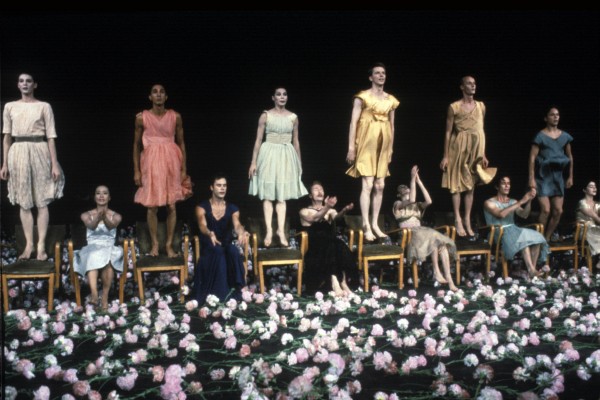
Documentary includes inside look at such Tanztheater Wuppertal productions as CARNATIONS (photo courtesy Icarus Films)

Documentary includes inside look at such Tanztheater Wuppertal productions as NELKEN (photo courtesy Icarus Films)

Akerman often leaves her camera static, letting the action unfold on its own, which is particularly beautiful when she films a dance through a faraway door as shadowy figures circle around the other side. It’s all surprisingly intimate, not showy, rewarding viewers with the feeling that they are just next to the dancers, backstage or in the wings, unnoticed, as the process unfolds, the camera serving as their surrogate. And it works whether you’re a longtime fan of Bausch, only discovered her by seeing Wim Wenders’s Oscar-nominated 3D film Pina, or never heard of her. “This film is more than a documentary on Pina Bausch’s work,” a narrator says introducing the film. “It is a journey through her world, through her unwavering quest for love.” As a bonus, the Film Society of Lincoln Center will be presenting free 7:30 screenings of Gustavo Beck and Leonardo Luiz Ferreira’s 2010 documentary, Chantal Akerman, from Here, in conjunction with the June 6-12 theatrical run of ”One Day Pina Asked…”
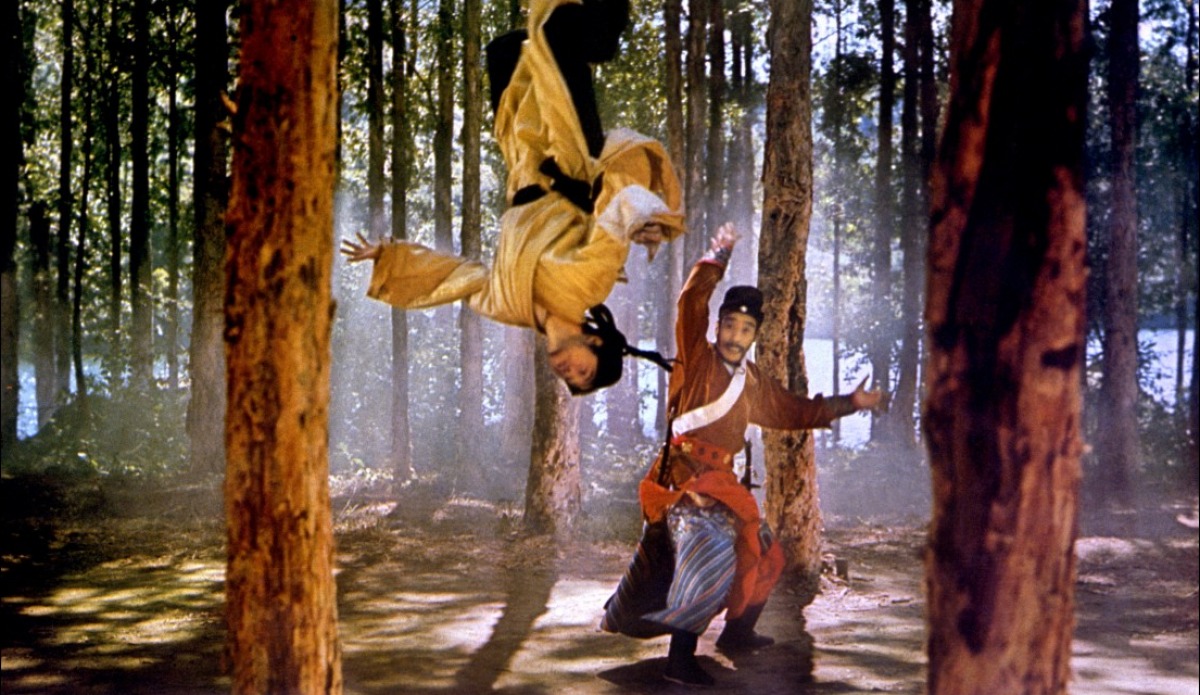

ALL HAIL THE KING — THE FILMS OF KING HU: A TOUCH OF ZEN

King Hu’s 1971 wuxia classic, A TOUCH OF ZEN, is a trippy journey toward enlightenment

A TOUCH OF ZEN (King Hu, 1971)
BAMcinématek, BAM Rose Cinemas
30 Lafayette Ave. between Ashland Pl. & St. Felix St.
Friday, June 6, $13, 7:30
Series runs June 6-17
718-636-4100
www.bam.org

Watching King Hu’s 1971 wuxia classic, A Touch of Zen, brings us back to the days of couching out with Kung Fu Theater on rainy Saturday afternoons. The highly influential three-hour epic features an impossible-to-figure-out plot, a goofy romance, wicked-cool weaponry, an awesome Buddhist monk, a bloody massacre, and action scenes that clearly involve the overuse of trampolines. Still, it’s great fun, even if it is way too long. (The film, which was initially shown in two parts, earned a special technical prize at the 1975 Cannes Film Festival.) Shih Jun stars as Ku Shen Chai, a local calligrapher and scholar who is extremely curious when the mysterious Ouyang Nin (Tin Peng) suddenly show up in town. It turns out that Ouyang is after Miss Yang (Hsu Feng) to exact “justice” for the corrupt Eunuch Wei, who is out to kill her entire family. Hu (Come Drink with Me, Dragon Gate Inn) fills the film with long, poetic establishing shots of fields and the fort, using herky-jerky camera movements (that might or might not have been done on purpose) and throwing in an ultra-trippy psychedelic mountain scene that is about as 1960s as it gets. A Touch of Zen is ostensibly about Ku’s journey toward enlightenment, but it’s also about so much more, although we’re not completely sure what that is. The film kicks off BAMcinématek’s “All Hail the King: The Films of King Hu” series, which runs June 6-17 and pays tribute to the Shaw Brothers veteran with such other works as The Love Eterne, Come Drink with Me, All the King’s Men, and The Valiant Ones in addition to movies it influenced and/or is related to, including Nicholas Ray’s Johnny Guitar, Tsai Ming-liang’s Goodbye, Dragon Inn, Ang Lee’s Crouching Tiger, Hidden Dragon, and Akira Kurosawa’s Seven Samurai.
SWOON: SUBMERGED MOTHERLANDS

(photo by twi-ny/mdr)

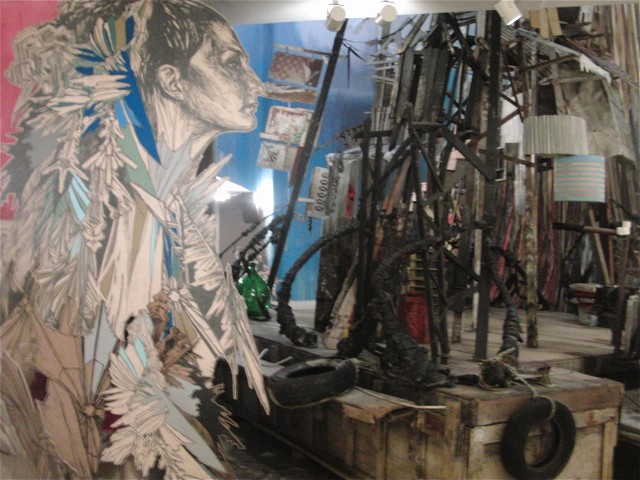
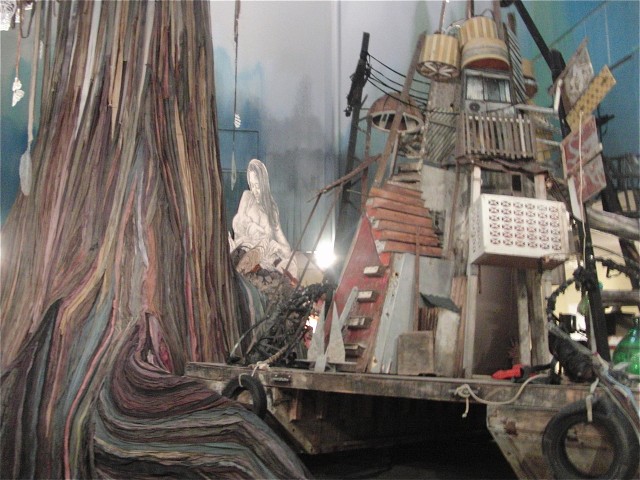
Swoon’s “Submerged Motherlands” fills the Brooklyn Museum’s fifth-floor rotunda (photo by twi-ny/mdr)

Brooklyn Museum
Iris and B. Gerald Cantor Gallery, fifth floor
200 Eastern Parkway at Washington St.
Wednesday – Sunday through August 24, $12 ($15 including “Ai Weiwei: According to What?”)
Art Off the Wall: Swoon’s “Submerged Collaborations,” June 12, $15, 6:30
212-864-5400
www.brooklynmuseum.org
www.facebook.com/SwoonStudio

“Is this insane? Is this dangerous? Should I not do this?” Brooklyn-based artist Caledonia Dance Curry, aka Swoon, asked an engineer when she first began putting together “Submerged Motherlands,” her enormous, environmentally conscious installation at the Brooklyn Museum. Filling much of the institution’s fifth-floor rotunda, the site-specific exhibit features two rickety-looking handmade junk rafts, Alice and Maria, that Swoon constructed using found materials, then sailed in New York waters for “Miss Rockaway Armada” and along Venice’s Grand Canal as part of her “Swimming Cities of Serenissima” project. At the center is a tall tree, made of dense layers of dyed fabric and elaborately detailed white cut-paper leaves, that rises to the rotunda’s seventy-two-foot-high circular skylight. The walls of the room suggest water and submersion, splattered with swoops of blue and green paint applied using fire extinguishers, interacting with light and shadow. “Submerged Motherlands” references climate change, Hurricane Sandy, and Doggerland, the Ice Age-era landmass that connected Great Britain and Europe and was destroyed by a tsunami; it also has conceptual ties to the Konbit Shelter sustainable building project in Haiti begun by Swoon and other artists shortly after the 2010 earthquake, as well as Swoon and art collective Transformazium’s Braddock Tiles community-based microfactory being built in an abandoned church in Pennsylvania. “Submerged Motherlands” also includes a healing gazebo decorated with corrugated cardboard honeycombs and wasp nests, and large-scale prints and drawings that recall Swoon’s wheatpastes, which dotted the streets of the city in recent years; here she depicts mothers and children and taliswomen, from a homeless Buddha figure to a friend breast-feeding to depictions of Swoon’s mother’s life cycle; her drug- and alcohol-addicted mother passed away from lung cancer last year.

Theres a distinctly feminist quality to Swoons site-specific installation at the Brooklyn Museum (photo by twi-ny/mdr)

There’s a distinctly feminist quality to Swoon’s site-specific installation at the Brooklyn Museum (photo by twi-ny/mdr)

Is it insane and dangerous? Probably, but we’re all the better for Swoon’s having gone ahead with “Submerged Motherlands,” an intimate, compelling, and welcoming exploration of life, death, and rebirth. The exhibition continues through August 24; on June 12, Swoon will participate in “Art Off the Wall: Swoon’s ‘Submerged Collaborations,’” which will include a screening of Flood Tide, Todd Chandler’s fictional film about the “Swimming Cities” project; a talk with Swoon and some of her collaborators; and a silent procession from the auditorium to the installation for a live performance by the Submerged Motherlands Orchestra (consisting of Mirah, Marshall LaCount, Chandler, the band North America, and violinist Chloe Swantner).

FRONT/ROW CINEMA: RISE OF THE PLANET OF THE APES

Caesar has had quite enough in excellent PLANET OF THE APES reboot

SEE/CHANGE: RISE OF THE PLANET OF THE APES (Rupert Wyatt, 2011)
South Street Seaport
Corner of Front & Fulton Sts.
Saturday, June 7, free, 8:00
www.southstreetseaport.com
www.apeswillrise.com

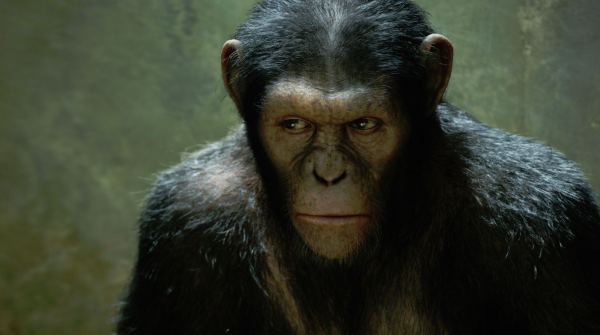
Director Rupert Wyatt and writers Rick Jaffa and Amanda Silver reimagine Pierre Boulle’s original Planet of the Apes story in the exciting and inventive reboot Rise of the Planet of the Apes. Taking elements from the first five Apes films, especially the fourth flick, Conquest of the Planet of the Apes, this blockbuster is a more science-based thriller that delves into the evolutionary (and devolutionary) nature of humans and animals. James Franco stars as Will Rodman, a scientist working on the anti-Alzheimer’s drug ALZ-112 for Gen-Sys, a big pharmaceutical company run by Steven Jacobs (David Oyelowo). After a demonstration for potential investors goes terribly wrong, Jacobs orders all of the ALZ-112 test subjects to be destroyed, but the baby of the primary subject survives and is brought home by Will, who raises Caesar (a motion-captured Andy Serkis) as if the chimpanzee were his own child, with the help of his scientist girlfriend, Caroline (Slumdog Millionaire’s Freida Pinto) and his father (John Lithgow), who was suffering from Alzheimer’s but is seeing remarkable improvement as Will secretly treats him with the controversial drug. As Caesar grows up, he gains insight into the state of the world, especially how apes are forced to literally live like caged animals, and soon he is ready to do something about it. Rise of the Planet of the Apes is no mere remake or summer popcorner capitalizing on the fame of the series (for that, see Tim Burton’s terrible 2001 disaster); instead, it is a moving, thoughtful study of the development of mammalian intelligence and the very basic need to be free. Wyatt (The Escapist) moves things along at a slow pace in the first half of the film, allowing Caesar’s character to blossom, leading to a believable revolution that culminates in an action-packed showdown on the Golden Gate Bridge. Serkis, who previously played such motion-capture characters as Gollum and King Kong, breathes remarkable life and emotion into Caesar, so much so that there was Oscar buzz around his performance. Rise earns its already respected place in the Apes pantheon, a worthy addition that honors the past while paving the way for a promising future.

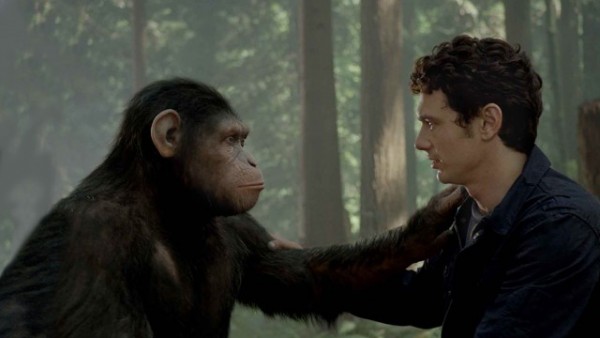
Caesar (Andy Serkis) and Will (James Franco) bond in RISE OF THE PLANET OF THE APES

Caesar (Andy Serkis) and Will (James Franco) bond in RISE OF THE PLANET OF THE APES

Although it is not a remake or a sequel, Rise does fit within the Apes mythology, and it includes numerous tributes to its predecessors: Gen-Sys head Jacobs is named for the producer of the five original films, Arthur P. Jacobs; Gen-Sys chimp handler Robert Franklin (Tyler Labine) is a subtle nod to the director of the first film, Franklin J. Schaffner; the circus orangutan Maurice pays tribute to Maurice Evans, who played the orangutan Dr. Zaius in the original; the chimp Cornelia is a sly combination of favorite characters Cornelius and Dr. Zira from the first flicks; and Brian Cox as John Landon and Tom Felton as Dodge, his son, remember original Apes astronauts Landon (Robert Gunner) and Dodge (Jeff Burton). In addition, at one point a television monitor shows a clip of Charlton Heston playing Julius Caesar, and one of the most famous lines from the original makes an appearance in this reboot, which ends with more than a hint that sequels are to follow, beginning in July 2014 with Matt Reeves’s Dawn of the Planet of the Apes, starring Jason Clarke, Keri Russell, Gary Oldman, and Serkis again as Caesar. Rise of the Planet of the Apes is screening June 7 as part of the South Street Seaport’s “Front/Row Cinema: See/Change” series, which continues Wednesday and Saturday nights through August 31. For a day-by-day listing of free summer movie screenings throughout New York City, go here.

JUST JIM DALE

(photo by Joan Marcus)

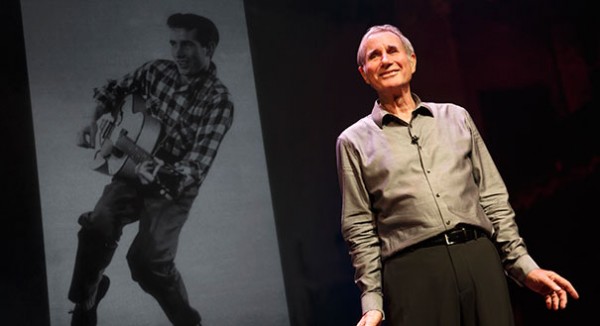
Jim Dale waits for applause — of which there’s plenty — in new one-man show (photo by Joan Marcus)

Laura Pels Theatre
Harold and Miriam Steinberg Center for Theatre
111 West 46th St. between Sixth & Seventh Aves.
Tuesday – Sunday through August 10, $79
212-719-1300
www.roundabouttheatre.org

Jim Dale shares his love of the footlights in his charming new one-man show, Just Jim Dale. Over the course of one hundred minutes, the Tony- and Grammy-winning, Oscar-nominated British actor traces his life and career, from his birth in the small town of Rothwell, “the dead center of England — in every way,” to his more recent fame as the man who voices the Harry Potter audiobooks. Dale, who will turn seventy-nine in August, is a tall, lanky performer who took his father’s words to heart: “Learn how to move,” his dad told him when young Jim Smith, Dale’s real name, expressed interest in show business after they saw Me and My Girl. Dale recalls his early days as a dancer, a British music hall comedian, and a pop singer, including a very funny bit in which he re-creates a pas de deux he was supposed to do with his cousin Ruth in a ballet competition when he was about eleven, but she missed the bus and Jim did the duet himself. Accompanied by co-arranger Mark York on piano, Jim performs songs from Me and My Girl and Barnum, for which he won a Tony playing Phineas Taylor Barnum; sings the music hall standard “Turned Up” and songs that he wrote, including the pop hit “Dicka Dum Dum” and “Georgy Girl”; and tells lots of old, purposely groan-worthy jokes. (“I said, ‘Waiter, what’s this?’ He said, ‘It’s bean soup.’ I said, ‘I don’t care what it’s been. What is it now?’”)

Jim Dale looks back at his life and career in charming Roundabout production (photo by Joan Marcus)

Jim Dale looks back at his life and career in charming Roundabout production (photo by Joan Marcus)

Dale also recites the climactic scene from Noël Coward’s Fumed Oak; gives a tour-de-force lesson in quoting Shakespeare in contemporary language (“If you can’t understand an argument and you say, ‘It’s all Greek to me,’ you’re quoting Shakespeare.”); and performs the powerful opening moments from Peter Nichols’s Joe Egg, getting the audience involved. In fact, throughout the show, Dale interacts with the crowd, occasionally ad-libbing and making everyone feel comfortable and welcome. He’s an amiable fellow, so it’s easy to forgive some of the transitions that need tightening, the timeline that occasionally gets confusing, and a few of the bits that go on too long (the Fumed Oak scene, for example). Dale begins the show, which is directed by Richard Maltby Jr. (Ain’t Misbehavin’, Fosse), with “I Gotta Be Me,” in which he sings, “So I’ve got to be me / I’ve said it before / A juicieful actor / for folks to adore.” Just Jim Dale reveals the many surprising facets of this juicieful actor who is easy to adore.

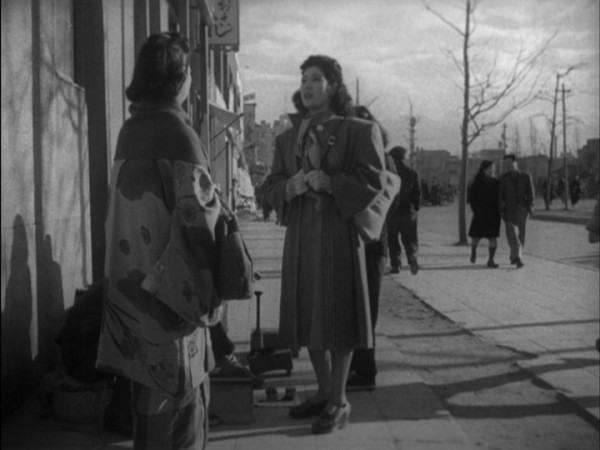
MIZOGUCHI: WOMEN OF THE NIGHT

WOMEN OF THE NIGHT

Sisters face terrible decisions in Kenji Mizoguchi’s unrelenting WOMEN OF THE NIGHT

WOMEN OF THE NIGHT (YORU NO ONNATACHI) (Kenji Mizoguchi, 1948)
Museum of the Moving Image
35th Ave. at 36th St., Astoria
Sunday, June 8, 4:30, free with museum admission of $12
Series runs May 2 – June 8
718-777-6800
www.movingimage.us

“I’ll find freedom and happiness my own way,” Kumiko (Tomie Tsunoda) declares in Women of the Night, but there’s no freedom or happiness for women in Kenji Mizoguchi’s bleak vision of postwar Japan. Based on the novel Joseimatsuri by Eijiro Hisaita, the 1948 film is another in the director’s series of harrowing works dealing with women who are given no option in society other than prostitution. Fusako (Kinuyo Tanaka) is trying to make ends meet as she awaits her husband’s return from the war and nursing her sick infant, but after learning that her husband is dead and losing their child to tuberculosis, she has little choice but to start selling her body. When her younger sister, Natsuko (Sanae Takasugi), finds out what she is doing, she tries to save her, but the system is against them. Meanwhile, Fusako’s young sister-in-law, Kumiko, decides to run away, but she is quickly beaten down as well. Mizoguchi, whose family sold his sister into prostitution, explored similar territory in such earlier films as Sisters of the Gion and Osaka Elegy and in his 1956 masterpiece, Street of Shame, sets Women of the Night in a near-postapocalyptic landscape, the ruined women equated with the rubble surrounding them, lending the film a neo-Realist quality. Nearly all of the men in the film are bad, creating conditions that have the women fighting against one another instead of helping each other out of their ever-more-dire circumstances. It’s a dark, unrelenting film featuring several daring shots, leading to a brutal, memorable finale. Women of the Night is screening June 8 at 4:30 as part of the Museum of the Moving Image’s five-week tribute to the master auteur — who made more than eighty films, less than half of which still exist — and continues with such other works as Princess Yang Kwei-fei, The Lady of Musashino, A Woman of Rumor, and Tales of the Taira Clan.

RANGERSTOWN VIEWING PARTY & FAN FEST

Bryant Park
Sixth Ave. between 40th & 42nd Sts.
Wednesday, June 4, free, 4:00
www.rangers.nhl.com
www.bryantpark.org

When we recommended Rangerstown Hockey House back in April as a great place to watch a Blueshirts playoff road game, little did we realize that more than five weeks later, the Rangers would be in the Stanley Cup Finals. Along with Hockey House, which is still going strong at the Garden, other public places to watch the Rangers battle the L.A. Kings are popping up, including Bryant Park, which is hosting a Fan Fest and Viewing Party for Game 1 on Wednesday. The festivities begin at 4:00 with ice skating, hockey clinics, face painting, giveaways, and meet-and-greets with Rangers alumni, followed by the game being projected on the big screen at the west side of the Bryant Park Lawn.