twi-ny recommended events

CHAIN LINKS: ONE-ACT WINTER FESTIVAL RETURNS WITH BEVY OF STARS

CHAIN WINTER ONE-ACT FESTIVAL
Chain Theatre
312 West Thirty-Sixth St. between Eighth & Ninth Aves.
February 5 – March 1, live and virtual, $24–$35
www.chaintheatre.org

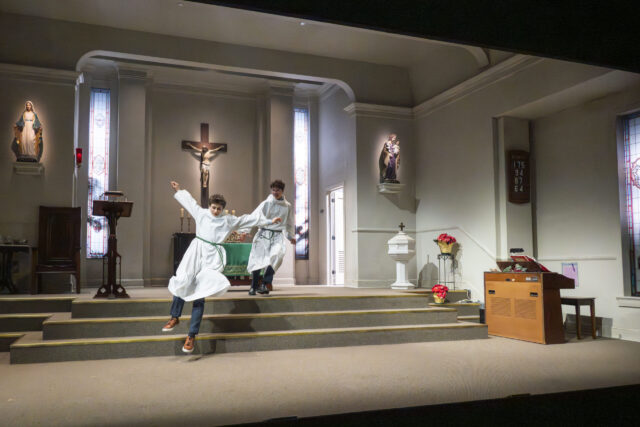
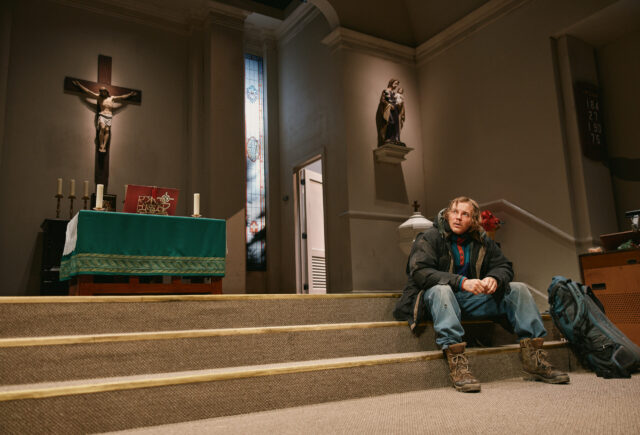
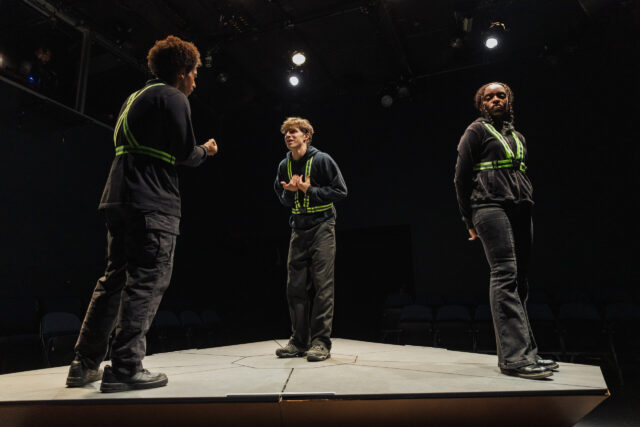
The Chain Winter One-Act Festival is back with an impressive lineup of plays through March 1, featuring twenty-eight programs consisting of between two and four works totaling sixty to eighty minutes. Soap opera fans will be especially excited, as many of the participants come from that genre (As the World Turns, All My Children, One Life to Live, Falcon Crest).

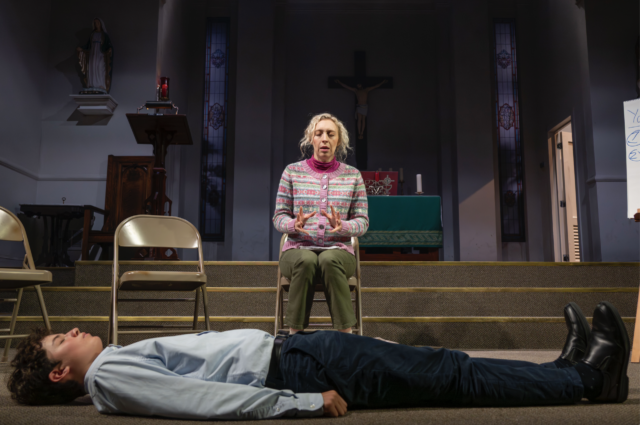
This year is highlighted by Jeryl Brunner’s Sweet Tart, directed by two-time Oscar nominee Jesse Eisenberg and starring Emmy nominee Ralph Macchio and his daughter, Julia Macchio, who played Vanessa on Cobra Kai. Sweet Tart is on a can’t-miss bill with Lyle Kessler’s Shit Kickers, starring two-time Emmy winner and Oscar nominee Carol Kane and Margaret Ladd, and John Arthur Long’s The Fusion Experiment, with David Rey and Christina Elise Perry, helmed by Chain artistic director Kirk Gostkowski. [Ed. note: It was announced on February 23 that Carol Kane will no longer be appearing in Shit Kickers; she will be replaced by Sachi Parker.]

“We don’t do safe — we do real,” Gostkowski said in a statement. “This is where audiences and artists meet on equal ground to explore the world as it is, and imagine what it could be.”

Two-time Obie-winning playwright José Rivera presents the world premiere of the fabulously titled Look What Crashed through the Portal and Ended up in Brooklyn, Emmy winner Jennifer Pepperman writes and directs Ray, David Zayas Jr. directs Diego Aguirre, Joseph Russo, and Jacob Lumet Cannavale in Aguirre’s Stalled, and three-time Emmy winner Cady McClain takes the lead in three-time Emmy-winning director Christopher Goutman’s The Oblique. Other shows to watch out for are Annabel McConnachie’s Waiting for Gadot, Sarah Swift’s True Crime, John Corins’s Brad Pitt and the Exploding Head, and Melanie Acampora’s Too Much Fondant.

General admission tickets begin at $24; if it’s too cold for you to venture outside, four of the programs will be livestreamed.

[Mark Rifkin is a Brooklyn-born, Manhattan-based writer and editor; you can follow him on Substack here.]
A SPECIAL ARTIST: RUTH ASAWA AT MoMA

Installation view, “Ruth Asawa: A Retrospective” (digital Image © 2025 the Museum of Modern Art, New York / photo by Jonathan Dorado / artwork © 2025 Ruth Asawa Lanier, Inc. / courtesy David Zwirner)

RUTH ASAWA: A RETROSPECTIVE
Museum of Modern Art
The Steven and Alexandra Cohen Center for Special Exhibitions
11 West 53rd St. between Fifth & Sixth Aves.
Through February 7, $17-$30
www.moma.org
ruthasawa.com

“To watch you at work on a wire sculpture is to see how a single line is transformed into a network of interconnectedness. It’s an expression of the Heart Sutra: form is emptiness, and emptiness is form,” author, filmmaker, and Zen Buddhist priest Ruth Ozeki writes in a letter to the late Ruth Asawa in the catalog of the outstanding MoMA exhibition “Ruth Asawa: A Retrospective.” She continues, “It’s a performance of eternal and infinite nonduality, in which inside is out, and outside is in, and there is no start, no finish, and no separation between these continuous and continually related moments of being.”

“Let the medium express itself.”

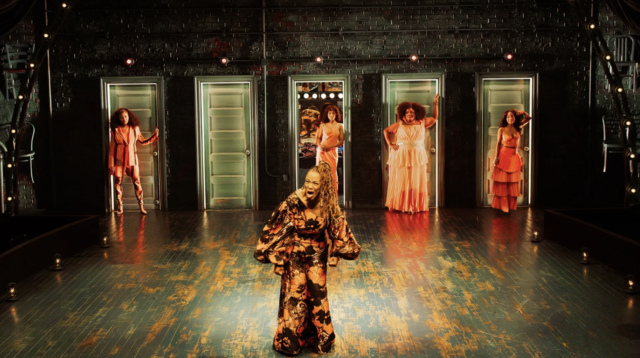
On view through February 7, the show features approximately three hundred wire sculptures, bronze casts, drawings, paintings, prints, class notes, a Guggenheim fellowship application, a letter of patent, and public projects. Asawa was born in California in 1926, was sent to an internment camp in Arkansas in 1942 (her parents were Japanese immigrants), studied at Black Mountain College in North Carolina with Josef Albers, Jacob Lawrence, John Cage, Merce Cunningham, Willem de Kooning, and Buckminster Fuller, and helped create the San Francisco School of the Arts, which was renamed the Ruth Asawa San Francisco School of the Arts in 2010. That background led to a career making wide-ranging works that combine movement, architecture, color, and music into something wholly new. She died in 2013 at the age of eighty-seven.

“I hold no hostilities for what happened; I blame no one. Sometimes good comes through adversity. I would not be who I am today had it not been for the internment, and I like who I am.”

Ruth Asawa, Untitled (BMC.145, BMC Laundry Stamp), stamped ink on fabric sheeting, ca. 1948–49 (© 2025 Ruth Asawa Lanier, Inc. / courtesy David Zwirner)

Among the pieces to watch out for are the oil on masonite We Five and Fourteen, the ink and crayon on paper Untitled (MI.121, Chair with Straw Bottom), the ink on paper Untitled (PT.128, Plane Tree), clay life masks, a glazed ceramic plate and persimmon, gentle watercolors, carved doors, lithographs of children, the ceramic Untitled (S.806d, Everyone’s Favorite City: The Golden Gate Bridge, the Cable Car, and the San Francisco Victorian House), bronze body parts, a series of flower lithographs from 1965, index cards, sketchbooks, archival photographs, and a wedding ring made for Asawa by Fuller. There are also works by Albers, Hazel Larsen Archer, Elizabeth Jennerjahn, Imogen Cunningham, Ray Johnson, Merry Renk, and Marguerite Wildenhain.

“I am able to take a wire line and go into the air and define the air without stealing it from anyone. A line can enclose and define space while letting the air remain air.”

Installation view, “Ruth Asawa: A Retrospective” (digital Image © 2025 the Museum of Modern Art, New York / photo by Jonathan Dorado / artwork © 2025 Ruth Asawa Lanier, Inc. / courtesy David Zwirner)

But mostly there are Asawa’s dazzling wire sculptures, mounted on bases and walls and hanging from above, intricate constructions of interlocking spheres and continuous organic forms within forms based on nature. They cast shadows as you walk around them, and some spin ever so slowly, but they all nimbly dance between positive and negative space.

“An artist is not special. An artist is an ordinary person who can take ordinary things and make them special.”

[Mark Rifkin is a Brooklyn-born, Manhattan-based writer and editor; you can follow him on Substack here.]
SITES OF MEMORY AND THE SHAPE OF THINGS: CARRIE MAE WEEMS AND FRIENDS AT LINCOLN CENTER

Who: Carrie Mae Weems, Craig Harris, Esther Armah, Nona Hendryx, Jennifer Koh, Carl Hancock Rux, Jawwaad Taylor
What: “Contested Sites of Memory”
Where: Alice Tully Hall, 1941 Broadway at West Sixty-Fifth St.
When: Thursday, January 28, and Friday, January 30, pay-what-you-wish ($5-$35+), 7:30
Why: In December 2021, American artist Carrie Mae Weems presented “The Shape of Things” at Park Ave. Armory, a masterful multidisciplinary examination of where we are as a nation as we face systemic racism, health and income inequality, police brutality, and the perpetuation of the Big Lie. The installation was accompanied by the “Land of Broken Dreams Convening and Concert Series,” three days of live music and dance, film screenings, and panel discussions.

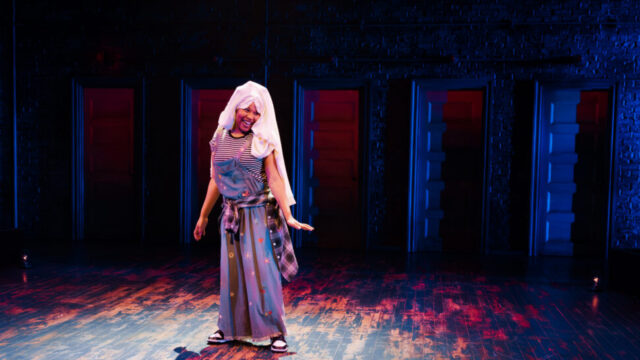
On January 29 and 30, Weems will be at Alice Tully Hall for her latest gathering, “Contested Sites of Memory.” Produced in collaboration with Shore Art Advisory and Lincoln Center, it will feature live music, video art screenings, spoken word, and more, with trombonist, composer, sonic shaman, and musical director Craig Harris, British-born Brooklyn-based playwright, radio host, author, and Armah Institute of Emotional Justice CEO Esther Armah, singer, songwriter, producer, and activist Nona Hendryx, Grammy-winning violinist Jennifer Koh, poet, playwright, novelist, essayist, composer, pianist, professor, and writer Vijay Iyer, and recording artist Carl Hancock Rux, and emcee, trumpeter, composer, producer, educator, and social activist Jawwaad Taylor. The focus is on the purpose and meaning of American monuments and how they relate to the past, present, and future of the country.

Born in Portland, Oregon, and based in Syracuse, Weems is best known for such highly influential photographic projects as “The Kitchen Table Series,” “Family Pictures and Stories,” “The Louisiana Project,” “Constructing History,” and “Museums.” A National Academician and MacArthur Genius, she was busy during the pandemic, making the hypnotic short film The Baptism with Rux and hosting a podcast for the Whitney, “Artists Among Us,” in which she spoke with a wide range of artists, curators, and writers, including Glenn Ligon, Bill T. Jones, Lucy Sante, Jessamyn Fiore, An-My Lê, and Adam Weinberg.

“Contested Sites of Memory” should be another unique and fascinating high point in the career of one of America’s genuine treasures, who has been documenting the shape of things for more than four decades.

[Mark Rifkin is a Brooklyn-born, Manhattan-based writer and editor; you can follow him on Substack here.]
SIGHING AND SWOONING AT THE MOON: JOE WHITE’S BLACKOUT SONGS

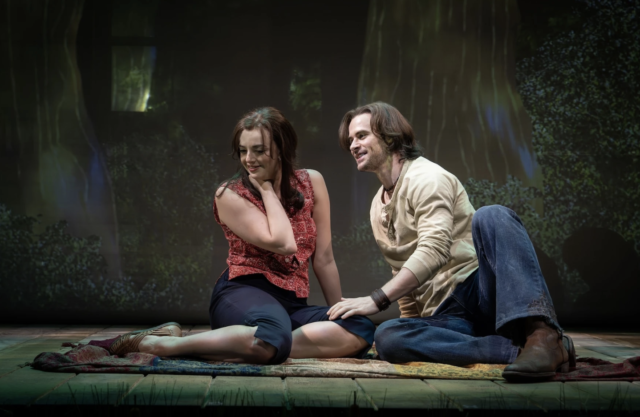
Abbey Lee and Owen Teague star as a couple seeking escape from the world in Blackout Songs (photo by Emilio Madrid)

BLACKOUT SONGS
Robert W. Wilson MCC Theater Space
Susan & Ronald Frankel Theater
511 West Fifty-Second St. between Tenth & Eleventh Aves.
Tuesday – Saturday through February 28, $59-$129
www.blackoutsongs.com

“I spoke about wings / You just flew / I wondered, I guessed, and I tried / You just knew / I sighed / But you swooned / I saw the crescent / You saw the whole of the moon,” Mike Scott sings in the 1985 Waterboys tune “The Whole of the Moon.” The propulsive song appears several times in Joe White’s scintillating, Olivier-nominated Blackout Songs.

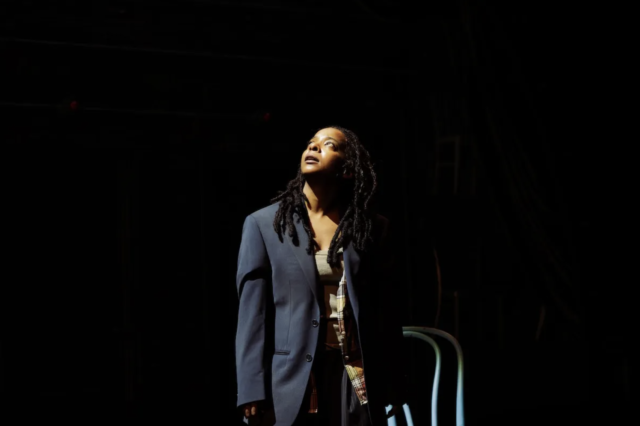
Running at the Susan & Ronald Frankel Theater through February 28, the show stars Owen Teague and Abbey Lee as an initially unnamed American college student studying painting and a free-spirited British wannabe poet who meet at their first AA meeting. While she looks stylish in jeans, a faux fur coat, a belly-revealing shirt, and sunglasses, he is ragged and unsteady, with torn pants and a denim jacket. (The costumes are by Avery Reed.) He speaks in a stammer, wearing a neck brace that he can’t explain.

Finding a tooth in her pocket, she says, “Some people might (panic), you know, but my brain, my brain’s just gone ‘pfff, don’t worry about it.’ Gone. And that’s — Well, that’s what, exactly? That’s mercy, isn’t it? This is what mercy looks like, you go out, get pissed, get hurt, fall in love, whatever, doesn’t matter, in the morning it’s gone anyway, new day — do you know you’re shaking?” He doesn’t.

That opening sets the stage for the rest of the play, in which the two alcoholics fall in and out of love, disappear for extended periods, and remember and forget significant parts of their toxic relationship. They are both completely right and completely wrong for each other; you can’t help but root for them even when it’s clear they are caught on a dangerous downward spiral, unable to avoid the “medicine” they still think can help them. They role-play, attend a funeral, and dance in a bar, as beautiful moments intersect with bad decisions. One night, when he shows up bleeding from the mouth, she says, “I think it’s sexy, actually. Desperately romantic. You’re so doomed, aren’t you.” He later professes, “There’s no life without you.”

They exist in an amorphous time and space, where no one else is ever around, just the two of them reveling in and falling prey to their inner demons. When she talks about her father, who essentially abandoned her when she was six, he asks, “Don’t you think you’re memorable? Is that what you think — Cos he — Cos he sent you away, that means he tried to forget you?” She responds, “OK, alright, thanks, Dr. Freud, but I’m done here — Let’s go get a drink.”

The past and the present intertwine as the man and the woman contemplate their future, minute by minute, depending on what they can remember.

Stacey Derosier’s extraordinary lighting nearly steals the show in Blackout Songs (photo by Emilio Madrid)

Blackout Songs unfolds in a mostly empty space designed by three-time Tony winner Scott Pask, with a small pub table on one side against the wall, a folding table with coffee and snacks on the other, and a church pulpit near a far corner, next to large windows that later reveal a glowing cross. In the first scene, the woman is convincing the man to leave the meeting and get some medicine; looking directly at the audience, she says to him, “Don’t look at them,” as if we’re not only watching the play but are also fellow recovering addicts at the meeting — and we have no right to judge them because we all have our failings.

The concept of the moon is a theme throughout the story; in addition to the Waterboys song, the man recalls the beauty of the moon when showing the woman one of his paintings, and he later says, “Won’t forget this, will you. Full moon, holy wine, it’s like a song or something. You know the world is different under a full moon? People are. People fall in love. Cos it pulls liquid around, doesn’t it. Tides. And there’s liquid in us too. Blood and. Other liquids. Chemicals. The brain is the moistest organ in the body. Moon drunk is different.”

Brian Hickey’s striking sound and original music and Stacey Derosier’s extraordinary lighting — almost a character unto itself — help define the shifts in time to startling effect. The production, under Rory McGregor’s (The Wasp, Buggy Baby) expert direction, evokes such other complex works as Nick Payne’s Constellations, in which a couple’s relationship constantly changes in the quantum multiverse, Philip Ridley’s Tender Napalm, about an unnamed man and woman whose intense passion leads them on mysterious mini-adventures, and David Ives’s Venus in Fur, in which a theater director and an actor turn an audition into a reality-bending treatise on gender, sexuality, and degradation, as well as Blake Edwards’s 1962 film Days of Wine and Roses, about a married couple who trap themselves in a haze of alcohol. (McGregor directed Tender Napalm at Theaterlab in late 2024, with a crew that included Reed, Hickey, and Derosier.)

Blackout Songs boasts a trio of firsts: Two-time Olivier nominee White’s (The Little Big Things, Mayfly) and Lee’s (Florida Man, Black Rabbit) American stage debuts and Teague’s (Kingdom of the Planet of the Apes, You Hurt My Feelings) US debut. Lee is a force of nature in the play, her character never slowing down, always on the move, while Teague lends a sensitive air to the man, who thinks he knows what he wants but keeps making choices that hold him back. It’s a beguiling, heart-wrenching ninety-minute pas de deux as two lost souls try to find love and escape together.

The play does have a hard time figuring out how to end, but by then you’ll be so entranced by the two characters, and the two actors, that you won’t mind, especially if you’re addicted to good theater.

[Mark Rifkin is a Brooklyn-born, Manhattan-based writer and editor; you can follow him on Substack here.]
SPACE IS THE PLACE: SETTING THE SCENE

There are no actors on hand but the Mabou Mines production of All That Fall boasts a magnificent set (photo by twi-ny/mdr)

“Space is the place,” Sun Ra sang on the title track of his 1973 album, Space Is the Place. “There’s no limit to the things that you can do. . . . And your life is worthwhile.”

The jazz legend might have been referring to the cosmos, but one of the (many) things that makes my life worthwhile is entering a theater with no idea what to expect visually. I’m not talking about standard setups where the proscenium stage is in front of rows of affixed seats but rooms that can be reshaped and reconfigured in multiple ways. For example, I am filled with anticipation every time I walk into Park Ave. Armory’s Wade Thompson Drill Hall, TFANA’s Polonsky Shakespeare Center, the Shed’s McCourt, BAM Fisher, and the Signature’s Romulus Linney Courtyard Theatre, all of which can be transformed into fascinating rearrangements.

Below are four recent shows I’ve seen that offered unique spatial experiences.

The cast of All That Fall does not appear in person at the 122 Community Center (photos by Jeri Coppola)

UNDER THE RADAR: ALL THAT FALL
Mabou Mines@122CC
150 1st Ave. at Ninth St.
January 8–25, $20-$50
www.maboumines.org
utrfest.org

Since 1970, the experimental avant-garde Mabou Mines troupe has been challenging the boundaries of theater, and they do it again with their adaptation of Samuel Beckett’s 1957 radio play, All That Fall. When audience members get off the elevator at the 122 Community Center, they encounter a series of objects in the hallway and a side room that prepare them for the show: a photo of the Orangedale train station next to a radio playing a Big Band–era instrumental; a poster of a railway man’s “hand, flag and lamp signals” with an actual rusty lamp; a photo of the train station interior, with empty benches, which hints at what we’ll soon see; horse-racing information; and a piece of paper with the opening quote from Beckett’s 1938 novel, Murphy, “The sun shone, having no alternative, on the nothing new,” along with a drawing of a tree by Harry Bliss with the caption “A tree greeting the morning sun, because it has no choice.”

Inside the theater, the seats are arranged in a traditional manner, but the set is like an art installation, a large model of a miniature town with tiny houses, bumpy hills, rocky streets, a river, two bridges, hens near the tracks, and an elevated train station, all surrounded by a map on the walls; in the back are regular-size remnants, an abandoned bicycle and parts of some kind of moving vehicle. In front of the model, a man is projecting slides on an old carousel of costumed men and women — the characters the actors will be portraying. Shortly after the projections stop and the man leaves, we realize that there will be no actors for us to watch; in true radio-play fashion, they will only be heard, prerecorded, but we now know what they look like.

The narrative is fairly straightforward: Mrs Maddy Rooney (Randy Danson) is worried when her blind husband, Dan (Tony Torn), is late getting home. She finds out that the ever-dependable train has not arrived yet, and she is concerned why. Along her journey, she meets up with Christy the carter (Jesse Lenat), Mr Barrell the station master (Lenat), Mr Tyler the retired bill collector (Steven Rattazzi), Mr Slocum the racecourse manager (Torn), Tommy the railway porter (Tẹmídayọ Amay), the pious Miss Fitt (Wendy vanden Heuvel), the little girl Dolly (Lila Blue), and the little boy Jerry (Sylvan Schneiderman). They have absurdist conversations about dung, the Matterhorn, damnation, sex, bicycles and vans, the Titanic and the Lusitania, and “the horrors of home life.”

Mrs Rooney’s dialogue is filled with lovely snippets about human existence: “What kind of a country is this where a woman can’t weep her heart out on the highways and byways without being tormented by retired bill-brokers!” she complains to Mr Tyler. “Christ what a planet,” she declares to Miss Fitt. “I do not exist,” she says to Tommy. “I am not half alive nor anything approaching it,” she explains to Mr Tyler. “Have you no respect for misery?”

The breathtaking set is by Thomas Dunn, lit by Jennifer Tipton, with a bevy of sound effects by Bruce Odland, from animal noises to a storm that shakes your seat almost like Sensurround. Mabout Mines cofounder JoAnne Akalaitis directs with a wry sense of humor.

Wally Cardona and Molly Lieber revive David Gordon’s Times Four for its fiftieth anniversary (photo by Maria Baranova)

LIVE ARTERY: TIMES FOUR / DAVID GORDON: 1975/2025
New York Live Arts / Pick Up Performance Co. Studio
541 Broadway between Spring & Prince Sts.
January 11–13, $33.85
newyorklivearts.org

In May 1977, husband-and-wife dancers David Gordon and Valda Setterfield performed their 1975 piece, Times Four in the SoHo loft where they lived and worked. Their son-in-law, Wally Cardona, has brought their little-seen pas d’deux back for a fiftieth-anniversary tribute, teaming up with Molly Lieber to re-create it from a video rehearsal, Setterfield’s handwritten notes, photographs, and other ephemera, taking place in the same loft. It is like a 1960s happening: The limited seating is a single row of folding chairs around the periphery of the otherwise empty room; in addition, the night I attended, there were numerous familiar choreographers and dancers in the audience, all greeting one another. There is no score; the only sounds are Cardona’s (Interventions, The Set Up) and Lieber’s (Rude World, Gloria) breathing and their feet and other body parts touching the floor, sometimes landing softly, sometimes hard. They stare at the walls and windows, rarely making eye contact with the audience, as they glide primarily in unison to four beats, then deleting one move and replacing it with another.

Concentrating mostly on their legs and feet, they move forward, backward, sideways, lifting here, pounding there, almost always in unison. They fall to the ground, extend their bodies, come within inches of the audience. When slight differences occur, you can feel it in your bones. You never know which direction they are going to turn in, resulting in a thrilling suspense to it all.

They both exert remarkable strength as they perform difficult maneuvers, their muscles rippling, sweat forming. It’s a compelling feat of human endurance that last about sixty tense, exhilarating minutes. A poem associated with the dance explains, “well worn wood floor / smooth burnished brown / the kind of floor that begs to be danced on / that wants to seduce me out of my shoes and socks. . . . I face my back to the windows / I imagine 1975.”

Consider me seduced.

Paul Lazar and Annie-B Parson stage first revival of Richard Foreman’s What to wear at BAM (photo by Stephanie Berger)

PROTOTYPE: WHAT TO WEAR
Brooklyn Academy of Music
BAM Strong Harvey Theater
651 Fulton St. at Ashland Pl.
January 15-18
www.bam.org
www.prototypefestival.org

In September 2006, experimental avant-garde legend Richard Foreman and composer Michael Gordon debuted their surreal post-rock opera, What to wear, at the Redcat in LA. It took twenty years, but the show has finally made it to New York at the BAM Strong Harvey Theater as part of the Prototype festival, in its first-ever revival. To prepare everyone for what awaited inside the theater, in the lobby was Foreman’s detailed original concept design model for the complex, fabulously overstuffed stage, a kind of mind-blowing melding of Monty Python, Pablo Picasso, and Alice in Wonderland. It is thrilling to walk into the Harvey and see how that set has been painstakingly re-created at full size by Michael Darling, like magic; Darling also did the props, and the wild costumes are again by E. B. Brooks. Big Dance Theater’s Paul Lazar and Annie-B Parson direct, honoring the 2006 production, which you can watch online here.

The show begins with fancy lighting coming down from the ceiling as a giant cartoonish duck emerges from a doorway and the deep voice of Richard Foreman booms from the heavens: “As of this moment, this ugly duckling is now effectively banished from the realm of the oh so beautiful people.” The duck exits, and sopranos Sarah Frei and Sophie Delphis, mezzo Hai-Ting Chinn, and tenor Morgan Mastrangelo sing, “This is Mad’line X” eight times, then adding, “In a terrible world / One unpleasant world / Such a bad, bad world.” Over the next sixty-plus minutes, those four are joined by St. Vincent, an ensemble of more than a dozen vocalists and dancers, and the seven-piece Bang on a Can orchestra caged in one corner as the story goes through such chapters as “Mad’line X, who understands now,” “So sad but I reject you,” and “When a duck enters a fine restaurant.”

Marchers in kilts hold signs with a big X on them, a pointing finger drops down from above like the hand of G-d, skulls abound, headpieces feature little colored balls on top, a character walks around in a barrel, golf clubs become weapons, a head is locked in a box, and cool wizardry occurs just about everywhere. The unsatisfying ending does not diminish the triumph of this engaging revival. We are told that “Madeline X lives in this terrible world,” but any world that includes works by Foreman can’t be all bad.

AN ARK
The Griffin Theater at the Shed
The Bloomberg Building at Hudson Yards
545 West 30th St. at Eleventh Ave.
Tuesday – Sunday through March 1, $45
theshed.org

“Don’t panic. Don’t be scared. This must feel strange to you. It felt strange to me,” an unnamed character played by Sir Ian McKellen says at the beginning of British playwright Simon Stephens’s An Ark, continuing at the Shed through March 1.

Too late.

In the summer of 2021, Stephens’s Blindness was reimagined for the pandemic, presented at the Daryl Roth Theatre in Union Square, where a maximum of eighty-six masked and blindfolded people were seated in chairs in pods of two, either facing the same or opposite directions, each couple at least six feet away from other pairs. Everyone listened to the play, about a spreading virus that leads to chaos, through individual binaural headphones; the prerecorded narrative was performed by Juliet Stevenson.

In the summer of 2023, Tin Drum brought Kagami to the Shed’s Griffin Theater, which began with a historical multimedia installation that led to a mixed-reality concert in which everyone put on specially designed optically transparent devices that made it appear that the late pianist Ryuichi Sakamoto was playing live, enveloped in augmented reality art. In actuality, the room was completely empty except for a row of chairs along the perimeter where audience members could sit and watch, although it was much better to walk around and get up close and personal with Sakamoto — you could even go right through him.

So I was beyond excited when I heard that Tin Drum had teamed up with Stephens (Sea Wall, Heisenberg, The Curious Incident of the Dog in the Night-Time) and the Shed for An Ark. The play features McKellen (Waiting for Godot, King Lear), Golda Rosheuvel (A Christmas Carol, Not Your Superwoman), Arinzé Kene (Misty, Get Up, Stand Up!), and Rosie Sheehy (Machinal, The Brightening Air) as four futuristic humans in a kind of intergalactic weigh station.

The prep for the show is mind-bogglingly annoying. The audience is encouraged to arrive at least fifteen or twenty minutes before showtime in order to check their coats and bags, which is mandatory; however, the line was so long when we go there that we were advised to just bring our stuff in with us. At the Griffin, a sign announced, “wipe your feet / check your glasses / store your shoes / enter through the curtain / find a seat / put on your headset / sit back / enjoy the ride.” There was no curtain; the open doorway revealed a large room with plush red carpeting, a giant glowing orb hanging in the center from the ceiling, and three circular rows of chairs with a pathway through the middle. While my guest waited for corrective lenses — glasses won’t work with the headset — I took off my shoes and jacket, placed them on the floor, and tried to grab a specific seat, then come back and store my garb in one of the small cubby-hole benches, but I was told by a guide that I couldn’t do that; first I had to put the shoes and coat away, then someone would guide me to a chair. The shoes fit in the little cubby, but I had to really force the coat into another slot, only to be told that I had placed them in the wrong bench and had to move them. By then, my guest was already seated — with her jacket, which she was allowed to keep on her lap, and bag, which she could put under her chair.

Mixed reality An Ark at the shed is a confusing jumble (photo by Marc J. Franklin)

Next, you put on the headsets, and four white holographic chairs appear in front of you; mine had to be adjusted by a guide because the chairs were enormous and floating in the ether. I was disappointed that I could also see everyone else in the room, which detracted from the personal nature of the show, even though theater is usually meant to be a communal experience. Then, guides wheeled the cubby benches straight through the middle of the theater and out the curtain on the other side of the room, further disturbing the alternate reality that was being created. As the play proper began, with the four characters, all barefoot and wearing white, entering the space and sitting down, it was hard not to wonder why the floor had to be carpeted and why we had had to take off our shoes; perhaps it was some kind of ASMR thing.

For forty-seven minutes, the actors perform just for you, making intense direct eye contact, reaching out with their hands, and using the second person as they recount multiple versions of a life, from birth, childhood, and adolescence to adulthood, the senior years, and death. For example: “At school you work hard but you never really feel like you belong,” “You’ll want to tell people about the things that have happened to you in here,” and “You get on first name terms with your pharmacist.” The dialogue is filled with detailed descriptions of objects and scenarios that involve all five senses; while poetic, they don’t propel the plot, which remains mysterious through the end.

Recorded in one take and directed by Sarah Frankcom (Our Town, Punk Rock) with sound by Ben and Max Ringham, set and costumes by Rosanna Vize, and lighting by Seth Reiser, An Ark has numerous beautiful moments, and the interaction between the characters and you can be utterly chilling (Sir Ian McKellen is only a few feet away!); when Sheehy reached a hand out to me, I reached back, attempting to grasp it.

But too much of it was confusing and unnecessary; I’m eager to see where the technology goes. Hopefully the kinks will be smoothed out and creators will have more faith in the story itself, without all the bells, whistles, and rules.

As McKellen says early on, “When this is over . . . things will have changed forever.” Well, hopefully not too much.

[Mark Rifkin is a Brooklyn-born, Manhattan-based writer and editor; you can follow him on Substack here.]
RAW AND NASTY OPERA: HEARTBEAT’S MANON!

MANON!
The Space at Irondale
85 South Oxford St. between Fulton St. & Lafayette Ave., Brooklyn
January 27 – February 15, $28.32-$116.75
www.heartbeatopera.org

“What will be surprising and exciting about this is how raw and some might even say nasty opera can be,” Natalie Walker says in a promotional video for Heartbeat Opera’s Manon!, running January 27 through February 15 at the Space at Irondale. The indie opera company is presenting a unique take on Jules Massenet’s 1884 opéra comique, based on the 1731 novel L’histoire du chevalier des Grieux et de Manon Lescaut by the Abbé Prévost. Set during the reign of King Louis XV, the narrative tells the story of a convent-bound woman who is caught between two men, the Chevalier Des Grieux and finance minister Guillot. Henri Meilhac and Philippe Gille’s original libretto has been adapted with a new book and English lyrics by Jacob Ashworth and Rory Pelsue, with Golden Age–style musical arrangements by conductor Dan Schlosberg; the show is directed by Obie winner Pelsue (The Last Bimbo of the Apocalypse, Circle Jerk) and choreographed by Sara Gettelfinger.

The cast features Emma Grimsley as Manon, Matt Dengler as the Chevalier, Glenn Seven Allen as Guillot, Jamari Darling as Lescaut, Justin Lee Miller as the Count Des Grieux, Kathryn McCreary as Pousette, and Walker as Javotte; the set is by Alexander Woodward, with costumes by David Mitsch, lighting by Yichen Zhou, and sound by Ryan Gamblin. The eight-piece orchestra consists of Pablo O’Connell on oboe and English horn, Atao Liu on bassoon, Nicolee Kuester on horn, Deanna Cirielli on harp, Julia Danitz on violin, Thapelo Masita on cello, Eleonore Oppenheim on bass, and Schlosberg on keyboards. There are still some pay-what-you-want preview tickets available starting at $10, but you need to act fast to grab them.

“No one’s ever done anything like this,” Dengler promises in the video.

[Mark Rifkin is a Brooklyn-born, Manhattan-based writer and editor; you can follow him on Substack here.]
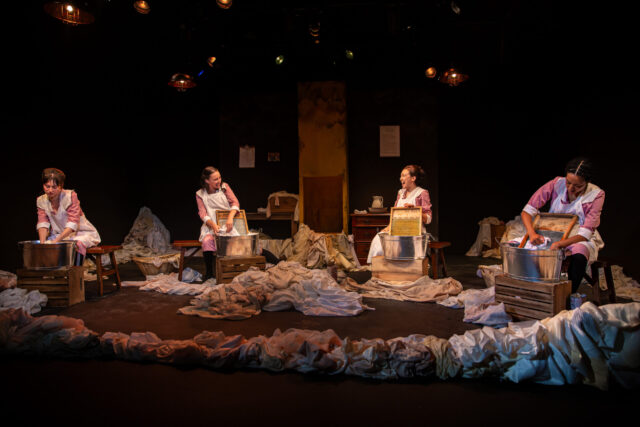
STATE OF THE ARTS: WE THE PEOPLE AT DANSPACE PROJECT

Who: Gregory Mosher, Sarah Calderón, Sara Farrington, Ty Jones, Lisa Kron, Mino Lora, Gary A. Padmore
What: “We the People: An Assembly of New York Artists”
Where: Danspace Project, St. Mark’s Church in-the-Bowery, 131 East Tenth St. at Second Ave.
When: Monday, January 26, free with advance RSVP, 4:00-7:00
Why: On May 1, 2025, the Office of the Arts at Hunter College, under the leadership of film and stage director Gregory Mosher, hosted “We the People: A Forum on Working Class Artists in America,” in which artists, arts administrators, policymakers, economists, scholars, elected officials, students, and journalists discussed the financial and social barriers that artists and audiences face around the country.

On January 26, they are following that up with “We the People: An Assembly of New York Artists,” a town-hall-style gathering at St. Mark’s Church in-the-Bowery where the focus will be more local. The panel features Classical Theatre of Harlem producing artistic director Ty Jones, award-winning playwright and performer Lisa Kron (Fun Home, Well), the People’s Theatre executive artistic director and cofounder Mino Lora, former Creatives Rebuild New York executive director Sarah Calderon, New York Philharmonic vice president of education and community engagement Gary A. Padmore, and playwright and author Sara Farrington (CasablancaBox, A Trojan Woman). Farrington, who writes the indispensable Substack Theater Is Hard, will make her way through the audience with a microphone, giving members of the community the chance to speak their mind for sixty seconds (and maybe more); it is pointed out that “everyone who comes will already know that art is good, so be specific.”

The presentation will be recorded for online viewing, and a detailed report will be sent to Mayor Mamdani and Governor Hochul. Attendance is free with advance RSVP, although it is all dependent on the weather.

[Mark Rifkin is a Brooklyn-born, Manhattan-based writer and editor; you can follow him on Substack here.]