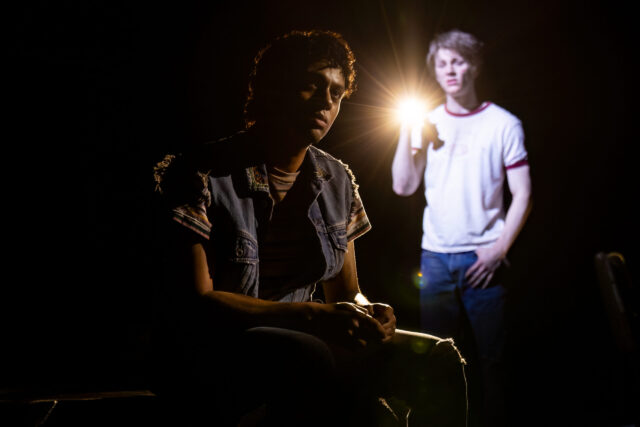
Johnny Cade (Sky Lakota-Lynch) and Ponyboy Curtis (Brody Grant) try to emerge from the adaptation darkness in The Outsiders (photo © 2024, Matthew Murphy)
The phrase “Familiarity breeds contempt” has been around for millennia, dating back to Aesop, Chaucer, and St. Augustine. It usually means that the more we know someone, the less we like them.
But the opposite seems to be true when it comes to Broadway, where the more familiar the public is with something, the more likely producers are going to stage it and the crowds will follow, often in adoration.
Such is the case with six current musicals on the Great White Way, each of which started as a book, was turned into a film, and then was adapted into a musical, with varying degrees of success.
As the Drama Desk Awards and the Tonys approach, here is a look at these shows, two of which I heartily recommend — and four of which you might want to take a pass on.
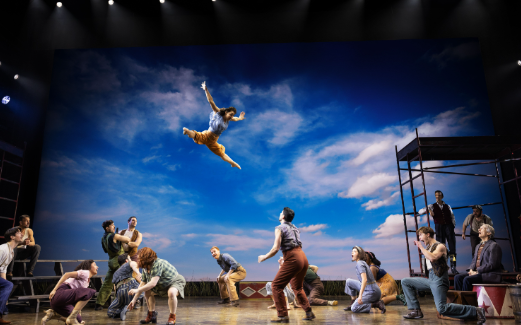
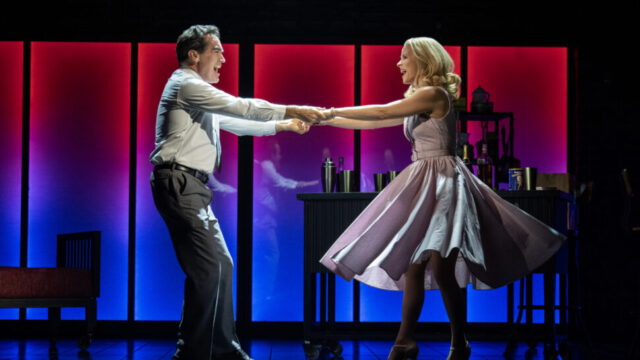
The acrobatic Water for Elephants is a high-flying triumph (photo by Matthew Murphy)
WATER FOR ELEPHANTS
Imperial Theatre
249 West 45th St. between Broadway & Eighth Ave.
Tuesday – Sunday through December 8, $59-$299
www.waterforelephantsthemusical.com
“Only three people were left under the red and white awning of the grease joint: Grady, me, and the fry cook. Grady and I sat at a battered wooden table, each facing a burger on a dented tin plate. The cook was behind the counter, scraping his griddle with the edge of a spatula. He had turned off the fryer some time ago, but the odor of grease lingered,” Sara Gruen writes at the beginning of her 2006 New York Times bestseller, Water for Elephants. Francis Lawrence directed the 2011 film, which was written by Richard LaGravenese and stars Reese Witherspoon, Robert Pattinson, Christoph Waltz, and Hal Holbrook.
I have not read the book nor seen the movie, but I love the musical, which is built around a traveling circus. When Jacob Jankowski (Grant Gustin) is caught wandering around behind the scenes after a performance as the tent is being taken down, circus boss Charlie (Paul Alexander Nolan) and horse rider June (Isabelle McCalla) are about to ask him to leave until he starts to tell them about how he was present at a famous, awful circus tragedy decades in the past. The narrative heads back decades as the younger Jacob (Grant Gustin), who lost his parents in a car accident, is searching for his place in the world, hops on a train, and ends up at a circus run by August (Nolan), who is in love with horse rider Marlena (McCalla). Jealousy rears its ugly head as Jacob falls for Marlena while dealing with an unsavory group of characters during the Great Depression.
The solid, if sentimental, book is by Rick Elice, with rollicking music and lyrics by PigPen Theatre Co.. Director Jessica Stone gives the narrative plenty of room to breathe amid Shana Carroll and Jesse Robb’s acrobatic choreography on Takeshi Kata’s wood-based sets and David Israel Reynoso’s period costumes.
“Man, this place . . . The sawdust, the smells . . . it’s old but it’s new,” the older Mr. Jankowski says, and he could be talking about the musical itself
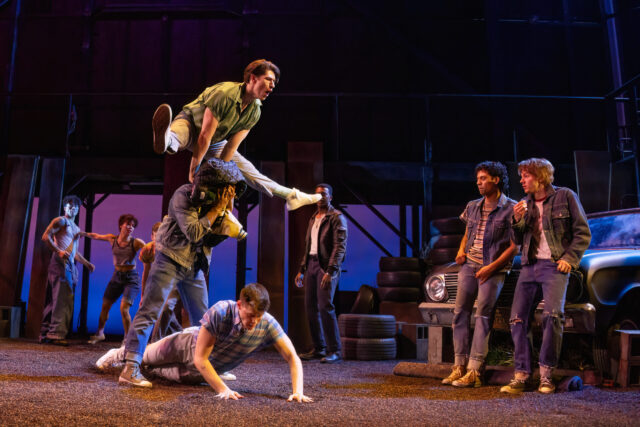
The Outsiders pulls off the rare triple play of excellent book, movie, and Broadway musical (photo © 2024, Matthew Murphy)
THE OUTSIDERS
Bernard B. Jacobs Theatre
242 West Forty-Fifth St. between Seventh & Eighth Aves.
Tuesday – Sunday through January 5, $69-$379
outsidersmusical.com
“When I stepped out into the bright sunlight from the darkness of the movie house, I had only two things on my mind: Paul Newman and a ride home. I was wishing I looked like Paul Newman — he looks tough and I don’t — but I guess my own looks aren’t so bad. I have light-brown, almost-red hair and greenish-gray eyes. I wish they were more gray, because I hate most guys that have green eyes, but I have to be content with what I have. My hair is longer than a lot of boys wear theirs, squared off in back and long at the front and sides, but I am a greaser and most of my neighborhood rarely bothers to get a haircut. Besides, I look better with long hair,” S. E. Hinton writes at the beginning of her beloved 1967 YA novel, The Outsiders. Francis Ford Coppola directed the 1983 film, which was written by Kathleen Rowell and stars C. Thomas Howell, Matt Dillon, Ralph Macchio, Patrick Swayze, Rob Lowe, Diane Lane, Emilio Estevez, Tom Cruise, and Leif Garrett.
Both the book and the movie had a profound influence on me, so I was anxious about seeing the musical, which is outstanding. Adam Rapp and Justin Levine’s book captures the essence of teen angst not only in 1967 Tulsa, Oklahoma, but anytime, anywhere, with superb country folk-pop and potent lyrics by Jamestown Revival and Levine. Director Danya Taymor and choreographers Rick and Jeff Kuperman avoid genre clichés as the battle between the wealthy Socs and the poor Greasers heats up. The Socs are led by the smarmy Bob Sheldon (Kevin William Paul), who drives around in his fancy car, his girl, Cherry Valance (Emma Pittman), at his side. When Bob nearly kills Greasers Johnny Cade (Sky Lakota-Lynch) and Ponyboy Curtis (Brody Grant) and ends up himself in a pool of blood, Johnny and Ponyboy — whose parents died in a car crash, so he is living with his older brothers, Darrel (Brent Comer) and Sodapop (Jason Schmidt) — are on the run from the only home they’ve ever known, being helped by legendary Greaser Dallas Winston (Joshua Boone), fresh out of county lockup. It gets more complicated when Cherry and Ponyboy grow close and a rumble is on the horizon.
The Outsiders is highlighted by an unforgettable fight scene in the rain, complete with strobe lights that enhance the slow-motion clash. The one low point is changing Ponyboy’s favorite novel from Gone with the Wind to Great Expectations, resulting in a disappointing and unnecessary underlying theme. It gets everything else right, from Sarafina Bush’s costumes and AMP’s (Tatiana Kahvegian) sets to Brian MacDevitt’s powerful sound and Hana Kim’s projections.
As Ponyboy says, “Unlike in the movies and the books I like to read, nothing in this town plays out the same.”
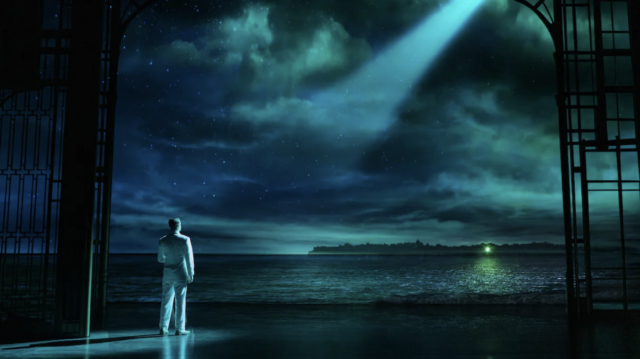
The Great Gatsby takes a much-needed pause to figure out where it all went wrong (photo by Matthew Murphy and Evan Zimmerman)
THE GREAT GATSBY
Broadway Theatre
Fifty-Third St. at Broadway
Tuesday – Sunday through November 24, $48-$298
broadwaygatsby.com
“In my younger and more vulnerable years my father gave me some advice that I’ve been turning over in my mind ever since. ‘Whenever you feel like criticizing any one,’ he told me, ‘just remember that all the people in this world haven’t had the advantages that you’ve had.’ He didn’t say any more but we’ve always been unusually communicative in a reserved way, and I understood that he meant a great deal more than that. In consequence I’m inclined to reserve all judgments, a habit that has opened up many curious natures to me and also made me the victim of not a few veteran bores,” F. Scott Fitzgerald writes at the beginning of his 1925 novel, The Great Gatsby. Jack Clayton directed the 1974 film, which was written by Francis Ford Coppola and stars Robert Redford, Mia Farrow, Bruce Dern, Sam Waterston, and Karen Black. There were also lesser-known adaptations made in 1926 and 1949, and Baz Luhrmann turned it into a glitzy spectacle in 2013, with Leonardo DiCaprio, Tobey Maguire, Carey Mulligan, Joel Edgerton, Isla Fisher, Jason Clarke, and Elizabeth Debicki.
The magnificent novel about a wealthy man stirring things up in East and West Egg during the Jazz Age is still a must-read; the 1974 film was a snoozy bore, but Luhrmann’s glitzy interpretation was a sumptuous delight. Coming on the heels of a fun, immersive version at the Park Central Hotel last year, the new musical at the Broadway Theater is, essentially, a glitzy bore. There’s no need to reserve judgment about this utter mess, which focuses on the wrong plot points and is more concerned with style over substance; it looks and sounds good for about ten minutes before falling into chaos.
The basic elements are there: The mysterious millionaire Jay Gatsby (Jeremy Jordan) likes throwing fashionable parties he doesn’t attend. He is still in love with his onetime flame, the debutante Daisy Buchanan (Eva Noblezada), who is married to the nasty Tom (John Zdrojeski), who is having an affair with Myrtle Wilson (Sara Chase), who wants more out of life than her hardworking husband, George Wilson (Paul Whitty), can manage. It’s all seen through the eyes of Yale grad and WWI vet Nick Carraway (Noah J. Ricketts), who is renting a small bungalow and soon winds up on the arm of amateur golfer Jordan Baker (Samantha Pauly).
But the similarities end there as book writer Kait Kerrigan dumbs everything down — who needs character development? — director Marc Bruni seems more lost than the audience, Dominique Kelley’s choreography calls so much attention to itself that it becomes purposeless quickly, Paul Tate dePoo III’s overwrought sets and projections and Linda Cho’s haughty costumes will cure you of ever wanting to go to such parties, Jason Howland’s score has little unique to it, and Nathan Tysen’s lyrics leave much to be desired. It’s all best exemplified by the head-scratching second act opener, “Shady,” in which Meyer Wolfsheim (Eric Anderson), Gatsby’s questionable business associate, declares, “We all need a distraction / We all need a hobby / We also need a second exit / That doesn’t go through the lobby / We enjoy a favorite cut of meat / But it’s rarely ever all we eat / What comes on the side makes a meal complete.”
You won’t have to worry about whether any exit goes through the lobby if you don’t enter the Broadway Theatre in the first place, old sport.
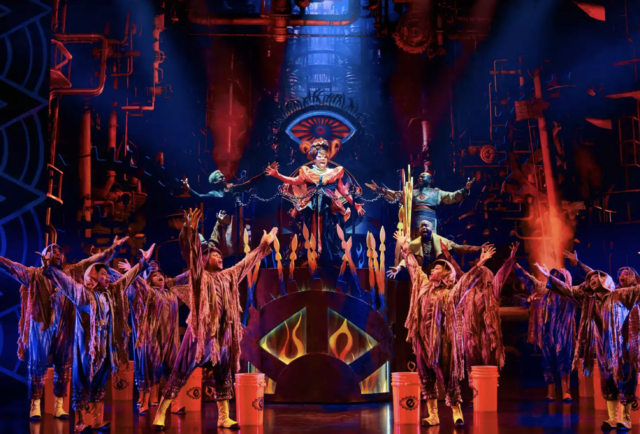
When it’s not underdone, The Wiz is overdone (photo by Jeremy Daniel)
THE WIZ
Marquis Theatre
210 West Forty-Sixth St. between Seventh & Eighth Aves.
Tuesday – Sunday through August 18, $88.75-$319.50
wizmusical.com
“Dorothy lived in the midst of the great Kansas prairies, with Uncle Henry, who was a farmer, and Aunt Em, who was the farmer’s wife. Their house was small, for the lumber to build it had to be carried by wagon many miles. There were four walls, a floor and a roof, which made one room; and this room contained a rusty looking cooking stove, a cupboard for the dishes, a table, three or four chairs, and the beds,” L. Frank Baum writes at the beginning of the first of his fourteen Oz books, the 1900 classic The Wonderful World of Oz. “Uncle Henry and Aunt Em had a big bed in one corner, and Dorothy a little bed in another corner. There was no garret at all, and no cellar — except a small hole, dug in the ground, called a cyclone cellar, where the family could go in case one of those great whirlwinds arose, mighty enough to crush any building in its path. It was reached by a trap-door in the middle of the floor, from which a ladder led down into the small, dark hole.” Victor Fleming, with assistance from George Cukor and King Vidor, directed the 1939 film, which was written by Noel Langley, Florence Ryerson, and Edgar Allan Woolf and stars Judy Garland, Frank Morgan, Ray Bolger, Bert Lahr, Jack Haley, Billie Burke, and Margaret Hamilton.
The story was turned into the 1975 Broadway show The Wiz: The Super Soul Musical “Wonderful Wizard of Oz,” starring Stephanie Mills as Dorothy, Hinton Battle as Scarecrow, Tiger Haynes as Tin Man, Ted Ross as the Lion, and André De Shields as the Wiz. Sidney Lumet directed the 1978 Motown film version, which was written by Joel Schumacher and stars Diana Ross as Dorothy, Michael Jackson as Scarecrow, Nipsey Russell as Tin Man, Ted Ross as the Cowardly Lion, and Richard Pryor as the Wiz. The show won nine Tonys, including Best Musical, while the critically panned movie earned four Oscar nominations.
However, something rather unpleasant must have happened when the 2024 revival eased on down that Yellow Brick Road, because this iteration is dull and lifeless; Dorothy’s house should have fallen on the whole production. The shell is still there: Dorothy (Nichelle Lewis) has ended up in Oz after a tornado swept across her home in Kansas. In order to get back, she must find the Wiz (Wayne Brady), but along the way she picks up a ratty scarecrow (Avery Wilson), a sad tin man (Phillip Johnson Richardson), and a meek lion (Kyle Ramar Freeman). She gets a bit of help from a good witch named Glinda (Deborah Cox), who has advised her to avoid her sister, Evillene (Melody A. Betts), a wicked witch.
“Don’t nobody bring me no bad news,” Evillene declares to her numerous flunkies. Too late.
The original book, by William F. Brown, has been updated by Amber Ruffin, Dorothy has been aged up a few years, and Toto is nowhere to be found, none of which works. Just because everyone basically knows what happens doesn’t mean director Schele Williams should forget about actual drama, while choreographer JaQuel Knight keeps any momentum at a low ebb with tired repetition. Hannah Beachler’s sets and Sharen Davis’s costumes are colorful, but Joseph Joubert’s orchestrations and arrangements are lackluster. The crows who harass Scarecrow are kinda nifty, so there’s that.
So what’s missing? Well, just a little heart, some smarts, and a dose of courage.
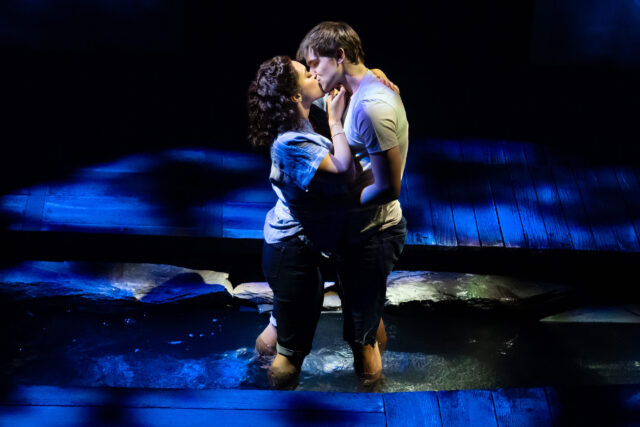
Musical version of The Notebook is all wet (photo by Julieta Cervantes)
THE NOTEBOOK
Gerald Schoenfeld Theatre
236 West 45th St. between Broadway & Eighth Aves.
Tuesday – Sunday through November 24, $74-$298
notebookmusical.com
“Who am I? And how, I wonder, will this story end?” Nicholas Sparks writes at the beginning of his 1996 debut novel. The Notebook. “The sun has come up and I am sitting by a window that is foggy with the breath of a life gone by. I’m a sight this morning: two shirts, heavy pants, a scarf wrapped twice around my neck and tucked into a thick sweater knitted by my daughter thirty birthdays ago. The thermostat in my room is set as high as it will go, and a smaller space heater sits directly behind me. It clicks and groans and spews hot air like a fairytale dragon, and still my body shivers with a cold that will never go away, a cold that has been eighty years in the making. Eighty years, I think sometimes, and despite my own acceptance of my age, it still amazes me that I haven’t been warm since George Bush was president. I wonder if this is how it is for everyone my age. My life? It isn’t easy to explain. It has not been the rip-roaring spectacular I fancied it would be, but neither have I burrowed around with the gophers. I suppose it has most resembled a blue-chip stock: fairly stable, more ups than downs, and gradually trending upward over time. A good buy, a lucky buy, and I’ve learned that not everyone can say this about his life. But do not be misled. I am nothing special; of this I am sure. I am a common man with common thoughts, and I’ve led a common life. There are no monuments dedicated to me and my name will soon be forgotten, but I’ve loved another with all my heart and soul, and to me, this has always been enough.” Nick Cassavetes directed the 2004 film, which was written by Jeremy Leven and stars Ryan Gosling, Rachel McAdams, James Garner, Gena Rowlands, James Marsden, and Sam Shepard.
The novel and film had plenty of naysayers, decrying it as sentimental claptrap; the third time is unlikely to be the charm for the haters out there. The show is nothing special, with underwhelming music and lyrics by American singer-songwriter Ingrid Michaelson and a tepid book by Bekah Brunstetter.
The plot is the classic hardworking tough guy meets rich girl, rich girl’s parents (Andréa Burns and Dorcas Leung) break them apart, boy joins the army with his best friend (Carson Stewart), girl finds a respectable lawyer (Chase Del Rey) to marry, boy and girl imagine what might have happened had they stayed together. The older Noah believes that by telling the story to Allie over and over again, it might help her regain at least some of her memories, while the nurse (Burns) insists Noah follow the rules and his physical therapist (Stewart) tries to get him to accept treatment for his ailing knee, but Noah has more important things on his mind.
Codirectors Michael Greif and Schele Williams are unable to rein in the overall befuddlement on David Zinn and Brett J. Banakis’s rustic set, which switches from a nursing home to a historic house that needs significant work; there’s also a pool of water in the front of the stage where Allie and Noah swim and play. When boredom sets in, you can check out Ben Stanton’s lighting design, which features dozens of narrow, cylindrical, fluorescent lights hanging from the ceiling with bulbs at the bottom that make them look like big pens (that one might, say, use to write in a notebook?). The lighting also casts a cool shimmer when it focuses on the pool.
The score, with arrangements by Michaelson and music supervisor Carmel Dean and orchestrations by Dean and John Clancy, can’t keep pace with the narrative, slowing it down dramatically. When teenage Allie asks teenage Noah if he has a pen and he says, “Why would I have a pen?,” I pointed up at the lights. When Middle Noah sings, “Leave the Light On,” I suddenly felt as if I were in a Motel 6 advertisement. And when the young Allie and Noah sing about his chest hair — twice — but Cardoza doesn’t have any, I wondered if it was meant to be a tongue-in-cheek joke. (If it was, it didn’t draw laughs.)
The musical probably has a big future ahead of itself too, naysayers be damned.

Yes, this is a picture from the current Broadway revival of Cabaret (photo by Marc Brenner)
CABARET AT THE KIT KAT CLUB
August Wilson Theatre
245 West Fifty-Second St. between Seventh & Eighth Aves.
Monday – Saturday through March 29, $99-$529
kitkat.club/cabaret-broadway
“From my window, the deep solemn massive street. Cellar-shops where the lamps burn all day, under the shadow of top-heavy balconied façades, dirty plaster frontages embossed with scrollwork and heraldic devices. The whole district is like this: street leading into street of houses like shabby monumental safes crammed with the tarnished valuables and second-hand furniture of a bankrupt middle class,” Christopher Isherwood writes at the beginning of his semiautobiographical 1939 novel, Goodbye to Berlin, the second part of The Berlin Stories. “I am a camera with its shutter open, quite passive, recording, not thinking. Recording the man shaving at the window opposite and the woman in the kimono washing her hair. Some day, all this will have to be developed, carefully printed, fixed.”
Straying slightly from the theme, Goodbye to Berlin was first adapted into the 1951 play I Am a Camera by John Van Druten, then into the musical Cabaret, which opened on Broadway in November 1966, with a book by Joe Masteroff, music by John Kander, and lyrics by Fred Ebb, directed by Harold Prince and choreographed by Ron Field; Joel Grey was the emcee, with Jill Haworth as Sally Bowles, Bert Convy as young American writer Clifford Bradshaw, Lotte Lenya as Fräulein Schneider, and Jack Gilford as Herr Schultz. The production was nominated for ten Tonys, winning seven, including Best Musical. Bob Fosse directed the 1972 film, which was written by Jay Allen and stars Liza Minnelli as Sally, Michael York as renamed young American writer Brian Roberts, and Grey reprising his role as the enigmatic emcee. The film was nominated for ten Oscars, winning eight.
It has been revived on the Great White Way four times, the latest bamboozling audiences at the August Wilson Theatre, which has been transformed into the Kit Kat Club to attempt to create a more intimate and immersive environment. Instead, the atmosphere is cold and alienating. Ticket holders are encouraged to arrive more than an hour before curtain so they can order pricey drinks at bars on several floors, where dancers perform behind beaded curtains and on platforms. The preshow is better than the show, which is set in the round, so half the time the audience is watching the characters’ back on Tom Scutt’s circular stage, which rises and descends because, well, why not. Director Rebecca Frecknall, choreographer Julia Cheng, and costume designer Scutt choose to focus on the grotesquerie of 1929–30 Weimar Germany, with Fascism right around the corner. Cabaret needn’t be clean and pretty, but you shouldn’t leave the theater in desperate need of a cold shower.
Oscar and Tony winner Eddie Redmayne does all he can to make the attendees deeply dislike him as he portrays the emcee as if he’s auditioning to be the Joker from hell in the next Batman movie, not making anyone feel welcome. Tony nominee Ato Blankson-Wood sleepwalks through his role as Cliff. Gayle Rankin brings the house down with the torrid title song but otherwise has no chemistry with the rest of the cast. Only Tony winner Bebe Neuwirth as Fraulein Schneider and Obie winner Steven Skybell as Herr Schultz manage to exhibit sensitivity and heart.
In one of the few scenes that work, Neuwirth poignantly and gorgeously sings, “With a storm in the wind, / What would you do? / Suppose you’re one frightened voice / Being told what the choice must be, / Go on, tell me, I will listen. / What would you do if you were me?”
What should you do? Avoid the Kit Kat Club — and choose one of Broadway’s many other excellent offerings, especially something that you might not be so familiar with, old chum.
[Mark Rifkin is a Brooklyn-born, Manhattan-based writer and editor; you can follow him on Substack here.]