SOHO’S GOT SEOUL
Park West Gallery
411 West Broadway between Prince & Spring Sts.
February 1 – March 4, free www.parkwestgallery.com
On February 1 at 6:00, Park West Gallery is opening its latest show, “SoHo’s Got Seoul,” highlighting five Korean artists hailing from different disciplines. The K-Pop auction and exhibition features paintings by contemporary conceptual sculptor Yongjae Choi, photographer and music video director Jun Shim (aka Negativ), singer and television personality Kwon Jian (aka SolBi), actor and director Jun Ko, and Lee Min-woo (aka M) from the South Korean boy band Shinhwa.
“These artists have devoted decades to perfecting their original art form, such as acting or performing,” exhibition curator Dr. Stephanie Seungmin Kim said in a statement. “These paintings allowed the artists to express something more intimate. The maturity and commitment to the art and brilliance deeply moved me to tell their stories.”
Several of the artists, known in Korea as artainers, have been painting since they were children, while others only picked it up a few years ago.
“I’m not a painter — just beginner!” Jun Ko declares in the above video. “I still can’t think of myself as an artist.”
Negativ adds, “Sometimes you get tired of working with a bunch of staff. When I paint, I can focus on myself.”
And SolBi explains, “Initially, I started drawing for the purpose of psychological therapy. Drawing not only brings healing but also allows me to convey the stories and messages I want to share through art.”
Terce: A Practical Breviary is another gem from Heather Christian (photo by Maria Baranova)
TERCE: A PRACTICAL BREVIARY
The Space at Irondale
85 S. Oxford St., Brooklyn
Wednesday – Sunday through February 4, $50-$150 prototypefestival.org here.org
Multidisciplinary artist Heather Christian doesn’t just make memorable shows; she creates unforgettable experiences.
Online and at the Bushwick Starr, Animal Wisdom was an intimate and rapturous confessional of music and storytelling, an ingenious journey into the personal and communal nature of ritual and superstition, of grief and loss, of ghosts and, most intently, the fear of death.
At Ars Nova at Greenwich House, Oratorio for Living Things was a gloriously exhilarating celebration of life, art, and nature, an immersive journey through the complex quantum, human, and cosmic time and space of our daily existence.
Christian is now back with the majestic Terce: A Practical Breviary, a reimagining of a monastic 9:00 morning mass as only she can present it, continuing at the Space at Irondale through February 4. “Terce” is the name of the third of the seven canonical hours of the divine office, while a breviary is an abridged liturgical tome of psalms, readings, and hymns.
Terce: A Practical Breviary takes place in a unique environment in the Space at Irondale (photo by Maria Baranova)
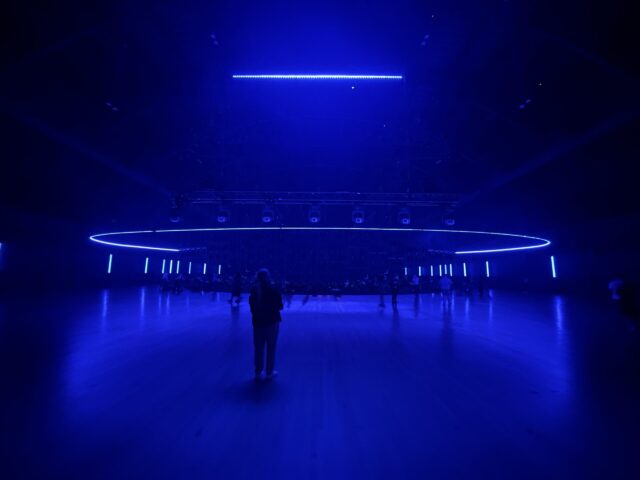
Part of the Prototype Festival and commissioned, developed, and produced by HERE, the show takes place in the former Sunday school home of the Lafayette Avenue Presbyterian Church on South Oxford St. in Brooklyn, which Nick Vaughan and Jake Margolin have remade into a welcoming area with two rows of chairs surrounding a central carpeted oval on which there are musical instruments, a mound of dirt, and a complex web of laundry lines emanating from a vertical loom, holding up fabric and household objects that will later be lowered down and used by the performers. Two tables contain tea and cookies that the audience can sample, along with the cast and crew.
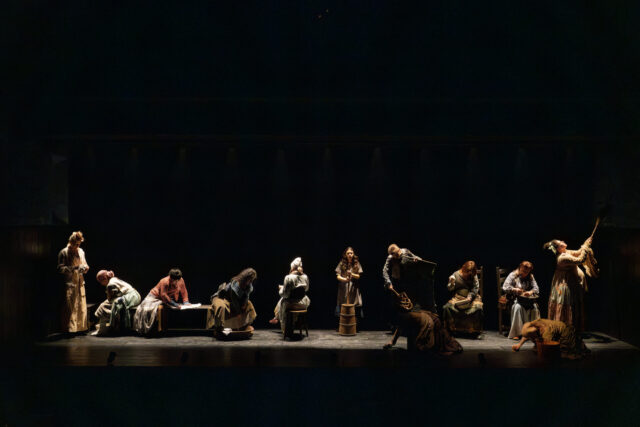
As the crowd enters, the thirty members of the community chorus of mothers and/or caregivers are on the upper level, putting on robes that have been individually designed for them by Brenda Abbandondolo; some have embroidery or ruffles, while others are distressed or torn. The band soon saunters onto the stage: Mona Seyed-Boloforosh on grand piano, Viva DeConcini on electric guitar, Mel Hsu on bass and cello, Maya Sharpe on acoustic guitar and violin, Rima Fand on violin, Jessica Lurie on wind, Christian on keyboards, vocal soloists Divya Maus and Kait Warner, and Terry Dame on saxophone and a percussion kit made of pots and pans. All of the performers identify as female; nearly all the props are items associated with what some still consider “women’s work.”
What follows is an exhilarating and powerful sixty-minute service that Christian, in a program note, explains “addresses the Holy Spirit through the lens of the Divine Feminine.” The words to each of the fifteen songs are projected onto large screens on either side of the space, accompanied by drawings by Alice Leora Briggs, Koomah, and Lovie Olivia. While singing, the chorus occasionally marches around the oval and through the audience, at one point breaking out into smaller groups, joining together for communal rituals.
(The lovely choir, which interacts with the audience, consists of Raquel Cion, Marisa Clementi, Ciera Cope, Nadine Daniels, Sandra Gamer, Audrey Hayes, Mercedes Hesselroth, Frances Higgins, Davina Honeghan, Beau Kadir, Rachel Karp, Sarah Lefebvre, Aris Louis, Teri Madonna, Grenetta Mason, Mickaila Perry, Eleanor Philips, Avery Richards, Kayleigh Rozwat, Amy Santos, Kayla Sklar, Sharyn Thomas, Shelley Thomas, Vanessa Truell, Grace Tyson, Madrid Vinarski, Jessie Winograd, and Allison Zhao.)
In the opening “Oratorio,” a singer declares, “You and me and both our mothers / opened up the bottle, / when we opened up our stories / carrying blood to somewhere else.” In “Gardener,” we are told that “the Mother is the garden and the gardener.” In “O Shepherdess,” an adaptation of three prayers by St. Hildegard of Bingen, we hear about “a wound of contrition / a wound of compassion / a wound of the earnest longing for someone.”
The “Psaltery” section is prefaced by the quote “To be divinely feminine is a beatified exhibition of multitasking,” followed by references to Gucci and the DMV; songs include “Poppyseed” and “Mercy Is a Work,” a response to Julian of Norwich. The final part, “Reckoning,” explores gravity, panic, and hurt. Christian sings, “Until we die longing for love / we’re here sensing the chaos / and we don’t know what we are. / When this confused / I submit to my mother / In the door crease of the backseat of the car. / I grasp it only for a moment and in bliss / I understand how everything is all at once / in mercy and in love / and then I lose it.”
Terce: A Practical Breviary is fluidly directed by Keenan Tyler Oliphant (queen,Will You Come with Me?), who superbly manages the large cast and vast space, with lighting by Masha Tsimring (that battles with the sun pouring through the windows at certain times), enveloping sound by Nick Kourtides, and intricate movement by Heather Christian, Darlene Christian, and Oliphant. Heather Christian wrote the libretto, sings several songs, and composed the score, which ranges from pop and gospel to soul and medieval organum.
Christian, who keeps fascinating little trinkets on her piano, never loses anything in her work, pontificating on the fullness and mystery of human experience, from rolling pins and vacuums to lilting choral voices and the ineffable grace of the feminine divine. “I have no artistic restraint / every think I see, I paint / with the image of myself / I am the vine,” she proclaims late in the show, in a processional that is a response to John 15.5. I pray that nothing ever restrains her unforgettable art.
Mai Khôi returns February 1 to Joe’s Pub with the final iteration of Bad Activist (photo by Nate Guidry)
BAD ACTIVIST
Joe’s Pub
425 Lafayette St.
Thursday, February 1, $15-$25 (plus two-drink or one-food-item minimum), 7:00 publictheater.org mai-khoi.com
Back in September, I attended a friend’s wedding in rural Pennsylvania. Sitting at our table was a woman who was introduced to us as Mai Khôi, the Lady Gaga of Vietnam. We discovered later in the evening why, when, in full makeup and costume, she performed a song written especially for the occasion. The groom, Alex Lough, is an experimental musician and teacher, and the bride, Hanah Davenport, is a singer-songwriter and urban planner; at one point the party broke out into a Greenwich Village–style happening with a series of avant-garde presentations.
Born Đỗ Nguyễn Mai Khôi in 1983 in Cam Ranh, Vietnam, Mai Khôi was an award-winning pop star whose activism infuriated the government as she advocated for freedom of expression, LGBTQ and women’s rights, and the environment and against censorship, domestic violence, and Donald Trump. She also got into trouble by announcing that she did not want to have children.
She’s been playing music since she was six, in her father’s wedding band and later in clubs. She released her first album in 2004, and ten more solo records followed between 2008 and 2018; as her fame and fortune exploded, so did her concern for the welfare of the Vietnamese people. She challenged the police and the government, leading her to have to play secret shows for her fans. Shortly after the release of the 2019 documentary Mai Khôi and the Dissidents, which screened at the Human Rights Watch Film Festival, she fled to America; she currently lives in Pittsburgh with her personal and professional partner, Mark Micchelli.
“Even though Mai Khôi primarily sings in Vietnamese, you can always understand the intention she’s trying to convey,” Lough, who is producing her upcoming album, explained to me. “Her band has a refreshing approach to protest music, like we haven’t heard since Rage Against the Machine. She has an incredible emotional range, from delicate sadness and vulnerability to screaming and extended vocal techniques. She is also able to freely move between her role as the frontwoman to blending in with everyone; it’s rare to see that kind of versatility in a vocalist with such a commanding stage presence.” The record will feature such tracks as “We Never Know,” “Innocent Deer,” and “The Overwhelming Feeling that We’re Already Dead.”
On February 1, she will return to Joe’s Pub with the biographical multimedia Bad Activist, which details her life and career through music, photographs, video, archival footage, and more. Directed by Cynthia Croot, the seventy-five-minute show features such songs as “Reeducation Camp,” “Just Be Patient,” and “Bitches Get Things Done,” with Mai Khôi joined by Alec Zander Redd on saxophones, Eli Namay on bass, PJ Roduta on drums, and music director Micchelli on keyboards, playing a mix of experimental jazz rock, folk, and deliberately cheesy pop; Aaron Henderson is the projection designer. Although the work has been performed and workshopped over the last four years at small venues and universities, this iteration is the debut of the full, finished production.
I recently spoke with Mai Khôi and Micchelli over Zoom, discussing music, repressive governments, cooking, and why she considers herself a bad activist.
twi-ny: The three of us were at the same table at Alex and Hanah’s wedding. How did you first meet Alex?
Mark Micchelli: Alex and I met in September of 2016; we were in the same cohort at the University of California, Irvine, where Alex finished his PhD and where I did my master’s. I moved out east, if you can call Pittsburgh east, first in 2019, and then he moved to South Jersey in 2020. And so we’ve been musical collaborators since 2016 and been around the world. We’ve done gigs throughout California and in Pennsylvania, Florida, Ohio, New Hampshire, and South Korea.
Mai Khôi: In 2020, I got a fellowship at the University of Pittsburgh and I was invited to work with Mark. We began with my project Bad Activist.
mm: I had actually gotten an email from the University of Pittsburgh that said there’s this Vietnamese singer-songwriter who’s looking for a pianist who knows something about jazz and Southeast Asian traditional music. And I said, Well, no one’s qualified for that job, so I may as well try. When I was told that I’d have to learn the music in three weeks, I knew I didn’t have time to learn it in that amount of time. I drafted an email to basically politely decline and say, find another pianist. And then I thought I should actually look up what this person’s music actually sounds like. And now we own a house together.
twi-ny: When was the last time you were in Vietnam to either see family members or play a secret show?
mk: Oh, when I moved to the US at the end of 2019. I have not been able to come back to Vietnam since.
twi-ny: What will happen if you try to go back? Would they arrest you?
mk: Yes, they could arrest me. They could detain me. That’s what happened with an activist friend of mine. So, yeah, it’s still dangerous for me to go back, so I’ve chosen not to. My friend had the same situation, like me. She left Vietnam for two years, and then when her mother got sick, she wanted to come home, but the police arrested her, and she is now in jail. They sentenced her to three years.
twi-ny: What family do you have in Vietnam?
mk: My mother, my father. And I have one brother who lives with them.
twi-ny: If they left the country, say, to visit you here, would they be allowed back in?
mk: They don’t have any plans to leave Vietnam.
twi-ny: But if they did, would the government let them return?
mk: If the police want to arrest you, they can arrest you any time. But I think my family will be safe because they’re not involved in activism at all. They did try to convince me to not get involved. From the beginning, the police came and investigated them. After many visits to my parents’ house, they realized my parents have nothing to do with activism, so they leave them alone.
twi-ny: Are you in contact with them either over the phone or via social media? I know you’ve accused Facebook of being in bed with the Vietnam government.
mk: My parents still use Facebook; that is the main thing we use to see each other every day. Of course, I know the police always follow my Instagram and my Facebook and try to hack into them. But it’s okay. I still know how to use Facebook to spread my word and deal with the situation. Someone like my parents or other friends that are not activists, they will not comment on any sensitive things I post on Facebook. They don’t like some of the posts about politics anyway.
twi-ny: You’ve said, “No one can stop me.” Has the government come to you and said, If you take back some of the things you’ve said, we’ll leave you alone?
mk: They did try that in 2016 [when I was applying to run for the National Assembly]. They sent a person to talk to me to give me that deal. Like if you withdraw your nomination campaign, the system will make you even more famous. That was the deal, but I didn’t take it.
I refuse to talk with them about those kinds of things. When the government detained me a couple of years after, they asked me some questions and I just gave them information that’s already public.
twi-ny: What are some of the main issues you are rallying against, in Vietnam and America?
mk: You will see this when you come to see Bad Activist. I am focusing on freedom of expression. And recently, I’m doing some advocacy work for climate activists. Because I’m here, it’s easy to lobby Congress and the State Department, to work with the US government. [ed. note: Mai Khôi met with members of Congress last summer, before President Biden traveled to Vietnam.]
Also, I was surprised by the brutality of the police here, so I want to fight against that. It’s very similar with the police in Vietnam. In New York, when the Black Lives Matter movement happened, I went to the protest every week. I really feel the brutality of the police everywhere is just the same.
twi-ny: On February 1, you’ll be at Joe’s Pub, where you performed two earlier versions of Bad Activist in 2021–22. What do you think of the venue?
mm: They treat you super well. They know how to work with performers.
mk: In 2020, they started to work with the SHIM:NYC team for artists like me, to give us a chance to perform in an iconic venue in New York like that. [ed. note: SHIM:NYC is “a creative and professional residency and mentorship program for international musicians who are persecuted or censored for their work; are threatened on the basis of their political or religious affiliations, ethnicity, sexual orientation, or gender identity; have been forcibly displaced; need a respite from dangerous situations; or are from countries experiencing active, violent conflict.”]
mm: We do have City of Asylum in Pittsburgh, which does something similar.
twi-ny: What makes you a bad activist?
mk: There’s some moments that I realized maybe I’m a bad activist because I am first an artist, but because I was born in my country, a country that’s not safe for artists, I decided to become an activist to protect my right to be an artist. So that’s why I don’t have good training to become a good activist. Sometimes I upset people. And sometimes I organize some things that aren’t . . . I just think sometimes I feel I’m a bad activist.
mm: I’ve had a lot of conversations with Khôi about this, and I feel like everyone who sees the show has the opposite feeling of Khôi about her and her activism, but everything she says is genuine. And I think the broader point is that despite her activism and since she has fled to the States, the situation in Vietnam has only been getting worse. And so I think reflecting on that failure is something that the show tries to come to terms with and talk about and that’s why the name is framed that way.
mk: Yes. So the point is, whether you’re bad or you’re good, you at least try to be an activist, to contribute something.
Mai Khôi has been playing music since she was six years old (photo courtesy Mai Khôi)
twi-ny: Activism these days seems to be more dangerous than ever.
mk: I don’t know. I just do things that I feel are the right thing to do and I do them. I always believe that doing the right thing will lead you to something good, even when you have to pay a price for doing it.
twi-ny: What’s next after Bad Activist?
mk: We have some ideas for a new project. It will be based on the activism and culture that I carry from Vietnam to here.
twi-ny: What do you do when you’re not making music or fighting the power?
mk: I have a hobby: cooking.
mm: Khôi is as good a chef as she is a vocalist, which is really unfair.
twi-ny: What are your favorite dishes to make?
mk: Bún bò huế (spicy beef and pork noodle soup), cá kho (caramelized and braised fish), and mì quảng (Quảng noodles).
twi-ny: One final question: Will we ever hear the song you wrote for Alex and Hanah again? And does it have a name?
mk: “I Hear the River Calling.” I don’t perform that song. It was a gift to them. But it might go on an album in the future.
[Mark Rifkin is a Brooklyn-born, Manhattan-based writer and editor; you can follow him on Substack here.]
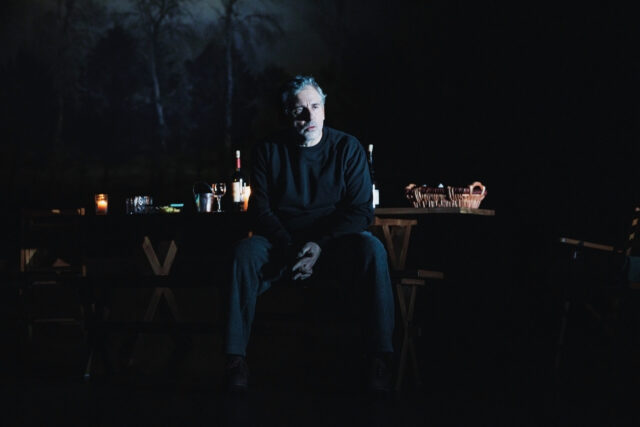
Eric Berryman shares African American toasts in Wooster Group’s Get Your Ass in the Water and Swim Like Me (photo by Marika Kent)
GET YOUR ASS IN THE WATER AND SWIM LIKE ME
The Wooster Group
The Performing Garage
33 Wooster St. between Grand & Broome Sts.
Tuesday – Saturday through February 3, $39-$79 thewoostergroup.org
In 2019, the Wooster Group production of The B-Side: “Negro Folklore from Texas State Prisons,” a Record Album Interpretation earned a Drama Desk nomination for Unique Theatrical Experience for Eric Berryman’s multimedia adaptation of a 1965 LP compiled by Bruce Jackson, consisting of performances by inmates of color on segregated agricultural prison farms.
Writer and actor Berryman and director Kate Valk are now back with their follow-up, Get Your Ass in the Water and Swim Like Me, continuing at the Performing Garage through February 3. This time Berryman dives deep into Jackson’s 1974 book and 1976 disc, Get Your Ass in the Water and Swim Like Me: Narrative Poetry from Black Oral Tradition, a collection of folktales known as toasts, made for heroes and antiheroes in the Black storytelling canon.
The set, by Wooster Group founding member and director Elizabeth LeCompte, evokes a radio DJ studio, where Berryman sits at a long table with a laptop and various electronic instruments; to his right is a microphone, behind him a monitor, and to his left a standing table with a smaller monitor. He is joined onstage by drummer Jharis Yokley, who adds percussion throughout, from pounding solos to gentle brushstrokes. As Berryman recites the toasts — some of which have been recorded by Rudy Ray Moore and George Clinton — he occasionally projects video and photographs on the monitor, from a car chase to archival footage to live shots of himself.
Berryman kicks things off with “Titanic,” which honors Shine, a Black man on the Titanic who kept “warning the captain and the white people that the ship is going down. They don’t believe him. So he says, ‘Fuck y’all, I’m out.’ He jumps overboard and starts swimming to shore. The white people on the deck start yelling, ‘Please come back and help us!’ And in one version of the toast, as he’s swimming away, Shine says, ‘Get your ass in the water and swim like me.’” Berryman’s retelling is fast-paced and rhythmic, with rap and hip-hop inflections that go well beyond mere recitation.
In “Signifying Monkey,” a forest primate battles a lion and an elephant. “Partytime Monkey” takes place at a party on Juneteenth, but the unhappy title mammal is incensed that he was not invited. In “Joe the Grinder and G.I. Joe,” a man returns from WWII to find his wife has been unfaithful. “’Flicted Arm Pete” is about a fornication contest that gets out of hand.
Drummer Jharis Yokley and actor Eric Berryman share a personal moment in Get Your Ass in the Water and Swim Like Me (photo by Marika Kent)
The tales are filled with tawdry sex and extreme violence — bullets are flying everywhere — but as funny as they are, there’s also an underlying sense of discomfort, particularly with a primarily white audience, as the stories contain stereotypes reminiscent of minstrelsy. Berryman compares these over-the-top characters to Greek myths, where such figures as Hercules and Jason “would do stupid shit because they knew it would help them uh, uh, more quickly achieve kleos, and get kleos . . . A community creates the heroes that they need.”
Berryman (Primary Trust,Toni Stone) is not just sharing old fables but exploring Black identity then and now. At one point he digresses into a discussion of his own name, how disappointed he is to be anchored with the plain “Eric” when he has relatives called Qasim, Idris, Indira, Akeem, Alenka, and Adia. (He does note that there is a Gary but does not share that it’s his uncle, Grammy-winning jazz saxophonist Gary Bartz.)
In addition to the eight toasts, each evening includes an improvised Q&A between Berryman and Yokley; the night I went, Berryman asked the charming drummer, producer, and songwriter about his favorite grade from K through 12 and what he is afraid of, again incorporating ideas of personal identity into the play and creating a further bond between the performers and the audience, some of whom sit in chairs on the stage.
The show concludes with the all-time favorite “Stackolee,” a tale of murder and mayhem that has been recorded in different versions by Mississippi John Hurt, Doc Watson, Wilbert Harrison, Long Cleve Reed, Lloyd Price, and Nick Cave and the Bad Seeds, among others, its familiarity spotlighting the centrality rather than the marginalization of the Black experience in American popular culture.
[Mark Rifkin is a Brooklyn-born, Manhattan-based writer and editor; you can follow him on Substack here.]
Compagnie Hervé KOUBI worships the sun in Sol Invictus (photo by Nathalie Sternalski)
DANCE REFLECTIONS: SOL INVICTUS
Joyce Theater
175 Eighth Ave. at 19th St.
January 23-28, $10-$71
212-645-2904 www.joyce.org
French choreographer Hervé Koubi studied dance and biology at the University of Aix-en-Provence, and he combines the two elements gorgeously in Sol Invictus as his company of eighteen performers pushes the limits of what the human body can do.
In a program note, Koubi calls the seventy-five-minute piece “a manifesto for life,” and he fills it with sections that explore ritual, worship, faith in a higher power — in this case, the sun — and life, death, and rebirth.
Continuing at the Joyce through January 28, Sol Invictus, which means “invincible sun,” is named for the Roman Sun God, a deity that inspired cult followings. It begins in silence with Allan Sobral Dos Santos running around in a circle, faster and faster, moving lower and lower until his hand touches the reflective floor. The other dancers watch him from either side.
Soon the soundtrack starts — the score features music and soundscapes by Mikael Karlsson, Maxime Bodson, Beethoven (the funeral procession from the Seventh Symphony), and Steve Reich — and a friendly street dance battle breaks out. Koubi’s movement language melds hip-hop, capoeira, ballet, and contemporary dance, heavily influenced by his discovery in 2009 of his Algerian heritage; his troupe comes primarily from North Africa.
They twirl, jump, slide, shake, lift, toss, and dash around the stage, doing flips, cartwheels, head- and handstands, and dazzling twists and spins in musical arranger Guilaume Gabriel’s muted-palette culottes, loose-fitting skirts or shorts, several of the men going bare-chested, revealing impressive, heavily tattooed bodies. For the first time, Compagnie Hervé KOUBI includes women (Francesca Bazzucchi, Joy Isabella Brown, Hsuan-Hung Hsu), toning down a bit of the beefy masculinity on display.
Lionel Buzonie’s lighting ranges from heavenly glows to ominous fog; the eight spots at the top back bounce off the floor, casting ululating shadows on the Joyce’s ceiling. At one point a handful of dancers, each with a light behind them, approaches the stage slowly, like zombies. The narrative shifts from dance-off to postapocalyptic survival to West Side Story jubilance.
A long stretch of fabric in the back becomes a glittering gold translucent parachute enveloping first Bazzucchi, then later the one-legged Samuel Da Silveira Lima.
The dancers spend most of the show closely observing one another, but occasionally a single performer comes to the front and looks out at the audience, both warning us and beckoning us to join in the group worship of the sun as a way to rise out of the hazy darkness.
Koubi, who previously presented The Barbarian Nights, or The First Dawns of the World in 2020 and What the Day Owes to the Night in 2018 at the Joyce, can get a bit lost in all the razzle-dazzle, as impressive as it is, but he finds hope and love in the gathering itself, and it’s hard not to find the joy on his journey.
[Mark Rifkin is a Brooklyn-born, Manhattan-based writer and editor; you can follow him on Substack here.]
HENRY TAYLOR: B SIDE
Whitney Museum of American Art
99 Gansevoort St.
Through January 28, $24-$30
212-570-3600 whitney.org
Among the many joys of the Whitney exhibit “Henry Taylor: B Side,” one of the best exhibitions of 2023 — catch it before it closes January 28 — is the audio guide. The work itself is extraordinary: stunning portraits, installations, assembled sculptures, early drawings, painted objects. Taylor, who was born in 1958 in Oxnard, California, and lives in Los Angeles, shares intimate details of his process on the guide, as do several subjects of his, artists themselves.
Regarding the above painting, a depiction of the murder of Philando Castile based on video taken by his girlfriend, Diamond Reynolds, Taylor says, “It was definitely emotional. . . . I do have a habit. I was a journalism major. Articles and things permeate. And then you say, no,I don’t want to do it. So, you have this ambivalence. But it’s not like I’m grabbing certain headlines. Sometimes we become, sort of, nonchalant is not the word, but when something happens over and over, we become sort of immune to it. But I think I just really reacted, you know what I mean?”
Below are six more works, with highlights from the audio.
Henry Taylor, i’m yours, acrylic on canvas, 2015 (courtesy the artist and Hauser & Wirth / photo by Sam Kahn)
Henry Taylor: I don’t always work from photographs, but this was a photograph taken by Andrea Bowers, and I liked it. . . . In the original photograph was just my son and I. And I added my daughter. Sometimes I might have material in the studio that I just grab or gravitate to. Sometimes it’s just there for a long time. So, you just put it to use, so to speak.
Andrea Bowers: It’s a beautiful old stove. And when Henry was living in downtown Los Angeles, near Chinatown, he had this beautiful old stove, very similar to this, and he cooked constantly. And his meals were fantastic. And he always said that his mother taught him how to cook. And so, I love that he found her name, “Cora,” in the word “cornbread.” And I think this was always a painting that Henry always had hanging wherever he lived. Seemed to be really meaningful to him, like a really special painting. . . . I think that Henry has painted almost every day of his life. . . . When you start working with materials, there’s things that are going to come up, that’s a whole different kind of knowledge or communication. And I think that’s where Henry’s brilliance lies, just the day-to-day working. He loves to do it. And he paints all the time, and that’s beautiful.
Henry Taylor, Andrea Bowers, acrylic on canvas, 2010 (courtesy the artist and Hauser & Wirth / photo by Robert Bean)
Andrea Bowers: Henry and I are friends, so I was over there all the time. So it was like, “Okay, I’m going to sit here.” I don’t know, it was probably, like, probably five sessions or something, but for kind of long periods, he kept working on it. I’m sure everyone has told you that he makes really funny faces when he draws? Oh, okay. So, Henry’s really famous for that, the intensity that he gets on the face and the speed at which he’s looking and recording, looking, recording, looking and recording, with this kind of squint, and real intensity with one eye. And the other he’s squinting with. So that’s really fun, because he’s so in it, and he’s so focused. And you can see it. You’re just constantly aware of being recorded, This is real work he’s doing. It’s really interesting and fun.
Installation view of “Henry Taylor: B Side,“ including Y’ALL STARTED THIS SHIT ANYWAY, mixed media, 2021 (photo by Ron Amstutz)
Henry Taylor: You hear writers who talk about, oh, I wrote that song in twenty minutes, and it was a hit. This one just came together. And it seemed to have a nice compact little story — for me anyway. There’s a head, a decapitated . . . or just a mannequin’s head. And maybe I was thinking of just putting everything together or some of the materials like, oh, I had a bull. I have the head. I’m thinking about Native Americans. I’m thinking about green pastures and I’m thinking about golf, and I’m thinking about land and you know the white golf thing. I just thought that the buffalo and everything just kind of worked for me. And the cowboy boots, you know, that kind of goes. The buffalo, the boots. Buffalo Bill. Hey!
Henry Taylor: My brother was about five years older than me, four grades, when I was in the ninth he was in twelfth. So, he made me aware of things like Bobby Seale, Eldridge Cleaver, George Jackson. And so, I was thinking about a leather jacket. I had an idea to make only one jacket. But huge, because I didn’t know anything about this space [at LACMA]. But I was given another space. So, I was experimenting, say like closet-size. So, maybe I had eight jackets. So, it just took off from there. And I thought about the [January 6] insurrection. That is scary to me. But I don’t think — the Panthers weren’t trying to be intimidating. This was trying to save people.
Henry Taylor, Deana Lawson in the Lionel Hamptons, acrylic on canvas, 2013 (courtesy the artist and Hauser & Wirth / photo by Sam Kahn)
Henry Taylor: Deana [Lawson] is a photographer, a really good one, and a dear friend. And I was fortunate enough to go to Haiti with her and watch her in action. I guess this is something I did when I was visiting A. C. Hudgins, who was a collector out in the Hamptons. But, and that’s what we’d do out there, or I would do out there. I’d always have canvas there. I think I’m one of those people that just travels with material and likes to engage with nature and with people. And musicians often carry their guitar and play and collaborate and so, I look at it like that. It’s just something I enjoy doing. I love to paint.
[Mark Rifkin is a Brooklyn-born, Manhattan-based writer and editor; you can follow him on Substack here.]
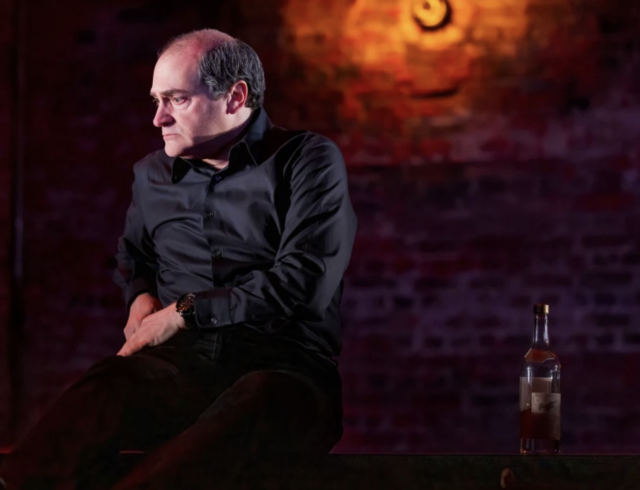
Lately I’ve been thinking more than ever about grief and death. I’m not a support group kinda guy, but when I heard about The Voices in Your Head, I knew I had to go.
I found solace — and nearly nonstop laughter — in Those Guilty Creatures’ immersive, site-specific group therapy black comedy, which continues at St. Lydia’s storefront dinner church in Brooklyn through January 29.
The space has been renamed St. Lidwina’s, after the Dutch patron saint of chronic pain and ice skating. The church has a large front window and door, looking more like a cozy shop than a place of worship. When you arrive, you are asked to check off your name on a sign-in sheet; to protect your anonymity, there are no last names, although people passing by outside can peek in and see you.
In the center of the room are more than two dozen unmatched chairs arranged in a large oval. In the back is a working kitchen where the facilitator, Gwen (Vanessa Kai), greets everyone while making tea and cookies. Several attendees engage in friendly conversation and chitchat. Shortly after Gwen calls the meeting to order, it becomes apparent that a handful of the participants are in the cast.
“It’s funny, when I was at my lowest, I was going to all these different meetings; it felt like dating, trying to find the right match, and they were all so . . . maudlin? I thought, there has to be another way. So, I started this group,” Gwen says. “Evidently, there was a need. So, we’re all here, we’ve met the criteria, but, broadly, I like to think of this as a place to share a sensibility. Laughter comes easier for me in here than out there. Everyone has their own relationship to grief; I’ve been considering mine, but what about anti-grief? We seek that through shared stories, activities, and discussions. . . . We aim to hear three stories each week, which, hopefully, helps us exchange some weird-ass joy.”
The audience becomes immersed in the grief of others in The Voices in Your Head (photo by HanJie Chow)
Sharing their sensibilities are the vivacious and outgoing Regina (Daphne Overbeck); Vivian (Marcia DeBonis), who believes in “Death, Embarrassment, Trauma”; Caleb (Christian Caro), who doesn’t want to be sad in college and can’t stop texting; the ultraserious Sandra (Erin Treadway); and the practical Hadiya (Jehan O. Young), who loves “the morbid stuff.”
They are eventually joined by first-timer Blake (Patrick Foley), who is determined to turn his story of loss into a Netflix special, and Ted (Tom Mezger), who actually attends the church and saw a flier.
Over the course of sixty fun, lively minutes, the group discusses Kelly Clarkson, hot cater waiters, self-care, vacuuming, exfoliating, sand, and other items and issues as they explore their personal misfortunes. A role-playing session that puts some of the group members in specific social situations doesn’t go quite as expected. During a break, the characters gossip, revealing more about who they are.
At the center of it all is the arbitrariness of death and Gwen’s assertion that we should “just approach the nature of the loss with a sense of humor. It helps us hold a certain space.”
The Voices in Your Head takes place in the storefront of a Brooklyn dinner church (photo by HanJie Chow)
The cast is uniformly excellent, led by Kai (The Pain of My Belligerence,KPOP) as the not-necessarily-so-stable Gwen, the always terrific DeBonis (Mary Page Marlowe,Small Mouth Sounds) as the chatty but caring Vivian, Treadway (Spaceman,War Dreamer) as the dour Sandra, Young (Speech,The Johnsons) as the purposeful Hadiya, Overbeck (Typed Out: A Princess Cabaret,Nightgowns) as the wonderfully over-the-top Regina, and Caro making his off-Broadway debut as the inattentive Caleb, but Foley (Circle Jerk,The Seagull/Woodstock, NY) nearly steals the show with his unforgettable Christmas story.
Created by Grier Mathiot and Billy McEntee and gleefully directed by Ryan Dobrin, The Voices in Your Head is as smart as it is hilarious. It’s not so much about how we deal with death than how we deal with life. Everyone reacts differently to tragedy and loss, but, as Gwen points out, “We need to hear each other’s laughter.”
The Voices in Your Head is not interactive — the audience should leave the talking to the actors — but feel free to mingle afterward and share your own thoughts about this engaging and involving experience.
[Mark Rifkin is a Brooklyn-born, Manhattan-based writer and editor; you can follow him on Substack here.]