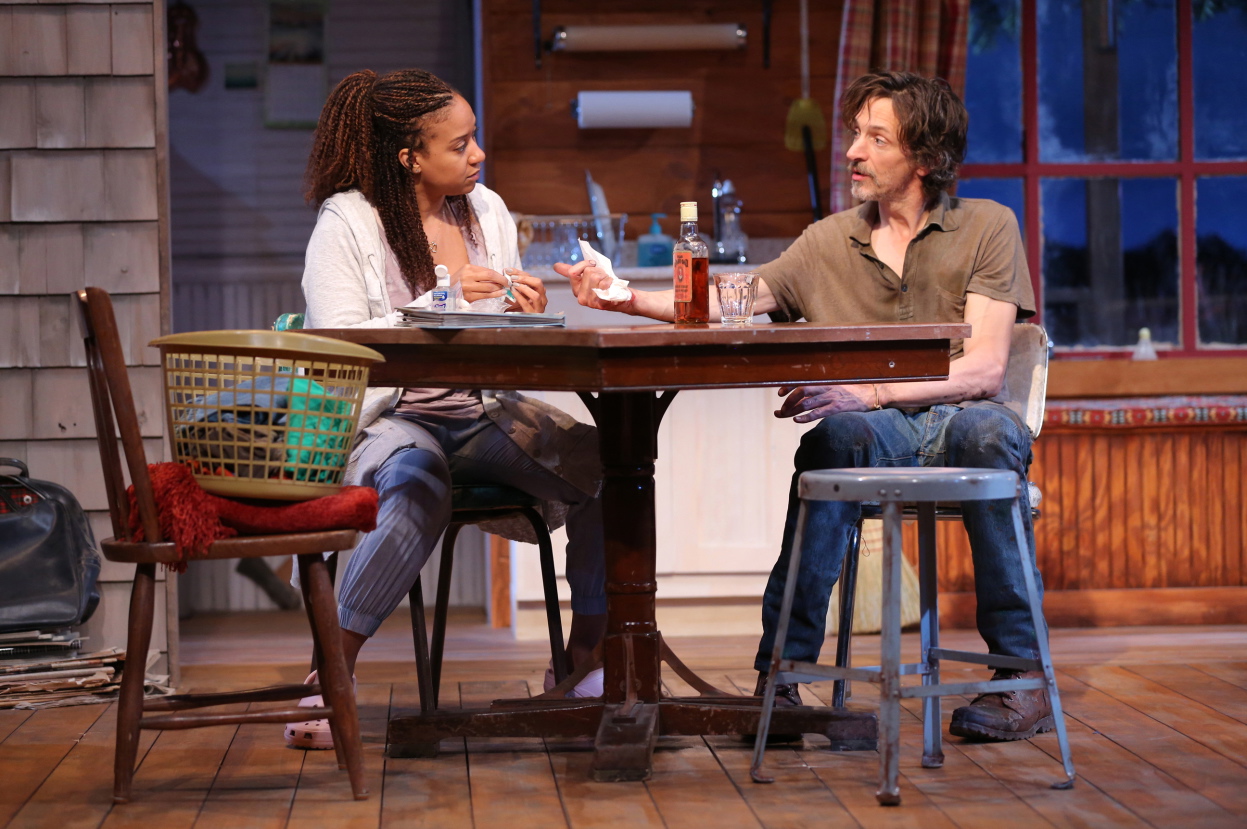
Veronica (Tracie Thoms) and Hogan (John Hawkes) are a pair of lost souls set adrift in new play by David Auburn (photo by Joan Marcus)
Manhattan Theatre Club
NY City Center Stage 1
131 West 55th St. between Sixth & Seventh Aves.
Tuesday – Saturday through December 21, $90
212-581-1212
www.lostlakemtc.com
www.nycitycenter.org
One of the best new plays of the fall season, David Auburn’s Lost Lake is a relatively simple yet compelling drama about two flawed souls trapped in worlds they can’t break out of. Veronica (Tracie Thoms) is a single mother looking to rent a cabin upstate for a week for her, her children, and one of their friends. Veronica goes up early to check out the cabin, which turns out to be as shoddy and ramshackle as its owner, Hogan (John Hawkes), a gaunt, grizzled, but well-meaning man who can’t seem to do anything right in his life. Both are repairers of a sort; Veronica is a nurse practitioner with aspirations to perhaps become a doctor, while Hogan purports to be a handyman who can fix just about anything, including the rotting swimming dock out on the lake behind the cabin. But neither can patch the gaping holes in their lives. As her supposed vacation progresses, Veronica gets caught up in Hogan’s family drama, as he lurks around the property, telling her about his problems with his ex-wife, his daughter, his brother, and, mostly, his despised sister-in-law, no matter how much Veronica just wants him to leave. But various events, both major and minor, keep bringing these two very different people together during a complicated period in which each is forced to take a long, hard look at the choices they’ve made while dealing with the hands they’ve been given.
Tony and Pulitzer Prize winner Auburn reteams with his Proof director, Daniel Sullivan, for this moving slice-of-life tale, which is highlighted by two superb performances. Thoms (Cold Case, Stick Fly) is careful and deliberate as Veronica, a troubled woman who does not like to let her wounds show. The Oscar-nominated Hawkes (Winter’s Bone, The Sessions) is riveting as Hogan, all herky-jerky and unpredictable as a man seemingly uncomfortable in his own skin. The back-and-forth banter between them is enhanced by the piercing yet vulnerable looks in their eyes, neither character happy with their lot in life but not sure how to turn things around. The script cleverly touches on such issues as race, the economic crisis, class, elitism, and gender roles while efficiently dismissing the one place you really don’t want it to go. J. Michael Griggs’s set is appropriately broken-down and dilapidated, echoing the protagonists’ inner demons. The ninety-minute Manhattan Theatre Club production follows the play’s debut earlier this year at the University of Illinois at Urbana-Champaign with Jake Weber and Opal Alladin as part of the Sullivan Project, a residency led by artistic director Daniel Sullivan, who has also helmed such shows as Rabbit Hole, Orphans, The Heidi Chronicles, and many Shakespeare in the Park presentations. Lost in the Lake is a fine fit for the intimate Stage I at City Center, where it is scheduled to run through December 21.

 Ben Niles’s Some Kind of Spark is a heartwarming and heartbreaking documentary about the importance of music education in children’s lives. Niles, whose award-winning 2007 film,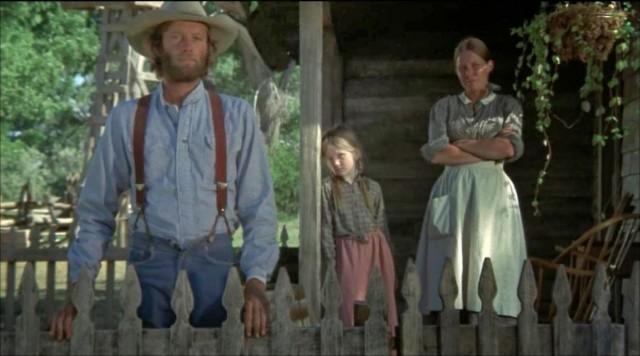
 After many years away from the homestead, Harry Collings (first-time-director Peter Fonda) returns to his farm, only to find that his wife (Verna Bloom) has kept herself rather busy once she assumed he was not coming back, in The Hired Hand, a so-called hippie Western written by Scottish novelist Alan Sharp, who also wrote Ulzana’s Raid and Night Moves. Warren Oates is his usual fine self as Harry’s dedicated sidekick, Arch Harris, as they do battle with the likes of the evil McVey (Severn Darden). The quiet, beautiful Fonda is like a Zen cowboy, trusting in karma to right the world’s wrongs, but that doesn’t always work out. Fonda considers the film, photographed by a young Vilmos Szigmond (McCabe & Mrs. Miller, The Deer Hunter), to be a Greek tragedy within a Western; indeed, it’s a little gem that that goes way beyond the trappings of the genre, laying the groundwork for such later anti-Westerns as Clint Eastwood’s Unforgiven. The film is being shown November 14 as part of the Rubin Museum Cabaret Cinema series “My Formative Years,” curated by artist Francesco Clemente in conjunction with his current solo show, “Inspired by India,” and will be introduced by playwright Neil LaBute. Clemente says about the film, “I’m in favor of psychedelia in all manifestations and to find psychedelia in a Western is always nice when it happens, but it never happens.” The film series continues with Alejandro Jodorowsky’s The Holy Mountain on November 21 and Pier Paolo Pasolini’s Salò, or the 120 Days of Sodom on November 28 (introduced by choreographer Karole Armitage), before concluding with Gianfranco Rosi’s Sacro GRA on December 5.

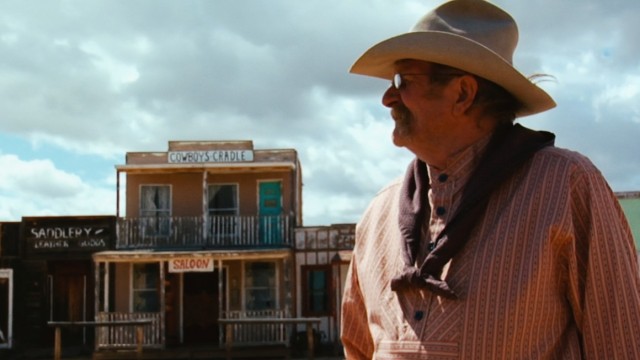
 Brooklyn-based documentarian Andrea B. Scott reveals the soft underbelly of contemporary America in Florence, Arizona, which is having its world premiere this week at the annual DOC NYC festival. Scott heads to the small desert town of Florence in the Grand Canyon State, an area that was a farm community until a nearby 1875 silver boom led to its becoming a more wild West kind of place. Today the town revolves around the prison system; there are twice as many prisoners in Florence as there are residents, and a call to privatize more of the jails is part of the battle for mayor between the New Age-y Lina Austin and former police chief Tom Rankin, both of whom speak openly and honestly with Scott. Scott, who directed, produced, coedited, and photographed the film — which includes gorgeous shots of sunrises and vast landscapes — also meets with prison barber and former inmate Andy Celaya, who remembers the respect ex-cons used to get after serving their time; another former prisoner, young Marcus Seitz, who can’t wait to turn twenty-one so he can work inside the prison, explaining, “That would be pretty cool”; and grizzled prison detention officer Gunny Jackson, who runs the Semper Fi Ranch with his wife, Lois, and considers himself a “dove” who can be “a very vicious man when I want to be; I know how to inflict pain.” Scott also visits the Pinal County Historical Society, which features a section on all of the people who have been executed in Florence’s prisons.