twi-ny recommended events

HAUTE COUTURE ON FILM: FUNNY FACE

FUNNY FACE

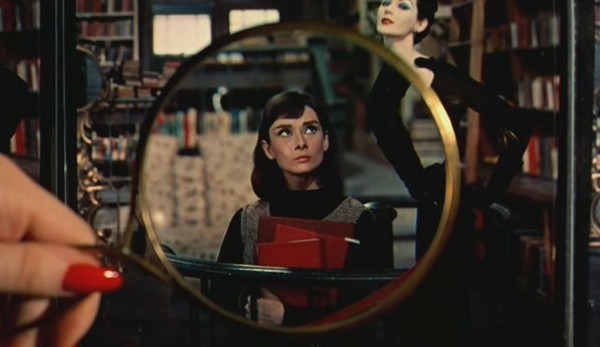
Jo Stockton (Audrey Hepburn) is not happy about fashionistas taking over the bookstore where she works in FUNNY FACE

CinéSalon: FUNNY FACE (Stanley Donen, 1957)
French Institute Alliance Française, Florence Gould Hall
55 East 59th St. between Madison & Park Aves.
Tuesday, April 7, $13, 4:00 & 7:30
Festival runs April 7 – May 26
212-355-6100
www.fiaf.org

The French Institute Alliance Française’s third annual “Fashion at Fiaf” festival kicks off April 7 with the “’s wonderful, ’s marvelous” 1957 romantic musical comedy Funny Face. When Quality magazine editor and publisher Maggie Prescott (Kay Thompson) decides she’s after the next big thing, photographer Dick Avery (Fred Astaire playing a fictionalized version of Richard Avedon, who served as a consultant on the film and took the photos) asks, “Are there no models who can think as well as they look?” So they descend on a “sinister” bookstore in Greenwich Village, Embryo Concepts, to show the intellectual side of star model Marion (real-life model Dovima), but instead Dick believes that the bohemian bookstore’s mousy, idealistic sales clerk, Jo Stockton (Audrey Hepburn), might just be exactly what they’re looking for, a fresh face with “character, spirit, and intelligence.” Jo is steadfastly averse to the plan at first, until Dick convinces her that it would be a great opportunity for her to see Paris and go to a lecture by her favorite philosopher, professor Emile Flostre (Michel Auclair), the father of empathicalism. So Maggie, Dick, Jo, and their crew head over to France, where Jo will soon be strutting down the runway in a line specially created for her by superstar designer Paul Duval (Robert Flemyng). But once they get to the City of Lights, everything goes more than a bit haywire as haute couture battles counterculture chic.
FUNNY FACE

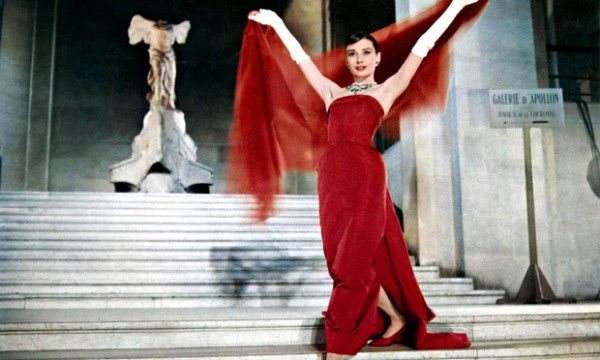
Audrey Hepburn is glamorous in Givenchy in classic musical

Partially based on an unproduced show by screenwriter Leonard Gershe called Wedding Bells — which was inspired by the real-life relationship between Avedon and model and actress Doe Nowell — and including four songs from George Gershwin’s 1927 musical, also called Funny Face (and starring Astaire and his sister, Adele), the film is an utter delight from start to finish. Despite an age difference of nearly thirty years, Hepburn and Astaire have genuine chemistry as their characters fall for each other. Unlike 1964’s My Fair Lady, in which Hepburn’s singing voice was dubbed by Marni Nixon, she does all of her own vocalizing in Funny Face, including a lovely solo on “How Long Has This Been Going On?,” and she uses her childhood dance training to fabulous effect in a stunning modern dance scene in a dark and smoky bohemian club. Astaire is a joy as Avery, particularly in the dazzling solo number “Let’s Kiss and Make Up,” performed with hat, raincoat, and umbrella. And Thompson, in her only major film role — she was already in the midst of her four-book children’s series about Eloise, the girl who lives in the Plaza Hotel in New York City — gets things going with the glorious opener “Think Pink!,” her character inspired by Harper’s Bazaar editors Carmel Snow and Diana Vreeland. Among the other songs by George and Ira Gershwin are “On How to Be Lovely,” “He Loves and She Loves,” “Clap Yo’ Hands,” and “Bonjour, Paris!” The costumes, of course, are spectacular, courtesy of Edith Head and Hubert de Givenchy, as are Eugene Loring’s choreography and Stanley Donen’s direction as the story roams around many of Paris’s iconic locations. Everything about the film, which was nominated for four Oscars but came up empty, is fun and fashionable, including cameos by model Suzy Parker; Carole Eastman, who would go on to write Five Easy Pieces and The Fortune; Hepburn’s mother; and a group of girls dressed up like French children’s book favorite Madeline.
Dick Avery (Fred Astaire) want to kiss and make up with Jo Stockton (Audrey Hepburn) in FUNNY FACE

Dick Avery (Fred Astaire) want to kiss and make up with Jo Stockton (Audrey Hepburn) in FUNNY FACE

Funny Face is screening April 7 at 4:00 & 7:30 as part of the FIAF CinéSalon series “Haute Couture on Film”; both screenings will be followed by a wine reception, and journalist Anne-Katrin Titze will introduce the later show. The series continues through May 26 with such other films as Lisa Immordino Vreeland’s Diana Vreeland: The Eye Has to Travel, John Cassavetes’s Gloria, Jean Renoir’s The Rules of the Game, and Jean Negulesco’s How to Marry a Millionaire. “Fashion at Fiaf” also includes talks with Jack McCollough and Lazaro Hernandez of Proenza Schouler, Kate Betts, and Garance Doré and a gallery show of the work of photographer Grégoire Alexandre.
TICKET ALERT: BLACK N’ BLUE BOWL

Who: The Regulators, BURN, Crumbsuckers, Candiria, Madball, Sick of It All, the Rival Mob, Turnstile, Earth Crisis, Fury of Five, Expire, Suburban Scum, Everybody Gets Hurt, Dave Smalley, and more
What: 2015 Black N’ Blue Bowl
Where: Webster Hall, 125 East 11th St.,
When: Saturday, May 16, and Sunday, May 17, $40 single day, $70 weekend pass, 1:30
Why: Formerly known as the Superbowl of Hardcore, the newly redubbed Black N’ Blue Bowl comes to Webster Hall — the event began in the 1980s at the old Ritz in the same space — on May 16-17 with more than two dozen hardcore punk bands, including an exclusive appearance by the reunited BURN. “Hardcore music has been instrumental in my life and I’m excited about getting onstage with Gavin again,” BURN leader Chaka Malik said in a statement. “We’ve been approached to do this for well over a decade and it never felt like it was the right time,” guitarist Gavin Van Vlack added. “Finally the stars have aligned at a time when it all feels so right, where the pure desire that Chaka and I have to play these songs has come to fruit.” Other highlights include the Regulators, with Darryl Jenifer and Dr. Know from Bad Brains and John Joseph and Mackie Jayson from Cro-Mags, and the Wilding Incident, with Lord Ezec on vocals, Jimmy Williams on drums, and Sacha Jenkins on guitar.

PAULA HAYES: GAZING GLOBES

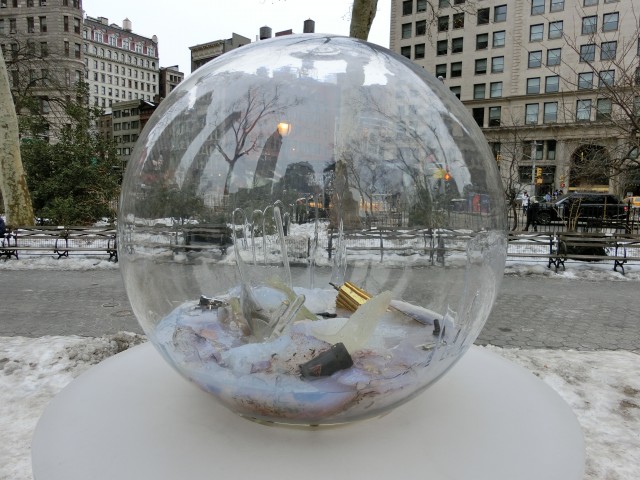
Paula Hayes’s “Gazing Globes” offers a different way to look at Madison Square Park (photo by twi-ny/mdr)

Paula Hayes’s “Gazing Globes” offers a different way to look at Madison Square Park (photo by twi-ny/mdr)

MAD. SQ. ART
Madison Square Park
23rd to 24th Sts. between Madison & Fifth Aves.
Daily through April 19, free
www.madisonsquarepark.org
www.paulahayes.com
gazing globes slideshow

In exhibits such as “Nocturne of the Limax maximus” at MoMA and “Land Mind” at Lever House, visual artist and landscape designer Paula Hayes created living botanical environments, terrariums that held plants and fish while emphasizing the relationship between humanity and nature. Now Hayes, who was born in Massachusetts and is based in New York City, has incorporated outdated technology into the mix with “Gazing Globes,” an illuminating site-specific display in the southwest gravel section of Madison Square Park. Eighteen glass orbs, sixteen, eighteen, or twenty-four inches in diameter, sit on fiberglass pedestals of varying heights between two and four feet, filled with detritus from analog radios, electronic transistors, vacuum tubes, rubber tires, and other technological and industrial waste, along with crystals, forming futuristic miniature postapocalyptic cities of blue, green, purple, gold, and black, layered with dust made from crushed CDs. The spheres change with the weather and the time of day, morphing from snow globes to colorful crystal balls to enchanting glowing orbs at night as they also reflect the surrounding architecture of the Flatiron District. As spring heats up and Teresita Fernández’s massive, five-hundred-foot-long “Fata Morgana” goes up in the park, “Gazing Globes” will mutate yet again, offering yet more fascinating glimpses into our past, present, and future.

GREAT KILLS

(photo by Rosalie Baijer)

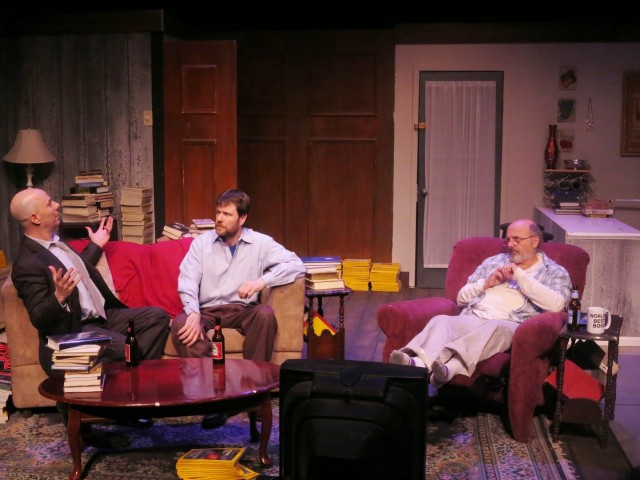
Robert (Peter Welch), Tim (Robert Homeyer), and Mr. G (Joe Pantoliano) concoct a crazy scheme in GREAT KILLS (photo by Rosalie Baijer)

Theater for the New City, Community Space
155 First Ave. between Ninth & Tenth Sts.
Wednesday – Sunday through April 12, $20
212-254-1109
www.theaterforthenewcity.net

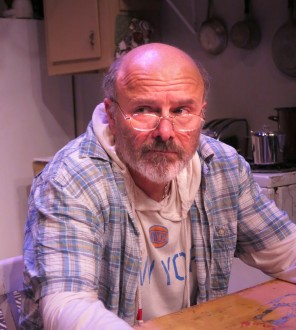
Tom Diriwachter captures the zeitgeist of the borough that never changes, Staten Island, in his involving new play, Great Kills, making its world premiere at Theater for the New City in the East Village. When you first encounter Mark Marcante’s set, you’re likely to think the story takes place in the 1970s, as the appliances in the kitchen are old, the décor static, with books stacked all over the floor, issues of National Geographic strewn about, and an ancient television front and center. But as soon as the TV is turned on and a sportscaster (voiced by director Jonathan Weber, who runs the New York Mets blog The Ballclub) announces that Mets pitcher Jason deGrom is facing Cincinnati Reds first baseman Joey Votto, it becomes apparent that the time is the present, as characters reach into their past to prepare for the future. Robert Homeyer stars as Tim, a tall, awkward, bearded forty-year-old former adjunct professor now working at a local B&N. An angry and desperate ne’er-do-well, Tim lives with his father, Mr. G (Joey Pantoliano), a gruff, grizzled drunk who’s been a painter at the Meadowbrook state institution for thirty-seven years, but the facility will be closing following a series of investigative reports that depicted it as a “horror show.” (That part of the plot was inspired by Geraldo Rivera’s real-life reporting on Staten Island’s Willowbrook facility.) When Tim finds out that Meadowbrook has apparently discarded a huge amount of cabinets, he decides to take them off their hands and make a fortune reselling them, claiming he’s seen similar items going for eighteen hundred bucks in the Village. So he calls in his childhood friend Robert (Peter Welch), a successful restaurateur, to help with the scheme. Wearing a sharp suit, Robert is suspicious of Tim and the plan, but he’s willing to listen, for reasons that eventually become apparent. And through it all, Mr. G just keeps on drinking and grumbling.

(photo by Rosalie Baijer)

Emmy winner Joe Pantoliano is a hoot as an aging drunk in play set in Staten Island (photo by Rosalie Baijer)

Great Kills is built around a suspect, questionable premise, and although it all makes sense in the end, it works best as a character study of three very different men. The way they interact with one another — Robert with Tim, Tim with Mr. G, Mr. G with Robert — is what drives the play, which features dark humor and gritty, rapid-fire dialogue with clever wordplay from lifelong Staten Islander Diriwachter. Robert: “We’re friends.” Tim: “We are friends.” Robert: “We’ve been friends a long time.” Tim: “We used to ride bikes together.” Robert: “I’d take a bullet for you.” Tim: “I’d . . . wrestle a bear for you.” Robert: “I don’t know why you’d ever have to do that.” Tim: “I’m just saying.” Robert: “But business is business.” Robert is cool and self-confident, Tim edgy and unnerving, Mr. G a grunting widower who serves as comic relief, but each one has surprises in store as the plot unfolds in real time. The Hoboken-born Pantoliano, who won an Emmy for his role as Ralphie Cifaretto on The Sopranos, starred with Rosie Perez on Broadway in Frankie and Johnny in the Claire de Lune, and has appeared in such other films as Memento, The Matrix, and Risky Business, is a hoot as Mr. G, just wanting to be left to his baseball and booze. He is practically one with his comfy chair, getting up only to grab another beer or a shot. Indie film actor, writer, and director Welch, who is also a fine art photographer, gives just the right edge to Robert, who keeps hanging around even as the plan gets more complicated. And Theater for the New City regular Homeyer plays Tim as a man uncomfortable in his own skin, believing that the world owes him a whole lot more. It might be Mamet-lite, but this tale of losers, idealists, and never-will-bes is an engrossing look at modern men and the American dream, with a sharp Staten Island tang.

FULL BUNNY CONTACT

(photo by twi-ny/mdr)

Full Bunny Contact pits giant bunnies against humans on a crazed Easter egg hunt (photo by twi-ny/mdr)

FULL BUNNY CONTACT
The Clemente Soto Vélez Cultural and Educational Center
107 Suffolk St. between Rivington & Delancey Sts.
April 1-5, $10-$60
www.fullbunnycontact.com
full bunny contact slideshow

Easter is a time of family and tradition, and we have discovered a new holiday tradition that we hope to be part of our family for a long time to come. Full Bunny Contact is a warped carnival of crazed games and oddball prizes, continuing at the Clemente Soto Vélez Cultural and Educational Center on the Lower East Side through Easter Sunday. Humans in huge, shabby chic bunny suits roam the space, mildly menacing carnies who lend just the right note of wackiness to the numerous carnival tests of strength and skill: In Shoot the Peep, you fire away a paintball rifle at a life-size version of the sweet treat. Bunny Ball involves tossing a football into a basketball hoop being defended by a giant furry bunny, while Egg Putt has no defensive bunnies but does require you to pitch and putt a decidedly nonround rubber egg into a hole. Little Bunny Fu Fu’s Revenge/Warrior Joust lets you and a bunny climb on padded pedestals and attempt to knock the other off. Ride the Rabbit features a mechanical bull with a bunny mask that first moves tamely before twisting and spinning a lot more fiercely. And the premiere event, Full Bunny Contact, is a cage match in which you try to fill your basket with eggs as a team of evil bunnies is out to stop you. You can also take a picture with the Insult Bunny, play rather basic games of ring toss and Tic-Tac-Toe, and get your fortune told by a psychotic bunny who can say and do just about anything, including pound a nail up his nose. Earning a silver or gold egg entitles you to spin the prize wheel to win very kitschy items that look like they’ve been gathering dust in someone’s attic since the 1950s. General admission is $10, and individual game tickets are an additional charge; for $60, you can go hog wild and play everything — and are given a pair of light-up bunny ears as a keepsake of this very different kind of celebration of the resurrection. Special events include a Bunny Beauty Pageant on Thursday night, an egg-decorating contest on Friday, a Temper Tantrum Easter Candy Contest on Saturday afternoon for kids and Saturday night for adults, and a Masters of Egg Putt shootout on Sunday.

FLOYDADA

(photo by Dan Lane Williams)

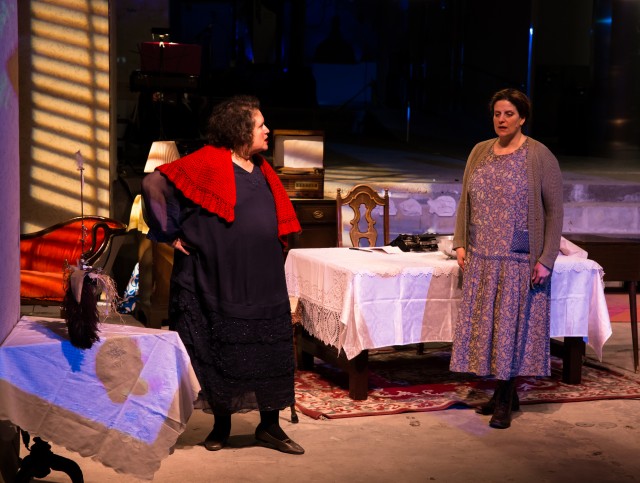
Sisters Dalia (Nomi Tichman) and Ada (Catherine Porter) reconnect in FLOYDADA (photo by Dan Lane Williams)

Peculiar Works Project
Merchants Square Building
40 Worth St. between Church St. & West Broadway
Wednesday – Saturday through April 11, $12-$18, 7:00
www.peculiarworks.org

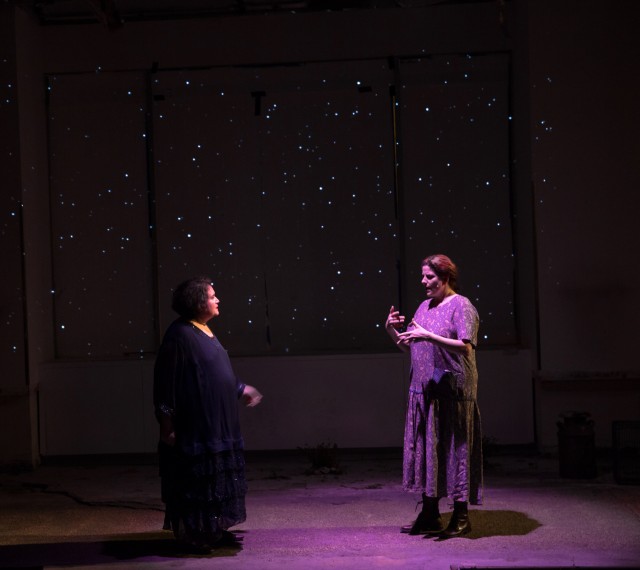
When you think of the revolutionary art movement known as Dada, West Texas is not generally one of the first things that comes to mind. But in the early 1990s, playwright Barry Rowell was driving to Lubbock when he saw a sign for the small town of Floydada, Texas, and decided right then and there that he was going to write a play that involved Dadaism. The result is Floydada, a two-character show running through April 11 in a large, empty storefront in the Merchants Square Building on Worth St. The premise is a bit thin, as well as somewhat random — which, of course, is a key element of Dada. But you don’t have to know anything about Dada — the experimental movement, based on readymade objects and chance, that developed from a disgust with the death and destruction of WWI — to understand the play; after all, “Dada does not mean anything,” Tristan Tzara wrote in his 1918 manifesto. It’s March 1927, and Dalia (Nomi Tichman) is ill, so she has returned home to be with her sister, Ada (Catherine Porter), in the small town of Floydada. Dalia has spent the last several decades primarily in New York, Berlin, and Paris — France, not Texas — writing poetry, giving performances, and hanging out with the cultural elite, including the Baroness Elsa von Freytag-Loringhoven, a close friend with whom she continues to exchange letters. Elsa has also given Dalia one of her most famous sculptures, “Portrait of Marcel Duchamp,” an avant-garde work that mystifies Ada almost as much as her sister’s activities do. Over the course of ten months, the sisters reconnect, the city girl and the country girl learning from each other and even performing together, turning the family’s dry goods store into a cabaret where they sing and recite poetry for the close-knit local community.

(photo by Dan Lane Williams)

FLOYDADA features unusual characters in an unusual space (photo by Dan Lane Williams)

When Dalia first suggests that they perform, she tells Ada, “All we need is an empty space.” The same can be said for Peculiar Works Project, the Obie-winning company, cofounded by Porter, Rowell, and Ralph Lewis in 1993, that specializes in experimental productions in unusual spaces. In 2013, they presented Rowell’s Manna-Hatta in multiple rooms upstairs in the James A. Farley Post Office. Floydada takes place on the ground floor of the Merchants Square Building, which was built in 1928, right around the time in which the play is set. One side of the long, horizontal room, which boasts large pillars, a cement floor, and an open ceiling revealing pipes, wires, and insulation, has been filled with new Dada-inspired art by Carlo Adinolfi, Michelle Beshaw, Myrel Chernick, Norman Chernick-Zeitlin, Anna Kiraly, Ray Neufeld, and Francesco Vizzini. A makeshift box-office area features a urinal tip jar and a slideshow of Dada artists. The play itself unfolds in an open area with some furniture, as the two actors wander from living room to outside road to dry goods store, using sound to indicate their coming and going. Porter and Tichman portray Ada and Dalia with an oddball eccentricity that is reminiscent of the mother and daughter Bouvier Beales from Grey Gardens, though not nearly as off the wall. “People think you’re strange, you know,” Ada says, to which Dalia replies, “I am.” Director David Vining (Cracked, The Blue Puppies Cycle) makes creative use of the space, though a lot of the movement grows repetitive; at times you’ll just wish the characters just stayed put for a few moments instead of constantly getting up and down and moving back and forth on Casey McLain’s set. Yoonmi Lee adds fine piano and percussion, while Lianne Arnold’s projections and Leila Ghaznavi’s live manipulations (and sound effects) are colorful but confusing. The overall aesthetic has a sweetly innocent DIY charm, as well as plenty of strangeness, but it’s probably about twenty minutes too long, which, in its own way, is rather Dada itself. It’s also extremely cold in the space, with no heating, so be prepared to leave your coat and hat on if the weather remains so bitter. Floydada runs Thursdays, Fridays, and Saturdays through April 11; there will be a “Dada (Re)Creation” benefit on April 6 with dance, music, art, and poetry, and the April 9-11 shows will be followed by a DadaDialogue with Pratt professor Dr. Dorothea Dietrich and other panelists.

FIRST SATURDAY: BASQUIAT

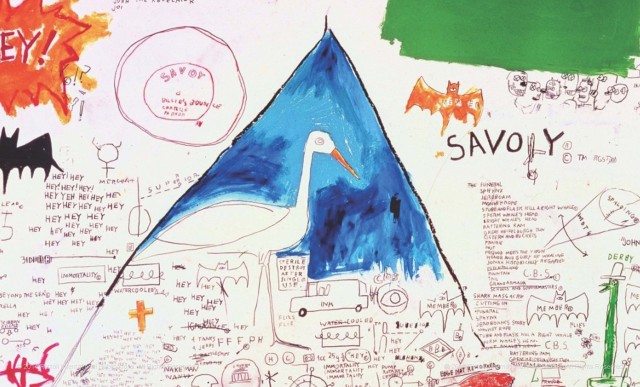
The opening of “Basquiat: The Unknown Notebooks” will be celebrated at free First Saturday program at the Brooklyn Museum

The opening of “Basquiat: The Unknown Notebooks” will be celebrated at free First Saturdays program at the Brooklyn Museum

Brooklyn Museum
200 Eastern Parkway at Washington St.
Saturday, April 4, free, 5:00 – 11:00
212-864-5400
www.brooklynmuseum.org

The April edition of the Brooklyn Museum’s First Saturdays program celebrates the opening of its latest exhibit on Jean-Michel Basquiat, “Basquiat: The Unknown Notebooks,” a collection of 160 pages from his never-before-shown notebooks, focusing on his use of text and image, along with works on paper and large-scale paintings. The free evening will feature live musical performances by the James Francies Trio and Lion Babe and a DJ set by Natasha Diggs; a curator talk by Tricia Laughlin Bloom about the new exhibition; a Basquiat crown-making workshop; a Basquiat-inspired writing workshop led by Tom La Farge and Wendy Walker; Cave Canem “Poetry Meets Art” readings from LaTasha N. Nevada Diggs and Roger Reeves; a children’s book presentation with illustrator Javaka Steptoe discussing Radiant Child: The Story of Young Artist Jean-Michel Basquiat; a screening of Tamra Davis’s 2010 documentary Jean-Michel Basquiat: The Radiant Child; a performance of Dark Swan by Urban Bush Women; and an interactive performance and dance workshop with W.A.F.F.L.E. (We Are Family for Life Entertainment). In addition, you can check out such exhibitions as “Revolution! Works from the Black Arts Movement,” “Kehinde Wiley: A New Republic,” “The Dinner Party by Judy Chicago,” and “Chitra Ganesh: Eyes of Time.”