twi-ny recommended events

ABOUT ELLY

ABOUT ELLY

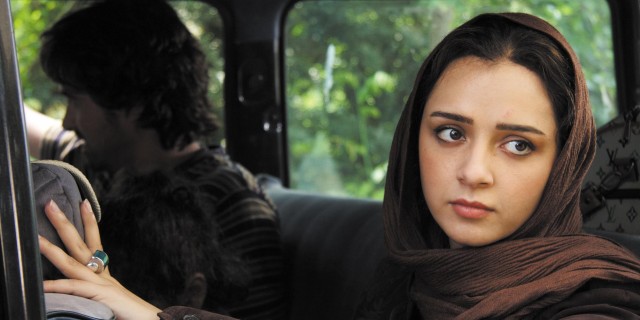
An uneasy Elly (Taraneh Alidoosti) is hiding something in Asghar Farhadi’s shattering ABOUT ELLY

ABOUT ELLY (DARBÂREYE ELI) (Asghar Farhadi, 2009)
Film Forum
209 West Houston St.
April 8-21, 12:45, 3:15, 6:45, 9:15
212-727-8110
filmforum.org
www.cinemaguild.com

“A bitter ending is better than an endless bitterness,” Ahmad (Shahab Hosseini) tells Elly (Taraneh Alidoosti) in Asghar Farhadi’s shattering, masterful 2009 drama, About Elly. Iranian writer-director Farhadi, whose A Separation was named Best Foreign Language Film at the 2012 Oscars — the film also earned him an Academy Award nomination for Best Original Screenplay — won the Silver Bear for Best Director at the 2009 Berlinale for About Elly, which also nabbed Best Picture at the 2009 Tribeca Film Festival. But rights issues have held up its U.S. theatrical release, depriving American audiences of a chance to see the work. Now that the film is finally opening here, beginning a two-week run at Film Forum on April 8 in a new 35mm print, the story of the film’s distribution is no longer bitter, but the searing tale itself couldn’t be more harrowingly acerbic. A group of upper-middle-class law school friends have come to a Caspian Sea villa from Tehran for a getaway weekend organized by Sepideh (Golshifteh Farahani), who has brought along Elly, her daughter’s teacher, as a potential love match for the recently divorced Ahmad, who has been living in Germany. Because of a scheduling snafu, they have to stay in a seaside house in desperate need of renovation, but the friends just go with the flow, singing and dancing and making the best of the awkward situation. But the playful atmosphere turns sour when tragedy strikes, leaving everyone to reexamine who they are.
ABOUT ELLY

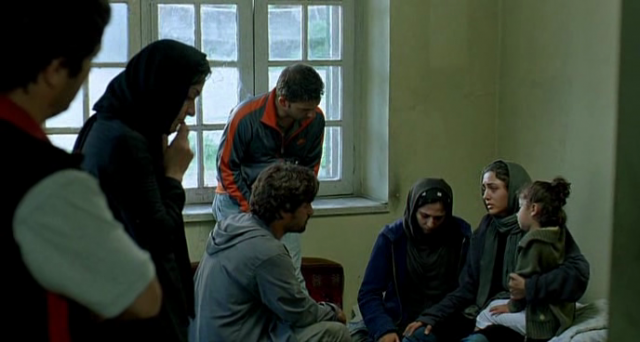
A group of friends has to face some hard truths during vacation gone terribly wrong

About Elly is a gripping, deeply thoughtful, and intensely intelligent exploration of class, romance, responsibility, culture, family, and, perhaps most of all, honesty in contemporary Iranian society. Although the film evokes such works as Michelangelo Antonioni’s L’Avventura and François Ozon’s Under the Sand, Farhadi (The Past, Fireworks Wednesday) infuses it with a profound sense of realism, involving the audience in its intricate, intimate mystery. You’ll feel like you’re on the beach with the friends, facing the same agonizing decisions. Shot in a naturalistic style by cinematographer Hossein Jafarian, About Elly takes place in a ramshackle vacation house, designed by Farhadi, that doubles for the characters’ psyche, with its broken windows, stuck doors, and lack of privacy. The scene in which a young boy goes missing in the ocean is as terrifying as it is heart-rending, a breathless extended sequence of events that feels like it will never let up. And indeed, the powerful emotions continue through the rest of the film — and will stay with you long after. The outstanding cast also includes Mani Haghighi as Amir, Sepideh’s husband; Peyman Moaadi and Merila Zarei as Peyman and Shohreh, the parents of the boy; and Ahmad Mehranfar and Rana Azadivar as another couple caught up in the tragedy. Fingers are pointed, bonds are tested, and relationships are fractured forever in Farhadi’s exquisite jewel of a film.

KINO! 2015 FESTIVAL OF GERMAN FILMS: SCHMITKE

SCHMITKE

Julius Schmitke (Peter Kurth) takes stock of his life in existential black comedy

SCHMITKE (Štěpán Altrichter, 2014)
Cinema Village
22 East 12th St. between University Pl. & Fifth Ave.
Sunday, April 12, 10:00, and Wednesday, April 15, 6:00
Festival runs April 9-16
212-924-3363
www.schmitkefilm.com
www.kinofestivalnyc.com

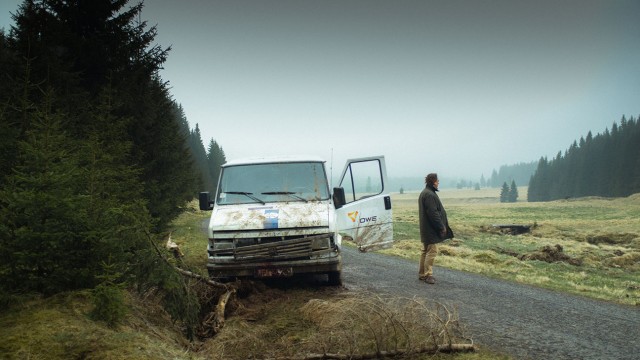
Based on the wonderfully titled Tomáš Končinský short story “Julius Schmitke slipped through death’s fingers like an awkward seal,” Czech director Štěpán Altrichter’s debut feature, Schmitke, is a darkly comic, Kaurismäkian character study of a middle-aged engineer making his way through a pretty simple life. Julius Schmitke (Peter Kurth) wakes up each morning, watches the coffeemaker get going, walks about slowly, stares a lot, and follows the story of a Bear-Man living in the German woods. A bear of a man himself, he is disappointed when he is reassigned — demoted — to fix a broken wind turbine in the small, foggy Czech border town of Chřmeleva in the Ore Mountains. Meanwhile, his grown daughter shows up unexpectedly, moving in with him and declaring, “I invested my energy wrong!” Schmitke and his new partner, the young, rather talkative Thomas Gruber (Johann Jürgens), head out in their white van, getting lost before ultimately arriving at their destination, where everyone, including the mayor (Jakub Žáček), hangs out in the local pub, drinking all day. But when Gruber suddenly goes missing, Schmitke sets off on a desperate search to find him — and, perhaps, himself in the process.
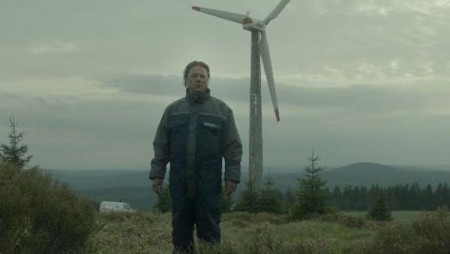

Peter Kurth stars as a man chasing a different kind of windmill in SCHMITKE

Peter Kurth stars as a man chasing a different kind of windmill in SCHMITKE

Cinematographer Cristian Pîrjol shoots Schmitke in muted greens and blues, with sudden bursts of red and yellow; his camera loves Schmitke, zooming in on his tired, heavy face, a man filled with desperation but too exhausted to do anything about it; instead, he dreams of becoming the Bear-Man himself. The old, rotting turbine, C174, turns agonizingly slowly, starting and stopping, emitting loud, echoing creaks that Schmitke might like to voice himself but won’t. “Damned thing,” he says to himself, but he could just as well be talking about his own life. He’s an existential Don Quixote figure, chasing windmills but just going around in circles. Altrichter, who wrote the script with Končinský and Jan Fusek, prefers short cuts with little camera movement, populating his film with strange characters and surreal plot twists. Johannes Repka’s moody score, going from mysterious to cheesy, and Katharina Grischkowski’s clever sound design enhance the overall subtly bizarre atmosphere. The motto of the company Schmitke works for is “Efficiency. Esteem. Energy.” The film has all three of those, albeit in its own unusual way. Schmitke is having its North American premiere April 12 and 15 as part of the Kino! 2015 Festival of German Film, which runs April 9-16 at Cinema Village and consists of ten recent features and one evening of shorts from Germany. Among the other films being screened are Mark Monheim’s About a Girl, Neele Leana Vollmar’s The Pasta Detectives, Christoph Hochhäusler’s The Lies of the Victors, and Christian Zübert’s Tour de Force. In addition, there will be conversations with some of the filmmakers at the Goethe-Institut and Deutsches Haus at NYU.

RECENT FILM ACQUISITIONS: THE PRINCESS OF MONTPENSIER

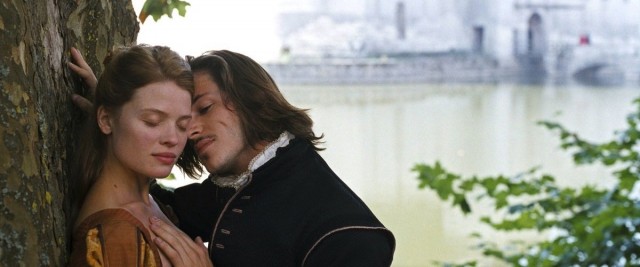
Marie de Mézières (Mélanie Thierry) and Henri de Guise (Gaspard Ulliel) have trouble keeping their hands off each other in Bertrand Tavernier’s sweeping romantic epic

Marie de Mézières (Mélanie Thierry) and Henri de Guise (Gaspard Ulliel) have trouble keeping their hands off each other in Bertrand Tavernier’s sweeping romantic epic

THE PRINCESS OF MONTPENSIER (Bertrand Tavernier, 2010)
MoMA Film, Museum of Modern Art
11 West 53rd St. between Fifth & Sixth Aves.
Friday, April 10, 7:30 (Roy and Niuta Titus Theater 1), and Tuesday, April 14, 6:30 (Education and Research Building)
Series runs through April 14
Tickets: $12, in person only, may be applied to museum admission within thirty days, same-day screenings free with museum admission, available at Film and Media Desk beginning at 9:30 am
212-708-9400
www.moma.org
www.ifcfilms.com

In Bertrand Tavernier’s sweeping romantic epic, young and beautiful Marie de Mézières (Mélanie Thierry) has a big problem: It seems that every man she meets falls in love with her. Already in a passionate relationship with the heroic Henri de Guise (Gaspard Ulliel), a leader of the Catholics against the Protestant Huguenots in the French Wars of Religion of the 1560s, Marie is suddenly part of a shady deal between her father (Philippe Magnan) and the Duke de Montpensier (Michel Vuillermoz), marrying her off to the rather uninspiring though steadfast Prince Philippe de Montpensier (Grégoire Leprince-Ringuet), who warms to his bride much quicker than she to him. Returning to the battlefield, Philippe asks his mentor, the older and wiser Count de Chabannes (Lambert Wilson), to teach Marie in the ways of the court to prepare her for meeting Catherine de Medici, but even such a solid, moralistic man as Chabannes — who deserted from the army after killing a peasant family, supposedly in the name of his lord and saviour — cannot prevent himself from succumbing to the many charms of his unaware charge. And when she meets the wild and unpredictable Duke d’Anjou (Raphaël Personnaz), the king’s brother is smitten as well. But through it all, Marie, a modern woman who wants to learn to write and make her own choices, remains fiercely drawn to Henri, a forbidden love that threatens dire consequences.
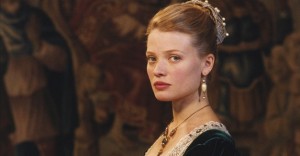

Mélanie Thierry

Mélanie Thierry stars as the irresistible Marie de Mézières in THE PRINCESS OF MONTPENSIER

Based on the 1662 novella by Madame de La Fayette, The Princess of Montpensier is a thrilling tale of love and war, of honor and betrayal. Master filmmaker Tavernier (The Clockmaker of Saint-Paul, A Sunday in the Country), who cowrote the daring script with longtime collaborator Jean Cosmos and François-Oliver Rousseau, focuses on character and story rather than pomp and circumstance, creating an intoxicating intimacy often missing from the genre. Thierry is alluring as Marie, who can be seen as an early feminist in a time when women were little more than possessions. Even at two hours and twenty minutes, the film flies by; you’ll feel sorry you can’t spend more time with the many wonderfully drawn characters who help make The Princess of Montpensier such a marvelous treat. The film is screening April 10 and 14 as part of MoMA’s presentation of its latest film acquisitions; among the other recently acquired works being shown are Aktan Arym Kubat’s Svet-Ake (The Light Thief), Bruno Barretto’s Bossa Nova, Xavier Dolan’s Les Amours imaginaires (Heartbeats), and Bong Joon-hoo’s Barking Dogs Never Bite.

GALLERY SESSIONS: BJÖRK EXPLAINED BY A FAN

Björk (photo by twi-ny/mdr)

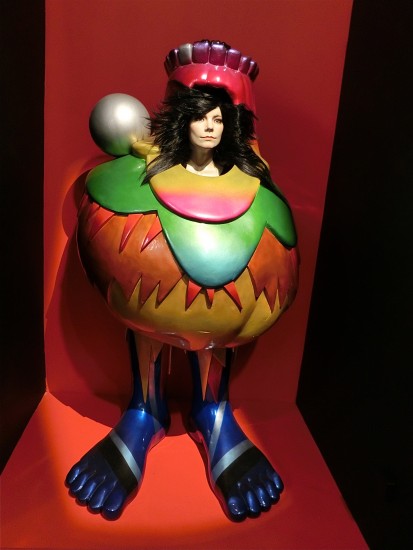
“Björk” exhibit at MoMA has led to quite a cacophony (photo by twi-ny/mdr)

BJÖRK
MoMA, Museum of Modern Art
11 West 53rd St. between Fifth & Sixth Aves.
Exhibit runs through June 7, $14-$25 (timed tickets available same day only)
212-708-9400
www.moma.org
bjork.com

There doesn’t seem to be a whole lot more that can be said about Björk’s disastrous solo exhibition at MoMA, so reviled that critics are calling for the heads of chief curator at large Klaus Biesenbach and museum director Glenn D. Lowry. The truth hurts; it’s a head-scratchingly absurd show. I went in determined to see something everyone else missed, trying to find something positive in the four-part presentation, having admired Björk Guðmundsdóttir’s work for many years, from her time leading the Sugarcubes to her award-winning performance in Lars von Trier’s Dancer in the Dark to her innovative Biophilia album, app, tour, and concert film. But alas, the simply titled “Björk” exhibition seems to go out of its way to annoy. The MoMA-commissioned ten-minute “Black Lake” music video, for a song from her latest album, Vulnicura, about her breakup with longtime partner Matthew Barney, is fine, a two-screen projection in which she lets loose against Barney, who just last week sued her for custody of their twelve-year-old daughter. “My soul torn apart / My spirit is broken / Into the fabric of all / He is woven,” she sings in a haunting volcanic landscape that features dripping substances evoking Barney’s use of petroleum jelly at the Guggenheim and in Drawing Restraint 9 (in which Björk had a major role) and lava and feces in “River of Fundament.” However, you will have to wait a lot longer than ten minutes to get into the specially designed area in MoMA’s atrium, then wait again after it’s over to enter the theater that shows many of Björk’s cutting-edge videos. Also, several of her unique Biophilia instruments play music in the lobby by the sculpture garden entrance. But it’s the heart of the show that is so disturbing, the time-ticketed “Songlines,” in which an iPod touch guides visitors through eight rooms, a chronological trip through Björk’s eight albums, from 1993’s Debut through January’s Vulnicura. The very small spaces feature handwritten notes and lyrics, costumes, video paraphernalia, and, through headphones, a bizarre fairy-tale-like fictionalized narrative, written by Icelandic poet Sjón and narrated by actress Margret Vilhjalmsdottir, about a young girl (Björk) growing up to become someone. You can’t purchase timed tickets in advance (only same day, onsite), so you might be shut out if you get to MoMA too late in the afternoon. Also, once you start going through “Songlines,” you are not allowed to go back to a previous room; you must proceed forward, and since it’s unlikely you’ll actually need all five minutes for each stop, the audio will often not be in sync with your physical surroundings.

Despite living part-time in New York (and Iceland and London) and having held several concerts in the city on her Vulnicura tour (she had to cancel her April 4 show but will be coheadlining the Governors Ball on Randall’s Island on June 6), Björk has not participated in any events and given only one interview (to Time magazine) in conjunction with the exhibit — although there are mannequins of an ornately designed Björk in “Songlines” — so MoMA is leaving it up to others to put it all in perspective and try to make sense of this utter mess. But they’re not exactly calling in the big guns; instead, on April 10 at 11:30 and April 22 at 1:30, the gallery session “Björk Explained by a Fan” will be led by an unnamed “dedicated fan of the composer, musician, and artist,” moderated by a museum educator. On April 12 and 18 at 11:30, “Sights and Sounds” will delve into how sound can be made visible. On April 17 and 24 at 11:30, “Björk” will examine art in relation to post-technological culture. And on April 26 at 11:30 and April 30 at 1:30, anyone can participate in “Björk: Human Behavior,” an open group discussion about Björk’s exploration of the connections between nature and human behavior; people are encouraged to share “their personal experience of the Björk exhibition,” which could be quite fascinating in and of itself. All talks are first-come, first-served and do not include a visit to the show. I can’t imagine that any of these talks will enhance your personal experience of a show that has been called “abominable,” “an ill-conceived disaster,” “oh so disappointing,” “a waste of time,” “a strangely unambitious hotchpotch,” and, quite simply and right to the point, “bad.”

MoCCA FEST 2015

mocca fest

Who: Guests of honor Aline Kominsky-Crumb, Scott McCloud, and Raina Telgemeier, international special guests Pénélope Bagieu, DoubleBob, Annie Goetzinger, Ilan Manouach, Anne-Françoise Rouche, and Barbara Stok, and many other comic artists
What: Society of Illustrators: MoCCA Arts Festival
Where: Center 548, 548 West 22nd St. between Tenth & Eleventh Aves., and the High Line Hotel, 180 Tenth Ave. at Twentieth St.
When: Saturday, April 11, and Sunday, April 12, $5, 11:00 am – 6:00 pm
Why: More than 350 publishers and artists will be exhibiting at the annual MoCCA Fest at Center 548, including Nick Bertozzi, C. M. Duffy, Fantagraphics, Dean Haspiel, Keren Katz, Peter Kuper, Liz Means, NBM, Greg Ruth, and Daniel Zender. Among the special programs (advance RSVP recommended), taking place at the nearby High Line Hotel, are Q&As with Scott McCloud, Aline Kominsky-Crumb, and Raina Telgemeier and such panel discussions as “Work in Progress” with Kim Deitch, Sarah Glidden, Dash Shaw, and Julia Wertz, moderated by Richard Gehr; “Alt-Weekly Comics” with Ben Katchor, Michael Kupperman, and Mark Newgarden, moderated by Bill Kartalopoulos; and “Saul Steinberg 101” with Austin English, Françoise Mouly, Joel Smith, and Patterson Sims.

CINDY KANE: EYES ON THE GROUND — JOURNALS OF WAR

Powerful Flatiron exhibit pays tribute to war journalists (photo by twi-ny/mdr)

Powerful Flatiron exhibit pays tribute to war journalists (photo by twi-ny/mdr)

The Sprint Prow Art Space
Flatiron Building
175 Fifth Ave. at Broadway & Fifth Ave.
Daily through April 15, free
www.cherylmcginnisgallery.com
www.cindykane.com

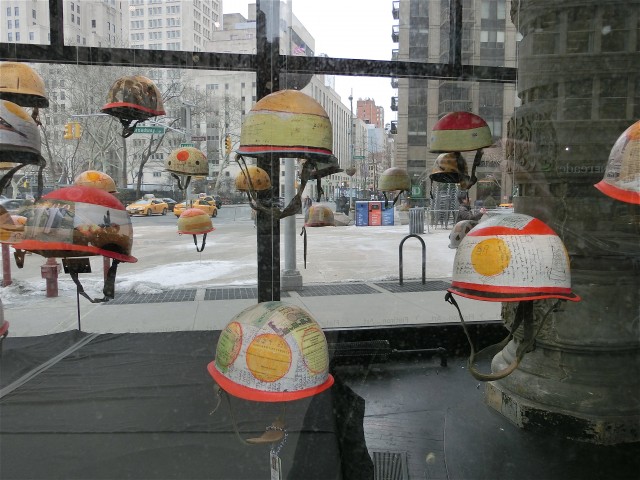
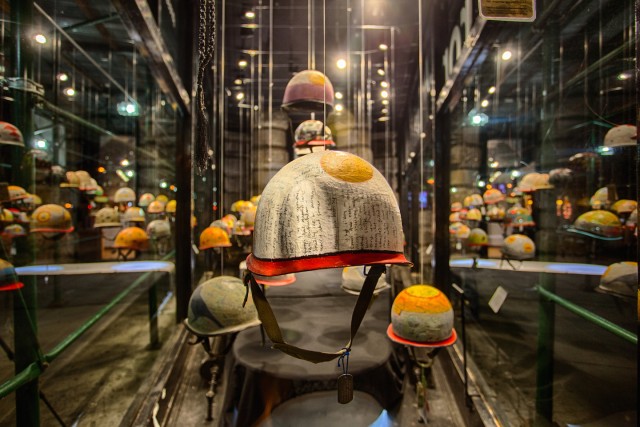
Although hats were often featured in the nineteenth-century shop windows of Fifth Avenue’s fashionable Ladies Mile, a different kind of headgear is on display there now. In 2008, visual artist Cindy Kane began creating collages on fifty used Vietnam War-era military helmets she purchased online. She contacted journalists who had covered international conflicts, asking them to contribute items from their reporting. Kane, who is based in Martha’s Vineyard, then took the objects — handwritten notes, photographs, press badges, foreign currency, e-mail exchanges, airline tickets, Band-Aids, expense bills, and other memorabilia — and layered them, decoupage-style, onto the helmets, each one dedicated to an individual journalist. The Helmet Project, which was first seen in a different iteration in New York City in 2009, has been transformed into “Eyes on the Ground — Journals of War,” a powerful exhibition extended through April 15 at the Sprint Prow Art Space in the Flatiron Building. The triangular street-level glass-walled gallery, pointing north on the corner of Twenty-Third St. and Broadway, contains the fifty helmets hanging from the ceiling at varying levels, paying tribute to the men and women who risk their lives to reveal the truth behind what is happening in battles around the world, from Iran, Iraq, and Afghanistan to El Salvador, Bosnia, and Democratic Republic of Congo, from the Balkans, Israel, and Russia to the Sudan, Libya, and New York City in September 2001. Curated by Cheryl McGinnis, the installation is a poignant reminder of the importance of a free press and the dangers these award-winning journalists face every day. Among the participants, many of whom have won Pulitzers in addition to other prestigious prizes, are Geraldine Brooks, Chris Hedges, Jeri Laber, Ward Just, Martha Raddatz, Steve Mumford, Deborah Amos, Scott Simon, Lynsey Addario, Nelson Bryant (who parachuted into Normandy on D-Day), and Anthony Shadid, the Washington Post Middle East correspondent who died from an asthma attack in 2012 while trying to leave Syria.

Award-winning journalist Chris Hedges is among fifty reporters contributing to Cindy Kane’s “Eyes on the Ground” exhibit (photo by Richard Kranzler / courtesy of Cheryl McGinnis Gallery)

Award-winning journalist Chris Hedges is among fifty reporters contributing to Cindy Kane’s “Eyes on the Ground” exhibit (photo by Richard Kranzler / courtesy of Cheryl McGinnis Gallery)

Hanging in the Prow Art Space, the helmets are unidentified, essentially representing all war journalists, but details about each reporter are included in the online site, including a short biography and what paraphernalia they contributed. Cairo-based McClatchy journalist Hannah Allam wrote to Kane, “Each item has a story,” while CBS News correspondent Kimberly Dozier explained, “It was harder than I thought to face gathering these.” Pulitzer Prize winner and bestselling author Brooks sums it all up with this statement: “The unexpected juxtaposition of an anonymous military helmet and deeply personal memorabilia provides a profound comment on the universality and the particularity of war. Each helmet, with its unique ephemera and calligraphy, offers an abbreviated portrait of an individual reporter; together, encircling the viewer, the Helmet Project becomes a monument to the hardships, the losses, and the absolute necessity of war reporting.”

STEPHEN PETRONIO COMPANY: BLOODLINES

Who: Stephen Petronio Company
What: “Bloodlines”
Where: Joyce Theater, 175 Eighth Ave. at 19th St., 212-691-9740
When: April 7-12, $10-$69
Why: Stephen Petronio Company concludes its thirtieth anniversary celebration with its annual season at the Joyce, kicking off its latest project, “Bloodlines,” a five-year initiative in which the company will perform works by other choreographers in addition to its namesake artistic director, starting with Merce Cunningham’s 1968 RainForest, featuring Andy Warhol’s “Silver Clouds,” costumes sliced by Jasper Johns, and a live score by David Tudor performed by John Driscoll, Phil Edelstein, Matt Rogalsky, and Stephan Moore. The program also includes the world premiere of Petronio’s Locomotor Non Locomotor, the follow-up to last year’s Locomotor; the new piece has music by hip-hop producer Clams Casino (who, coincidentally, released the EP Rainforest in 2011), costumes by Narciso Rodriguez, and vocal contributions by the Young People’s Chorus of New York City. (“Bloodlines,” which seeks to foster an artistic dialogue between paired works and choreographers, will continue with Trisha Brown’s Glacial Decoy and pieces by Anna Halprin, Lucinda Childs, and others. “Hanging with giants has its advantages to a mind in formation,” Petronio writes in his 2014 memoir, Confessions of a Motion Addict.) Former Merce Cunningham dancer Melissa Toogood will appear as a special guest, along with company members Davalois Fearon, Gino Grenek, Barrington Hinds, Jaqlin Medlock, Nicholas Sciscione, Emily Stone, and Joshua Tuason. Petronio will participate in a postperformance Curtain Chat following the April 9 show.