twi-ny recommended events

HUDSON RIVER DANCE FESTIVAL

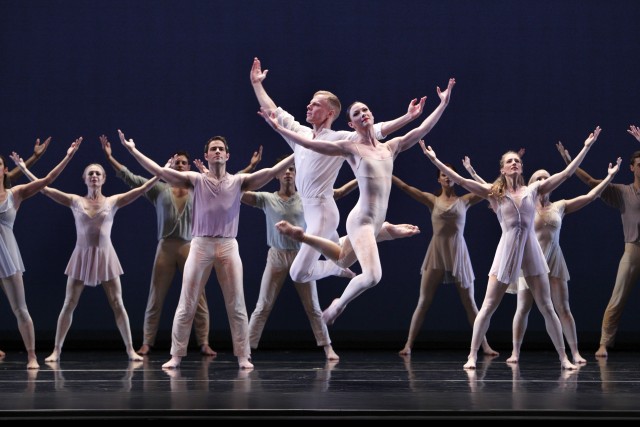
Paul Taylor Dance is one of three local companies performing at the free, inaugural Hudson Dance Festival this week (photo by Paul B. Goode)

Paul Taylor Dance is one of three local companies performing at the free, inaugural Hudson Dance Festival this week (photo by Paul B. Goode)

Who: Paul Taylor Dance Company, Parsons Dance, Ballet Hispanico
What: Hudson River Dance Festival
Where: Pier 63, Hudson River Park, cross at West 22nd & 24th Sts.
When: Wednesday, June 17, and Thursday, June 18, free, 6:30
Why: The inaugural Hudson River Dance Festival consists of three New York City companies presenting works for free outdoors on Pier 63 in Hudson River Park this week, two nights of modern movement featuring pieces by Paul Taylor Dance Company, Parsons Dance, and Ballet Hispanico. Attendees can bring blankets, but no chairs are allowed on the lawn.

THE SPOILS

(photo by Monique Carboni)

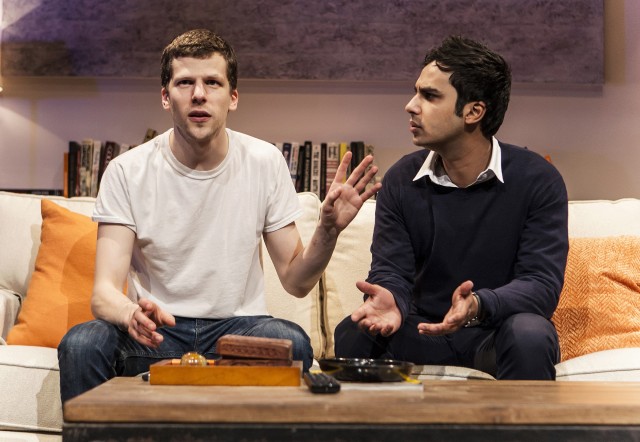
Ben (Jesse Eisenberg) shares his bitter thoughts on the state of the world with Kalyan (Kunal Nayyar) in THE SPOILS (photo by Monique Carboni)

The Pershing Square Signature Center
The Alice Griffin Jewel Box Theatre
480 West 42nd St. between Tenth & Eleventh Aves.
Tuesday – Sunday through June 28, $75-$95
212-244-7529
www.thenewgroup.org
www.signaturetheatre.org

In the second act of Jesse Eisenberg’s third play, The Spoils, Eisenberg, as the deeply troubled and extremely obnoxious Ben, says, “Did you think she was too mean? I’m struggling to figure out who our protagonist is. You can’t have a mean protagonist, but if they’re too perfect then they have nowhere to go. You know?” Yes, we know; Ben is referring to a woman in a documentary he is purportedly making, but he just as easily could be talking about himself, a nasty, confused, and confusing character who dishes out streams of sharp barbs and insensitive jokes. It is the third consecutive unlikable part that Eisenberg has written for himself for the stage, following Asuncion and The Revisionist. (He’s more likable in his film work: He was nominated for an Oscar for his portrayal of Facebook founder Mark Zuckerberg in The Social Network and has also starred in such underrated films as Adventureland and The Double.) Ben is a pot-smoking, jobless New Jersey Jew living in a New York City apartment with his roommate, Nepalese business student Kalyan (The Big Bang’s Kunal Nayyar). An all-around nice guy and good friend to Ben, Kalyan is dating Reshma (Annapurna Sriram), an Indian American doing her med school residency — and who can’t stand Ben. (Kalyan is based on a real-life Nepalese friend of Eisenberg’s who was in Indonesia during the recent earthquake and returned home to help with the disaster.) Ben’s slacker-like existence, supported by his parents’ money, turns when he bumps into an old grade school acquaintance, Ted (Michael Zegen of Boardwalk Empire and Rescue Me), a banker engaged to Ben’s first crush, the sweet, kind, and innocent Sarah (Erin Darke). Suddenly infused with a purpose in his life, Ben sets out to steal Sarah from Ted, but he is unaware of just how pathetic and unpleasant he really is.

(photo by Monique Carboni)

A group of friends apologize to the rest of the world for their supposed success in Jesse Eisenberg’s THE SPOILS (photo by Monique Carboni)

The Spoils opens with Kalyan showing Reshma a PowerPoint presentation he has created called “American Football: An Introduction to the Ballet of Brutality,” asking the questions “Is it appropriate to withhold knowledge from someone even if you think it might hurt them? Is it ethical to deny someone information, even if disclosing that information might hurt them?” Eisenberg’s play is also a ballet of brutality centered around the vitriolic Ben, who is haunted by dreams and memories that he can’t hold within himself. Eisenberg gives a whirling, energetic performance as Ben, words flowing out of him like Barry Sanders racing toward the goal line. Nayyar is much more calm and subdued as Kalyan, whose nature is to find the good in all people, including Ben. The New Group world premiere, in the Alice Griffin Jewel Box Theatre at the Signature Center, is ably directed by Scott Elliott, making good use of Derek McLane’s traditional living room/kitchen apartment set with a balcony; one nice touch is that Ben and Kalyan use a print of Jasper Johns’s “White Flag” as a screen for their PowerPoint and video projections, a very subtle reference to both surrender and the whitewashing of the American Dream. At one point in the play, the five characters are drinking Nepalese beer, and Ben calls for a special toast. We gotta say ‘Cheers’ in Nepali!” he proclaims. “I don’t think I ever said anything that would be an equivalent to ‘Cheers,’” Kalyan says. “I guess when we’re drinking, we don’t really feel a need to congratulate each other.” Ben ultimately decides that they “should apologize to the world. Because they’re toiling away while we get to sit here and drink. . . . A Nepalese Cheers: To all the pathetic f—s breaking their back while we drink this beautiful beer: I’m sorry!” It’s a funny moment that perhaps best represents the bubble they are all living in. But The Spoils still has a hard time getting past just how contentious and ill-natured Ben is, even when he begins to reveal his true self. He’s just not someone you’ll ever want to share a beer with.

A HUMAN BEING DIED THAT NIGHT

(photo by Richard Termine)

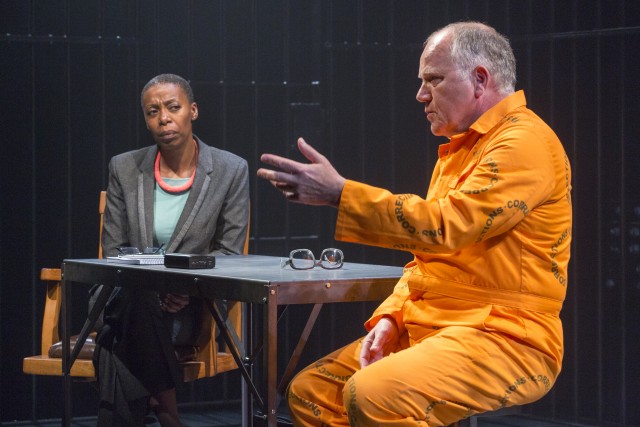
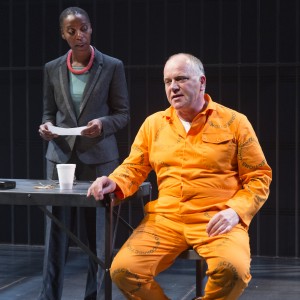
Pumla Gobodo-Madikizela (Noma Dumezweni) and Eugene de Kock (Matthew Marsh) discuss violence and murder, forgiveness and reconciliation in A HUMAN BEING DIED THAT NIGHT (photo by Richard Termine)

BAM Fisher, Fishman Space
321 Ashland Pl.
Tuesday-Sunday through June 21, $65
718-636-4100
www.bam.org

Near the beginning of Nicholas Wright’s sharp, powerful A Human Being Died That Night, inmate Eugene de Kock (Matthew Marsh) asks psychologist Pumla Gobodo-Madikizela (Noma Dumezweni), “Does this set-up that you’re looking at now make you think of a certain film?” It’s a question meant for the audience too, who are thinking the same thing as de Kock continues, “With Jodie Foster and Sir Anthony Hopkins? . . . Well, that’s what they think I am.” Set in a prison where de Kock is serving two life sentences plus 212 years for committing political crimes against black South Africans, earning the nickname “Prime Evil” for his involvement in numerous cold-blooded murders, A Human Being Died That Night instantly recalls Jonathan Demme’s The Silence of the Lambs; Marsh’s erudite manner as de Kock even mimics Hopkins’s portrayal of Hannibal the Cannibal. But there are two primary differences: First, de Kock is a real person, and his story is true. Second, where the fictional Hannibal Lecter reveled in his deeds, de Kock is exploring forgiveness and repentance. Based on Gobodo-Madikizela’s book, which details her meetings with de Kock in Pretoria Central Prison, the play takes place inside a prison cell (designed by Paul Wills), with Gobodo-Madikizela, who served on Nelson Mandela’s Truth and Reconciliation Commission, on one side of a rectangular table, de Kock, in leg irons that limit his movement, on the other. Over the course of eighty minutes, they discuss the nature of his killings, which included a public bombing, his victims and their families, and his fellow policemen, particularly his superiors, who gave him his orders but have paid no consequences. Gobodo-Madikizela is not interviewing de Kock in an official capacity but for her own personal and professional studies, although she does not want to get too close to him. “There’s a line that I don’t want to cross,” she explains, to which he responds, “You want to understand me, but you don’t want to cross a line? Isn’t that making things unnecessarily difficult for yourself?” But she is shocked when she suddenly does cross that line, leading the way to deeply intimate revelations.

(photo by Richard Termine)

Nicholas Wright’s play offers a different look at apartheid (photo by Richard Termine)

Originally staged by Cape Town’s Fugard Theatre, A Human Being Died That Night is a riveting exploration of forgiveness and reconciliation. Olivier Award winner Dumezweni (A Raisin in the Sun, The Bogus Woman) and Marsh (Proof, The Last of the Haussmans) are mesmerizing as their characters warm to each other and reach unforeseen conclusions. Director Jonathan Munby, a veteran of many a Shakespeare production at theaters around the world, maintains a tense calm throughout that is heightened by a moment that frightens Gobodo-Madikizela; meanwhile, the sound of de Kock’s rattling chains are occasionally heard, a reminder of what he has done, even as he speaks eloquently about what’s in his heart. In the latter part of the play, the two characters switch sides of the table, de Kock no longer tethered to his spot, as if each is now in the other’s shoes, offering a different perspective on what comes next. Haunting and harrowing yet with a gentle soul, A Human Being Died That Night is especially relevant given America’s reaction to the Boston Marathon bomber, with calls for his execution coming from even those who are usually against the death penalty. Meanwhile, in January of this year, de Kock was granted parole. The play will have you looking inside yourself, examining your own views on forgiveness and reconciliation, empathy and compassion, and the nature of good and evil, whether in relation to a mass murderer or a more personal and private matter. And you might be surprised what you learn about yourself.

NORTHSIDE FESTIVAL 2015: THE KITE APP

Kite introduces its app at Northside Innovation Conference and Expo party at the Counting Room (photo by twi-ny/ees)

Kite introduces its app at Northside Innovation Conference and Expo party at the Counting Room (photo by twi-ny/ees)

The Northside Festival is known for music, but its Innovation Conference and Expo is shaping up on a SXSW model. Thursday’s launch party for the Kite social news feed app was packed, and Kite founder Trond Werner Hansen was on hand to give twi-ny an interview and insight into what Kite is all about. An app for Mac devices (downloadable on the App Store), Kite lets users read and share articles from any website. They can also follow other users to see what sites they read and share so each person’s news feed is socially curated. Users can follow other users who share content they like, just as they do on Instagram, but they’ll see news articles rather than photos. Kite is also a browser that can go to any website, so users can build whatever kind of feed they like — it’s not limited by who’s signed on to Kite — or who’s paid to be there. On the hot summer street corner of Berry and North Eleventh, twi-ny asked Trond — a tall, amiable Norwegian who lives in Bushwick and is well known for his work developing browser software for Mozilla and others: “Why Kite?” He gave three reasons:

Screenshot of sites Trond follows via Kite — and you can too

Screenshot of sites Trond follows via Kite — and you can too

1) The Open Web. As a content platform, until now we have taken that for granted, but in the fall Apple is launching Apple News, and then you don’t have an open free platform anymore. Now they don’t have that control, but we don’t even want to go in that direction.

2) Convenience. You know people are starting to be pushed to individual apps — the CNN app, the New York Times app — and that’s just not the best way for the user. [News sites] should focus on making great content, not on making apps. Kite brings all sources into one container, but when you go to each of them, you go to their direct website, so they control their own thing, but they’re contained within one user experience, so that’s better for the user.

3) The social aspect. We’ve seen now that social curation of content works. I want to read what you read. So there’s two ways of curation: There’s the old-fashioned way — you go to CNN to see what kind of information they have curated for you, that works, and now we have the social curation that works, and Kite brings those two things together, kind of like the yin to the yang. And we also believe while Twitter, Facebook, LinkedIn, or these other social networks cater to sharing, they were not specifically made for content sharing. For example, on Kite I can go on your profile and see what kind of curation comes to you. You can’t do that on Facebook.

“I’ve learned through doing the web browser for so many years that algorithmic curation of things generally doesn’t work over scale over time,” Trond added. “Social curation works; brand curation works. But not algorithmic curation. I like food, so then I’m gonna get food articles. It’s unpredictable. . . . Engineers love to do algorithmic things, because that’s what they can do with their machines. ‘Look, you enter cheese, you can get a lot of articles about cheese!’ But it’s not really valuable or interesting. You can see on the Kite app, when you click another person, you can see his feed and his sites, what he reads. It’s useful, it’s predictable, it’s not algorithmic.”

We clicked on Trond’s feed and it’s fascinating. Try Kite and save some screen space — no need to clutter your iPhone with separate apps from CNN, WSJ, NYT, BBC, Guardian, Economist, etc. ThisWeekInNewYork is starting a Kite feed now, and curious readers can download the app for free on the App Store; during the festival, which continues through June 14 and has a terrific app of its own, you can use the invite code: northside.

JOAN OF ARC AT THE STAKE

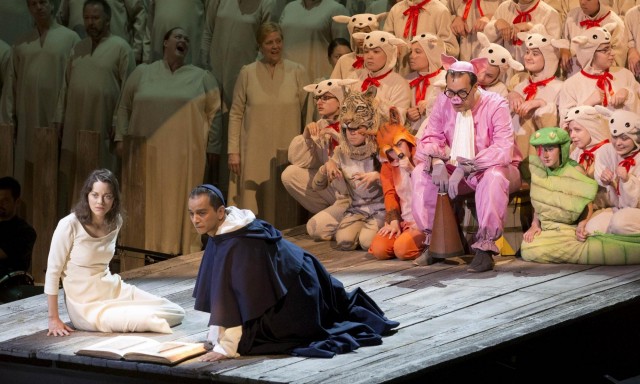
Joan of Arc (Marion Cotillard) and Brother Dominique (Éric Génovèse) contemplate her fate as the stake awaits (photo by Startraks Photo/Rex Shutterstock)

Joan of Arc (Marion Cotillard) and Brother Dominique (Éric Génovèse) contemplate her fate as the stake awaits (photo by Startraks Photo/Rex Shutterstock)

Who: Actors Marion Cotillard, Éric Génovèse, and Christian Gonon, the New York Choral Artists, the Brooklyn Youth Chorus, conductor Alan Gilbert, the New York Philharmonic, and others
What: Honegger’s Joan of Arc at the Stake
Where: Avery Fisher Hall, 10 Lincoln Center Plaza, 212-875-5030
When: Saturday, June 13, $50-$164, 8:00
Why: Director Côme de Bellescize’s concert staging of Swiss composer Arthur Honegger’s 1935 oratorio Joan of Arc at the Stake might occasionally be more than a bit head-scratching (a court of adults and children in animal costumes?), but the music, conducted by Alan Gilbert, is glorious, with the Philharmonic joined by the New York Choral Artists, who hover in the back like an angelic jury, and the Brooklyn Youth Chorus, composed of children in a dazzling spectrum of outfits. Oscar-winning actress Marion Cotillard (La Vie en Rose) stars as Joan of Arc, the fifteenth-century French nationalist heroine who is accused of being a witch and a heretic. The production works best when Joan and Brother Dominique (Éric Génovèse) examine her life and fate, on a central wooden rectangular stage featuring a threatening stake in front of hellish red lighting. Other standouts include Faith Sherman as Catherine and Simone Osborne as Marguerite. The eighty-minute presentation is divided into a prologue followed by eleven scenes, with such titles as “The Voices of Heaven,” “Joan Given Up to the Beasts,” and “The Sword of Joan,” leading to a powerful, emotional conclusion.

HUMAN RIGHTS WATCH FILM FESTIVAL 2015: THE LOOK OF SILENCE

THE LOOK OF SILENCE

Joshua Oppenheimer’s THE LOOK OF SILENCE stares directly into the eyes of perpetrators of genocide in Indonesia

THE LOOK OF SILENCE (Joshua Oppenheimer, 2014)
IFC Center
323 Sixth Ave. at West Third St.
Saturday, June 13, $14, 9:15
Festival runs June 11-21 at multiple venues
ff.hrw.org/new-york
thelookofsilence.com

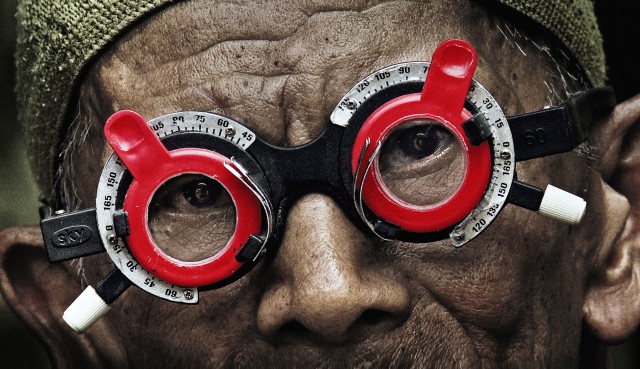
Joshua Oppenheimer’s The Look of Silence opens with an old man, wearing a pair of red optic trial lens frames, gazing into and around the camera for twelve uncomfortable seconds, in complete silence, showing no emotion. It is a striking metaphor for the rest of the film, a shocking documentary about the 1965–66 Indonesian genocide and a bold man determined to confront the men who brutally murdered his brother then, along with a million other supposed communists. In 2012, Oppenheimer made the Oscar-nominated The Act of Killing, in which the leaders of the genocide, who are still in power today, restaged their killings as if they were Hollywood movie scenes. Created as a companion piece to that documentary, The Look of Silence follows forty-four-year-old optometrist Adi as he learns the details of what happened to his brother, Ramli, who was butchered two years before Adi was born. Adi has decided to do what no one else in his country will: break his culture’s silence and denial and face the perpetrators to make them take responsibility for what they did. If they are willing to show remorse, he is willing to forgive. But he has set out on what appears to be an impossible mission; the men he meets with still run Indonesia, and they are more than comfortable threatening the well-being of Adi and his family. Meanwhile, Adi’s parents and patients don’t want to talk about what occurred back in 1965–66, or what is still going on today, as they live in fear of these same men. “No, nothing happened,” one woman says when asked about the killings in her town of Aceh. “You ask too many questions,” she adds. Kemat, a survivor of the Snake River massacres, says, “The past is the past. I’ve accepted it. I don’t want to remember. It’s just asking for trouble.” Adi learns horrifying details as he meets with village death squad leader Inong (the old man shown at the beginning of the film), Snake River death squad commander Amir Siahaan, and regional legislature speaker M. Y. Basrun, all of whom defend their actions, and their power and wealth, while more than hinting that Adi should end his quest. But Adi isn’t about to back down.
THE LOOK OF SILENCE

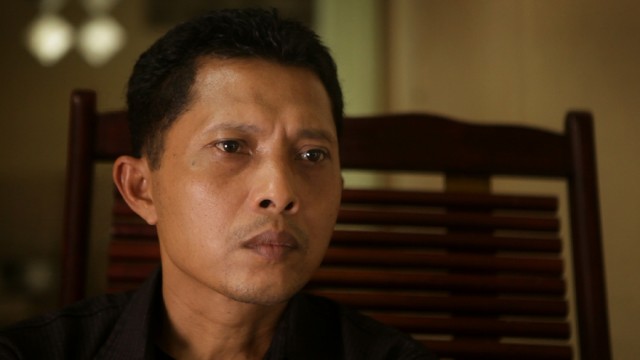
Adi faces a group of mass murders, including his brother’s killers, in powerful documentary

Adi is often shown in front of a television, mystified as Oppenheimer shows him footage taken for The Act of Killing; Adi stares ahead in disbelief and silence, much like we did when watching the final film, amazed at what we were seeing. It is a fascinating coincidence that Adi is an optometrist, going around his community fitting people for glasses, helping them see better, even if they don’t always want to look at certain things. He is appalled that his children’s school still teaches that the evil communists deserved to die; it’s particularly telling when his young daughter playfully puts on two pairs of glasses, as if perhaps the next generation will not look away — and to emphasize that, Oppenheimer cuts directly to Adi’s aging, decrepit father, Rukun (whom his wife, Adi’s mother, Rohani, claims is 140), his eyes closed, as he can barely see or hear anymore and needs to be taken care of like a baby. Adi has become a folk hero in Indonesia, where some regions have banned the film and screenings had to be canceled because of threats of violence from the police and military. But the film itself depicts Adi as an everyman; he could be any one of us, saying the things that need to be said. “Making any film about survivors of genocide is to walk into a minefield of clichés, most of which serve to create a heroic (if saintly) protagonist with whom we can identify, thereby offering the false reassurance that, in the moral catastrophe of atrocity, we are nothing like the perpetrators,” Oppenheimer (The Globalisation Tapes) writes in his extensive, must-read notes on the film’s official website. “But presenting survivors as saintly in order to reassure ourselves that we are good is to use survivors to deceive ourselves. It is an insult to survivors’ experience, and does nothing to help us understand what it means to survive atrocity, what it means to live a life shattered by mass violence, and to be silenced by terror. To navigate this minefield of clichés, we have had to explore silence itself.” In that way, to use a cliché, The Look of Silence speaks volumes. And although it’s specifically about the Indonesian genocide, it could just as easily be made about many other mass murders that have occurred, and are still going on, around the world.

Adi might be receiving long standing ovations at screenings where he appears, but it’s telling that the film’s closing credits include more than two dozen people listed as “Anonymous,” from the codirector and a coproducer to a camera operator and production managers. Clearly, fear still rules in Indonesia. An unforgettable film that needs to be widely seen, The Look of Silence, which was executive produced by Werner Herzog, Errol Morris, and André Singer, is screening June 13 at 9:15 at the IFC Center as part of the Human Rights Watch Film Festival and will be followed by a discussion with journalist Antonius Made Tony Supriatma and Human Rights Watch Asia division deputy director Phelim Kine. (The film will open theatrically in New York City on July 17 at the Landmark Sunshine.) The HRW festival runs through June 21 at IFC, the Film Society of Lincoln Center, and the Times Center, featuring such other socially, culturally, and politically sensitive and important works as Stanley Nelson’s The Black Panthers: Vanguard of the Revolution, Joey Boink’s Burden of Peace, François Verster’s The Dream of Shahrazad, and Tamara Erde’s This Is My Land.
BIG APPLE BARBECUE BLOCK PARTY 2015

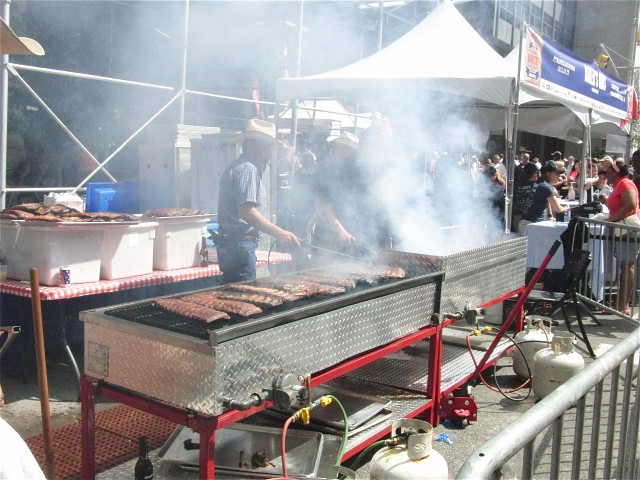
There’s plenty of smokin’ good ’cue at annual BBQ Block Party in Madison Square Park (photo by twi-ny/mdr)

There’s plenty of smokin’ good ’cue at annual BBQ block party in Madison Square Park (photo by twi-ny/mdr)

Madison Square Park
23rd to 26th Sts. between Fifth & Madison Aves.
Saturday, June 13, and Sunday, June 14, 11:00 am – 6:00 pm
Admission: free; $9-$12 per plate of barbecue
Fast Pass: $125; BigPiggin’ Pass: $265
www.bigapplebbq.org
www.madisonsquarepark.org

The immensely popular and ridiculously crowded Big Apple Barbecue Block Party is upon us, as pitmasters from around the country gather in Madison Square Park and serve up some damn fine BBQ. The thirteenth annual event, being held June 13-14, features some old favorites as well as some up-and-comers: Mike Mills of the 17th Street Bar & Grill (Murphysboro, Illinois; baby back ribs with baked beans), Tim Love (the Woodshed Smokehouse, Dallas/Ft. Worth; lamb brisket with borracho beans), Chris Lilly of Big Bob Gibson Bar-B-Q (Decatur, Alabama; pulled pork sandwich with spicy mustard coleslaw), Mike Emerson of Pappy’s Smokehouse (St. Louis; baby back ribs with baked beans), Jimmy Hagood of BlackJack Barbecue (Charleston, South Carolina; pulled pork with coleslaw), Wayne Mueller of Louie Mueller Barbecue (Taylor, Texas; Texas beef rib with pickled southern vegetables), Patrick Martin of Martin’s Bar-B-Que Joint (Nashville; Western Tennessee whole hog sandwich with coleslaw), Garry Roark of Ubon’s Barbeque of Yazoo (Yazoo City, Mississippi; pulled pork shoulder sandwich with coleslaw), Scott Roberts of the Salt Lick Bar-B-Que (Driftwood, Texas; beef brisket, sausage, and coleslaw), Brad Orrison of the Shed Barbeque & Blues Joint (Ocean Springs, Mississippi; pulled whole hog sandwich with baked beans), John Wheeler of Memphis Barbecue Co. (Horn Lake, Mississippi; baby back ribs with baked beans), Drew Robinson of Jim N’ Nick’s Bar-B-Que (Birmingham, Alabama; smoked pork hot links with pimento cheese), Samuel Jones of the Skylight Inn (Ayden, North Carolina; chopped whole hog sandwich with coleslaw), and local purveyors Jean-Paul Bourgeois of Blue Smoke (pork spare ribs with pickled peppers), Charles Grund Jr. of Hill Country (beef brisket sandwich with sweet and spicy pickles), John Stage of Dinosaur Bar-B-Que (beef brisket with BBQ beans), and Bill Durney of Hometown Bar-B-Que (Jamaican jerk St. Louis ribs with Caribbean slaw). The lines can get extremely long, so the best way to enjoy the event is to go with a bunch of friends, get on different lines, and then gather somewhere in the park to devour your meal (while also checking out Teresita Fernandez’s new mirrored installation, “Fata Morgana”). Each plate of ’cue will run you between nine and twelve bucks, with desserts from Sugaree’s and Robicelli’s. The FastPass is no more, so if you want to go VIP, you need to pick up the BigPiggin’ Pass, where for $275 you get your food brought to you in the comfort of the hospitality tent. Saturday’s music lineup consists of the Reed Turner Band at 1:00, Shook Twins at 2:45, and Andrew Combs at 4:30, while Sunday’s is Whiskey Shivers at 1:00, Nikki Lane at 2:45, and Jonny Fritz at 4:30.