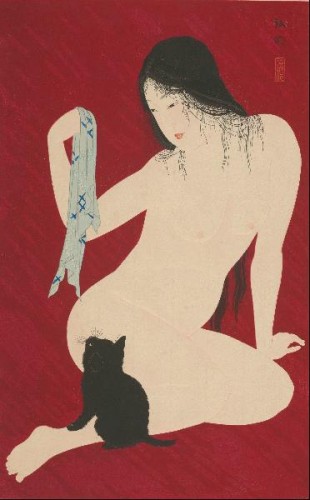
Takahashi Hiroaki (Shotei), “Nude Playing with a Cat,” color woodblock print, ca. 1927-30 (courtesy Private Collection, New York and Tokyo)
Japan Society
333 East 47th St. at First Ave.
Through Sunday, June 7, $12 (free Friday 6:00 – 9:00)
212-715-1258
www.japansociety.org
“Whenever I write a novel, music just sort of naturally slips in (much like cats do, I suppose),” Japanese novelist Haruki Murakami said in an interview about his 2002 book, Kafka on the Shore, which features a character who has a rather unique rapport with felines. (It’s not a coincidence that we named one of our cats Haruki.) Japan’s relationship with cats goes back some fifteen hundred years, when it is believed that cats came to the islands on ships carrying Buddhist scriptures from China. Cats do more than just naturally slip in in the Japan Society exhibit “Life of Cats: Selections from the Hiraki Ukiyo-e Collection,” a claw-some gathering of more than 120 color woodblock prints, hanging scrolls, paintings, and sculptures. Each work contains a cat in one form or another, sometimes hovering in the background, other times front and center, for both good and evil purposes. Dating from the Edo Period (1615-1867), the works are divided into five groups: “Cats and People,” “Cats as People,” “Cats versus People,” “Cats Transformed,” and “Cats and Play,” depicting the diverse relationship between humans and felines. “A cat is just a cat, but the cat motif contains many nuances and connotations,” the catalog points out, and indeed, the nuances and connotations are many in the exhibition. Sometimes the cat is hovering in the background, barely visible, or on the pattern of a kimono, while at other times it’s front and center, providing loving warmth or performing a dastardly dance of death. People become anthropomorphized cats, with claws, whiskers, and not-so-cute ears. Housecats turn into demonic figures, while tigers and lions lurk threateningly. A cat sits on a man’s back or cuddles at a woman’s neck. Some works are tantalizing and sexy, like Takashi Hiroaki’s “Nude Playing with a Cat,” while others, known as omocha-e, or “toy pictures,” provide moral lessons for children, like “Newly Published Scenes of Good and Evil Cats,” by an unknown artist. There are works by Utagawa Kuniyoshi, Kanagaki Robun, Utagawa Hiroshige, Kitagawa Utamaro, Utagawa Kunisada, Katsushika Hokusai, and even Édouard Manet, depicting cats in a multitude of ways, not always as adorable as they are in online videos. (If you saw the show prior to the end of April, you might want to go back, as nearly fifty pieces were rotated in on April 29.) Essentially, the exhibition reveals what we already know: that cats rule, and there’s nothing you can do about it.


 Three-time loser Skip McCoy (Richard Widmark) gets more than he bargained for when he lifts femme fatale Candy’s (Jean Peters) wallet on the subway, landing him in trouble with mysterious Joey (Richard Kiley) and the Feds in Samuel Fuller’s fab Cold War noir set in New York City. “If you refuse to cooperate, you’ll be as guilty as the traitors that gave Stalin the A bomb,” the cops tell him, to which Skip classically replies, “Are you waving the flag at me?” Widmark is almost too good as Skip, a suave pickpocket who lives under the Brooklyn Bridge in an old bait and tackle shack. Sure, it gets a little melodramatic at the end, which comes too soon (the film is only eighty minutes long), but it’s worth every minute nonetheless. And yes, that is Brooklyn’s own Thelma Ritter as the curious little lady who sells ties for information, earning her fourth consecutive Oscar nomination for Best Supporting Actress. One of Fuller’s best, Pickup on South Street is screening at Film Forum in a new 4K restoration May 29 to June 4.