twi-ny recommended events

JOAN OF ARC AT THE STAKE

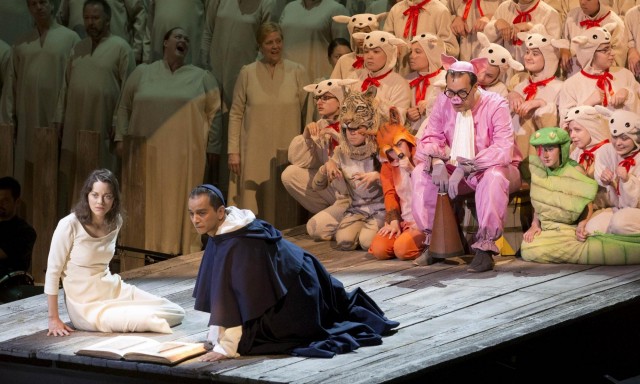
Joan of Arc (Marion Cotillard) and Brother Dominique (Éric Génovèse) contemplate her fate as the stake awaits (photo by Startraks Photo/Rex Shutterstock)

Joan of Arc (Marion Cotillard) and Brother Dominique (Éric Génovèse) contemplate her fate as the stake awaits (photo by Startraks Photo/Rex Shutterstock)

Who: Actors Marion Cotillard, Éric Génovèse, and Christian Gonon, the New York Choral Artists, the Brooklyn Youth Chorus, conductor Alan Gilbert, the New York Philharmonic, and others
What: Honegger’s Joan of Arc at the Stake
Where: Avery Fisher Hall, 10 Lincoln Center Plaza, 212-875-5030
When: Saturday, June 13, $50-$164, 8:00
Why: Director Côme de Bellescize’s concert staging of Swiss composer Arthur Honegger’s 1935 oratorio Joan of Arc at the Stake might occasionally be more than a bit head-scratching (a court of adults and children in animal costumes?), but the music, conducted by Alan Gilbert, is glorious, with the Philharmonic joined by the New York Choral Artists, who hover in the back like an angelic jury, and the Brooklyn Youth Chorus, composed of children in a dazzling spectrum of outfits. Oscar-winning actress Marion Cotillard (La Vie en Rose) stars as Joan of Arc, the fifteenth-century French nationalist heroine who is accused of being a witch and a heretic. The production works best when Joan and Brother Dominique (Éric Génovèse) examine her life and fate, on a central wooden rectangular stage featuring a threatening stake in front of hellish red lighting. Other standouts include Faith Sherman as Catherine and Simone Osborne as Marguerite. The eighty-minute presentation is divided into a prologue followed by eleven scenes, with such titles as “The Voices of Heaven,” “Joan Given Up to the Beasts,” and “The Sword of Joan,” leading to a powerful, emotional conclusion.

HUMAN RIGHTS WATCH FILM FESTIVAL 2015: THE LOOK OF SILENCE

THE LOOK OF SILENCE

Joshua Oppenheimer’s THE LOOK OF SILENCE stares directly into the eyes of perpetrators of genocide in Indonesia

THE LOOK OF SILENCE (Joshua Oppenheimer, 2014)
IFC Center
323 Sixth Ave. at West Third St.
Saturday, June 13, $14, 9:15
Festival runs June 11-21 at multiple venues
ff.hrw.org/new-york
thelookofsilence.com

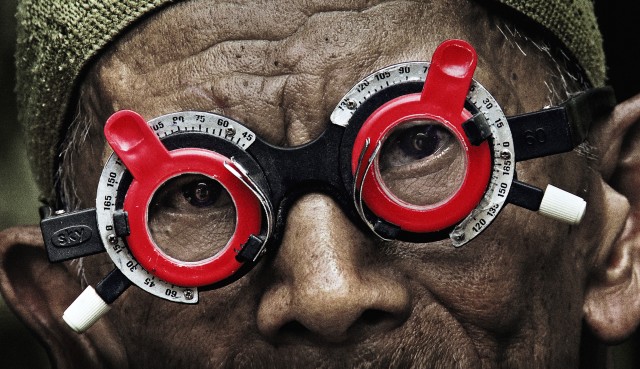
Joshua Oppenheimer’s The Look of Silence opens with an old man, wearing a pair of red optic trial lens frames, gazing into and around the camera for twelve uncomfortable seconds, in complete silence, showing no emotion. It is a striking metaphor for the rest of the film, a shocking documentary about the 1965–66 Indonesian genocide and a bold man determined to confront the men who brutally murdered his brother then, along with a million other supposed communists. In 2012, Oppenheimer made the Oscar-nominated The Act of Killing, in which the leaders of the genocide, who are still in power today, restaged their killings as if they were Hollywood movie scenes. Created as a companion piece to that documentary, The Look of Silence follows forty-four-year-old optometrist Adi as he learns the details of what happened to his brother, Ramli, who was butchered two years before Adi was born. Adi has decided to do what no one else in his country will: break his culture’s silence and denial and face the perpetrators to make them take responsibility for what they did. If they are willing to show remorse, he is willing to forgive. But he has set out on what appears to be an impossible mission; the men he meets with still run Indonesia, and they are more than comfortable threatening the well-being of Adi and his family. Meanwhile, Adi’s parents and patients don’t want to talk about what occurred back in 1965–66, or what is still going on today, as they live in fear of these same men. “No, nothing happened,” one woman says when asked about the killings in her town of Aceh. “You ask too many questions,” she adds. Kemat, a survivor of the Snake River massacres, says, “The past is the past. I’ve accepted it. I don’t want to remember. It’s just asking for trouble.” Adi learns horrifying details as he meets with village death squad leader Inong (the old man shown at the beginning of the film), Snake River death squad commander Amir Siahaan, and regional legislature speaker M. Y. Basrun, all of whom defend their actions, and their power and wealth, while more than hinting that Adi should end his quest. But Adi isn’t about to back down.
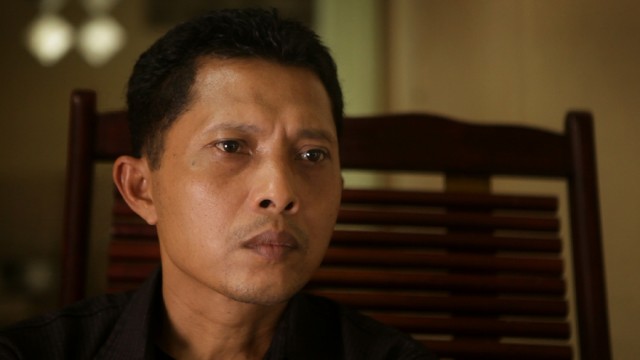
THE LOOK OF SILENCE

Adi faces a group of mass murders, including his brother’s killers, in powerful documentary

Adi is often shown in front of a television, mystified as Oppenheimer shows him footage taken for The Act of Killing; Adi stares ahead in disbelief and silence, much like we did when watching the final film, amazed at what we were seeing. It is a fascinating coincidence that Adi is an optometrist, going around his community fitting people for glasses, helping them see better, even if they don’t always want to look at certain things. He is appalled that his children’s school still teaches that the evil communists deserved to die; it’s particularly telling when his young daughter playfully puts on two pairs of glasses, as if perhaps the next generation will not look away — and to emphasize that, Oppenheimer cuts directly to Adi’s aging, decrepit father, Rukun (whom his wife, Adi’s mother, Rohani, claims is 140), his eyes closed, as he can barely see or hear anymore and needs to be taken care of like a baby. Adi has become a folk hero in Indonesia, where some regions have banned the film and screenings had to be canceled because of threats of violence from the police and military. But the film itself depicts Adi as an everyman; he could be any one of us, saying the things that need to be said. “Making any film about survivors of genocide is to walk into a minefield of clichés, most of which serve to create a heroic (if saintly) protagonist with whom we can identify, thereby offering the false reassurance that, in the moral catastrophe of atrocity, we are nothing like the perpetrators,” Oppenheimer (The Globalisation Tapes) writes in his extensive, must-read notes on the film’s official website. “But presenting survivors as saintly in order to reassure ourselves that we are good is to use survivors to deceive ourselves. It is an insult to survivors’ experience, and does nothing to help us understand what it means to survive atrocity, what it means to live a life shattered by mass violence, and to be silenced by terror. To navigate this minefield of clichés, we have had to explore silence itself.” In that way, to use a cliché, The Look of Silence speaks volumes. And although it’s specifically about the Indonesian genocide, it could just as easily be made about many other mass murders that have occurred, and are still going on, around the world.

Adi might be receiving long standing ovations at screenings where he appears, but it’s telling that the film’s closing credits include more than two dozen people listed as “Anonymous,” from the codirector and a coproducer to a camera operator and production managers. Clearly, fear still rules in Indonesia. An unforgettable film that needs to be widely seen, The Look of Silence, which was executive produced by Werner Herzog, Errol Morris, and André Singer, is screening June 13 at 9:15 at the IFC Center as part of the Human Rights Watch Film Festival and will be followed by a discussion with journalist Antonius Made Tony Supriatma and Human Rights Watch Asia division deputy director Phelim Kine. (The film will open theatrically in New York City on July 17 at the Landmark Sunshine.) The HRW festival runs through June 21 at IFC, the Film Society of Lincoln Center, and the Times Center, featuring such other socially, culturally, and politically sensitive and important works as Stanley Nelson’s The Black Panthers: Vanguard of the Revolution, Joey Boink’s Burden of Peace, François Verster’s The Dream of Shahrazad, and Tamara Erde’s This Is My Land.
BIG APPLE BARBECUE BLOCK PARTY 2015

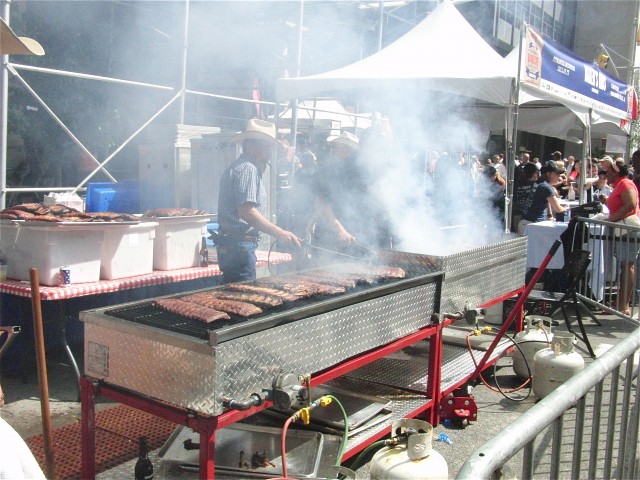
There’s plenty of smokin’ good ’cue at annual BBQ Block Party in Madison Square Park (photo by twi-ny/mdr)

There’s plenty of smokin’ good ’cue at annual BBQ block party in Madison Square Park (photo by twi-ny/mdr)

Madison Square Park
23rd to 26th Sts. between Fifth & Madison Aves.
Saturday, June 13, and Sunday, June 14, 11:00 am – 6:00 pm
Admission: free; $9-$12 per plate of barbecue
Fast Pass: $125; BigPiggin’ Pass: $265
www.bigapplebbq.org
www.madisonsquarepark.org

The immensely popular and ridiculously crowded Big Apple Barbecue Block Party is upon us, as pitmasters from around the country gather in Madison Square Park and serve up some damn fine BBQ. The thirteenth annual event, being held June 13-14, features some old favorites as well as some up-and-comers: Mike Mills of the 17th Street Bar & Grill (Murphysboro, Illinois; baby back ribs with baked beans), Tim Love (the Woodshed Smokehouse, Dallas/Ft. Worth; lamb brisket with borracho beans), Chris Lilly of Big Bob Gibson Bar-B-Q (Decatur, Alabama; pulled pork sandwich with spicy mustard coleslaw), Mike Emerson of Pappy’s Smokehouse (St. Louis; baby back ribs with baked beans), Jimmy Hagood of BlackJack Barbecue (Charleston, South Carolina; pulled pork with coleslaw), Wayne Mueller of Louie Mueller Barbecue (Taylor, Texas; Texas beef rib with pickled southern vegetables), Patrick Martin of Martin’s Bar-B-Que Joint (Nashville; Western Tennessee whole hog sandwich with coleslaw), Garry Roark of Ubon’s Barbeque of Yazoo (Yazoo City, Mississippi; pulled pork shoulder sandwich with coleslaw), Scott Roberts of the Salt Lick Bar-B-Que (Driftwood, Texas; beef brisket, sausage, and coleslaw), Brad Orrison of the Shed Barbeque & Blues Joint (Ocean Springs, Mississippi; pulled whole hog sandwich with baked beans), John Wheeler of Memphis Barbecue Co. (Horn Lake, Mississippi; baby back ribs with baked beans), Drew Robinson of Jim N’ Nick’s Bar-B-Que (Birmingham, Alabama; smoked pork hot links with pimento cheese), Samuel Jones of the Skylight Inn (Ayden, North Carolina; chopped whole hog sandwich with coleslaw), and local purveyors Jean-Paul Bourgeois of Blue Smoke (pork spare ribs with pickled peppers), Charles Grund Jr. of Hill Country (beef brisket sandwich with sweet and spicy pickles), John Stage of Dinosaur Bar-B-Que (beef brisket with BBQ beans), and Bill Durney of Hometown Bar-B-Que (Jamaican jerk St. Louis ribs with Caribbean slaw). The lines can get extremely long, so the best way to enjoy the event is to go with a bunch of friends, get on different lines, and then gather somewhere in the park to devour your meal (while also checking out Teresita Fernandez’s new mirrored installation, “Fata Morgana”). Each plate of ’cue will run you between nine and twelve bucks, with desserts from Sugaree’s and Robicelli’s. The FastPass is no more, so if you want to go VIP, you need to pick up the BigPiggin’ Pass, where for $275 you get your food brought to you in the comfort of the hospitality tent. Saturday’s music lineup consists of the Reed Turner Band at 1:00, Shook Twins at 2:45, and Andrew Combs at 4:30, while Sunday’s is Whiskey Shivers at 1:00, Nikki Lane at 2:45, and Jonny Fritz at 4:30.

THE YES MEN ARE REVOLTING

THE YES MEN ARE REVOLTING

Andy Bichlbaum and Mike Bonanno travel the world calling attention to climate change in THE YES MEN ARE REVOLTING

THE YES MEN ARE REVOLTING (Laura Nix & the Yes Men, 2014)
IFC Center
323 Sixth Ave. at West Third St.
June 12-25
212-924-7771
www.ifccenter.com
theyesmenarerevolting.com

Since 1999, culture-jamming pranksters Mike Bonanno (Igor Vamos) and Andy Bichlbaum (Jacques Servin) have been staging events to call attention to economic and environmental abuses perpetrated by big business and international governments, including Dow Chemical, the World Trade Organization, ExxonMobil, and BP. In their latest film, The Yes Men Are Revolting, the follow-up to 2003’s The Yes Men and 2009’s The Yes Men Fix the World, the daring, inventive activists find themselves facing a series of midlife crises, both personal and professional, particularly after one of their hoaxes goes embarrassingly awry. “Whenever we would do actions, I would always think, like, ‘This is the one that’s gonna change everything,’” a distraught Bichlbaum says in the film. “I would convince myself of that, and then afterwards there would be this huge depression, like, ‘Oh, we didn’t change everything.’” The action involving the presentation of a fake polar bear to an Amsterdam zoo might have failed, but it’s not long before Bonanno, who had moved to Scotland with his wife and children, and Bichlbaum, who was struggling to maintain a relationship with his boyfriend in New York City, are back together, fighting the good fight. The Yes Men Are Revolting follows the two men over the course of several years as they take on climate change, focusing on COP 15 and the partnership between Gazprom and Shell Oil, traveling from Zuccotti Park, Amsterdam, and Seattle to Uganda, Copenhagen, and Washington, DC, to call attention to the impact of Arctic drilling and polar ice cap melting on the future of the planet.
Laura Nix, who codirected the film with the Yes Men, goes behind the scenes as they construct their actions, hire actors to play media representatives and lobbyists, choose the wardrobe (and wigs), and build fake websites to help establish credibility. It’s amazing what they get away with and what people will believe — and it’s even funnier when they get caught (and sued). But at the heart of it all is a very real desire to, as their second film proclaimed, fix the world, while also maintaining their long friendship. The new movie begins with them on the Brooklyn shore, announcing the creation of the SurvivaBall, a ridiculous-looking giant costume that promises people protection from the elements “no matter what happens to the climate.” The Yes Men open the public’s eyes to so much infuriating corporate crime and corruption that you might just want to hide away in your own SurvivaBall, hoping and praying that things will get better. But don’t count on it. The Yes Men Are Revolting opens June 12 at the IFC Center, with the Friday-night screening part of the 2015 Human Rights Watch Film Festival, followed by a Q&A with Nix and the Yes Men, who on Thursday were in Columbus Circle, handing out free shaved-ice cones purportedly made from the melting polar ice cap. There will be a live video discussion with the Yes Men in person and Julian Assange after the 2:40 show on June 14, a Q&A with the Yes Men following the 8:25 shows on June 15 & 16, and a Q&A with editor Claire L. Chandler after the 8:25 screening on June 18.

NORTHSIDE FESTIVAL 2015 VIDEO OF THE DAY: “DAMN, GIRL” BY HEEMS

Who: Heems
What: Northside Festival International Showcase
Where: McCarren Park, North Twelfth St., Lorimer St., and Manhattan Ave. between Bayard St. and Berry St. and Nassau Ave.
When: Friday, June 12, free with RSVP, 8:30
Why: Queens native and Das Racist cofounder Himanshu “Heems” Suri has struck out on his own, touring behind his debut solo album, Eat Pray Thug, which was released in March in conjunction with a similarly titled art exhibition at Aicon Gallery. The politically tinged record, with a deep personal connection, features such tracks as “So NY,” “Flag Shopping,” “Hubba Hubba,” “Al Q8a,” “Suicide by Cop,” and “Patriot Act.” Heems is playing a free show with St. Grandson, Sevdaliza, Oy, Jacco Gardner, Irie Maffia, and the Very Best on June 12 in McCarren Park as part of the Northside Festival, which runs through June 14 in venues all over Brooklyn’s north side, featuring innovation speakers, panel discussions, and a trade-show expo June 11-12, music June 11-14, and art walks June 13-14; among the other bands performing on June 12 are Morello Twins at Cameo, Sons of an Illustrious Father at Muchmore’s, Vomitface at Pet Rescue, Walking Shapes at the Polish National Church, and Beach Fossils at Rough Trade.

NITEHAWK BRUNCH SCREENINGS: THE EPIC OF EVEREST

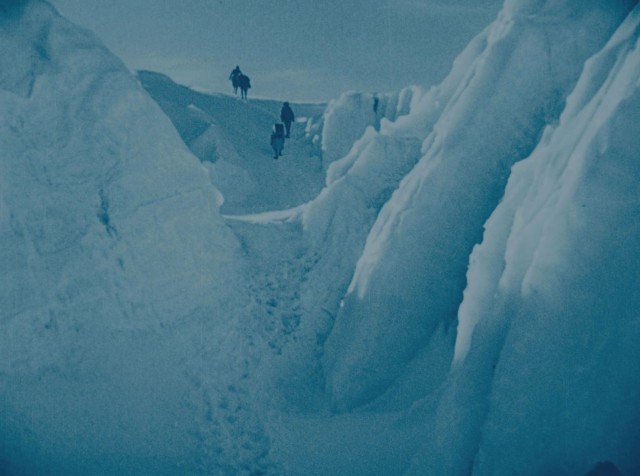
Striking document of 1924 attempt to climb Mount Everest has been restored by the British Film Institute

Striking document of 1924 attempt to climb Mount Everest has been restored by the British Film Institute

THE EPIC OF EVEREST (Captain John Noel, 1924)
Nitehawk Cinema
136 Metropolitan Ave. between Berry St. & Wythe Ave.
Saturday, June 13, and Sunday, June 14, 12 noon
718-384-3980
www.nitehawkcinema.com
www.bfi.org.uk

In 1924, two British men, among the most famous mountaineers of their time, George Mallory and Andrew “Sandy” Irvine, set out with a large team to climb to the summit of Everest. Their amazing journey was documented by Captain John Noel, who used a hand-cranked camera with an impressive telephoto lens and sent the footage via yak to a lab in Darjeeling to be developed. The resulting black-and-white film, The Epic of Everest, is a poetic document of the third attempt to scale Everest, a mountain the Tibetans called “Chomo-Lung-Ma,” or Goddess Mother of the World. The eighty-seven-minute silent film has been digitally restored by the British Film Institute in a beautiful version that made its New York premiere last fall at the Rubin Museum and next will be shown June 13-14 at the Nitehawk Cinema as part of its ongoing Brunch Screenings series. The Epic of Everest, which is also ethnographically important for its (at times ethnocentric) depiction of local Tibetan culture, includes several scenes of Mount Everest tinted in blue, red, and violet; the ice-blue Fairyland section is especially breathtaking. Meanwhile, the restored intertitles display such dramatic text as “There is nowhere here any trace of life or man. It is a glimpse into a world that knows him not. Grand, solemn, unutterably lonely, the Rongbuk Glacier of Everest reveals itself.” and “Nor can one wonder at the invention that has clothed this extraordinary peak with a sacred character. What a terrifying thing it is! What an immensity of size, height and power it possesses!”

Irvine and Mallory — the latter famously answered “Because it’s there” when asked why he wanted to climb Everest — are joined by Sherpas and donkeys; mountaineer and artist Howard Somervell, who is seen smoking a pipe while sketching in his notebook; Alpine climbers John de Vars Hazard and Edward Norton; mountaineer Geoffrey Bruce, who is described as “the Expedition’s right hand man”; and geologist Noel Odell as they attempt to do what no human had done before. The 4K restoration, done in collaboration with Noel’s daughter, Sandra, also features a haunting new score by Simon Fisher Turner that incorporates both Western and Nepalese sounds. The Epic of Everest is particularly fascinating when compared to such recent mountaineering adventures as K2: Siren of the Himalayas, revealing how little has changed, except technology, as fearless men and women seek to climb toward the heavens.

AFGHANISTAN, ZIMBABWE, AMERICA, KUWAIT

(photo © Joan Marcus)

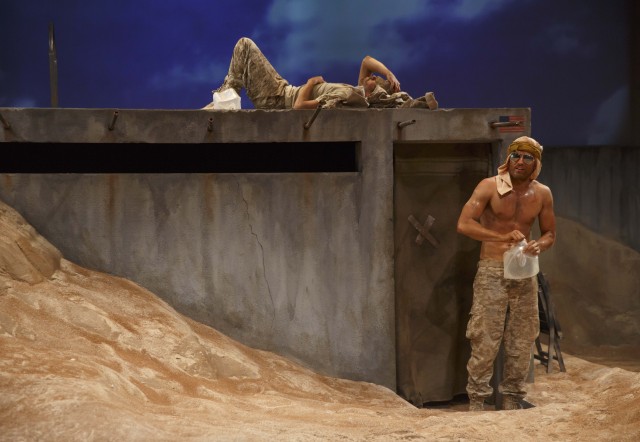
The maddening desperation of war hovers over Rattlestick production of AFGHANISTAN, ZIMBABWE, AMERICA, KUWAIT (photo © Joan Marcus)

The Gym at Judson
243 Thompson St. at Washington Square South
Through June 27, $18
866-811-4111
www.rattlestick.org
www.judson.org

Early on in Daniel Talbott’s Afghanistan, Zimbabwe, America, Kuwait, two American soldiers, Smith (Seth Numrich) and Leadem (Brian Miskell), are outside their desert bunker, burning up in the furious heat and talking about a bird that recently flew past them. “The f—in’ bitch thought we were going to die,” Smith says. “I waved at her. I waved. Like with both hands up. Gave her the f—in’ hang loose sign. The peace sign.” The time is the near future, and Smith and Leadem are in the middle of nowhere, fighting a war they don’t understand. They don’t even know what day it is, but they’re well aware that they’re running desperately short of food and water, with no way to call for help, and the vultures are circling. Their precarious existence becomes even more troublesome when a third soldier, Miller (Chris Stack), arrives, with no hope to offer them. “It’s like Chernobyl a week after the f—ing meltdown,” he says. “Just silence. Like f—ing New York, or DC, after China. It’s all gone.” Throughout the play, the soldiers are visited by various characters who could be ghosts, hallucinations, or memories as they discuss family and lovers, the past and the future, avoiding the central issue of the brutal effects of war. Leadem is particularly spooked by a Serbian woman (Jelena Stupljanin) who cries out in the night about being tortured and raped. “The only conversation we had was when I was begging them to kill me,” she explains. “That’s when they laughed. Their response was, ‘We don’t need you dead.’” But the soldiers are determined not to give up, not to die in this unstated location, which could be anywhere, for seemingly no reason at all.

(photo © Joan Marcus)

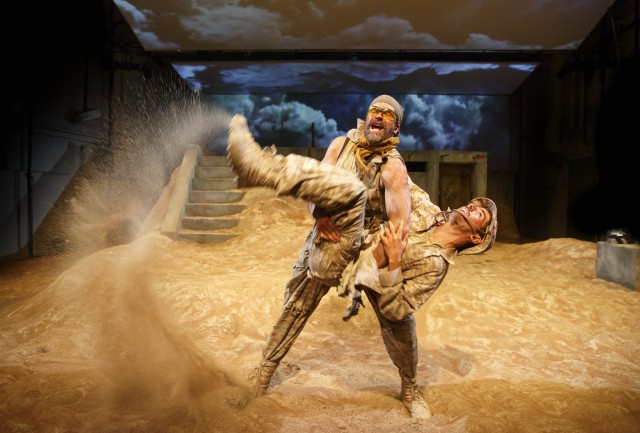
Soldiers search for a way out in bleak, devastating play (photo © Joan Marcus)

Raul Abrego’s set is harshly realistic, a small concrete shelter surrounded by hills of sand that trickle toward the audience. Above and behind them, David Tennent’s projections depict bright blue skies and approaching clouds. Rattlestick literary manager Talbott (Slipping, Yosemite) also directs the play with a sure hand, making powerful use of John Zalewski’s sound design and Joel Moritz’s lighting to indicate changes of scenes, turning the theater pitch black, filling the space with loud feedback, then bringing the lights back up with the actors in different positions to signify the passage of time. The fine cast also includes Jimi Stanton as Leadem’s brother and Kathryn Erbe as his mother, adding to the mystery of what exactly is unfolding onstage. Afghanistan, Zimbabwe, America, Kuwait is a dark, bleak experience, an existential exploration of the horrors of war without overtly political content. The narrative occasionally gets confusing and repetitive; even at a mere ninety intermissionless minutes, it feels too long, but Talbott is not out to make the audience comfortable in their seats, instead intent on sharing aspects of the soldiers’ physical and psychological terror. It’s not a pleasant catharsis, and it’s not supposed to be. (The June 16 performance will be followed by a panel discussion with Greg Grandin, Morgan Jenness, and Michael Ratner, moderated by the Reverend Micah Bucey.)