twi-ny recommended events

SHAKESPEARE IN THE PARK: THE TEMPEST

(photo by Joan Marcus)

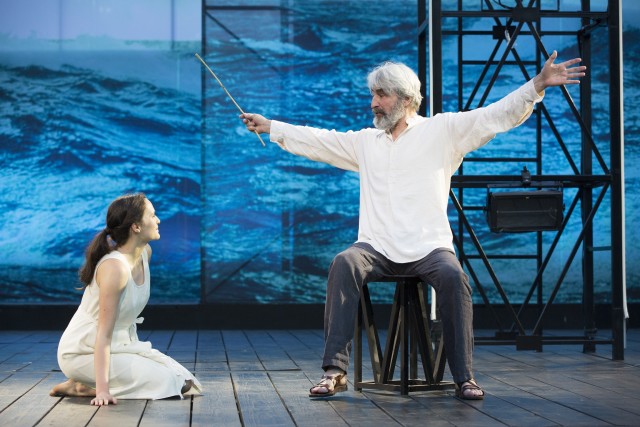
Miranda (Francesca Carpanini) and her father, Prospero (Sam Waterston), make magic in Central Park (photo by Joan Marcus)

Central Park
Delacorte Theater
Through July 5, free, 8:00
publictheater.org/tempest

In the brief synopsis of The Tempest in the program for the Public Theater’s latest Shakespeare in the Park presentation, which opened at the Delacorte on June 16, it says in bold caps, “The play opens with a storm. . . . The storm isn’t natural.” But the night I saw it, real blasts of thunder accompanied the beginning, a striking depiction of the sudden squall that deposits a group of noblemen on a remote island. The elements are always part of the fun in these Public Theater productions, so the darkening clouds and threatening rain — which never came — added to the drama, which at times needed a little help. The island is occupied by the gray-bearded, professorly magician Prospero (Sam Waterston), his fifteen-year-old daughter, Miranda (Francesca Carpanini), and his two slaves, the playful sprite Ariel (Chris Perfetti) and the brooding, deformed Caliban (Louis Cancelmi). Formerly the duke of Milan, Prospero was exiled twelve years earlier when his brother, Antonio (Cotter Smith), usurped his title, and Prospero has been planning his revenge ever since; it is no coincidence that the shipwrecked boat was carrying Antonio, along with Alonso, the king of Milan (Charles Parnell), his brother, Sebastian (Frank Harts), and Ferdinand, the son of the king of Naples (Rodney Richardson), along with several others, including the honest councilor Gonzalo (Bernard White), Alonso’s jester, Trinculo (Jesse Tyler Ferguson), and the drunken butler Stephano (Danny Mastrogiorgio). Promising him freedom, Prospero sends out Ariel to do his dirty work, turning the men against one another so he can regain his title, while also playing matchmaker to Miranda and Ferdinand, who take an instant liking to each other.
(photo by Joan Marcus)

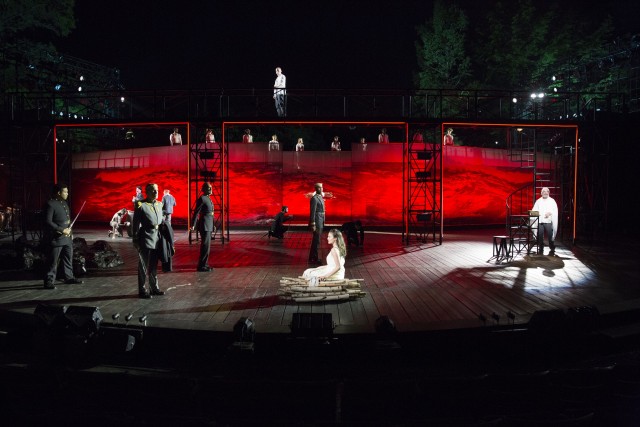
Prospero (Sam Waterston) orchestrates strange doings on a remote island in THE TEMPEST (photo by Joan Marcus)

“Your tale, sir, would cure deafness,” Miranda says to her father when he is filling her in about their past, but unfortunately, Waterston (Law & Order, Grace and Frankie), wearing what appears to be a kind of tallit (Jewish prayer shawl), is marble-mouthed as Prospero, hesitant and uneasy in his line readings, particularly in the first act, making it hard to understand him as he strains to find a rhythm. This is his tenth Shakespeare in the Park appearance, an illustrious resume that dates back to his starring role in Hamlet back in 1975, so his performance is somewhat confounding, although he does settle down significantly in the second act. Perfetti’s (Sons of the Prophet) Ariel, clad in a mildly S&M body harness, is also questionable and ill-defined. But the rest of the cast is strong and engaging; current Juilliard student Carpanini and Richardson (Pulse) have infectious chemistry as the potential lovers, Ferguson (Modern Family, The Comedy of Errors) and Mastrogiorgio (Lucky Guy, Golden Boy) provide necessary comic relief, and Cancelmi (Father Comes Home from the Wars, The Hallway Trilogy) is excellent as the native “monster,” a character who evokes colonialism, bigotry, and fear of the other. Through it all, Arthur Solari’s percussion, played from his own booth at the corner of the stage, is filled with emotion itself as it goes from anger and ire to passion and love. Director Michael Greif (Next to Normal, Our Lady of Kibeho,), who helmed the well-received 2007 Shakespeare in the Park production of Romeo and Juliet with Lauren Ambrose and Oscar Isaac, never quite finds his own rhythm, the three story lines bumpy until all coming together in the end on Riccardo Hernandez’s scaffold-based set. And speaking of the end, when Waterston stood alone onstage to deliver the epilogue, asking for applause to help him return to Milan, a goose flew overhead as if on cue, honking like a warped metronome, the outdoor elements once again becoming part of the show. This brave goose might not have laid a golden egg, but it did recall Mercutio telling Romeo, “Nay, if thy wits run the wild-goose chase, I have done, for thou hast more of the wild-goose in one of thy wits than, I am sure, I have in my whole five: was I with you there for the goose?”
TICKET GIVEAWAY: A MIDSUMMER NIGHT’S DREAM

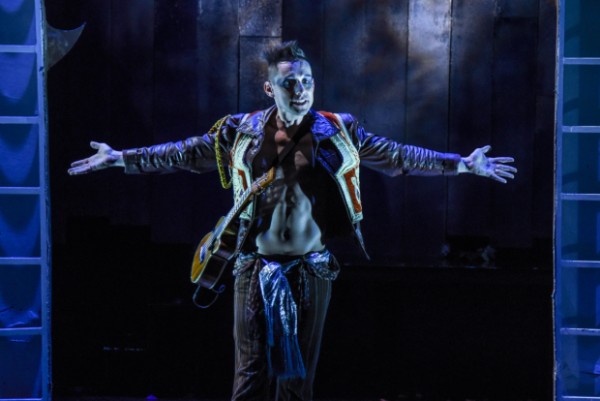
Nick Cearley stars as a musical Puck in Masterworks Theater (photo by Russ Rowland)

Nick Cearley stars as a musical Puck in the Masterworks Theater Company production of A MIDSUMMER NIGHT’S DREAM (photo by Russ Rowland)

A MIDSUMMER NIGHT’S DREAM
47th Street Theatre
304 West 47th St. between Eighth & Ninth Aves.
Tuesday – Sunday through June 28, $19-$65
212-279-4200
www.masterworkstheatercompany.org

It’s hard to get New Yorkers to pay to see Shakespeare in the summer, what with so many free productions in parks, parking lots, and other outdoor spaces around the city. (You can check out an updated day-by-day list here.) But the Masterworks Theater Company is defying the odds, staging the Bard favorite A Midsummer Night’s Dream at the 47th St. Theatre. Clocking in at a breezy ninety minutes, this version, which features a lot of music and pop-culture references, stars Nick Cearley as Puck, Warren Jackson as Bottom, Jenny Strassburg as Hippolyta/Titania, Andrew Ramcharan Guilarte as Theseus/Oberon, Sheria Irving as Hermia, Becca Ballenger as Helena, Reynaldo Piniella as Lysander, Emilio Paul Tirado as Demetrius, and Jack Herholdt as Snout and Wall. Tamilla Woodard directs, with choreography by Shannon Stowe. The show is set in a modern-day playground designed by Raul Abrego.

TICKET GIVEAWAY: A Midsummer Night’s Dream is running through June 28 at the 47th St. Theatre, and twi-ny has three pairs of tickets to give away for free. Just send your name, daytime phone number, and favorite Midsummer Night’s Dream production (film or theater) to contest@twi-ny.com by Wednesday, June 17, at 12 noon to be eligible. All entrants must be twenty-one years of age or older; three winners will be selected at random.

ANYWHERE IN TIME: A CONLON NANCARROW FESTIVAL

(photo courtesy Charles Amirkhanian)

The life and career of one-of-a-kind composer Conlon Nancarrow will be celebrated at twelve-day fest at the new Whitney (photo courtesy Charles Amirkhanian)

Whitney Museum of American Art
Susan and John Hess Family Theater, third floor
99 Gansevoort St.
June 17-28, $22 (includes admission to galleries)
212-570-3600
whitney.org

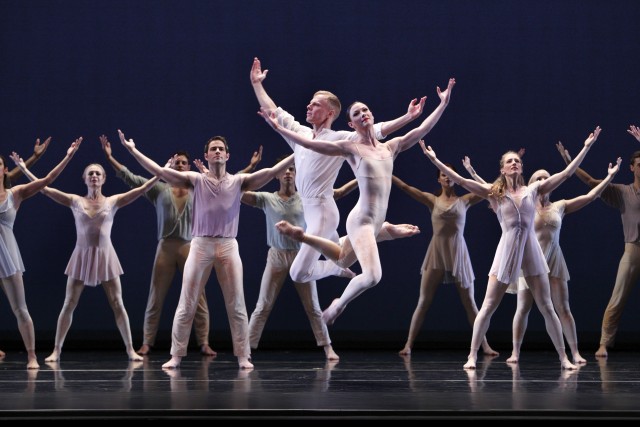
In a 1981 letter to Charles Amirkhanian, György Ligeti wrote, “This music is the greatest discovery since Webern and Ives . . . something great and important for all music history! His music is so utterly original, enjoyable, perfectly constructed but at the same time emotional . . . for me it’s the best of any composer living today.” Ligeti was referring to the little-known Conlon Nancarrow, an American-born composer who had become a Mexican citizen and had done extraordinary work with the player piano. The recipient of a MacArthur genius grant, Nancarrow, who passed away in 1997 at the age of eighty-four, will be celebrated at the new Whitney Museum of American Art with “Anywhere in Time: A Conlon Nancarrow Festival,” twelve days of special live performances, talks, and films paying tribute to Nancarrow’s influential career. Among those taking the stage in the Susan and John Hess Family Theater will be Steve Coleman and Five Elements, dancers from the Merce Cunningham Trust Fellowship Program performing Crises (1960) (reconstructed and staged by Jennifer Goggans), percussionist Chris Froh, Alarm Will Sound, and Henry Kaiser and Lukas Ligeti with Charles Amirkhanian. Cocurated by Dominic Murcott and Jay Sanders, “Anywhere in Time” also features screenings of James Greeson’s 2012 documentary Conlon Nancarrow: Virtuoso of the Player Piano, the panel discussion “Nancarrow Deconstructed” with Froh and Murcott, and a 1921 Marshall and Wendell Ampico upright player piano on view on the veranda with Nancarrow’s “Study #36” piano roll, which will occasionally play. “Conlon Nancarrow had perhaps the most single-minded career of any great American composer, devoting his life to exploring the rhythmic possibilities of juxtaposing multiple simultaneous tempos,” notes Alarm Will Sound conductor and artistic director Alan Pierson. “The combination of Nancarrow’s catchy materials and the complex way he deals with them puts his work in a sweet spot of immediacy and complexity occupied by much of the music we love. And the challenge of performing music not meant to be played by human beings is a stimulating one.” The festival comes to a close on June 28 with the eight-hour “Complete Studies for Player Piano: A Marathon Concert Event,” presented in numerical order from 11:00 am to 7:00 pm and including appearances by Nancarrow’s wife, Yoko, and their son, Mako. Most of the events require ticketing, and it’s best if you get them in advance; the cost is the same as museum admission, and the ticket gets you into all the galleries.

HUDSON RIVER DANCE FESTIVAL

Paul Taylor Dance is one of three local companies performing at the free, inaugural Hudson Dance Festival this week (photo by Paul B. Goode)

Paul Taylor Dance is one of three local companies performing at the free, inaugural Hudson Dance Festival this week (photo by Paul B. Goode)

Who: Paul Taylor Dance Company, Parsons Dance, Ballet Hispanico
What: Hudson River Dance Festival
Where: Pier 63, Hudson River Park, cross at West 22nd & 24th Sts.
When: Wednesday, June 17, and Thursday, June 18, free, 6:30
Why: The inaugural Hudson River Dance Festival consists of three New York City companies presenting works for free outdoors on Pier 63 in Hudson River Park this week, two nights of modern movement featuring pieces by Paul Taylor Dance Company, Parsons Dance, and Ballet Hispanico. Attendees can bring blankets, but no chairs are allowed on the lawn.

THE SPOILS

(photo by Monique Carboni)

Ben (Jesse Eisenberg) shares his bitter thoughts on the state of the world with Kalyan (Kunal Nayyar) in THE SPOILS (photo by Monique Carboni)

The Pershing Square Signature Center
The Alice Griffin Jewel Box Theatre
480 West 42nd St. between Tenth & Eleventh Aves.
Tuesday – Sunday through June 28, $75-$95
212-244-7529
www.thenewgroup.org
www.signaturetheatre.org

In the second act of Jesse Eisenberg’s third play, The Spoils, Eisenberg, as the deeply troubled and extremely obnoxious Ben, says, “Did you think she was too mean? I’m struggling to figure out who our protagonist is. You can’t have a mean protagonist, but if they’re too perfect then they have nowhere to go. You know?” Yes, we know; Ben is referring to a woman in a documentary he is purportedly making, but he just as easily could be talking about himself, a nasty, confused, and confusing character who dishes out streams of sharp barbs and insensitive jokes. It is the third consecutive unlikable part that Eisenberg has written for himself for the stage, following Asuncion and The Revisionist. (He’s more likable in his film work: He was nominated for an Oscar for his portrayal of Facebook founder Mark Zuckerberg in The Social Network and has also starred in such underrated films as Adventureland and The Double.) Ben is a pot-smoking, jobless New Jersey Jew living in a New York City apartment with his roommate, Nepalese business student Kalyan (The Big Bang’s Kunal Nayyar). An all-around nice guy and good friend to Ben, Kalyan is dating Reshma (Annapurna Sriram), an Indian American doing her med school residency — and who can’t stand Ben. (Kalyan is based on a real-life Nepalese friend of Eisenberg’s who was in Indonesia during the recent earthquake and returned home to help with the disaster.) Ben’s slacker-like existence, supported by his parents’ money, turns when he bumps into an old grade school acquaintance, Ted (Michael Zegen of Boardwalk Empire and Rescue Me), a banker engaged to Ben’s first crush, the sweet, kind, and innocent Sarah (Erin Darke). Suddenly infused with a purpose in his life, Ben sets out to steal Sarah from Ted, but he is unaware of just how pathetic and unpleasant he really is.

(photo by Monique Carboni)

A group of friends apologize to the rest of the world for their supposed success in Jesse Eisenberg’s THE SPOILS (photo by Monique Carboni)

The Spoils opens with Kalyan showing Reshma a PowerPoint presentation he has created called “American Football: An Introduction to the Ballet of Brutality,” asking the questions “Is it appropriate to withhold knowledge from someone even if you think it might hurt them? Is it ethical to deny someone information, even if disclosing that information might hurt them?” Eisenberg’s play is also a ballet of brutality centered around the vitriolic Ben, who is haunted by dreams and memories that he can’t hold within himself. Eisenberg gives a whirling, energetic performance as Ben, words flowing out of him like Barry Sanders racing toward the goal line. Nayyar is much more calm and subdued as Kalyan, whose nature is to find the good in all people, including Ben. The New Group world premiere, in the Alice Griffin Jewel Box Theatre at the Signature Center, is ably directed by Scott Elliott, making good use of Derek McLane’s traditional living room/kitchen apartment set with a balcony; one nice touch is that Ben and Kalyan use a print of Jasper Johns’s “White Flag” as a screen for their PowerPoint and video projections, a very subtle reference to both surrender and the whitewashing of the American Dream. At one point in the play, the five characters are drinking Nepalese beer, and Ben calls for a special toast. We gotta say ‘Cheers’ in Nepali!” he proclaims. “I don’t think I ever said anything that would be an equivalent to ‘Cheers,’” Kalyan says. “I guess when we’re drinking, we don’t really feel a need to congratulate each other.” Ben ultimately decides that they “should apologize to the world. Because they’re toiling away while we get to sit here and drink. . . . A Nepalese Cheers: To all the pathetic f—s breaking their back while we drink this beautiful beer: I’m sorry!” It’s a funny moment that perhaps best represents the bubble they are all living in. But The Spoils still has a hard time getting past just how contentious and ill-natured Ben is, even when he begins to reveal his true self. He’s just not someone you’ll ever want to share a beer with.

A HUMAN BEING DIED THAT NIGHT

(photo by Richard Termine)

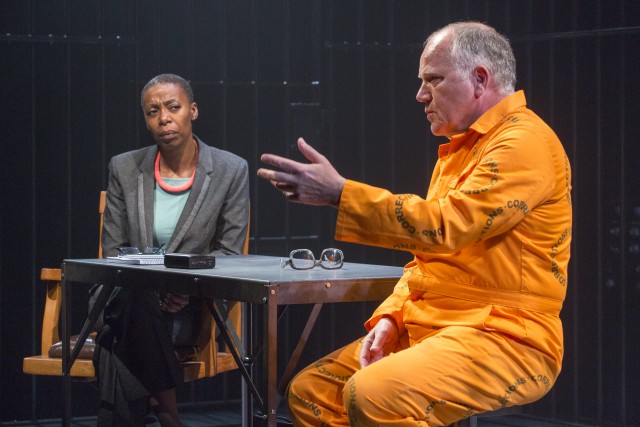
Pumla Gobodo-Madikizela (Noma Dumezweni) and Eugene de Kock (Matthew Marsh) discuss violence and murder, forgiveness and reconciliation in A HUMAN BEING DIED THAT NIGHT (photo by Richard Termine)

BAM Fisher, Fishman Space
321 Ashland Pl.
Tuesday-Sunday through June 21, $65
718-636-4100
www.bam.org

Near the beginning of Nicholas Wright’s sharp, powerful A Human Being Died That Night, inmate Eugene de Kock (Matthew Marsh) asks psychologist Pumla Gobodo-Madikizela (Noma Dumezweni), “Does this set-up that you’re looking at now make you think of a certain film?” It’s a question meant for the audience too, who are thinking the same thing as de Kock continues, “With Jodie Foster and Sir Anthony Hopkins? . . . Well, that’s what they think I am.” Set in a prison where de Kock is serving two life sentences plus 212 years for committing political crimes against black South Africans, earning the nickname “Prime Evil” for his involvement in numerous cold-blooded murders, A Human Being Died That Night instantly recalls Jonathan Demme’s The Silence of the Lambs; Marsh’s erudite manner as de Kock even mimics Hopkins’s portrayal of Hannibal the Cannibal. But there are two primary differences: First, de Kock is a real person, and his story is true. Second, where the fictional Hannibal Lecter reveled in his deeds, de Kock is exploring forgiveness and repentance. Based on Gobodo-Madikizela’s book, which details her meetings with de Kock in Pretoria Central Prison, the play takes place inside a prison cell (designed by Paul Wills), with Gobodo-Madikizela, who served on Nelson Mandela’s Truth and Reconciliation Commission, on one side of a rectangular table, de Kock, in leg irons that limit his movement, on the other. Over the course of eighty minutes, they discuss the nature of his killings, which included a public bombing, his victims and their families, and his fellow policemen, particularly his superiors, who gave him his orders but have paid no consequences. Gobodo-Madikizela is not interviewing de Kock in an official capacity but for her own personal and professional studies, although she does not want to get too close to him. “There’s a line that I don’t want to cross,” she explains, to which he responds, “You want to understand me, but you don’t want to cross a line? Isn’t that making things unnecessarily difficult for yourself?” But she is shocked when she suddenly does cross that line, leading the way to deeply intimate revelations.

(photo by Richard Termine)

Nicholas Wright’s play offers a different look at apartheid (photo by Richard Termine)

Originally staged by Cape Town’s Fugard Theatre, A Human Being Died That Night is a riveting exploration of forgiveness and reconciliation. Olivier Award winner Dumezweni (A Raisin in the Sun, The Bogus Woman) and Marsh (Proof, The Last of the Haussmans) are mesmerizing as their characters warm to each other and reach unforeseen conclusions. Director Jonathan Munby, a veteran of many a Shakespeare production at theaters around the world, maintains a tense calm throughout that is heightened by a moment that frightens Gobodo-Madikizela; meanwhile, the sound of de Kock’s rattling chains are occasionally heard, a reminder of what he has done, even as he speaks eloquently about what’s in his heart. In the latter part of the play, the two characters switch sides of the table, de Kock no longer tethered to his spot, as if each is now in the other’s shoes, offering a different perspective on what comes next. Haunting and harrowing yet with a gentle soul, A Human Being Died That Night is especially relevant given America’s reaction to the Boston Marathon bomber, with calls for his execution coming from even those who are usually against the death penalty. Meanwhile, in January of this year, de Kock was granted parole. The play will have you looking inside yourself, examining your own views on forgiveness and reconciliation, empathy and compassion, and the nature of good and evil, whether in relation to a mass murderer or a more personal and private matter. And you might be surprised what you learn about yourself.

NORTHSIDE FESTIVAL 2015: THE KITE APP

Kite introduces its app at Northside Innovation Conference and Expo party at the Counting Room (photo by twi-ny/ees)

Kite introduces its app at Northside Innovation Conference and Expo party at the Counting Room (photo by twi-ny/ees)

The Northside Festival is known for music, but its Innovation Conference and Expo is shaping up on a SXSW model. Thursday’s launch party for the Kite social news feed app was packed, and Kite founder Trond Werner Hansen was on hand to give twi-ny an interview and insight into what Kite is all about. An app for Mac devices (downloadable on the App Store), Kite lets users read and share articles from any website. They can also follow other users to see what sites they read and share so each person’s news feed is socially curated. Users can follow other users who share content they like, just as they do on Instagram, but they’ll see news articles rather than photos. Kite is also a browser that can go to any website, so users can build whatever kind of feed they like — it’s not limited by who’s signed on to Kite — or who’s paid to be there. On the hot summer street corner of Berry and North Eleventh, twi-ny asked Trond — a tall, amiable Norwegian who lives in Bushwick and is well known for his work developing browser software for Mozilla and others: “Why Kite?” He gave three reasons:

Screenshot of sites Trond follows via Kite — and you can too

Screenshot of sites Trond follows via Kite — and you can too

1) The Open Web. As a content platform, until now we have taken that for granted, but in the fall Apple is launching Apple News, and then you don’t have an open free platform anymore. Now they don’t have that control, but we don’t even want to go in that direction.

2) Convenience. You know people are starting to be pushed to individual apps — the CNN app, the New York Times app — and that’s just not the best way for the user. [News sites] should focus on making great content, not on making apps. Kite brings all sources into one container, but when you go to each of them, you go to their direct website, so they control their own thing, but they’re contained within one user experience, so that’s better for the user.

3) The social aspect. We’ve seen now that social curation of content works. I want to read what you read. So there’s two ways of curation: There’s the old-fashioned way — you go to CNN to see what kind of information they have curated for you, that works, and now we have the social curation that works, and Kite brings those two things together, kind of like the yin to the yang. And we also believe while Twitter, Facebook, LinkedIn, or these other social networks cater to sharing, they were not specifically made for content sharing. For example, on Kite I can go on your profile and see what kind of curation comes to you. You can’t do that on Facebook.

“I’ve learned through doing the web browser for so many years that algorithmic curation of things generally doesn’t work over scale over time,” Trond added. “Social curation works; brand curation works. But not algorithmic curation. I like food, so then I’m gonna get food articles. It’s unpredictable. . . . Engineers love to do algorithmic things, because that’s what they can do with their machines. ‘Look, you enter cheese, you can get a lot of articles about cheese!’ But it’s not really valuable or interesting. You can see on the Kite app, when you click another person, you can see his feed and his sites, what he reads. It’s useful, it’s predictable, it’s not algorithmic.”

We clicked on Trond’s feed and it’s fascinating. Try Kite and save some screen space — no need to clutter your iPhone with separate apps from CNN, WSJ, NYT, BBC, Guardian, Economist, etc. ThisWeekInNewYork is starting a Kite feed now, and curious readers can download the app for free on the App Store; during the festival, which continues through June 14 and has a terrific app of its own, you can use the invite code: northside.