twi-ny recommended events

SOMETHING ELSE: A CELEBRATION OF ORNETTE COLEMAN ON FILM — ORNETTE: MADE IN AMERICA / CHAPPAQUA

Shirley Clarke’s portrait of free jazz legend Ornette Coleman is screening in Brooklyn in a beautiful 35mm restoration

ORNETTE: MADE IN AMERICA (Shirley Clarke, 1985) & CHAPPAQUA (Conrad Rooks, 1966)
Spectacle
124 South Third St. between Bedford Ave. & Berry St.
July 17-23, $5
212-924-7771
www.spectacletheater.com
www.milestonefilms.com

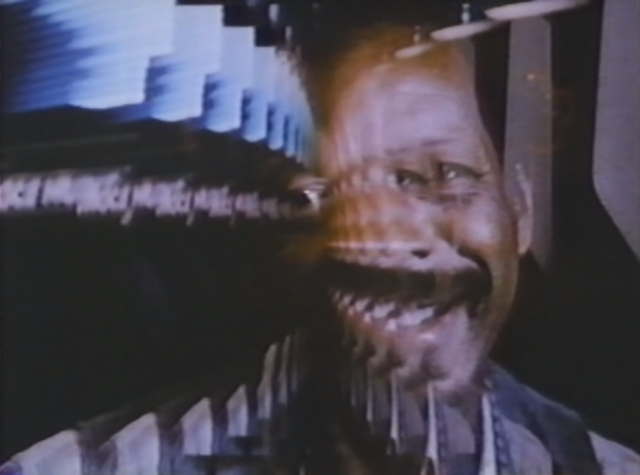
In September 1983, innovative saxophonist and Fort Worth, Texas, native Ornette Coleman received a key to the city of his hometown and then helped open the new Caravan of Dreams arts center by performing the world premiere of “Skies of America,” a specially commissioned work that teamed Coleman and his band, Prime Time, with the Fort Worth Symphony. Director Shirley Clarke uses this celebratory event as the central focus of her 1985 documentary, Ornette: Made in America, which was recently released in a beautiful new 35mm restoration overseen by Milestone Films as part of its continuing Project Shirley, which began with a dazzling new print of Clarke’s 1962 film about jazz and drugs, The Connection. In Ornette: Made in America, Clarke combines footage she shot of Coleman back in the 1960s for a never-completed film with new material that offers an inside look at Coleman and his relationship with his son, Denardo, a musical prodigy who has played drums with his father for decades, since he was a young boy. Clarke also includes staged scenes of young versions of Coleman wandering through his old neighborhood of Fort Worth, then turning to the camera to deliver determined stares, in addition to shots of a theater troupe dancing joyously down the street, Coleman performing through the years in San Francisco, New York City, and Nigeria, and interactions with such prominent figures as music critic Robert Palmer, artist Brion Gysin, writer William S. Burroughs, and architect Buckminster Fuller, who had a profound influence on Coleman’s unique free jazz sound. “As Buck says, you can’t see outside yourself, but we do have imagination,” Coleman explains inside a geodesic dome. “The expression of all individual imagination is what I call harmolodics, and each being’s imagination is their own unison, and there are as many unisons as there are stars in the sky.” Clarke puts the film together like one of Coleman’s free jazz compositions, filled with harmolodics, going from black-and-white to color and back again, cutting between interviews and live performances, moving from relaxing images to propulsive moments, and regularly bordering on the goofy, including talking heads in an animated television set, brief explanatory text in marquee scrolls, and shots of Coleman riding a spacecraft over the surface of the moon. Despite such silliness, Ornette: Made in America is a thrilling portrait of a national treasure, a one-of-a-kind musician who was still playing his unique brand of music into his eighties, right up until his death last month.

Brooklyn’s Spectacle Theater is paying tribute to Coleman with the special presentation “Something Else: A Celebration of Ornette Coleman on Film,” running July 17-22 and consisting of daily screenings of Ornette: Made in America along with Pierre Hébert’s 1968 fourteen-minute short, Population Explosion, with a score by Coleman, and Conrad Rooks’s 1966 forty-eight-minute cult film, Chappaqua, which was supposed to use Coleman’s specifically commissioned “Chappaqua Suite,” but Rooks decided to replace it because it was too good; however, Spectacle will be showing the film with Coleman’s original composition. In addition, a separate program will feature Andrew Lampert’s 2012 film, All Magic Sands/Chappaqua, which pairs Coleman’s “Chappaqua Suite” with footage from producer Al Gannaway’s never-completed religious adventure story.

THE LOOK OF SILENCE

THE LOOK OF SILENCE

Joshua Oppenheimer’s THE LOOK OF SILENCE stares directly into the eyes of perpetrators of genocide in Indonesia

THE LOOK OF SILENCE (Joshua Oppenheimer, 2014)
Landmark Sunshine Cinema
143 East Houston St. between First & Second Aves.
Opens Friday, July 17
212-330-8182
www.landmarktheatres.com
thelookofsilence.com

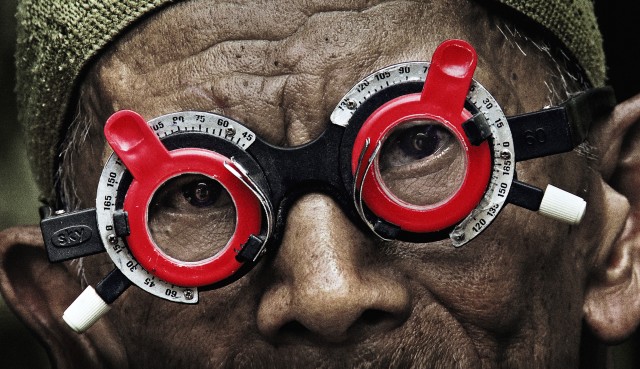
Joshua Oppenheimer’s The Look of Silence opens with an old man, wearing a pair of red optic trial lens frames, gazing into and around the camera for twelve uncomfortable seconds, in complete silence, showing no emotion. It is a striking metaphor for the rest of the film, a shocking documentary about the 1965–66 Indonesian genocide and a bold man determined to confront the men who brutally murdered his brother then, along with a million other supposed communists. In 2012, Oppenheimer made the Oscar-nominated The Act of Killing, in which the leaders of the genocide, who are still in power today, restaged their killings as if they were Hollywood movie scenes. Created as a companion piece to that documentary, The Look of Silence follows forty-four-year-old optometrist Adi as he learns the details of what happened to his brother, Ramli, who was butchered two years before Adi was born. Adi has decided to do what no one else in his country will: break his culture’s silence and denial and face the perpetrators to make them take responsibility for what they did. If they are willing to show remorse, he is willing to forgive. But he has set out on what appears to be an impossible mission; the men he meets with still run Indonesia, and they are more than comfortable threatening the well-being of Adi and his family. Meanwhile, Adi’s parents and patients don’t want to talk about what occurred back in 1965–66, or what is still going on today, as they live in fear of these same men. “No, nothing happened,” one woman says when asked about the killings in her town of Aceh. “You ask too many questions,” she adds. Kemat, a survivor of the Snake River massacres, says, “The past is the past. I’ve accepted it. I don’t want to remember. It’s just asking for trouble.” Adi learns horrifying details as he meets with village death squad leader Inong (the old man shown at the beginning of the film), Snake River death squad commander Amir Siahaan, and regional legislature speaker M. Y. Basrun, all of whom defend their actions, and their power and wealth, while more than hinting that Adi should end his quest. But Adi isn’t about to back down.
THE LOOK OF SILENCE

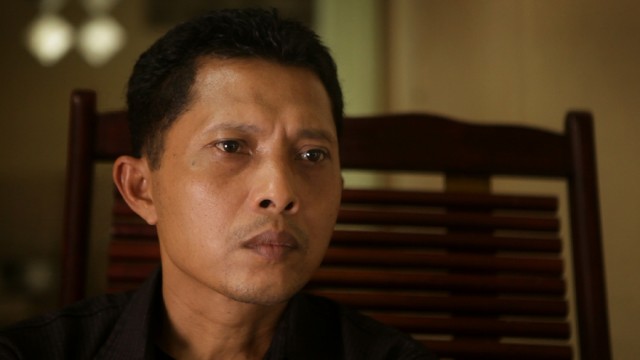
Adi faces a group of mass murders, including his brother’s killers, in powerful documentary

Adi is often shown in front of a television, mystified as Oppenheimer shows him footage taken for The Act of Killing; Adi stares ahead in disbelief and silence, much like we did when watching the final film, amazed at what we were seeing. It is a fascinating coincidence that Adi is an optometrist, going around his community fitting people for glasses, helping them see better, even if they don’t always want to look at certain things. He is appalled that his children’s school still teaches that the evil communists deserved to die; it’s particularly telling when his young daughter playfully puts on two pairs of glasses, as if perhaps the next generation will not look away — and to emphasize that, Oppenheimer cuts directly to Adi’s aging, decrepit father, Rukun (whom his wife, Adi’s mother, Rohani, claims is 140), his eyes closed, as he can barely see or hear anymore and needs to be taken care of like a baby. Adi has become a folk hero in Indonesia, where some regions have banned the film and screenings had to be canceled because of threats of violence from the police and military. But the film itself depicts Adi as an everyman; he could be any one of us, saying the things that need to be said. “Making any film about survivors of genocide is to walk into a minefield of clichés, most of which serve to create a heroic (if saintly) protagonist with whom we can identify, thereby offering the false reassurance that, in the moral catastrophe of atrocity, we are nothing like the perpetrators,” Oppenheimer (The Globalisation Tapes) writes in his extensive, must-read notes on the film’s official website. “But presenting survivors as saintly in order to reassure ourselves that we are good is to use survivors to deceive ourselves. It is an insult to survivors’ experience, and does nothing to help us understand what it means to survive atrocity, what it means to live a life shattered by mass violence, and to be silenced by terror. To navigate this minefield of clichés, we have had to explore silence itself.” In that way, to use a cliché, The Look of Silence speaks volumes. And although it’s specifically about the Indonesian genocide, it could just as easily be made about many other mass murders that have occurred, and are still going on, around the world. Adi might be receiving long standing ovations at screenings where he appears, but it’s telling that the film’s closing credits include more than two dozen people listed as “Anonymous,” from the codirector and a coproducer to a camera operator and production managers. Clearly, fear still rules in Indonesia. An unforgettable film that needs to be widely seen, The Look of Silence, which was executive produced by Werner Herzog, Errol Morris, and André Singer, opens July 17 at the Landmark Sunshine, with Oppenheimer taking part in Q&As following the 7:00 & 9:45 screenings on Friday and Saturday and the 4:35 & 7:00 shows on Sunday.

HOT! FESTIVAL: POUND

(photo by Gareth Gooch)

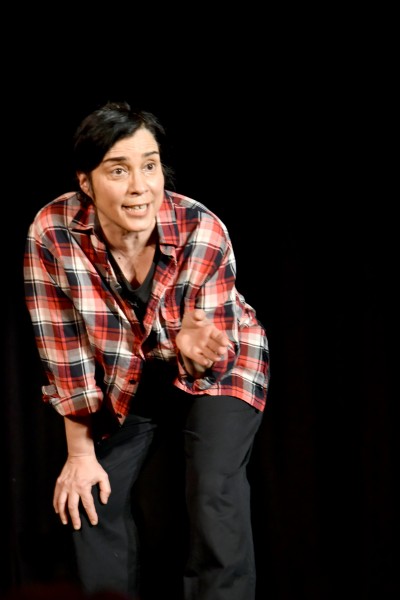
Marga Gomez examines celibacy and fictional lesbian characters in POUND (photo by Gareth Gooch)

Dixon Place
161A Chrystie St. between Rivington & Delancey Sts.
Fridays & Saturdays, July 17, 18, 24, 25, $16-$20, 7:30
212-219-0736
dixonplace.org
www.margagomez.com

The first half of Marga Gomez’s new autobiographical one-woman show is absolutely brilliant, an engaging, hysterical, and poignantly honest look at celesbians, celibacy, and the depiction of lesbians in mainstream films. Gomez, a GLAAD Award-winning actress who appeared in Barry Levinson’s 1998 underwater thriller, Sphere, alongside fellow lesbian Queen Latifah, compares her lack of sex with her search for a movie that portrays realistic lesbians who get physical with one another. “I will go to any movie if I think chicks will make out,” she says, “even documentaries on cabinet making. Because I have medical needs. I have a condition.” Dressed in the stereotypical dyke outfit of plaid shirt, shorts, and army boots, the gap-toothed Gomez commands the stage at Dixon Place, engaging the audience with direct address and constant eye contact as she discusses the damage that was done to her by watching The Children’s Hour as a small girl, mimicking Audrey Hepburn as Karen Wright and Shirley MacLaine as Martha Dobie. “Not once in the one hundred and eight minutes of The Children’s Hour was the word ‘lesbian’ spoken. All I knew then was ‘I think I’m a . . . a . . . Martha Dobie,’” Gomez says. Embodying various characters, she also examines such other lesbian-related films as Basic Instinct (Sharon Stone as Catherine Tramell), The Killing of Sister George (Susannah York as Childie), Showgirls (Gina Gershon as Cristal Connors), The Fox (Sandy Dennis as Jill Banford, Anne Heywood as Ellen March), Notes on a Scandal (Judi Dench as Barbara Covett, Cate Blanchett as Bathsheba Hart), and her favorite of them all, Bound (Gershon as Corky, Jennifer Tilly as Violet).

Along the way, she explains that when she grew up it was “not like today, when lesbian characters lead happy lives in prison,” tries to pick up a fellow Bound fan in an online chat room, gets excited when her gynecologist squeezes her nipples, and insists that her nephew Mikey refer to her as her cousin when they go dancing at a gay club. Pound, which is set up as a screenplay being dictated by a deep-voiced Hollywood-type man, takes a strange turn when Gomez gets sucked into a woman’s vagina and enters the data cloud of cinematic dysfunctional lesbian and bisexual archetypes, getting caught up in meeting and interacting with many of the aforementioned fictional characters. The show, which had been so on point, loses its focus, notwithstanding numerous intelligent insights and some riotous, and extremely dirty, lines that cannot be shared here. But Gomez eventually returns to reality and Dixon Place, declaring, “I’m so celibate my legs have been together longer than Aerosmith.” Gomez, whose previous one-woman shows include Long Island Iced Latina, A Line Around the Block, and Marga Gomez Is Pretty, Witty & Gay, is a wonderfully talented performer, compelling and fearlessly funny. With energy reminiscent of Jack Ferver, she has a natural rapport with the audience, an inviting self-deprecation that is as brutally honest as it is cathartic. Despite dealing with some very heady subject matter, Gomez is at ease with her place in the world, and that puts the crowd at ease as well as we follow her on her deeply personal journey. Directed by David Schweizer, Pound continues July 18-19 and 25-26 as part of Dixon Place’s twenty-fourth annual Hot! Festival: The NYC Celebration of Queer Culture, which continues through August 8 with such other works as Douglas Santiago Pomales’s Thank You Mr. Douglas, G. J. Dowding’s Out of the Ash, and Michael Cross Burke’s Michael Jackson Was Innocent and I Didn’t Kill JonBenet Ramsey . . . But I Was There the Night She Died.

SUMMER RESTAURANT WEEK 2015

SRW15_HP_hero-1

Multiple locations
July 20 – August 14
Lunch $25, dinner $38
www.nycgo.com/restaurantweek

You can “Eat Up” again at the twenty-fourth annual Summer Restaurant Week at more than three hundred spots serving three-course lunches for $25 and/or dinners for $38. You can find just about any kind of cuisine you’re interested in, from pan-Latin, new American, Cuban, Italian, Asian fusion, Australian, Greek, Mexican, Brazilian, Vietnamese, and Spanish to Indian, Mediterranean, steakhouse, Chinese, seafood, barbecue, Japanese, French, soul food, Peruvian, Thai, African, Korean, and continental. Among the myriad participating eateries are such new and returning favorites as American Cut, Asia de Cuba, Aureole, Bann, Barbetta, Casa Lever, City Hall, Darbar, Esca, Gotham Bar & Grill, HanGawi, Il Mulino, JoJo, Le Cirque, Mercer Kitchen, and Red Rooster Harlem, many of which have posted their special menus on the promotion’s official website. Below is a small sampling of meals you can put together at several city favorites.

‘21 Club’: ‘21’ Caesar Salad; Faroe Islands Salmon; Ricotta Tart

Artisanal Fromagerie & Bistro: Parmesan Arincini in Black Garlic Aioli; Dry Aged Hanger Steak with Frites and Watercress; Chocolate Hazelnut Bomb

Bar Boulud: Chilled Tomato Gazpacho with Focaccia Crouton and Pesto; Brown Butter Skate Grenobloise with Onion Soubise and Swiss Chard; Entremet “Crème Brûlée” with Coconut Tuile and Strawberry Sorbet

Blue Smoke: NOLA Barbecue Shrimp; Cornmeal Fried Catfish with Roasted Corn Succotash; Key Lime Pie

The Cecil: Crispy Squash Blossoms with Lemon Grass Shrimp, Hearts of Palm, and Cilantro; Roti with Jollof Rice and Pine Nut Dressing; Baobab Mousse with Olive Oil Cake, Lavender Honey Ice Cream, Raspberries, and Hibiscus Cream

Delmonico’s: Gulf Shrimp Risotto with Heirloom Tomato, Charred Corn, and Basil; Overnight Barbecued Short Rib with Roast Garlic and Herbed Grits, Charred Corn, and Summer Greens; Dark Chocolate Mousse Cake with Salted Caramel Sauce

I Trulli: Pulpo Grilled Octopus Salad with Black Chickpeas and Cerignola Olives; Merluzzo Pan Roasted Chatham Cod with Roasted Peppers, Cherry Tomatoes, and Eggplant; Tiramisu Mascarpone Mousse Layered with Espresso-Soaked Ladyfingers

Lure Fishbar: Fresh Shucked Oysters with Dipping Sauces; Nori Crusted Tuna with Garlic Fried Rice, Chinese Broccoli, and Citrus Emulsion; Vanilla Bean Blackberry Semifreddo with Roasted White Peaches, Blackberry
Champagne Sauce, and Blackberry Foam

Petrossian: Petrossian Smoked Salmon with Crème Fraîche, Dill, and Toast Points; Pan Roasted New York Steak with Rhubarb, Celeriac Puree, Brussels Sprouts, Asparagus, Coco Beans, and Cinnamon Sauce; Peach Crumb Cake with Vanilla Ice Cream

Russian Tea Room: Traditional Tea Room Red Borscht with Pickled Red Beets, Seasonal Vegetables, and Dill in a Short Rib and Bacon Broth Served with a Braised Beef Pirozhok; Boeuf à la Stroganoff of Red Wine Braised Beef Short Ribs with Thick Noodles Tossed in a Creamy Mushroom and Black Truffle Cream Sauce; Chocolate Mousse Cake with a Chocolate Hazelnut Crunch Center

Tao: Bang Bang Chicken Salad; Asian BBQ Hanger Steak with Pepper Spiced Fries; Chocolate Zen Parfait

Yerba Buena: Chupe de Camaron Shrimp Soup, Peruvian Potatoes, Fava Beans, Queso Fresco, Aji Panka; Lechon Suckling Pig Carnitas, Habanero-Orange Salsa, Cactus Salad, Chicharron; Tarta de Queso Mezcal Cherry Cheese Tart, Chantilly, Smoked Chocolate Ganache

THE ESSENTIAL JOHN FORD: THE SEARCHERS

In iconic Western, Jeffrey Hunter and Ethan Edwards search for Natalie Wood, with very different motives

THE SEARCHERS (John Ford, 1956)
Museum of the Moving Image
35th Ave. at 36th St., Astoria
Friday, July 17, $12, 7:00, and Saturday, July 18, $12, 4:30
Series runs through August 2
718-777-6800
www.movingimage.us

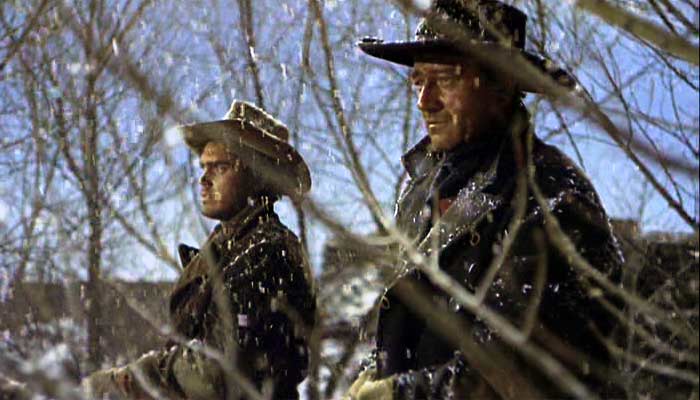
That’ll be the day when someone tries to claim there’s a better Western than John Ford’s ethnocentric look at the dying of the Old West and the birth of the modern era. Essentially about a gunfighter’s attempt to find and kill his young niece, who has been kidnapped and, ostensibly, ruined by Indians, The Searchers is laden with iconic imagery, inside messages, and not-so-subtle metaphors. Hence, it is no accident that John Wayne’s son, Patrick, plays an ambitious yet inept officer named Greenhill. The elder Wayne stars as Ethan Edwards, a tough-as-nails Confederate veteran seeking revenge for the murder of his brother’s family; he’s also out to save Debbie (Natalie Wood) from the Comanches, led by a chief known as Scar (Henry Brandon), by ending her life, because in his world view, it’s better to be dead than red. Joining him on his trek is Debbie’s adopted brother, Martin Pawley (Jeffrey Hunter), who wants to save her from Edwards. The magnificent film balances its serious center with a large dose of humor, particularly in the relationships between Ethan and Martin and Ethan with his Indian companion, Look (Beulah Archuletta). And keep your eye on that blanket in front of the house. The Searchers is screening July 17 & 18 as part of the Museum of the Moving Image series “The Essential John Ford,” which continues through August 2 with such other Ford fare as The Long Gray Line, The Quiet Man, Sergeant Rutledge, Mogambo, and Stagecoach. Born in Maine in 1894, Ford made some of the most dazzling Westerns and literary adaptations ever put on celluloid; he passed away in 1973 at the age of seventy-nine, having won four Best Director Oscars among his nearly 140 pictures.

ANDREI TARKOVSKY, SCULPTING IN TIME: STALKER

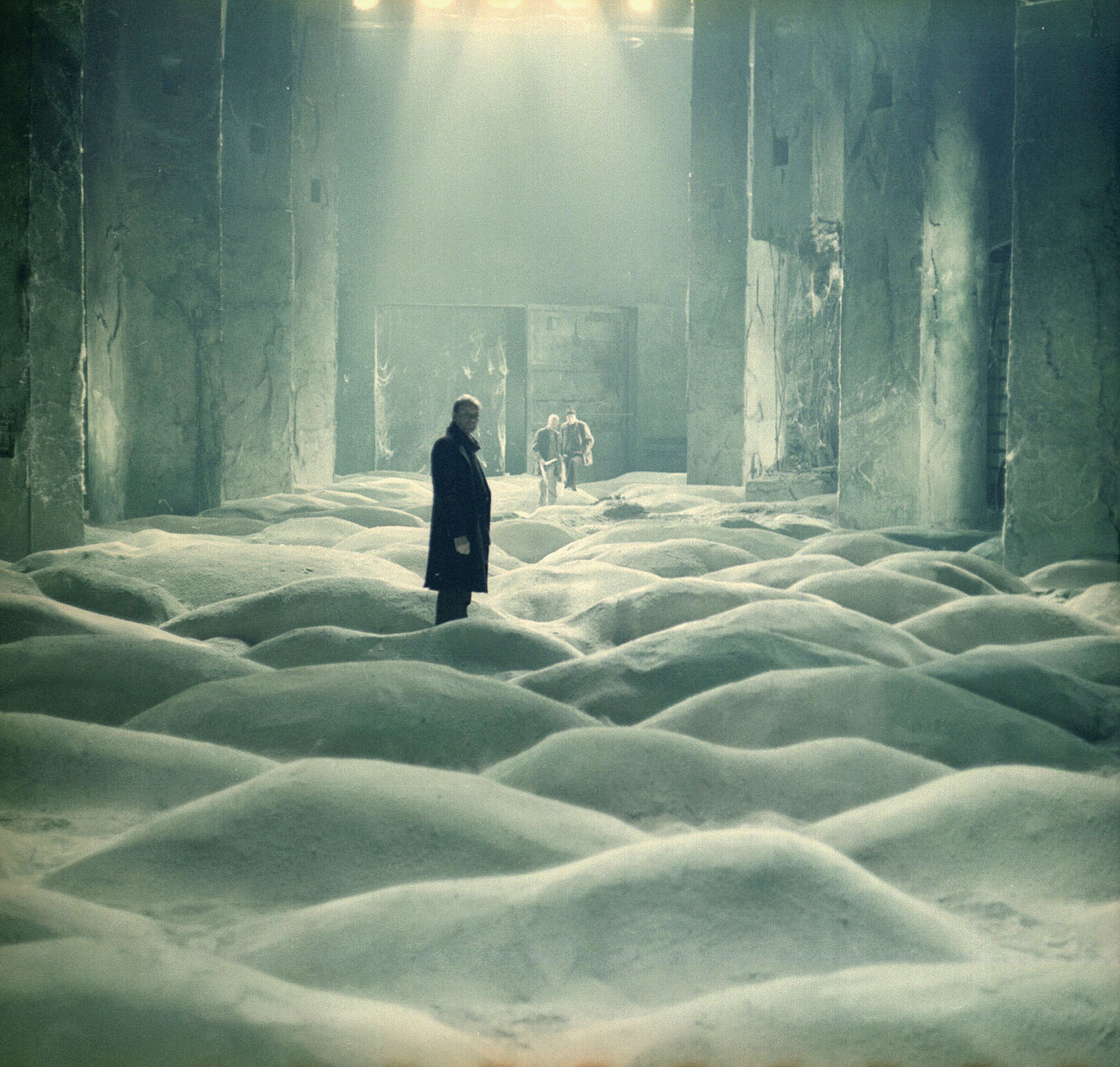
Andrei Tarkovsky’s STALKER takes place in the fantastical land known as the Zone

Andrei Tarkovsky’s STALKER takes place in the fantastical land known as the Zone

STALKER (Andrei Tarkovsky, 1979)
Museum of Arts & Design
2 Columbus Circle at 58th St. & Eighth Ave.
Friday, July 17, $10, 7:00
Series continues Friday nights through August 28
212-299-7777
madmuseum.org

Set in a seemingly postapocalyptic world that is never explained, Andrei Tarkovsky’s Stalker is an existential work of immense beauty, a deeply philosophical, continually frustrating, and endlessly rewarding journey into nothing less than the heart and soul of the world. Alexander Kaidanovsky stars as Stalker, a careful, precise man who has been hired to lead Writer and Professor (Tarkovsky regulars Anatoli Solonitsyn and Nikolai Grinko, respectively) into the forbidden Zone, a place of mystery that houses a room where it is said that people can achieve their most inner desires. While Stalker’s home and the bar where the men meet are dark, gray, and foreboding, the Zone is filled with lush green fields, trees, and aromatic flowers — as well as abandoned vehicles, strange passageways, and inexplicable sounds. The Zone — which heavily influenced J. J. Abrams’s creation of the island on Lost — has a life all its own as past, present, and future merge in an expansive land where every forward movement is fraught with danger but there is no turning back. An obsessive tyrant of a filmmaker, Tarkovsky imbues every shot with a supreme majesty, taking viewers on an unusual and unforgettable cinematic adventure.


Loosely based on the novel Roadside Picnic by the Strugatsky Brothers, Stalker is screening July 17 at 7:00 as part of the the Museum of Arts & Design film series “Andrei Tarkovsky, Sculpting in Time,” which runs Friday nights through August 28 and includes all seven of Tarkovsky’s masterpieces (Solaris, Stalker, Ivan’s Childhood, Andrei Rublev, The Mirror, Nostalghia, The Sacrifice) before concluding with the behind-the-scenes documentary Directed by Andrei Tarkovsky. Tarkovsky, who died in 1986 at the age of fifty-four, was a superior craftsman whose cinematic oeuvre is filled with poetry and wonder, mystery and self-examination, exploring life and death, the past, the present, and the future, incorporating mesmerizing sound and visuals in telling complex stories like one else before or since. (For our 2012 twi-ny talk with Geoff Dyer, the author of Zona: A Book about a Film about a Journey to a Room, which offers quite a unique take on Stalker, go here.)

JELLYFISH EYES

JELLYFISH EYES

Masashi (Takuto Sueoka) and cuddly cute Kurage-bo have to save their strange Japanese town in Takashi Murakami’s JELLYFISH EYES

JELLYFISH EYES (Takashi Murakami, 2015)
IFC Center
323 Sixth Ave. at West Third St.
Opens Wednesday, July 15
212-924-7771
www.jellyfisheyesthemovie.com
www.ifccenter.com

Japanese artist and brand name Takashi Murakami — his 2008 exhibition at the Brooklyn Museum was unironically titled “© Murakami” — brings his unique take on his country’s culture and history to the big screen in his feature debut, Jellyfish Eyes. In his catalog essay “Flat Boy vs. Skinny: Takashi Murakami and the Battle for ‘Japan,’” Dick Hebdige wrote, “Combining shock and awe in equal measure with a destruction/solicitation strategy aimed at winning over jaded hearts and minds, Superflat functions like the ancient Trojan horse to penetrate the art and fashion world’s defenses and to neutralize whatever vestiges remain in the age of the corporate-sponsored art opening of the hermeneutics of suspicion.” That shock and awe is at the center of Murakami’s film, a battle for Japan as seen through the eyes of children, the only ones left with any semblance of humanity in a post-Hiroshima, post-Fukushima world. Sixth grader Masashi Kusakabe (Takuto Sueoka) has just moved to a strange suburban town with his recently widowed mother, Yasuko (Shizuko Amamiya). Masashi instantly makes a new friend, Kurage-bo, a ridiculously adorable jellyfish-like flying creature who goes with him everywhere. Once at school, Masashi discovers that all of the kids have a F.R.I.E.N.D. (the acronym comes from “life-Form, Resonance, Inner Energy, Negative emotion, Disaster prevention”), a kind of avatar/yōkai reminiscent of the daemons in Philip Pullman’s His Dark Materials trilogy. Some of the boys engage their cute or scary buddies in fights akin to bullying, controlling them with electronic devices that evoke the global obsession with smartphones and video games. Masashi makes a real friend in Saki Amamiya (Himeka Asami), a fellow student who abhors fighting and protects herself with her hairy oversize companion, Luxor. As the adults get caught up in strict rules, religious cults, and an unhealthy obsession with safety, a quartet of kids known as the Black Cloaked Four — Blue Dragon (Masataka Kubota), White Tiger (Shota Sometani), Black Tortoise (Hidemasa Shiozawa), and Vermilion Bird (Ami Ikenaga) — is working with Masashi’s uncle, Naoto (Takumi Saito), to capture enough negative energy to destroy and rebuild Japan. Oh, did we mention that this is a kids movie?
JELLYFISH EYES

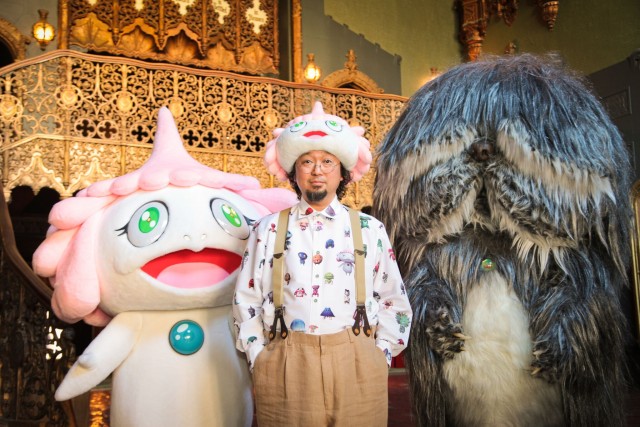
JELLYFISH EYES director Takashi Murakami playfully poses with some F.R.I.E.N.D.s (photo by Chika Okazumi)

It comes as no surprise that Jellyfish Eyes is a bright, colorful film set in a magical otaku/kawaii-crazed society (designed by art director Nori Fukuda), like Murakami’s paintings and sculptures come to life, with dazzling hues jumping off the screen; only the symbol of the Black Cloaked Four, the yin and yang sign, is in cold black-and-white. The F.R.I.E.N.D.s, from Masashi’s Kurage-bo and Saki’s Luxor to Tatsuya’s evil Yupi and Juran’s violent Shimon, as well as Koh’s Ko2, a large-scale, round-eyed anime girl, are tailor made for merchandising, and they are indeed available for purchase. Murakami has always had a dark side, perhaps never so clear as in his most recent exhibition, “In the Land of the Dead, Stepping on the Tail of a Rainbow,” a reaction to the devastation of the 2011 earthquake and tsunami, and it’s at the center of Jellyfish Eyes, the first of a proposed trilogy. But it’s also part of the problem, creating a murkiness and confusion in a narrative that doesn’t always make sense. The soundtrack, by KZ (livetune) and Yoshihiro Ike, is treacly sweet to a fault, and Murakami overdoes the CGI fight scenes. He’s also not shy about declaring this a message picture; “In the wake of 3/11, the damage sustained by Japan runs deep. We must all do our best to emerge from that shadow,” he has stated in reference to the film, as well as “In a sense, one of the few places in which the darkness still lurks in our time is inside mobile phones. Their screens are pitch black.” Murakami and screenwriter Jun Tsugita liberally borrow from such familiar tales as Godzilla, Where the Wild Things Are, Pokémon, and E.T. the Extra-Terrestrial, and the overload of cultural references threaten to pull Jellyfish Eyes down. But Sueoka’s charming innocence and Kurage-bo’s angelic delightfulness eventually triumph over the film’s various shortcomings. Jellfyish Eyes opens July 15 at the IFC Center, with Murakami on hand for a Q&A at the 7:00 show on Wednesday night.