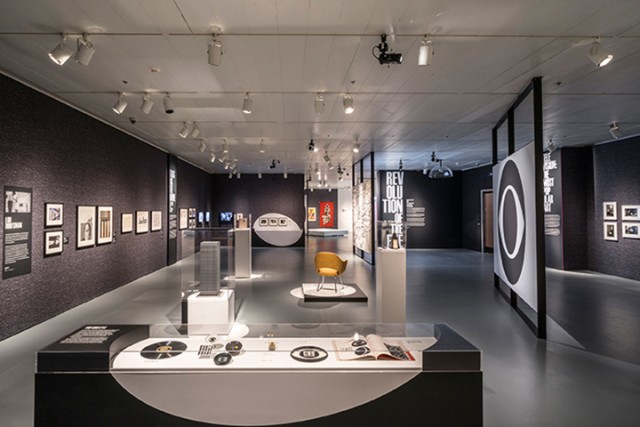
Jewish Museum show explores relationship between early television and modern art (photo by David Heald)
The Jewish Museum
1109 Fifth Ave. at 92nd St.
Thursday – Tuesday through September 27, $7.50-$15 (children eighteen and under free; free admission Saturday 11:00 am – 5:45 pm, pay-what-you-wish Thursday 5:00 – 8:00)
212-423-3200
thejewishmuseum.org
I am a proud TV baby, born into the first generation that treated television like a cherished member of the family. I actually took great offense that my bonus sibling — it was much more than a mere babysitter to me — was referred to as the boob tube and that many people claimed that watching too much of what I even as a kid considered a legitimate art form was bad for your physical and mental well-being. In Annie Hall, Alvy Singer (Woody Allen) famously explains to his actor pal, Rob (Tony Roberts), and girlfriend, Annie (Diane Keaton), why it’s so clean in California: “They don’t throw their garbage away. They make it into television shows.” Which leads me to the Jewish Museum’s fun and fascinating new look at the medium, the informative and entertaining exhibition “Revolution of the Eye: Modern Art and the Birth of American Television,” continuing through September 27. “Rarely is TV discussed in terms of art — and when it is, critics have usually focused on the ways television has influenced high art, or been critiqued and ridiculed by it,” UMBC Center for Art, Design, and Visual Culture executive director Symmes Gardner writes in his foreword to the catalog. “Yet as network television now shares the stage with other forms of broadcasting and video dissemination, we can see the ways in which this popular, commercial mechanism aided art, responded to art — and was, many times, itself art.”
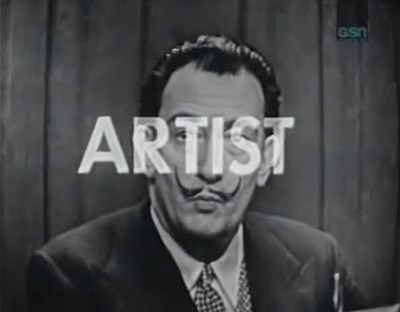
Exhibition includes clip of Salvador Dali appearance on WHAT’S MY LINE? (© Fremantle Media)
The multimedia show follows the development of television from the 1940s through the 1970s, tracing the impact that modern art had on the telly, which in turn influenced contemporary American society. Lovingly curated by Maurice Berger — although a bit noisy, with too many of the sounds bouncing off one another — the exhibition explores links between Rod Serling’s anthology series The Twilight Zone and surrealism (including a startling comparison of the opening title sequence to clips of short films by Marcel Duchamp, Fernand Léger, and René Clair), and Ernie Kovacs and Dada (and how the comic master was among the first to exploit the technology of the medium itself while playfully attacking the corporations that sponsored it). The development of television logos, advertising, and title sequences turns out to be quite a tale, involving such cutting-edge graphic designers as Saul Bass and established artists as Ben Shahn. Rowan and Martin’s Laugh-In is seen in conjunction with Pop, Op, and psychedelic art, while the tongue-in-cheek Batman series is compared to the comic-book Pop art of Roy Lichtenstein. Even Dinah Shore and Ed Sullivan make the cut, the latter’s mod sets matched with sculptures by Sol Lewitt, Donald Judd, and Robert Morris. The exhibit also has rare clips of artists on television, including Salvador Dali, Andy Warhol, Alexander Calder, Willem de Kooning, John Cage, Duchamp, Shahn, and Lichtenstein, although they are all far too short, but a segment of Aline Saarinen’s Sunday Show with Alberto Giacometti is a real treat. There are also works by Lee Friedlander (mocking the medium), Georgia O’Keeffe, Man Ray, Robert Motherwell, Eero Saarinen (Aline’s husband), Agnes Martin, and others, in addition to sections devoted to Winky Dink and You, which invited kids to be artists using the television screen, and the Museum of Modern Art’s Television Project, which sought to place the medium in a higher art form, something that the Jewish Museum has ably accomplished in this splendid exhibit that justifies my longtime love affair with the boob tube.
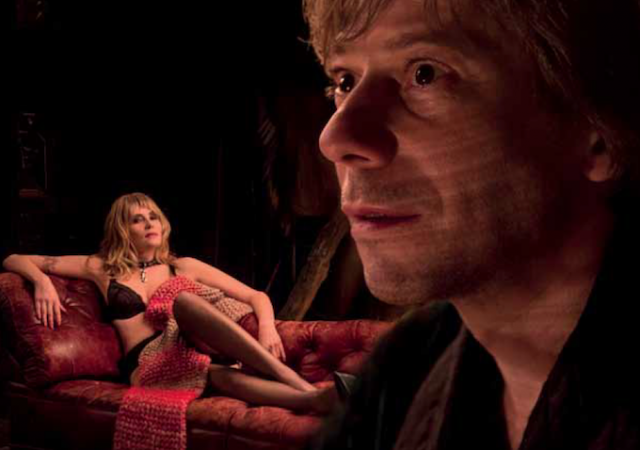
 For his third stage adaptation in ten years, following 1994’s Death and the Maiden and 2011’s Carnage, Roman Polanski created a marvelous, multilayered examination of the intricate nature of storytelling, consumed with aspects of doubling. David Ives’s Tony-nominated play,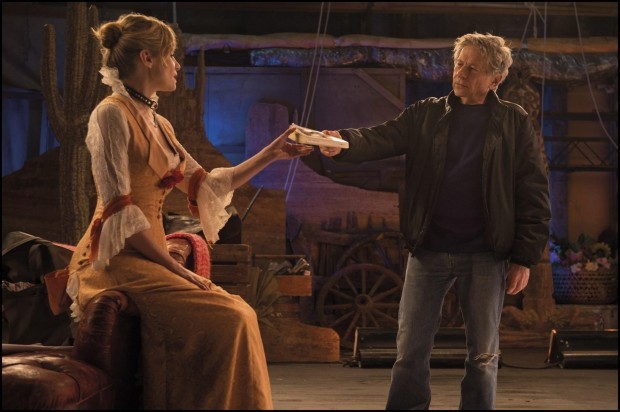

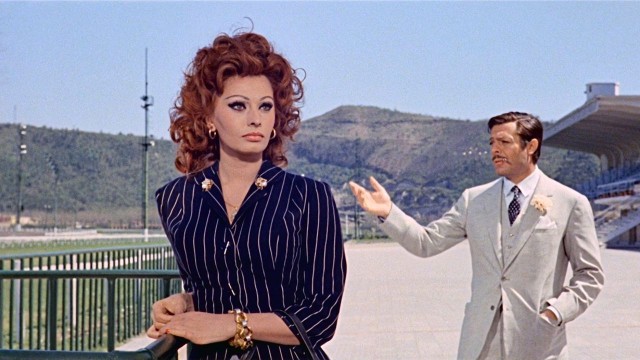
 Marcello Mastroianni and Sophia Loren have a blast playing off their reputations in Vittorio De Sica’s Oscar-nominated romantic farce, Marriage Italian Style. The colorful 1964 film is a kind of follow-up to Pietro Germi’s 1961 comedy, Divorce Italian Style, which earned Mastroianni an Oscar nomination for Best Actor. In Marriage, which is based on Eduardo De Filippo’s 1946 play, Filumena Marturano, Mastroianni stars as Domenico Soriano, a well-to-do businessman who takes an instant liking to seventeen-year-old prostitute Filumena (an Oscar-nominated Loren) in a Naples brothel during a WWII air raid. Their relationship secretly blossoms, but when Filumena grows tired of being hidden by Domenico, treated more like a maid than a lover, she decides to take matters into her own hands, with more than a few surprises. Mastroianni is exceptional as the smooth-talking, dapper, and elegant Domenico, who can’t keep away from beautiful young women, while Loren, who previously worked with De Sica in The Gold of Naples and Two Women, winning an Oscar for Best Actress in the latter, is at her fiery best as the hot-blooded hooker trying to raise her station in life. Produced by Carlo Ponti during the brief annulment period in his marriage to Loren, the film, which is told partly in flashback, also features Tecla Scarano as Domenico’s maid, Rosalia, and Aldo Puglisi as Domenico’s right-hand man, Alfredo, who takes quite a shine to Filumena. Armando Trovajoli’s lush, romantic score adds wonderful irony to the comic proceedings. And just wait till you see Loren in that mind-blowing black lingerie. Marriage Italian Style is screening September 20 & 21 as part of Film Forum’s twenty-four-day retrospective of elegant actor-director De Sica, one of the great Italian neorealists; the series continues through October 8 with such other seminal works as Bicycle Thieves, Miracle in Milan, Umberto D., General Della Rovere, Shoeshine, Two Women, and The Earrings of Madame De . . .