twi-ny recommended events

PALEYFEST NY

The real Tatiana Maslany will be at PaleyFest NY to discuss ORPHAN BLACK

The real Tatiana Maslany will be at PaleyFest NY on October 18 to talk about her hit BBC America show, ORPHAN BLACK

The Paley Center for Media
25 West 52 St. between Fifth & Sixth Aves.
October 10-19, $10 (Viewing Room) – $50 (main theater)
paleycenter.org

It’s time to stop all that binge-watching, get off the couch, and actually go outside, where you can see the real deal at PaleyFest NY, taking place October 10-19 at the Paley Center for Media in Midtown. Each day, the Paley Center will be featuring a panel discussion on a different series, with many of the stars and creators in person to talk about the show. Some events ($50) are already sold out, but you can still get a ticket ($10) to watch them projected live in the Viewing Room. Things kick off on October 10 with “Dr. Horrible’s Sing-Along Blog Reunion,” gathering together Neil Patrick Harris, Nathan Fillion, Felicia Day, and Joss Whedon. That is followed by Pretty Little Liars (Lucy Hale, Ashley Benson, Troian Bellisario, Sasha Pieterse, I. Marlene King, Oliver Goldstick, Joe Dougherty), The Affair (Dominic West, Ruth Wilson, Maura Tierney, Joshua Jackson, Josh Stamberg, Julia Goldani Telles, Sarah Treem), Ash vs Evil Dead (Bruce Campbell, Lucy Lawless, Ray Santiago, Dana DeLorenzo, Jill Marie Jones, Sam Raimi, Craig DiGregorio), Mr. Robot (Rami Malek, Christian Slater, Carly Chaikin, Portia Doubleday, Sam Esmail), Fargo (Kirsten Dunst, Jesse Plemons, Jean Smart, Noah Hawley, Warren Littlefield), The Mindy Project (Mindy Kaling, Ike Barinholtz, Ed Weeks, Beth Grant, Xosha Roquemore, Matt Warburton, Charlie Grandy, Tracey Wigfield, Lang Fisher, Chris Schleicher, David Stassen), Orphan Black (Tatiana Maslany, Jordan Gavaris, Maria Doyle Kennedy, Kristian Bruun, Graeme Manson), and Transparent (Jeffrey Tambor, Judith Light, Amy Landecker, Jay Duplass, Gaby Hoffmann, Jill Soloway).

THE NEW MORALITY

(photo by Richard Termine)

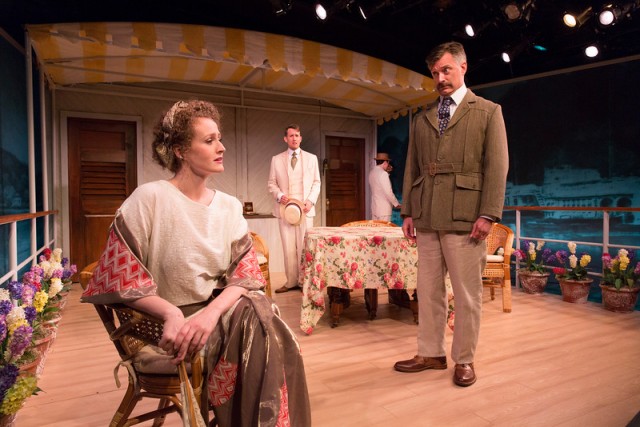
Betty Jones (Brenda Meaney) has a bone to pick with her husband (Michael Frederic) in Mint revival of Harold Chapin’s THE NEW MORALITY (photo by Richard Termine)

Mint Theater
311 West 43rd St. between Eighth & Ninth Aves.
Tuesday – Sunday through October 25, $55-$65 (all seats $43 for the final week; $100 for last show, followed by a farewell party)
866-811-4111
www.minttheater.org

The Mint does the theater world another great service by reviving Harold Chapin’s deliciously delightful comedy of manners, The New Morality. In honor of the centennial of Chapin’s death — the Brooklyn-born British playwright and actor was killed in action in WWI in September 1915 at the age of twenty-nine, before this play was ever produced — Mint artistic director Jonathan Bank has finally brought it to New York for its first theatrical run; it previously played only a handful of matinees way back in 1921. The three-act, nearly two-hour show takes place in 1911 on a houseboat on the Thames, where local socialite Betty Jones (a devilishly vampy Brenda Meaney) has just laced into neighbor Muriel Wister with a loud string of unwomanly insults on a day so hot that the morning milk is going sour almost immediately. Her friend Alice Meynell (Clemmie Evans), a prim, proper, demure young woman, arrives for tea only to find Betty still in bed, bemoaning her outburst. “Did you or did you not hear me call that woman a —,” Betty begins to ask, cut off by Alice responding, “Well, she is . . . ,” to which Betty declares, “I know she is! But you can’t go calling people dog-show names on the deck of their own houseboat in a voice loud enough to be heard across the river.” Betty’s husband, the stodgy Colonel Ivor Jones (Michael Frederic), then comes in, demanding that his wife apologize to Muriel, but she insists she will do nothing of the sort. “Don’t you think it would be politic? I do,” Jones says, to which Betty replies, “A man always thinks the most politic thing he can do is to humiliate his wife.” It turns out that Betty verbally attacked her neighbor because Muriel more than tolerates Ivor’s infatuation with her; he follows her around like a puppy dog in full view of the rest of the community, wholly embarrassing his wife. After Alice departs, Betty and Ivor are visited by Muriel’s husband, E. Wallace Wister (Ned Noyes), a milquetoast stick in the mud who demands that Betty answer for her actions, but again she refuses to acquiesce. Soon Betty’s suave brother, lawyer Geoffrey Belasis (Christian Campbell), enters the fray as the discussions grow more and more heated in wildly funny ways, assessing not only the specific situation but the state of British high society and women’s place in it.

(photo by Richard Termine)

Playwright Harold Chapin examines love, marriage, and British society in stinging comedy (photo by Richard Termine)

As with so many Mint productions, the set, designed by Steven C. Kemp, is utterly charming; the first act takes place in Betty’s lovely chintz-covered bedroom, while the second and third acts are held on the spacious deck of their houseboat, with projections of the Thames and the shore on the back and sides of the stage. (Be sure to stick around during the first intermission to watch the magical change.) Meaney (Indian Ink, Venus in Fur) is superb as Betty, a clever, forward-thinking woman with a yearning sexuality and a fab wardrobe courtesy of costume designer Carisa Kelly. Chapin joins Shaw and Wilde in their investigations of the “New Woman” of the early twentieth century, breaking with Victorian ideas of propriety and forging a new identity in public and private spheres. Like them, he delivers his sociological thoughts via wickedly sharp dialogue skewering the British upper class, ably performed by a cast that also includes Kelly McCready as the Joneses’ curious maid, Lesceline, and Douglas Rees as their stout man-servant, Wooten. When Chapin died, the British theatrical press mourned his loss; St. John Ervine wrote in the Guardian, “It must be true that the taste for comedy, which is an educated taste, has very nearly disappeared from London. But it will, no doubt, come back again; and when it does this play will have its day.” The New Morality is finally having its day in New York City at the Mint, and one can only hope that more of Chapin’s works are on the horizon. Unfortunately, that won’t be happening in the Mint’s home of twenty years, 311 West Forty-Third St., where the company has become the latest victim of the real estate market. The Mint will continue — Bank has a full slate of plays lined for 2016 — but the location is up in the air as of now.

A WOMAN LIKE ME

Alex Sichel and Lily Taylor

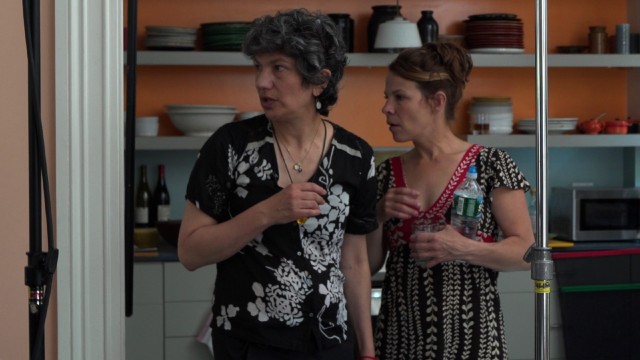
Filmmaker Alex Sichel and her onscreen alter ego, actress Lili Taylor, face mortality head-on in A WOMAN LIKE ME

A WOMAN LIKE ME (Alex Sichel & Elizabeth Giamatti, 2015)
Village East Cinemas
181-189 Second Ave. at 12th St.
Opens Friday, October 9
212-529-6799
www.awomanlikemefilm.com
www.villageeastcinema.com

When filmmaker Alex Sichel was diagnosed with metastatic breast cancer a few years ago, she turned to her stock in trade: making movies. But Sichel, the writer-director of the indie gem All Over Me and an episode of HBO’s If These Walls Could Talk 2 starring Michelle Williams and Chloë Sevigny, decided to share her situation in an unusual way, combining documentary with fiction in the intimate, moving A Woman Like Me. In the film, which she codirected with Elizabeth Giamatti, Sichel shows herself going through chemotherapy, meeting with holistic healers, and dealing with family issues with her husband, Erich Hahn, who is not exactly thrilled with many of his wife’s choices and constantly being on camera himself; their seven-year-old daughter, Anastasia, with whom they have chosen not to share the details of Sichel’s illness; and Sichel’s parents and sisters, who have their own opinions about how she should be facing her cancer, which doctors say is terminal. As the film opens, Sichel’s voice floats over a black screen, talking about the Buddhist meditation on death. “The point is, we’re all going to die, and it sounds so obvious, but that’s the point that I don’t accept,” she says. “Somehow I’m going to be the exception. It’s crazy.”

Alongside the documentary part of A Woman Like Me, Sichel is also making a fictionalized account of what she’s going through, with Lili Taylor as Anna Seashell, Jonathan Cake as her husband, Walter, and Maeve McGrath as their young daughter, Zoe. “The only way you even have a chance of living longer with the disease is if you face your fear of death, and the movie is a way of trying to do that,” Sichel says in voiceover as Taylor walks over to a window, puts her hands on the glass, and looks out as, ultimately, Sichel watches the scene unfold on her director’s monitor. It’s a powerful moment, as is a scene in which Sichel and Taylor go over the script together. Sichel is bold and blunt throughout A Woman Like Me, especially when her situation worsens, but she’s able to temper her fears by having her fictional self face death in a much more positive light. Despite its serious subject matter, A Woman Like Me is a celebration of life that avoids mundane sentimentality and self-indulgence, instead intelligently and honestly depicting how one brave woman and her family come to grips with mortality. “How do you make a movie about cancer,” Sichel says into the camera after undergoing a medical test. She and Giamatti have certainly found one unusual, and successful, way. Winner of the SXSW Special Jury Prize for Directing, A Woman Like Me opens October 9 at Village East, with panel discussions taking place after the 7:00 shows on October 9, 10, 11, and 13 and the 4:30 screenings on October 10 and 11.

HOW CATS TOOK OVER THE MUSEUM OF THE MOVING IMAGE

Alexander Hammid and Maya Derens PRIVATE LIFE OF A CAT is part of feline festivities at Museum of the Moving Image

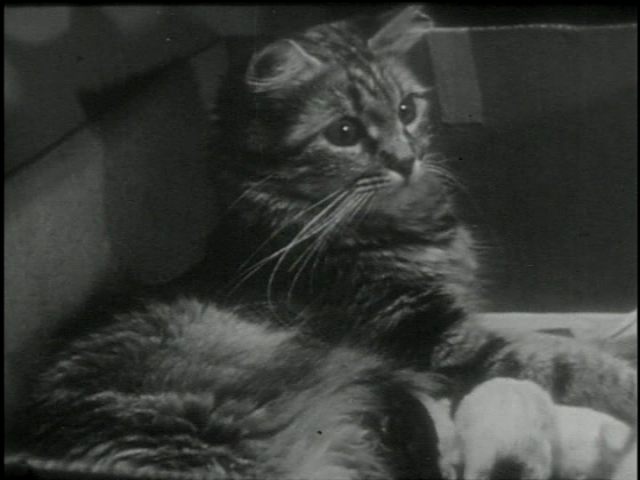
Alexander Hammid and Maya Deren’s PRIVATE LIFE OF A CAT is part of feline festivities at Museum of the Moving Image

Museum of the Moving Image
35th Ave. at 36th St., Astoria
Special events October 9, 10, 23 (free with gallery admission of $6-$12)
Exhibit continues Wednesday – Sunday through January 31, $6-$12
718-777-6800
www.movingimage.us

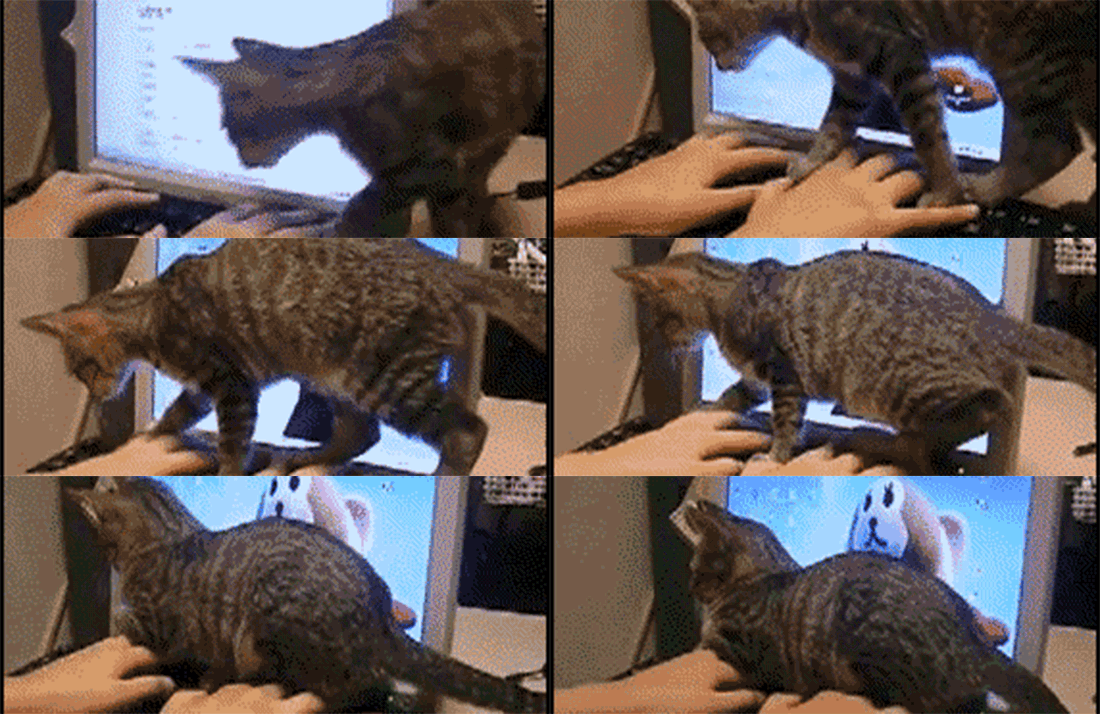
A little more than ten years ago, on May 22, 2005, YouTube cofounder Steve Chen posted a video of his cat, Pajamas, on the new social media hub. It didn’t take long until felines ruled all of cyberspace with their unbelievable cuteness and nasty tempers, whether trying to squeeze into a glass vase, gliding through the kitchen on a Roomba, playing the piano, or sneaking up on their humans like a ninja in the night. Now they have descended upon Astoria, where they have taken over the Museum of the Moving Image. Through January 31, the Queens institution dedicated to the evolution of film and television is showing “How Cats Took Over the Internet,” a fun, if relatively slight, exploration of the history of the filming of pussycats, from Thomas Edison to Steve Chen to Grumpy Cat. The exhibit is divided into such sections as “Anthropomorphism,” “The Mediated Cat,” and “Watching Cats (and Seeing Ourselves),” includes a timeline that traces the phenomenon from Meowchat, Bonsai Kitten, and Cat Scan Contest to My Cat Hates You, Caturday, and Lolcats — I Can Has Cheezburger?, tracks the impressive number of hits on YouTube, Instagram, Buzzfeed, and Tumblr, and, most important, delves into the Happiness Factor. Because when hasn’t a video of a cat doing something so charmingly stupid brightened even your darkest day? And you might just find one of your favorites in the twenty-four-minute loop that kicks off the exhibition, featuring such cat-video classics as “Cool Cat / Charlie Schmidt’s Keyboard Cat! — THE ORIGINAL!,” “Dog Baths Cat,” “Henri 4 — L’Haunting,” “8 Signs of Addiction,” “Vinyl Cat,” and “Willie Is Better Than Your Cat.”

Museum of the Moving Image is being overrun by cats this fall

Museum of the Moving Image is being overrun by cats this fall

The museum will also be hosting several special events in conjunction with “How Cats Took Over the Internet.” On October 9 at 7:00, An Xiao Mina, Matt Stempeck, Ben Valentine, and Luis Daniel will be on hand for “Not Just Cats: Llamas, Goats, and Other Animal Memes from Around the World,” discussing how cats are treated (and worshiped) across the globe. On October 10 at 2:00, “The Cat-vant Garde Film Show” consists of fourteen cat shorts made by such experimental-film pioneers as Stan Brakhage (Nightcats, Cat’s Cradle), Pola Chapelle (How to Draw a Cat), Martha Colburn (Cat’s Amore), Alexander Hammid and Maya Deren (The Private Life of a Cat), and Ken Jacobs (Airshaft). Also on October 10 from 1:00 to 5:00, you can take home your own kitten at the ASPCA Mobile Adoption Event. And on October 23 at 7:00, Kevin Allocca, Amanda Brennan, and Jack Shepherd will be at the museum for “Internet Cat Experts Tell All,” letting us know why we can’t stop watching and laughing at this endless supply of adorable and frightening kitty vids.

TWI-NY TALK: ROARKE MENZIES

(photo by Dusdin Condren)

Roarke Menzies will celebrate the release of his debut album with an intimate party October 10 at Bunna Cafe (photo by Dusdin Condren)

Bunna Cafe
1084 Flushing Ave., Brooklyn
Saturday, October 10, free, 11:00 pm
www.roarkemenzies.com
bunnaethiopia.net

Vancouver-born, Brooklyn-based multidisciplinary artist, composer, and producer Roarke Menzies knows about collaboration. For the past ten years, Menzies has been working with dancers, storytellers, choreographers, visual artists, and film directors, creating soundscapes and scores primarily using electronics, vocals, and his body. He’s been involved in projects at the Kitchen, the New Museum, Jacob’s Pillow, Abrons Arts Center, the Bushwick Starr, and the Vancouver Biennale in addition to composing music for a VICE web pilot and an award-winning educational app for children. But now Menzies, a self-described “sonic explorer,” is entering new territory, putting himself front and center with the release of his debut album, Shapes (October 13, Coup de Glotte). The record features six soundscapes, running in length from 2:11 (“Man in the Myler”) to 13:58 (“Music for Spatial Shift”), that take listeners on an ethereal journey through space and time, from the gentle, lilting “Those Pretty Lights” to the echoing, wind-strewn “Pulse Inflections.” Earlier this year, we did a twi-ny talk with Menzies and Rome about their show Philadelphia and Other Stories. Now we go it alone with Menzies, as he discusses sonic phenomena and the material world, his rather heady reading list, Aboriginal artist Warlimpirrnga Tjapaltjarri, and more.

twi-ny: We first met five years ago, when artist Nuala Clarke invited us, along with several others, to perform at her art opening, “You Delight Me,” on Shelter Island. How’s life been treating you since then?

Roarke Menzies: Yeah, that was a lovely event. Nuala contacted me out of the blue. We’d never met before. I was working on some music with my brother in LA and got an email from her asking me to participate. I think she’d found something of mine online.

I’ve been so lucky, in a lot of ways. I get approached to work on a lot of compelling projects, and between that and my other jobs [in performing arts management] I’m able to earn enough to support myself and pursue creative endeavors.
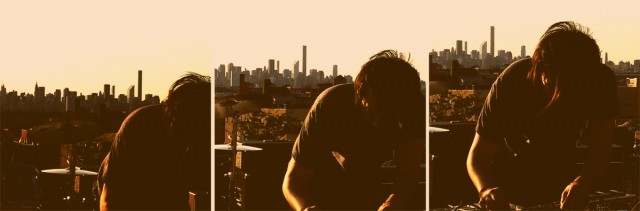
(photos by Paul Rome)

Roarke Menzies expands his horizons with new album, SHAPES (photos by Paul Rome)

twi-ny: I’m really enjoying your debut album, Shapes, which takes listeners on a fascinating sonic journey. You wrote and play all the music as well as handle the production, recording, and mixing. How long did it take you to put it all together?

RM: That’s awesome. I’m glad you’re enjoying it. These are works that have developed slowly over the past several years. The earliest recorded material on there is from late 2009 and has been revisited and reworked a number of times. I’ve put a lot of thought and care into these tracks. It’s a lot of work, but it’s definitely a labor of love.

twi-ny: You describe Shapes as both creating space and filling it up. Can you expand on that a little?

RM: I’m actually referring not just to the sounds on Shapes but to sound in general, and how we interpret sound phenomena in relation to our sense of space.

If you’re on an underground subway platform, every sound you hear reverberates in ways that inform your sense of that space. Even without visual cues, your mind can put together the cavernous space you’re in. That same effect can be simulated artificially using reverb. Sound designers and engineers make practical use of it all the time, in film or radio, for instance, creating the sense of size or the characteristics of the space you’re “in” using only sound. But that space doesn’t actually exist, at least not in the way “existence” is generally understood. It’s a fiction fabricated using particular signs and signals that your mind interprets as a space.

In other instances, the sheer “density,” “mass” or “volume” of a sound can create this feeling that it’s there in front of you — “a sound filled the room” — like you could just reach out and touch it in the same way you can touch a glass of whiskey or a person on the cheek. But sound doesn’t really behave that way either.

One of the curious aspects in working with sound as a material is that it’s not, in fact, material. And yet it seems to have this power to at times convince us of its materiality, even if just temporarily, and to completely change our sense of the material world around us. I’m interested in how those processes play out.

twi-ny: Where do you get your sonic inspirations? I have a feeling that when you traverse the city, you listen to all the cacophony and noise in a different way than the rest of us, gathering ideas for your work.

RM: I’m definitely a sound-obsessed person, and I’m often mesmerized and perplexed by the city’s sound culture. I do a lot of listening and a lot of reading. I find reading fuels my creative life like nothing else, whether articles, essays, books, blog posts, Wikipedia entries. Ben Lerner’s novel 10:04 is a recent favorite, and I have a long reading list that I’m slowly working through of texts related to performance, sound and technocultural studies. I think the next will be Brandon LaBelle’s Lexicon of the Mouth: Poetics and Politics of Voice and the Oral Imaginary.

twi-ny: That’s some heavy stuff. Shapes includes a tribute to the great La Monte Young. Who are some of your other musical influences?

RM: I feel like my influences are all over the place — Arvo Pärt, Portishead, Fluxus, Sam Cooke’s gospel recordings with the Soul Stirrers, Deerhunter’s Cryptograms, Geinoh Yamashirogumi’s soundtrack for Akira, Kanye West’s 808s & Heartbreak, the choral works of Morten Lauridsen, the rugged lands of early RZA, the pop masterpieces of Max Martin, the subterranean cityscapes of Burial, the codeine-soaked tapescapes of DJ Screw, the Courvoisier-soaked jiggyscapes of early 2000s Neptunes, etc. I’m a huge music appreciator.

twi-ny: Who do you listen to on your iPod?

RM: All that being said, there’s really not a lot of it on my iPhone. Other than work-related stuff and that U2 album we were all force-fed (I never bothered to listen to or erase it), all I’ve got on there at the moment is Cocteau Twins, Arthur Russell, Nico Muhly, Tim Hecker, Oneohtrix Point Never, James Blake, a vintage Soweto compilation, and a few mixes from the UK music publication The Wire.

twi-ny: What about seeing live music?

RM: Recent highlights that come to mind include Tyondai Braxton’s new Hive project at the Kitchen, FKA Twigs’ Congregata for Red Bull Music Academy, a riveting set from Pharmakon at St. Vitus, the experimental synth duo Long Distance Poison at Pioneer Works, and an improvised set from saxophonist Colin Stetson, bassist Trevor Dunn, and drummer Greg Fox (of Zs) at Outpost.

twi-ny: You also compose scores and soundscapes for Paul Rome’s story presentations, Jack Ferver’s multidisciplinary performances, and such choreographers as Adam Barruch and Meredith Glisson. How does your creative process differ for such diverse projects, or do you approach them all the same?

RM: My approach can be radically different, depending on the project and the working styles of the people involved. I try to learn the vocabulary and codes — “When they say this, they mean this” — then develop an understanding for what will best support the work.

twi-ny: You’ll be celebrating the release of your debut album, Shapes, with a party on October 10 at Bunna Cafe in Brooklyn, and you’ll be joined by Rome, Katie Mullins, and David Kammerer. What do you have planned for the event?

RM: I’m planning a very warm, intimate event. Bunna’s a great Ethiopian restaurant with a small stage. It’s a favorite spot of mine. We’ll likely open the evening with an Ethiopian coffee ceremony. Then Paul will read a new story he’s been working on, David and Katie will each play a few new songs of theirs, and I’ll perform a short solo set. The performances will be relatively brief since the focus is really to celebrate with friends.

I actually have a really exciting last-minute addition to the night’s festivities. The Ghanaian xylophone virtuoso SK Kakraba is going to come to Bunna after his show at Bossa Nova Civic Club for an informal late night solo set. I have to thank my good friend Mike Visser (of Imaginary Tricks) for arranging that one. It’s going to be a really special night.

twi-ny: What do you do when you take a break from music, if you ever take breaks from music?

RM: I definitely take lots of breaks. When I’m not at work or focusing on a specific project, I don’t like to be holed up in my studio for no reason. I like to get out and see things, or spend time with friends and loved ones.

I recently saw an incredible painting show at Salon 94 on the Bowery. It’s the first solo show in the US by an Australian Aboriginal artist named Warlimpirrnga Tjapaltjarri, who along with his family was living nomadically until they were “discovered” in the ’80s. [Ed. note: The show, “Maparntjarra,” continues at Salon 94 through October 24.] Apparently this guy is revered as an important leader and healer among Australian tribes and is also considered one of the most important innovators in contemporary indigenous art from Australia. All I can say is it was one of the most powerful experiences I’ve ever had at a painting show, incredibly inspiring.

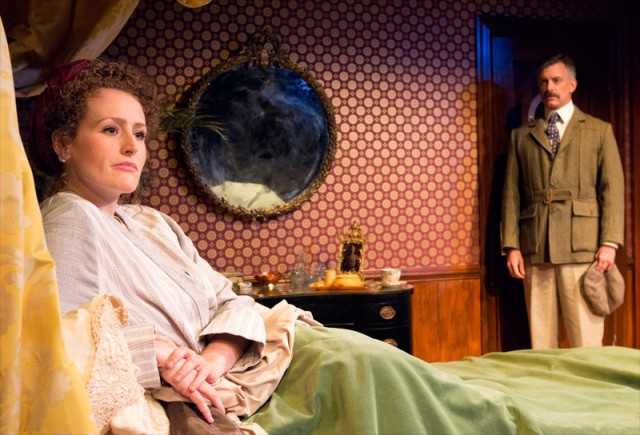
CINDERELLA: A BAROQUE BURLESQUE BALLET

(photo by Phillip Van  Nostrand)

Austin McCormick and Company XIV give a whole new look to beloved fairy tale (photo by Phillip Van Nostrand)

Minetta Lane Theatre
18 Minetta Lane between MacDougal St. & Sixth Ave.
Tuesday – Sunday through November 15, $40-$100
companyxiv.com
minettalanenyc.com

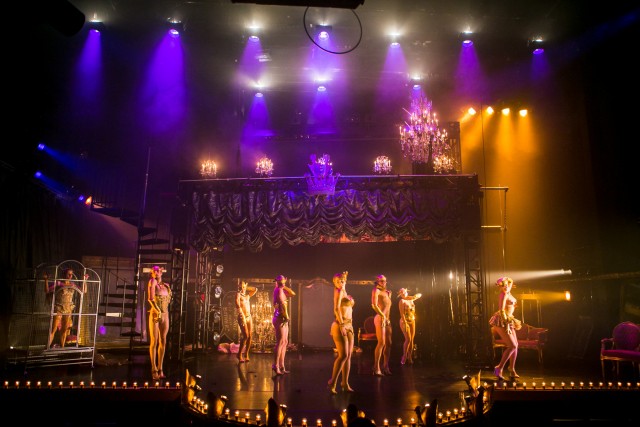
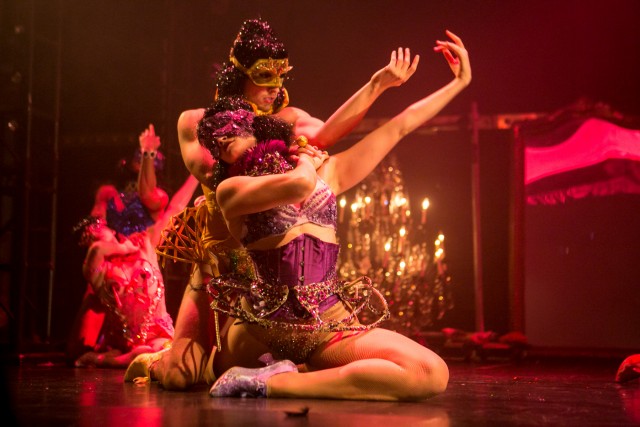
New York-based Company XIV brings a rather decidedly decadent edge to Cinderella, the anti-Disney version of Charles Perrault’s 1697 fairy tale about an orphaned and abused girl on the cusp of womanhood, seeking her Prince Charming despite severe family dysfunction. Billed as a “Baroque Burlesque Ballet,” this Cinderella boasts bold sexuality, acrobatics, cross-dressing, pole dancing, and a wildly imaginative score, all brought together by company artistic director Austin McCormick. Outfitted in Zane Pihlstrom’s dazzling, body-baring costumes that quote drag ball and S&M style — Pihlstrom also designed the small set, which features a lush curtain topped by a glittering crown, a baroque backdrop, and a fun-house mirror — the twelve dancers put on a dazzling show, with Allison Ulrich as Cinderella, Steven Trumon Gray as the strikingly handsome prince, Marcy Richardson and Brett Umlauf as the dastardly stepsisters, Katrina Cunningham as the heroic Fairy Godmother (who takes nurturing to a new extreme), and Davon Rainey as the devious stepmother, a fearlessly erotic combination of Tim Curry in The Rocky Horror Picture Show and Billy Porter in Kinky Boots as conceived by the Marquise de Sade and Louis XIV. The two-hour-plus show, with two intermissions, contains almost no dialogue; instead, details of the plot are revealed by performers Hilly Bodin, Lea Helle, Jakob Karr, Nicholas Katen, Malik Kitchen, and Mark Osmundsen, who walk across the stage with two-sided chalkboards announcing scenes and acts in addition to their other roles. Jeanette Yew’s lighting shows off the heated dancing and eye-opening costumes to great effect.

(photo by Phillip Van  Nostrand)

Company XIV reimagining of CINDERELLA is a decidedly adult undertaking (photo by Phillip Van Nostrand)

Highlights include a virtuoso solo by Rainey, a provocative duet between Ulrich and Cunningham, the beautifully choreographed ball scene, and a cage dance by Ulrich, turning the standard fairy-tale musical inside out with more than a touch of strip-club bravado. The score contains eerie versions of such songs as Lorde’s “Royals,” Lana Del Rey’s “Born to Die,” Roxy Music’s “Love Is the Drug,” and Nicki Minaj’s “Get on Your Knees,” as well as works by Prokofiev, Tchaikovsky, Verdi, and Irving Berlin. During the two intermissions, the performers display their vast talents in out-of-character burlesque vignettes that are well worth sticking around for. Company XIV has previously staged such compelling, cutting-edge shows as Rococco Rouge and Lover. Muse. Mockingbird. Whore, and in November they’ll be bringing back their popular Nutcracker Rouge, with their rendition of Snow White scheduled for January. We can’t wait to see what this immensely skilled and adventurous company has in store for that.

OLD TIMES

(photo by Joan Marcus)

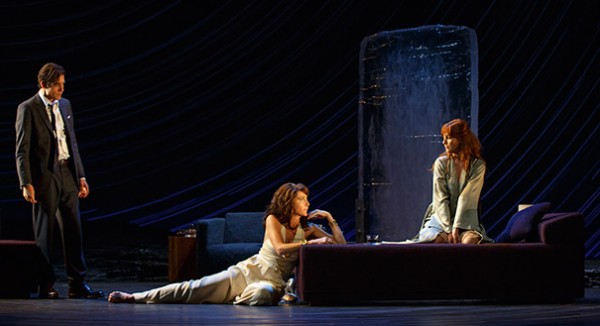
Clive Own, Eve Best, and Kelly Reilly delve into the mysterious past in Roundabout revival of Harold Pinter’s OLD TIMES (photo by Joan Marcus)

American Airlines Theatre
227 West 42nd St. between Broadway & Eighth Ave.
Tuesday – Sunday through November 29, $67-$137
212-719-1300
www.roundabouttheatre.org

As the Roundabout’s Broadway revival of Harold Pinter’s Old Times opens, Deeley (Clive Owen) is man-spread on a fashionably modern chair, Kate (Kelly Reilly) lies on a matching couch, and Anna (Eve Best) stands between them, facing a large, rectangular block of ice, her back to the audience at the American Airlines Theatre. It looks as if something happened the night before, something no one wants to remember. “Dark,” Kate says to Deeley. Indeed, Old Times is dark. And this being Pinter, don’t expect there to be much light shed on exactly what might have happened the night before, or at all, during this seventy-minute journey into a never-defined past or present. Early on, Kate confesses to Deeley, her husband, that Anna was her best and only friend, that they once lived together, but she also admits, “I hardly remember her. I’ve almost forgotten her.” Meanwhile, Anna raves about the two women’s relationship in great detail, with verve and excitement, but she adds, “There are some things one remembers even though they may never have happened. There are things I remember which may never have happened but as I recall them so they take place.” They all discuss having seen Carol Reed’s IRA noir masterpiece, Odd Man Out, and at one time or another in the play, each of the characters becomes the “odd man out” as the other two bond by telling old stories, singing American classics, or debating a possible previous meeting. “Some people throw a stone into a river to see if the water’s too cold for jumping,” Anna says, continuing, “others, a few others, will always wait for the ripples before they will jump.” There are plenty of ripples in Old Times, which has a backdrop of ever-widening concentric circles that evoke the ripples in a lake, or the rays of a pitiless sun. Christine Jones’s (American Idiot, The Green Bird) set also features black clumps of dried lava (“I live on a volcanic island,” Anna says), a sharp counterpoint to the huge block of ice and the mural of rippling water or blazing sun, echoing the characters’ ability to go from hot to cold and back again in an instant.

(photo by Joan Marcus)

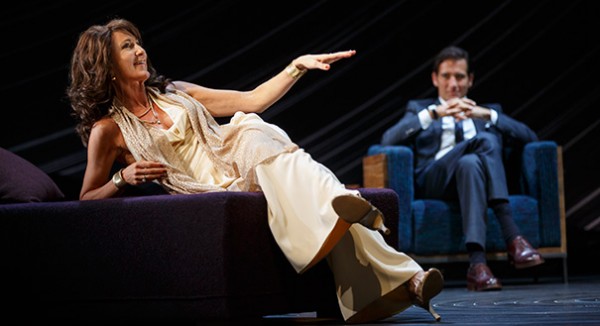
The sexy Anna (Eve Best) shares her memories in OLD TIMES (photo by Joan Marcus)

It’s been forty-four years since Old Times was last seen on Broadway, in its Great White Way debut with Robert Shaw, Rosemary Harris, and Mary Ure, and the Roundabout previously revived it in 1984 with Anthony Hopkins, Jane Alexander, and Marsha Mason. It is considered one of Pinter’s middle-period memory plays, which also include 1974’s No Man’s Land and 1978’s Betrayal, each of which has been revived on Broadway the last two years, the former a huge hit, the latter a major disappointment. Douglas Hodge, who has appeared in and directed many of Pinter’s works over the past two decades, makes his Broadway directorial debut here with a sure hand, keeping things appropriately mystifying, obscure, and utterly compelling, although the strobe lights and the onetime rotation of the stage seem unnecessary. Owen (A Day in the Death of Joe Egg, Closer) and Reilly (After Miss Julie, Russian Dolls) make strong impressions in their Broadway bows, he giving Deeley more than a little smarm, she imbuing Kate with an uncomforting yet sublime mystery, but Best, who was nominated for a Tony in 2008 for her performance as Ruth in Pinter’s The Homecoming, is an absolute whirlwind, dominating the stage in her gorgeous, sexy white pantsuit, making confident declarations with a commanding physicality. She mesmerizes even with a casual swipe of the floor with her bare foot. There are various theories exploring what Old Times is really about; perhaps Kate and Anna are two parts of the same person, or maybe one of the women has killed the other, or maybe they’re all dead, lingering in a kind of way station. Pinter never said, so we’ll never be sure. But we do know that there may be no one better at evoking the prismatic nature of time and memory and the brilliant refractions of human relationships than the iconoclastic British playwright.