Jack Ferver channels Lady Gaga and Jean Genet in brilliant CHAMBRE (photo by Jason Akira Somma)
CROSSING THE LINE: CHAMBRE
New Museum Theater
235 Bowery at Prince St.
Installation: through October 4
Performances: October 1-2, 7:00, October 3, 3:00 & 7:00, October 4, 3:00, $15
www.fiaf.org
www.jackferver.org
Writer, actor, dancer, and choreographer Jack Ferver holds nothing back in his electrifying, emotionally charged performances. In his latest piece, Chambre, he took things to the next level, literally bleeding for his art. In a climactic moment during the work’s official New York City premiere last week at the New Museum, Ferver put his hand through a window in Marc Swanson’s set, shattering the glass and apparently cutting his palm. At first the audience was uncertain, wondering if it was part of the show or just more artifice. Ferver has an innate knack for pushing audiences into bouts of uncomfortable laughter and challenging them to separate the real from the imagined, fact from fantasy. Blood seemed to well on his palm, and his fellow performers, Michelle Mola and Jacob Slominski, very carefully navigated around the sea of glass shards on the floor; the mystery of whether it was real or staged continued into a closing monologue in which a diva-like Ferver complained about barely being able to afford health insurance. Not until later that night did it become clear that it was indeed accidental when Ferver posted a photograph of the broken window on Facebook and publicly apologized to Swanson. But it all fit in rather well with the work itself, a slyly playful and inventive reimagining of Jean Genet’s The Maids, which itself was inspired by the true story of two sisters, Christine and Léa Papin, who perpetrated a horrific crime in France in 1933. At the beginning of Chambre, ticket holders can walk around Swanson’s set, which includes unfinished walls, windows, mirrors, a rack of white dresses (designed by Reid Bartelme), and three statues representing the main characters. After the statues are moved out of the way, Ferver emerges in a glittering, glamorous gold-chained outfit and, with the audience still gathered around him, delivers a deliciously wicked monologue taken verbatim from a bitter deposition Lady Gaga gave in 2013 when being sued by a former personal assistant. It’s a classic celebrity rant: “I’m quite wonderful to everybody that works for me, and I am completely aghast to what a disgusting human being that you have become to sue me like this,” Ferver spits out venomously into a microphone.
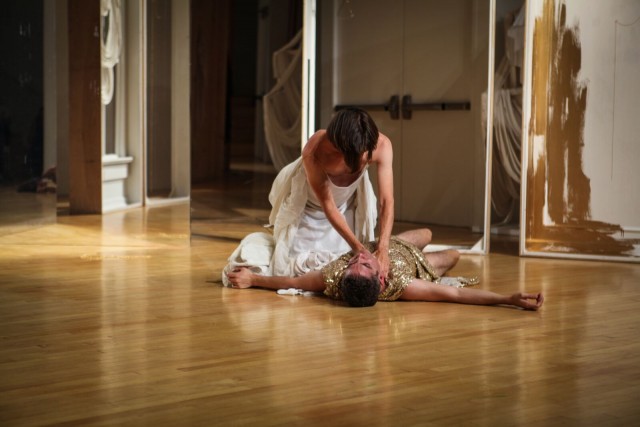
Jacob Slominski and Jack Ferver take role-playing to a new level in immersive presentation at the New Museum (photo by Jason Akira Somma)
Meanwhile, the audience can watch him, as well as themselves, in a large horizontal mirror hung from the ceiling behind white-draped rows of seats, multiplying the number of visible Fervers, who is not attacking Lady Gaga as much as celebrity culture. It’s also a terrific lead-in for the role-playing done by Ferver as Christine and Jacob as Léa, mocking how they are treated by Madame (Mola), exaggerating how the wealthy take advantage of and abuse the poor. “I know you are necessary, like ditch diggers and construction workers are necessary, but I hate having to see you,” Slominski-as-Léa-as-Madame says. But soon the sisters take their revenge, doing what so many only fantasize about doing to the rich and privileged. “I’m surprised things like this don’t happen more often,” Ferver says shortly after the opening soliloquy. Eventually, the audience gets to sit down and experience Chambre in a more traditional arrangement, although there’s very little that’s traditional about the thoroughly engaging and entertaining production, which also features a subtly ominous score by Roarke Menzies. Ferver examines class division, sibling rivalry, gender, and the “monetization of performance” as only he can, with a wickedly potent sense of humor loaded with hard-to-swallow truths. In his introduction to Genet’s The Maids and Deathwatch, Jean-Paul Sartre writes, “For Genet, theatrical procedure is demoniacal. Appearance, which is constantly on the point of passing itself off as reality, must constantly reveal its profound unreality. Everything must be so false that it sets our teeth on edge.” Ferver (Rumble Ghost, Night Light Bright Light,), Swanson, Slominski, Mola, and Menzies set our teeth and more on edge with the seriously funny Chambre, which continues at the New Museum through October 3 as part of FIAF’s Crossing the Line festival, an apt name for Ferver’s fiendishly clever work.
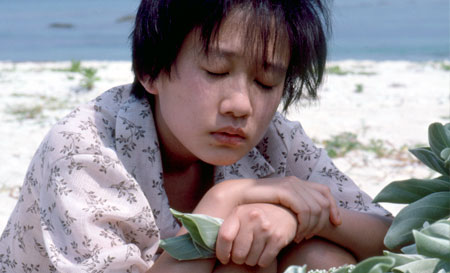
 Japan Society has picked a real gem for its October Monthly Classics presentation, writer-director Gō Takamine’s rarely shown wry black comedy, Paradise View. The thirtieth anniversary screening is also part of Japan Society’s three-month multidisciplinary program “Okinawan Vibes,” which takes a look at the southern island that was occupied by the American military from 1945 to 1972 and, in many ways, is not exactly Japan’s favorite relation; Okinawans, who have their own heritage of language, culture, and religion, have faced longtime discrimination as Japan’s largest minority group. The film opens with a gorgeous shot (the cinematographer is Takao Toshioka) of ant lover Reishu (yakuza actor Kaoru Kobayashi, not the executed child murderer) on a vast beach, collecting sea salt to make him feel better about life, which is rather bleak for everyone on Okinawa, especially now that the occupation is over. The married Reishu has apparently knocked up local simpleton Chiru (Japanese pop star Jun Togawa); island girl Nabee is breaking tradition by marrying a Japanese teacher, Ito; Bindalay (Yoko Taniyama) is quitting her music group, the Tropical Sisters, to go solo, while being stalked by a former boyfriend who dresses as a samurai; a blind man returns home after losing his second family in the Philippines; blue chickens and rainbow pigs roam the land; Reishu’s dog has developed a liking for goat balls, which make the mutt horny; and poisonous snakes are everywhere, from coffins to amphibious trucks. The wacky cast also includes Shinzoku Ogimi, Tomi Taira, and composer and musician Haruomi Hosono as the dude with the great porn stache. “The Japanese are strange creatures,” one ne’er-do-well says. An elderly woman soon laments, “We’ll all be Japanese soon,” after which the man adds, “I wonder if we’ll just end up as a backwater province.” There’s plenty of backwater strangeness in Okinawa, as short vignettes sweetly portray a collection of oddballs doing very odd things while also remaining intensely concerned about holding on to their souls. “I had a dream that a dog ate Reishu’s spirit, then threw it up. He’s lost his spirit! He’s been spirited away!” a deadpan Chiru says, capturing the essence of Okinawan native Takamine’s (Okinawan Dream Show, Untamagiru) brilliant love letter to his homeland. The Japan Society screening will be followed by a reception with Okinawan beer and snacks. The Monthly Classics film series continues on November 6 with Yoji Yamada’s The Yellow Handkerchief, in tribute to star Ken Takakura, who passed away last November at the age of eighty-three.
 Inspired by the story of feudal lord Mori Motonari and Shakespeare’s King Lear, Akira Kurosawa’s Ran is an epic masterpiece about the decline and fall of the Ichimonji clan. Aging Lord Hidetora (Tatsuya Nakadai) is ready to hand over his land and leadership to his three sons, Taro (Akira Terao), Jiro (Jinpachi Nezu), and Saburo (Daisuke Ryû). But jealousy, misunderstandings, and outright deceit and treachery result in Saburo’s banishment and a violent power struggle between the weak eldest, Taro, and the warrior Jiro. Hidetaro soon finds himself rejected by his children and wandering the vast, empty landscape with his wise, sarcastic fool, Kyoami (Peter), as the once-proud king descends into madness. Dressed in white robes and with wild white hair, Nakadai (