twi-ny recommended events

TERESA DIEHL: BREATHING WATERS

(photo by twi-ny/mdr)

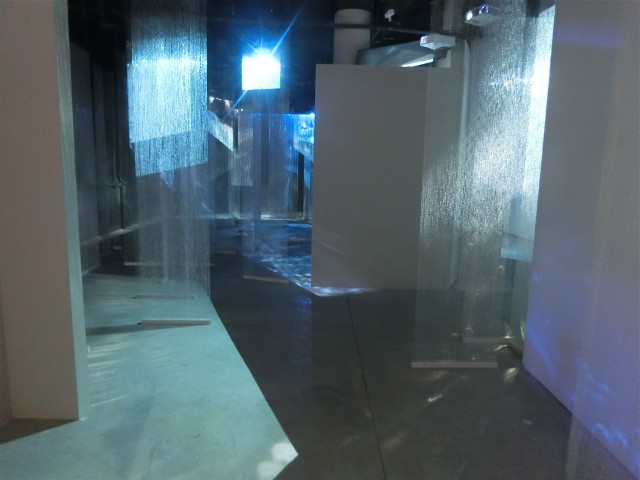
Site-specific installation immerses visitors in a fantasy world of water (photo by twi-ny/mdr)

NO LONGER EMPTY
117 Beekman Pl.
Daily through October 25, free, 12 noon – 7:00 pm
Free performance October 25, 4:00 – 6:00
www.nolongerempty.org
breathing waters slideshow

Miami-based artist Teresa Diehl emphasizes humanity’s intrinsic relationship with water in her immersive installation “Breathing Waters.” Diehl, who was born in Lebanon and raised in Venezuela, incorporates sound and video into a mazelike path of walls and hanging screens made of monofilament onto which drops of resin have been added, resembling dripping water or even tears. Diehl quotes from “The Paradox of the Nature of Water” in the Tao Te Ching, evoking awe at the power of water: “Nothing is weaker than water / But when it attacks something hard / Or resistant, then nothing withstands it, / And nothing will alter its way.” As you wind through the room, motion sensors trigger sound effects that add to the playful magic and mystery of it all, and the site-specific work directly references the South Street Seaport area, where the Hudson and East Rivers come together. Diehl, whose “L-Aber-Into” was part of No Longer Empty’s “When You Cut into the Present the Future Leaks Out” group show at the Old Bronx Borough Courthouse this past spring, also references a quote from Ishmael in Herman Melville’s Moby-Dick: “Let the most absent-minded of men be plunged in his deepest reveries — stand that man on his legs, set his feet a-going, and he will infallibly lead you to water, if water there be in all that region. Should you ever be athirst in the great American desert, try this experiment, if your caravan happen to be supplied with a metaphysical professor. Yes, as every one knows, meditation and water are wedded forever.” Make sure that the door in the back is closed so you get the full meditative effect of “Breathing Waters,” which Diehl sees as a healing refuge, especially in the crowded, fast-paced Seaport District. On October 25 at 4:00, closing day, members of Areytos Performance Works will dance through the “Breathing Waters” labyrinth, inspired by Yemayá, the orisha of motherhood and the queen of the sea.

FRIDA KAHLO: ART, GARDEN, LIFE

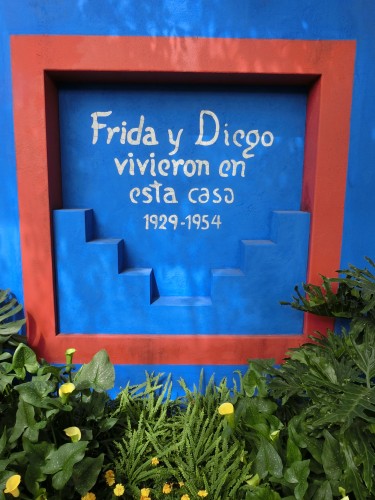
New York Botanical Garden re-creates Frida Kahlos Casa Azul studio and garden (photo by twi-ny/mdr)

New York Botanical Garden re-creates Frida Kahlo and Diego Rivera’s Casa Azul studio and garden (photo by twi-ny/mdr)

The New York Botanical Garden
Enid A. Haupt Conservatory
2900 Southern Blvd., Bronx
Tuesday – Sunday through November 1, $8-$25
718-817-8700
www.nybg.org/frida
frida kahlo: art garden life slideshow

Don’t let the cold weather scare you away from seeing the New York Botanical Garden’s beautiful celebration of Mexican painter Frida Kahlo’s passionate relationship with the natural world. “Frida Kahlo: Art, Garden, Life,” on view at the Bronx institution through November 1, is a wide-ranging tribute to the artist, including paintings, photographs, a historical timeline, a re-creation of her garden and studio, known as La Casa Azul, and special programs. “When we began to research Frida Kahlo, we wanted to delve into the story of the woman who has been examined through her pain and suffering and paint her in a different light,” NYBG associate vice president of exhibitions and public engagement Karen Daubmann writes in her catalog essay, “Making Frida Kahlo’s Garden in New York: The Conservatory Exhibition.” She continues, “We wanted to learn more about the iconic face that is emblazoned on canvases, the strong and fierce-looking dark-haired, dark-eyed woman who used to be known as Diego Rivera’s wife and is now known simply as Frida. The more we researched, the more intrigued we became. . . . We were fascinated by the incredible detail of Kahlo’s curated life.” That curated life is lovingly explored in the exhibition, which features fourteen of the artist’s paintings in the LuEsther T. Mertz Library’s art gallery, including “Portrait of Luther Burbank,” in which Kahlo depicts the famed botanist emerging from the root of a tree; the vulvic “Sun and Life”; “Two Nudes in the Forest,” which was originally called “The Earth Itself”; and the sensational “Self-Portrait with Thorn Necklace and Hummingbird,” in which Kahlo, in between her first and second marriages to Rivera, paints herself surrounded by flowers, a dead hummingbird, a monkey, butterflies, and a black cat, a symbolic representation of life, death, and rebirth. The path to the next part of the show, in the Enid A. Haupt Conservatory, is lined with poems by Nobel Prize–winning Mexican poet Octavio Paz, including “The Religious Fig” and “Nightfall.” Paz was in fact not a big fan of Kahlo’s and Rivera’s; “Diego and Frida ought not to be subjects of beatification but objects of study — and of repentance . . . the weaknesses, taints, and defects that show up in the works of Diego and Frida are moral in origin,” Paz wrote in Essays on Mexican Art. “The two of them betrayed their great gifts, and this can be seen in their painting.”
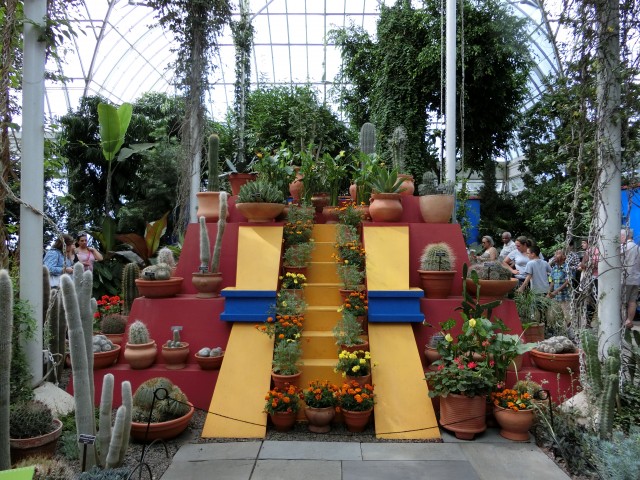
Pyramid is centerpiece of Casa Azul re-creation (photo by twi-ny/mdr)

Pyramid is centerpiece of Casa Azul re-creation (photo by twi-ny/mdr)

The centerpiece of the exhibition is La Casa Azul, a reconstruction of Kahlo’s studio and garden at her family home in Mexico City, which is now a museum. The conservatory is filled with folk art objects, religious ex-voto paintings, Mexican plants described in both English and Spanish (and inspired by archival photographs), and re-creations of the Frog Fountain with its mosaic floor, Kahlo’s desk and easel, and the strikingly colorful Casa Azul pyramid, holding dozens of Mexican cacti and succulents. The conservatory exhibition was designed by Scott Pask, the three-time Tony-winning designer of The Book of Mormon, The Coast of Utopia, and The Pillowman. Outside the conservatory, by the lily pond, is a fence of organ pipe cacti, like the one Kahlo had at her San Ángel house. “Frida Kahlo: Art, Garden, Life” immerses you in the world of this fascinating artist, who passed away in 1954 at the age of forty-seven. In conjunction with the exhibition, the NYBG is hosting special programming through closing day. On Saturdays and Sundays at 1:00, there is live music and dance in Ross Hall and throughout the garden, with performances by such groups as Mexico Beyond Mariachi, the Villalobos Brothers, Flor de Toloache, and Calpulli Danza Mexicana. “Cooking with Frida” takes place in the Ruth Rea Howell Family Garden on Wednesdays, Saturday, and Sundays at 2:00 & 4:00. The daily “Frida’s Fall Harvest” consists of family-friendly activities in the Everett Children’s Adventure Garden, including a puppet show and playhouse kitchen; the children’s garden will be open till 9:30 on October 23 for “Frida for Families: A Spooky Nighttime Adventure.” Also daily (but not for kids), “Spotlight on Agave: A Tequila Story” presents the history and tradition of the Mexican spirit. October 22 is “Frida al Fresco Evening” LGBT Night, with live music, stilt dancers, and Mexican food and drink. On October 24-25 and October 31 – November 1, things get scary with Día De Los Muertos Weekends, featuring skeletal processions, stilt dancers, skull face painting, and more. The “¡Cámara, Acción!” film series continues on Sundays at 3:00 in Ross Hall with Alonso Ruiz Palacios’s Güeros on October 25 and Francisco Franco’s Last Call on November 1. Also on November 1, there will be a live performance by two male models interacting with Humberto Spíndola’s “Two Fridas” sculptural installation, based on Kahlo’s 1939 double portrait in which two versions of her sit next to each other, holding hands.
CLEVER LITTLE LIES

(photo by Matthew Murphy)

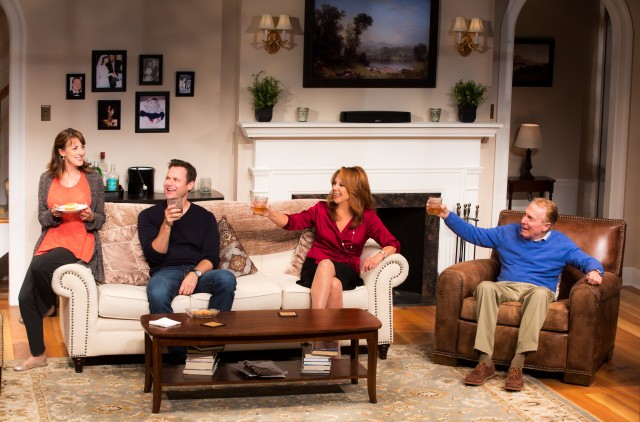
Kate Wetherhead, George Merrick, Marlo Thomas, and Greg Mullavey star in Joe DiPietro’s CLEVER LITTLE LIES (photo by Matthew Murphy)

Westside Theatre
407 West 43rd St. between Ninth & Tenth Aves.
Wednesday – Monday through March 20, $79-$89
www.cleverlittlelies.com
www.westsidetheatre.com

Two-time Tony winner Joe DiPietro has followed up his disappointing Broadway flop, the romantic drawing-room farce Living on Love, with the clever little romantic comedy Clever Little Lies. In contemporary suburbia, Billy (George Merrick) has admitted to his father, Bill Sr. (Greg Mullavey), that he his having an affair with a twenty-three-year-old trainer at the gym. That doesn’t make Dad happy, as Son has just had a baby with his wife, Jane (Kate Wetherhead). Bill Sr. promises to keep the secret and not tell Mom, his wife, Alice (Marlo Thomas), although he admits to his son, “Your mother has this way of extracting information from me,” and explains that he has never cheated on Alice. But Billy continues to defend his actions. “That’s the thing about lying to your spouse — it’s so easy to do,” he says. Of course, when Bill Sr. gets home, Alice, who owns a local bookstore, almost immediately recognizes that something is wrong, and she invites Billy, Jane, and the baby over so she can get to the bottom of things. During a tense evening, everyone is forced to reevaluate their lives and their relationships as they examine their past and look toward the future.

Marlo Thomas stars as a domineering mother determined to fix a family problem in CLEVER LITTLE LIES (photo by Matthew Murphy)

Marlo Thomas stars as a domineering mother determined to fix a family problem in CLEVER LITTLE LIES (photo by Matthew Murphy)

Directed by David Saint, the artistic director of the George Street Playhouse in New Brunswick, where this and other works by DiPietro have debuted, Clever Little Lies is primarily set in Bill Sr. and Alice’s comfy but cold living room, designed by Yoshi Tanokura. A scene in which Billy drives Jane and the baby in a car in front of a projection of a parkway goes on a bit long, especially because the car doesn’t flow together with the moving traffic behind it. But the cast is solid throughout, especially the seventy-seven-year-old Thomas (That Girl, The Shadow Box), who plays the domineering mother with a secret with a kittenish sex appeal, and the seventy-six-year-old Mullavey (The Last Seder, Mary Hartman, Mary Hartman), who gives Bill Sr. an understated charm as his simple life turns complicated over the course of one crazy day. The plot and dialogue teeter on the edge of sitcom cliché but have enough twists and turns to keep the play from becoming overly predictable and mundane, particularly when Alice rants about the current state of publishing or shares an intimate story from her past. “When we’re young, we all do foolish things, don’t we?” she says, but not everyone nods their head in agreement. New Jersey native DiPietro has had most of his success with musicals, including Memphis, Nice Work If You Can Get It, and I Love You, You’re Perfect, Now Change, but Clever Little Lies is a fun if slight diversion from those bigger productions, with a finale that will stay with you for quite some time.

THEATER & CINEMA: GAMES OF LOVE AND CHANCE

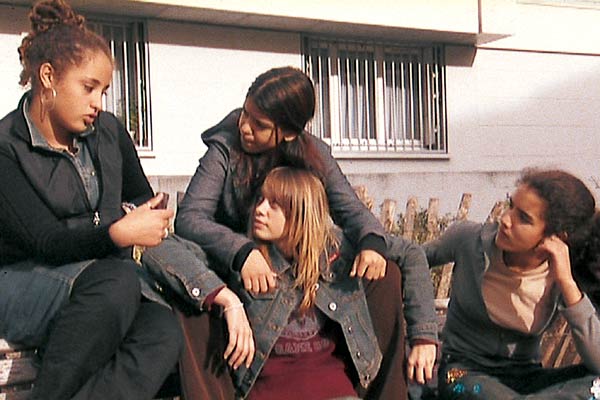
Teenagers discuss life and love in award-winning GAMES OF LOVE AND CHANCE

Teenagers argue over life and love in award-winning GAMES OF LOVE AND CHANCE

CINÉSALON: GAMES OF LOVE AND CHANCE (L’ESQUIVE) (Abdellatif Kechiche, 2003)
French Institute Alliance Française, Florence Gould Hall
55 East 59th St. between Madison & Park Aves.
Tuesday, October 20, $14, 4:00 & 7:30 (later screening introduced by Nicolas Bouchaud)
Series continues through October 27
212-355-6100
www.fiaf.org

FIAF’s CinéSalon series “Theater & Cinema” continues October 20 with Abdellatif Kechiche’s poignant 2003 drama, Games of Love and Chance. Winner of the César Award for Best Film, Best Director, Best Writing (Kechiche and Ghalia Lacroix), and Most Promising Actress (Sara Forestier), the film follows a group of teenagers, mostly of North African descent, in the housing projects of Seine-Saint-Denis as their everyday lives intersect with the play that is being put on in their French literature class, Marivaux’s 1730 romantic comedy, The Game of Love and Chance. In the class play, Forestier is Lydia, a bit of a diva who is portraying Lisette, a maid posing as a wealthy woman, opposite the always loud and angry Frida (Sabrina Ouazani), who is Silvia, a wealthy woman pretending to be a maid. Rachid (Rachid Hami) is initially Arlequin, but he is bribed out of the role by Krimo (Osman Elkharraz), who desperately wants to get close to Lydia. However, he has no real interest in acting, and no talent, which upsets their teacher (Carole Franck), who is looking forward to staging a quality show. Krimo’s pursuit of Lydia also creates more problems with his on-again, off-again longtime girlfriend, Magali (Aurélie Ganito), who believes the two are destined to be together no matter what. And when Krimo’s best friend, Fathi (Hafet Ben-Ahmed), gets involved, things threaten to get explosive. Kechiche, who also won the César for Best Director and Best Original Screenplay for The Secret of the Grain and the Palme d’Or for Blue Is the Warmest Colour, explores class distinction, teenage awkwardness, and artistic expression in the film, which is shot by Lubomir Bakchev primarily with a handheld camera and features powerful performances by the young cast. The differences between the language spoken in Marivaux’s play and the slang of the boys and girls in the hood can be a bit much at times, and the English subtitles are almost ridiculously outdated and stagy, but you’ll get used to it. Kechiche clearly has an eye for new talent; three of his five films featured young women who went on to win the César for Most Promising Actress (Forestier in Games of Love and Chance, Hafsia Herzi in The Secret of the Grain, and Adèle Exarchopoulos in Blue Is the Warmest Colour). Games of Love and Chance is screening in Florence Gould Hall on October 20 at 4:00 and 7:30; the later show will be introduced by actor and director Nicolas Bouchaud, who starred in The Exercise Was Beneficial, Sir at FIAF in May 2014. The series, highlighting films about theater, concludes October 27 with François Truffaut’s The Last Metro.

2015 NYC FOOD FILM FEST

AMC Empire 25
234 West 42nd St. between Seventh & Eighth Aves.
October 22-25, $49-$125
thefoodfilmfestival.com

Food and film go together like, well, dinner and a movie. The annual Food Film Fest takes it to the next level, showing films about food, accompanied by special talks and tastings. The 2015 event features more than two dozen short works, including several New York City, U.S., and world premieres. Among the tasty morsels are Nina Ha’s rap music parody Baby Got Kale, Barbara Zonzin’s Choco Thriller, Barbara Tranter’s Happy Goats Happy Cheese, Derek Klingenberg’s Serenading the Cattle with My Trombone, and Natasha Subramaniam and Alisa Lapidus’s animated fridge fight, Zergut. The festival takes place at the AMC Empire in Times Square, beginning October 22 ($89 / VIP $114) with “Tender: Stories of Love and Meat, which pairs four films with Texas BBQ from Kreuz Market, Kent Black of Black’s Barbecue, and Scott Morales of Taylor Café, pork tacos by Tortilleria Nixtamal, sliders from Schnipper’s, and potent potables from Iron Station, Black Rooster, and NY Distilling Co. October 23 ($99 / VIP $124) is the ever-popular “Food Porn Party,” with nine films, an appearance by Larry Caldwell, a VIP party by Public, ramen by Yosuke Sumida with Keizo Shimamoto, a vegetarian treat from Dirt Candy’s Amanda Cohen, and sweets from Archichef and Top Pot Donuts. On October 24 at noon (kids $23, adults $32, family packages $100-$125), “Eat Your Movies!” is a family event with six children’s films, food by Night Kitchen inspired by the films, treats from Fishing Creak Creamery and Robicelli’s, and kid-friendly food activities. On Saturday night ($99 / VIP $129), “Edible Adventure #13: Hungry for Love” consists of five films, a VIP party by David Burke Kitchen, food from Uncle Boons, Manna’s, chef Karl Palma, and Liddabit Sweets, and a matcha tea tasting. The culinary festivities conclude on October 25 at noon ($49) with “Restaurant Revival: Jodie’s Diner (1985-2014),” a screening of James Boo’s Nothing with Something: The Death of a Diner, with brunch prepared by Jodie Royston of Jodie’s Restaurant, the Albany, California, favorite that closed last year but is looking for a new home. Part of the proceeds from the festival benefit the Billion Oyster Project.

HELEN LAWRENCE

(photo by David Cooper)

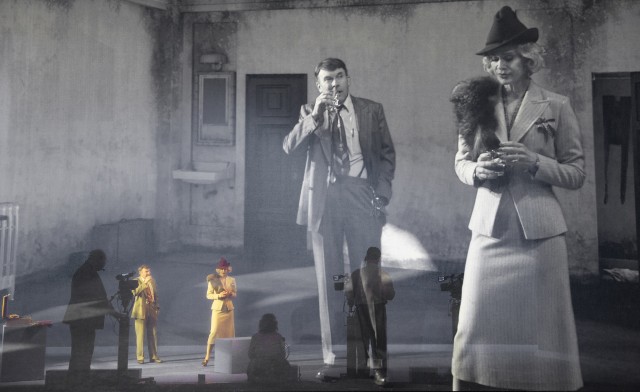
Stan Douglas’s HELEN LAWRENCE is quite a visual spectacle at BAM (photo by David Cooper)

BAM NEXT WAVE FESTIVAL
BAM Howard Gilman Opera House
30 Lafayette Ave. between Ashland Pl. & St. Felix St.
October 14-17, $24-$95, 7:30
718-636-4100
www.bam.org

Canadian visual artist Stan Douglas creates quite a spectacle with his multimedia theatrical presentation Helen Lawrence, but after the initial wonder wears off, he’s not able to fully exploit the cutting-edge technology, some of which was invented specifically for this show, to illuminate writer Chris Haddock’s noir narrative. The Vancouver native sets the tale in his hometown shortly after World War II, as femme fatale Helen Lawrence (Lisa Ryder) arrives, having emerged from a psych ward ready to seek vengeance for a wrong done her. She gets caught up in a world of corrupt cops (Ryan Hollyman, Greg Ellwand), a clever bookie (Nicholas Lea), a creepy hotel owner (Hrothgar Mathews), a hooker looking to get out of seedy Hogan’s Alley (Emily Piggford), a tomboy hotel clerk always looking for the inside scoop (Haley McGee), and a pair of very different men battling for control of the neighborhood (Allan Louis and Sterling Jarvis). The actors perform in front of a blue screen and behind a large translucent scrim that covers the entire stage; several camera operators move around filming them live, with the results projected onto the scrim, accompanied by John Gzowski’s noir score. The characters wear colorful clothing courtesy of costume designer Nancy Bryant — no, they are not by British fashion designer Helen Lawrence — with Lawrence’s yellow outfit particularly eye-catching, but their onscreen versions are seen in black-and-white. And although the actors walk on a primarily empty stage, 3-D imaging places them on street corners and in hotel rooms as they appear to interact with objects that are not really there. It’s a fantastic effect, especially set in a noir world, a kind of live cinema that takes the audience behind the scenes as the action plays out, a separation between color and black-and-white that brings together the past, present, and future of cinematic storytelling, but it fails to delve any deeper over the course of its ninety minutes. While the beginning is ridiculously cool, it starts to feel like a lost opportunity as more of the same continues. Such multimedia works as Reid Farrington’s Tyson vs. Ali, The Return, and Gin & “It,” Tina Landau’s Old Hats (which is returning to the Signature Theatre in January), and Josie Rourke’s The Machine have been able to make more effective use of technology in relation to the narrative. The Canadian Stage production of Helen Lawrence is still quite a sight, but it’s hard not to wonder what more could have been done with it.

THE ASSASSIN

THE ASSASSIN

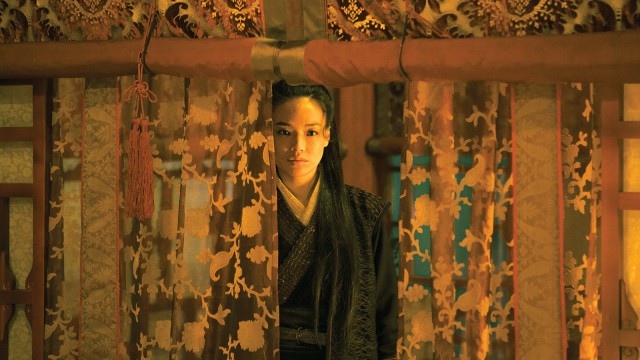
Shu Qi is an expertly trained killer with a conscience in Hou Hsiao-hsien’s gorgeous period drama THE ASSASSIN

THE ASSASSIN (刺客聶隱娘) (NIE YINNIANG) (Hou Hsiao-hsien, 2015)
Film Society of Lincoln Center, Walter Reade Theater, 165 Werst 65th St., 212-875-5050
IFC Center, 323 Sixth Avenue at West Third St., 212-924-7771
Opens Friday, October 16
wellgousa.com

Taiwanese master Hou Hsiao-hsien’s first film in eight years is a visually sumptuous feast, perhaps the most beautifully poetic wuxia film ever made. Inspired by a chuanqi story by Pei Xing, The Assassin is set during the ninth-century Tang dynasty, on the brink of war between Weibo and the Royal Court. Exiled from her home since she was ten, Nie Yinniang (Hou muse Shu Qi) has returned thirteen years later, now an expert assassin, trained by the nun (Fang-Yi Sheu) who raised her to be a cold-blooded killer out for revenge. After being unable to execute a hit out of sympathy for her target’s child, Yinniang is ordered to kill Tian Ji’an (Chang Chen), her cousin and the man to whom she was betrothed as a young girl, as a lesson to teach her not to let personal passions rule her. But don’t worry about the plot, which is far from clear and at times impossible to follow. Instead, glory in Hou’s virtuosity as a filmmaker; he was named Best Director at Cannes for The Assassin, a meditative journey through a fantastical medieval world. Hou and cinematographer Mark Lee Ping-Bing craft each frame like it’s a classical Chinese painting, a work of art unto itself. The camera moves slowly, if at all, as the story plays out in long shots, in both time and space, with very few close-ups and no quick cuts, even during the martial arts fights in which Yinniang displays her awesome skills. Hou often lingers on her face, which shows no outward emotion, although her soul is in turmoil. Hou evokes Andrei Tarkovsky, Akira Kurosawa, Ang Lee, and Zhang Yimou as he takes the viewer from spectacular mountains and river valleys to lush interiors (the stunning sets and gorgeous costumes, bathed in red, black, and gold, are by Hwarng Wern-ying), with silk curtains, bamboo and birch trees, columns, and other elements often in the foreground, along with mist, fog, and smoke, occasionally obscuring the proceedings, lending a surreal quality to Hou’s innate realism.

There are long passages of silence or with only quiet, barely audible music by composer Lim Giong, with very little dialogue, as rituals are performed, baths are prepared, and a bit of black magic takes place. The opening scenes, set around a breathtaking mountain abbey in Inner Mongolia, are shot in black-and-white with no soundtrack, like a silent film, harkening to cinema’s past as well as Yinniang’s; when it switches over to color, fiery reds take over as the credits begin. Throughout the film, the nun wears white and the assassin wears black, in stark contrast to the others’ exquisitely colorful attire; however, the film is not about good and evil but something in between. Shu and Cheng, who played a trio of lovers in Hou’s Three Times, seem to be barely acting in The Assassin, immersing themselves in their characters; Hou (The Puppetmaster, Flowers of Shanghai) gives all of his cast, professional and nonprofessional alike, a tremendous amount of freedom, and it results here in scenes that feel real despite our knowing better. Sure, a touch more plot explication would have been nice, but that was not what Hou was after; he wanted to create a mood, an atmosphere, to transport the actors and the audience to another time and place, and he has done that marvelously. The Assassin is a treasure chest of memorable moments that rewards multiple viewings. I’ve already watched it twice and can’t wait to see it again — and I’ve given up trying to figure out exactly what it’s about, instead reveling in its immense, contemplative beauty. Hou’s previous full-length film was 2007’s Flight of the Red Balloon; here’s hoping it’s not another eight years till his next one.