twi-ny recommended events

THE HOLLYWOOD CLASSIC BEHIND WALKERS: THE LAST PICTURE SHOW

Timothy Bottoms, Jeff Bridges, and Cybill Shepherd prepare for adulthood in THE LAST PICTURE SHOW

THE LAST PICTURE SHOW (Peter Bogdanovich, 1971)
Museum of the Moving Image
35th Ave. at 36th St., Astoria
Saturday, December 26, and Sunday, December 27, $12, 7:00
Series runs through December 27
718-777-6800
www.movingimage.us

Peter Bogdanovich’s The Last Picture Show is a tender-hearted, poignant portrait of sexual awakening and coming-of-age in a sleepy Texas town. Adapted from the Larry McMurtry novel by the author and the director, the film is set in the early 1950s, focusing on Sonny Crawford (Timothy Bottoms), a teenager who works at the local pool hall with Billy (Timothy’s brother Sam), a simple-minded boy who needs special caring. Sonny’s best friend, Duane Jackson (Oscar-nominated Jeff Bridges), is dating the prettiest girl in school, Jacy Farrow (Cybill Shepherd, in her film debut), who is getting ready to test out the sexual waters, sneaking away on a date with Lester Marlow (Randy Quaid), who takes her to a naked-swimming party in a wealthier suburb of Wichita Falls. Meanwhile, Sonny breaks up with his girlfriend, Charlene Druggs (Sharon Taggart), and becomes drawn to the sad, unhappy Ruth Popper (an Oscar-winning Cloris Leachman), the wife of his football coach (Bill Thurman). The outstanding all-star cast also features Oscar-nominated Ellen Burstyn as Lois, Jacy’s mother; Eileen Brennan as a waitress in the local diner who makes cheeseburgers for Sonny; Clu Gulager as a working man who has a thing for Lois; Frank Marshall, who went on to become a big-time producer, as high school student Tommy Logan; and Oscar winner Ben Johnson as Sam the Lion, the moral center of the town and owner of the pool hall, diner, and movie theater, which shows such films as Father of the Bride and Red River. Cinematographer Robert Surtees shoots The Last Picture Show in a sentimental black-and-white that gives the film an old-fashioned feel, as if it’s a part of Americana that is fading away. Bogdanovich also chose to have no original score, instead populating the tale with country songs by Hank Williams, Bob Wills and the Texas Playboys, Lefty Frizzell, Tony Bennett, and others singing tales of woe.

In many ways the film is the flip side of George Lucas’s 1973 hit American Graffiti, which is set ten years later but looks like it’s from another century; it also has a lot in common with François Truffaut’s 1962 classic Jules and Jim. Nominated for eight Oscars including Best Picture and Best Director, The Last Picture Show is an unforgettable slice-of-life drama that will break your heart over and over again. It is screening December 26 & 27 at 7:00 in the Museum of the Moving Image series “The Hollywood Classics Behind Walkers,” which is being held in conjunction with the exhibition “Walkers: Hollywood Afterlives in Art and Artifact,” consisting of Hollywood-related photography, drawing, sculpture, print, and video by such artists as Francis Alÿs, Richard Avedon, Jim Campbell, Gregory Crewdson, Douglas Gordon, Isaac Julien, Ellen Mark, Tom Sachs, Hiroshi Sugimoto, and many others. Also screening December 26 & 27 is Sam Peckinpah’s classic Western, The Wild Bunch.

LAZARUS

(photo by Jan Versweyveld)

Michael C. Hall reprises David Bowie role from THE MAN WHO FELL TO EARTH in LAZARUS at NYTW (photo by Jan Versweyveld)

New York Theatre Workshop
79 East Fourth St. between Second & Third Aves.
Tuesday – Sunday through January 19, $129; Wednesday, January 20 benefit, $1,004 – $2,504
www.nytw.org

David Bowie’s resurrection after a long public absence continues with Lazarus, an intriguing, at times captivating, and often confusing musical drama at New York Theatre Workshop though January 20. A little over a decade ago, in June 2004, the iconoclastic British artist suffered a heart attack onstage and underwent emergency surgery. He stayed out of the limelight after that, making only rare appearances and not releasing a new record until 2013, The Next Day, declaring on the title track, “Here I am / Not quite dying / My body left to rot in a hollow tree / Its branches throwing shadows / On the gallows for me / And the next day / And the next / And another day.” But evidently with a renewed lust for life, Bowie has been very busy over the last few years, and he takes a fascinating look at his personal and professional past, present, and future in Lazarus, a multimedia collaboration with playwright Enda Walsh (Once, The Walworth Farce) and heavily in-demand director-of-the-moment Ivo van Hove (Scenes from a Marriage, A View from the Bridge). The show picks up some forty years after the end of The Man Who Fell to Earth, the 1976 Nicolas Roeg film in which Bowie portrayed Thomas Jerome Newton, an alien who comes to Earth to collect water to save his planet. As the audience enters the theater, Newton (Michael C. Hall) is lying flat on the stage, as if dead. He eventually rises, met by his old friend Michael (Charlie Pollock) and his new assistant, Elly (Cristin Milioti). Newton is now a retired, reclusive, wealthy former businessman who stays at home drinking gin and eating Lucky Charms and Twinkies, watching a large television screen that broadcasts things going on in his head as he agonizes over his loneliness, his wife and daughter long gone from his life. “Don’t you remember the person you were? Your life outside,” Michael asks. “That was before,” Newton answers. “And it’s all gone?” Michael says. “Of course it’s gone,” Newton responds shortly before singing “Lazarus,” one of four new songs Bowie has written for the show. “Look up here, I’m in heaven / I’ve got scars that can’t be seen / I’ve got drama, can’t be stolen / Everybody knows me now / Look up here, man, I’m in danger / I’ve got nothing left to lose,” Hall sings in a strong Bowie accent. The music is performed live by a band in a glassed-in booth across the back of the stage, behind Jan Versweyveld’s apartment set, which features a refrigerator at the right (next to a record player on the floor with a pile of Bowie LPs), a bed at the left, and a large screen at the center. Newton is soon visited by a young girl (Sophia Anne Caruso) who he knows is a figment of his imagination, there to help him find purpose in his life, as well as hers. “You’re not dying, are you?” she asks. “A little bit every day. I’m a dying man who can’t die,” he says. “That’s a joke, right?” she replies. “Yes, not being able to die is a joke. A fucking terrible joke,” he states. Newton’s life is further complicated by three teenage girls (Krystina Alabado, Krista Pioppi, and Brynn Williams) who form a kind of Greek chorus, the mysterious Valentine (Michael Esper), Elly’s jealous husband, Zach (Bobby Moreno), and a couple madly in love, Maemi (Lynn Craig) and Ben (Nicholas Christopher).

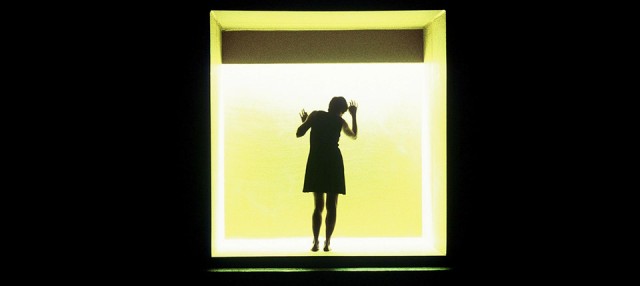
(photo by Jan Versweyveld)

Ivo van Hove’s LAZARUS uses David Bowie songs to explore love and loneliness (photo by Jan Versweyveld)

Lazarus was inspired by Walter Tevis’s 1963 science-fiction novel, The Man Who Fell to Earth, in which Newton is described thusly: “He was human; but not, properly, a man. Also, man-like, he was susceptible to love, to fear, to intense physical pain and to self-pity.” Hall (Hedwig and the Angry Inch, Cabaret) embodies the character with a tender simplicity despite the craziness that Newton is experiencing. As the girl, Caruso again shows intelligence and instincts well beyond her fourteen years, as she did earlier in 2015 in Jennifer Haley’s The Nether. The music, consisting of new arrangements of Bowie classics and deep cuts, from 1970’s The Man Who Sold the World, 1971’s Hunky Dory, 1980’s Scary Monsters, and The Next Day, in addition to the four new songs, is a treat for Bowie fans, especially the Japanese and English “It’s No Game (Part 1),” Pollock’s “The Man Who Sold the World,” Hall’s “Where Are We Now?” and “Killing a Little Time,” and Caruso’s “Life on Mars.” In a soft, gentle version of “Changes,” Tony nominee Milioti (Once) sings “Turn and face the strange,” and strangeness is just what keeps this production from soaring into the stratosphere. Too much of Lazarus, which is about love and loss and making connections, is head-scratchingly opaque, particularly the use of the video monitor; Tal Yarden’s projections are occasionally poetic and visually striking but much more often bewildering, muddying the narrative with perplexing shots that could be memories, long-gone dreams and desires, or — well, by the time Alan Cumming appears onscreen, you can forget about trying to figure out what’s going on. But if you instead concentrate on Hall’s thrilling performance, the central relationship between Newton and the girl, and the outstanding musical numbers, Lazarus will lift you up, making you thankful that Bowie has returned to Earth to share his unique, and plenty strange, world view with us mere mortals again.

MARK BRADFORD: BE STRONG BOQUAN

(photo by twi-ny/mdr)

Mark Bradford, “Waterfall” (foreground), mixed media, 2015, and “Black and White” (background), mixed media on canvas, 2015 (photo by twi-ny/mdr)

Who: Mark Bradford
What: “Be Strong Boquan”
Where: Hauser & Wirth, 511 West 18th St. between Tenth & Eleventh Aves., 212-790-3900
When: Through Wednesday, December 23, free, 10:00 am – 6:00 pm
Why: Los Angeles artist Mark Bradford has had quite a 2015, highlighted by a major exhibition, “Scorched Earth,” at the Hammer Museum; setting a personal record when his painting “Smear” sold for $4.4 million at Sotheby’s in May; being named Artist of the Year by The Week magazine; completing a commission for a lobby work at Rockefeller Center; and having his first New York City solo show at his new gallery, Hauser & Wirth. The H&W exhibit, “Be Strong Boquan,” which continues through December 23, is breathtaking, consisting of nine large-scale mixed-media collages, two short films, a text-based work, and “Waterfall,” which encompasses dozens and dozens of strips of scraps from his studio, all draped over a metal bar. Bradford’s “paintings” are actually palimpsestual collages made out of billboard flyers, colored paper, posters, newsprint, and photographs layered with clear shellac on a stretched canvas; he also adds twine and other objects that he pulls to form rivulets that tear through the pieces. From a distance they look like abstract paintings, but up close you can see the depth and density of the materials, adding a mesmerizing sculptural physicality to the works, which reference urban violence, race riots, the AIDS crisis, gender identity, and other social concerns. Bradford gives the works such titles as “Hunger with Salt and Pepper Tastes Better,” “Killing the Goodbye,” and “Dead Hummingbird,” names that stand in stark contrast to the visceral beauty of the canvases. In the long, horizontal video installation “Deimos,” Bradford brings roller-skate wheels to animated stop-motion life, dancing to the soul funk of Sylvester’s “Grateful,” paying tribute to the “Queen of Disco” who died from AIDS in 1988 at the age of forty-one. (The wheels were left over from the old Roxy nightclub, which previously inhabited the H&W space on Eighteenth St.) Bradford’s “Spiderman” reimagines Eddie Murphy’s controversial 1983 “Delirious” stand-up special; a red spotlight shines on a vacant space as a black comedian can be heard on the film, which shows only the words being said, not the speaker, who discusses Michael Jackson, Eazy-E, and AIDS as an unseen audience laughs at his jokes. “Be Strong Boquan” is a breakthrough exhibit for Bradford, who at the age of fifty-four is experiencing a well-deserved surge in his career.

IMITATIONS OF LIFE — THE FILMS OF DOUGLAS SIRK: MAGNIFICENT OBSESSION / ALL THAT HEAVEN ALLOWS

MAGNIFICENT OBSESSION

Rock Hudson and Jane Wyman star in Douglas Sirk’s gorgeous Technicolor melodrama MAGNIFICENT OBSESSION

MAGNIFICENT OBSESSION (Douglas Sirk, 1954)
ALL THAT HEAVEN ALLOWS (Douglas Sirk, 1955)
Film Society of Lincoln Center, Walter Reade Theater
165 West 65th St. between Eighth Ave. & Broadway
Magnificent Obsession: Thursday, December 24, 2:00, and Friday, December 25, 6:30
All That Heaven Allows: Thursday, December 24, 4:30, and Friday, December 25, 9:00
Series runs December 23 – January 6
212-875-5050
www.filmlinc.org

Forget about It’s a Wonderful Life, Miracle on Thirty-Fourth Street, and endless versions of A Christmas Carol; our new favorite holiday movie is Douglas Sirk’s sensationally strange and beautiful All That Heaven Allows, and you can see it, along with the similarly sensationally strange and beautiful Magnificent Obsession, December 24 & 25 as part of the Film Society of Lincoln Center’s two-week, twenty-eight-movie retrospective “Imitations of Life: The Films of Douglas Sirk.” Released in 1954, Magnificent Obsession is a remake of John Stahl’s 1935 film, which starred Irene Dunne and Robert Taylor and was based on Lloyd C. Douglas’s book. In his breakthrough performance in the 1954 version, Rock Hudson is Bob Merrick, an errant playboy who gets seriously injured while recklessly racing his fancy speedboat. He is saved when the town’s only resuscitator is rushed over to him; however, it turns out that at the same time, a well-respected and beloved local doctor, Wayne Phillips, suffers a heart attack and dies because the resuscitator was being used for Merrick instead. Eventually riddled with guilt, Merrick attempts to befriend the doctor’s widow, Helen (an Oscar-nominated Jane Wyman), but only ends up making things worse when he helps cause an accident that blinds Helen. He then falls in love with her, which leads to a whole slew of other problems. The next year, Hudson and Wyman fell in love again in Sirk’s All That Heaven Allows. This time around, Hudson is Ron Kirby, a soft-hearted, hunky gardener who prefers a simple, outdoorsy life yet is drawn to Cary Scott (Wyman), an older widow who is firmly entrenched in her community’s country-club lifestyle. They begin a passionate affair but when they decide to wed, Cary’s children and the snooty members of the town’s social register are thoroughly appalled and do everything in their power to drive them apart because of class, wealth, and age differences.

ALL THAT HEAVEN ALLOWS

Rock Hudson and Jane Wyman star in Douglas Sirk’s gorgeous Technicolor melodrama ALL THAT HEAVEN ALLOWS

Magnificent Obsession and All That Heaven Allows have intriguing similarities and critical differences that go far beyond their stars and main plot points. The two Technicolor melodramas both feature romances between Hudson and Wyman, but age only plays a part in the latter, with Hudson made to look younger and Wyman older than they actually were. (At thirty-seven, Wyman was a mere eight years older than Hudson in real life.) Wyman is a widow in both pictures, Hudson a bachelor with his choice of young blondes. Agnes Moorehead plays Helen’s friend and nurse in Magnificent Obsession and Cary’s best friend in All That Heaven Allows. In Magnificent Obsession, Helen’s stepdaughter, Joyce (Barbara Rush), takes an immediate dislike to Merrick, while in All That Heaven Allows, Cary’s kids, high schooler Kay (Gloria Talbott) and college student Ned (William Reynolds), find their mother’s impending marriage to Kirby disgusting and distasteful, preferring she marry Harvey (Conrad Nagel), a plain, sexless widower. In 1950s America, women were still subservient to the needs of men and to raising their children, not permitted by society to lead their own lives and make decisions for themselves, especially when it comes to their sexuality. Each picture also features an essentially nonreligious belief system that is embodied by the Hudson character; in Magnificent Obsession, Merrick learns of a secretive, pay-it-forward philosophy with New Testament overtones, while in All That Heaven Allows, Kirby is inspired by the writings on naturalism and the true meaning of success espoused by Henry David Thoreau in Walden. Indeed, the outside world is central to both films; Sirk and his longtime cinematographer, Russell Metty, let the camera linger on trees, lakes, snow banks, and deer. Flowers abound indoors and out, and windows always look out on beautiful scenery, as if paintings, accompanied by Frank Skinner’s equally lush scores and Bill Thomas’s colorful costumes.

It all makes for the kind of candy-coated America that David Lynch turned upside down and inside out in Blue Velvet and that directly influenced Todd Haynes’s 2002 Sirk homage, Far from Heaven, in which white Connecticut housewife Cathy Whitaker (Julianne Moore), who is married to a closeted white executive (Dennis Quaid), becomes perhaps too friendly with her black gardener (Dennis Haysbert), a melding of All That Heaven Allows and Imitation of Life. (At one point in All That Heaven Allows, Kirby talks about how his best friend learned to be his own man. “And you want me to be a man,” Cary says. “Only in that one way,” Kirby responds, playfully looking over at Cary; it’s as if Hudson is teasing her about his real-life sexuality.) People’s double nature is reflected throughout both films, as Sirk and Metty use fireplace screens, windshields, mirrors, and even a television set to create physical separation between two characters as well as the inner and outer parts of the same character. In addition, there is a vast array of ties, cravats, scarves, ascots, bow ties, and other articles of clothing that everyone wears around their necks in both films, as if their true feelings are always being choked and hidden. They’re both magnificent films, richly textured and multilayered, not nearly as cynical and tongue-in-cheek as some claim them to be, making for an outstanding double feature for Christmas (although you have to pay separate admission for each). After watching these two masterful works of art, you’ll become obsessed with Sirk (if you’re not already), so be sure to come back for plenty more; the series includes a wide range of Sirk’s films, from such other Sirk/Hudson collaborations as Written on the Wind, Battle Hymn, Captain Lightfoot, The Tarnished Angels, and Taza, Son of Cochise to such Sirk favorites as Imitation of Life, A Time to Love and a Time to Die, and There’s Always Tomorrow, with such stars as Barbara Stanwyck, George Sanders, Ann Sheridan, Charles Boyer, Claudette Colbert, Scatman Crothers, Lauren Bacall, and Jack Palance as Attila the Hun (in Sign of the Pagan).

A DARLENE LOVE CHRISTMAS: LOVE FOR THE HOLIDAYS

Rock and Roll Hall of Famer Darlene Love brings her annual Christmas show to B. B. Kings December 23 & 26 and January 2

Rock and Roll Hall of Famer Darlene Love brings her annual Christmas show to B. B. King’s December 23 & 26 and January 2

Who: Darlene Love
What: Annual Christmas show
When: Wednesday, December 23, Saturday, December 26, and Saturday, January 2, $45-$50, 8:00
Where: B. B. King Blues Club & Grill, 237 West 42nd St. between Broadway & Eighth Ave., 212-997-4144
Why: If you’re like us, one of the saddest parts of David Letterman’s retirement was not ever being able to see the one and only Darlene Love tear down the Ed Sullivan Theater again performing her rousing rendition of “Christmas (Baby, Please Come Home).” But you don’t have to miss out, as you can catch the Rock and Roll Hall of Famer at B. B. King’s, playing her annual holiday show at the Times Square music palace, which will be experiencing its first Christmas without its founder, who died in May at the age of eighty-eight. Love will be mixing in songs from throughout her career, from 1960s hits (“He’s a Rebel,” “He’s Sure the Boy I Love,” “Da Doo Ron Ron”) to holidays faves (including “Marshmallow World” from A Christmas Gift for You from Phil Spector) to tunes from her latest release, September’s Introducing Darlene Love, which was produced by Steve Van Zandt and features new and old tunes by Bruce Springsteen, Elvis Costello, Linda Perry, Jimmy Webb, Joan Jett, and others.

ALVIN AILEY AMERICAN DANCE THEATER AT CITY CENTER: ALL-NEW

AWAKENING

Robert Battle’s AWAKENING is his first new work for Ailey since becoming AAADT artistic director

New York City Center
130 West 56th St. between Sixth & Seventh Aves.
Through January 3, $25-$150
212-581-1212
www.alvinailey.org
www.nycitycenter.org

“All my life I’ve been fascinated by the precipice in all of us. When you come to it, you either choose to fall or you don’t,” Alvin Ailey once said. That theory is still alive and well at Alvin Ailey American Dance Theater under the leadership of artistic director Robert Battle, who took over the reins from Ailey protégée Judith Jamison in July 2011. And it is particularly evident in the new works that Battle has brought into the company, four of which were on display December 17 as part of AAADT’s annual month-long season at City Center. The evening began with Piazzolla Caldera, the second piece by Paul Taylor to enter the Ailey repertoire, following Arden Court in 2011, Battle’s inaugural year. Created by Taylor in 1997 and restaged for Ailey by Richard Chen See, Piazzolla Caldera is a reinterpretation of the tango, set to music by Jerzy Peterburshky and Astor Piazzolla in four sections. On a dimly lit stage with fifteen lighting fixtures dangling from the ceiling at different heights (designed by Jennifer Tipton), the dazzling Linda Celeste Sims is fighting her loneliness as she moves through a dusky nightclub. Men pair up with women, women pair up with women, and men pair up with men — a pas de deux between Daniel Harder and Michael Francis McBride seems to defy the laws of gravity — but Sims can’t find her place, even getting involved in a hard-fought battle with Belen Pereyra over Yannick Lebrun. The brown costumes, with the men in pants and shirts, the women in knee-length dresses, stockings, and heels, are by Oscar-nominated, Tony-winning designer Santo Loquasto. Kyle Abraham, whose Another Night premiered with Ailey in 2012, is back with Untitled America: First Movement, the beginning of a trilogy about the effects of the prison system on families. Set to British soul singer Laura Mvula’s plaintive “Father, Father,” which contains the lyrics “Brother, brother, let me love you / Whisper all your deepest fears, you can trust me / And when it’s over we can begin / Finally to make amends, try to save us,” the stark, spare dance was beautifully performed by Jacqueline Green, Chalvar Monerior, and Danica Paulos, but at ten minutes, it was more of a teaser for what is to come than a self-contained work.

OPEN DOOR

Ronald K. Brown offers up another Ailey treat with the world premiere of OPEN DOOR

Next up was Battle’s Awakening, his first new piece for Ailey since he became artistic director and one that Battle has noted was influenced by Taylor’s Piazzolla Caldera. Set to composer John Mackey’s loud, heavily cinematic “Turning” and “The Attention of Souls,” Awakening is an eighteen-minute sci-fi epic with heavenly overtones that evoke, of all things, Alejandro Jodorowsky’s The Holy Mountain. Wearing all-white costumes by Jon Taylor, twelve dancers come together and drift apart in chaotic fashion, both escaping from and searching for something, with the tall, always impressive Jamar Roberts trying to establish a unique identity away from the pack amid futuristic lighting by Al Crawford that includes a wall that slowly separates to reveal a mysterious glowing horizon. The evening concluded with Ronald K. Brown’s latest piece for Ailey, the sensational Open Door. As he has done with such previous works as Grace and Four Corners, Brown, the head of Brooklyn’s Evidence, a Dance Company, gets the most out of the Ailey dancers, who clearly love performing his West African-based choreography. Open Door is centered by a series of lovely duets by Celeste Sims and guest artist and Ailey rehearsal director Matthew Rushing that go from slow and aching to dynamic and rhythmic, set to four songs by Arturo O’Farrill & the Afro Latin Jazz Orchestra. The colorful costumes by Keiko Voltaire, with the women in long, flowing skirts and the men in tank tops and pants, interact with Crawford’s ever-shifting smoky backdrop. Rushing, Celeste Sims, Roberts, Pereyra, Harder, Akua Noni Parker, Glenn Allen Sims, Rachael McLaren, Vernard J. Gilmore, and Hope Boykin swing their arms, swirl their bodies, leap, kick, and lie on the floor in an energetic and infectious celebration of movement. It was a thrilling conclusion to a wonderful evening of company and world premieres. The all-new program will also be presented on December 22 (with Rennie Harris’s Exodus in place of Piazzolla Caldera), December 26, and January 2; you can also catch Open Door on December 23 and Awakening on December 24.

RONNIE SPECTOR’S BEST CHRISTMAS PARTY EVER

Ronnie Spector will celebrate a musical Christmas at City Winery on December 22 & 23

Ronnie Spector will celebrate a musical Christmas season at City Winery on January 5 & 12

Who: Ronnie Spector
What: “Ronnie Spector’s Best Christmas Party Ever”
Where: City Winery, 155 Varick St. between Spring & Vandam Sts., 212-608-0555
When: Tuesday, January 5 & 12 (rescheduled from Tuesday, December 22, and Wednesday, December 23), $50-$75, 8:00
Why: Spanish Harlem native Ronnie Spector’s traveling show, “Ronnie Spector’s Best Christmas Ever,” which was scheduled to come to City Winery on December 22 & 23, has been postponed till January 5 & 12, when Spector will be celebrating the holiday season as only the self-described “Bad Girl” and former Ronettes singer can. Spector will be featuring songs from her 2010 Christmas EP, which includes “My Christmas Wish,” “It’s the Time (Happy Holidays),” “Light One Candle,” “Best Christmas Ever,” and “It’s Christmas Once Again,” in addition to favorites from 1963’s classic A Christmas Gift for You from Phil Spector, on which the Ronettes famously sing “Frosty the Snowman,” “Sleigh Ride,” and “I Saw Mommy Kissing Santa Claus.”