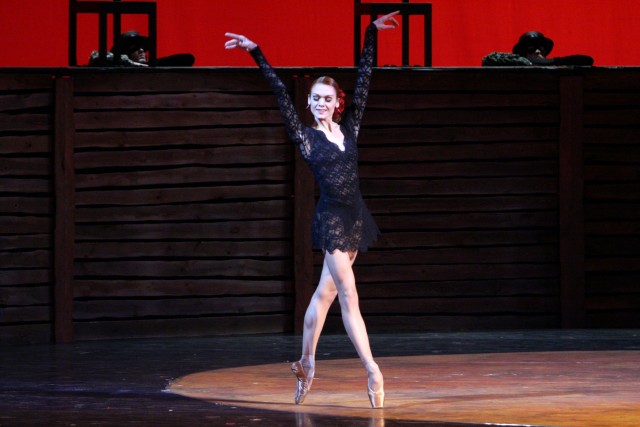
Mariinsky principal dancer Uliana Lopatkina is part of four-night tribute to Maya Plisetskaya at BAM (photo by Natasha Razina)
BAM Howard Gilman Opera House
Peter Jay Sharp Building
230 Lafayette Ave.
February 24-28, $30-$175
718-636-4100
www.bam.org
www.mariinsky.ru/en
Last May, Maya Plisetskaya, who became an international star with the Bolshoi Ballet in the 1950s and ’60s, passed away at the age of eighty-nine. Russia’s Mariinsky Theatre will be honoring the legacy of the legendary prima ballerina in its second annual residency at BAM this week. “It has always seemed to me that books were written by people who were absolutely extraordinary. Supersmart. Superscholarly,” the absolutely extraordinary dancer and choreographer writes in the preface to her 2001 memoir, I, Maya Plisetskaya. “And here was a ballerina picking up the pen. It reminded me of an old joke. When a huge ship, practically the Titanic, sank in the ocean, only two passengers survived, because they could float: a government minister, because he was such a big turd, and a ballerina, because she was an airhead.” Running February 25-28, “A Tribute to Maya Plisetskaya” is divided into four programs, featuring current Mariinsky principals Uliana Lopatkina and Diana Vishneva, neither of whom have been called airheads, performing live with the Mariinsky Orchestra, with musical direction by Mariinsky artistic and general director Valery Gergiev and either Gergiev or Alexei Repnikov conducting. (As a bonus, on February 24, Gergiev will conduct “Folk, Form, and Fire: The Prokofiev Piano Concertos,” with the Mariinsky Orchestra and soloists George Li, Alexander Toradze, Daniil Trifonov, Sergei Redkin, and Sergei Babayan.)
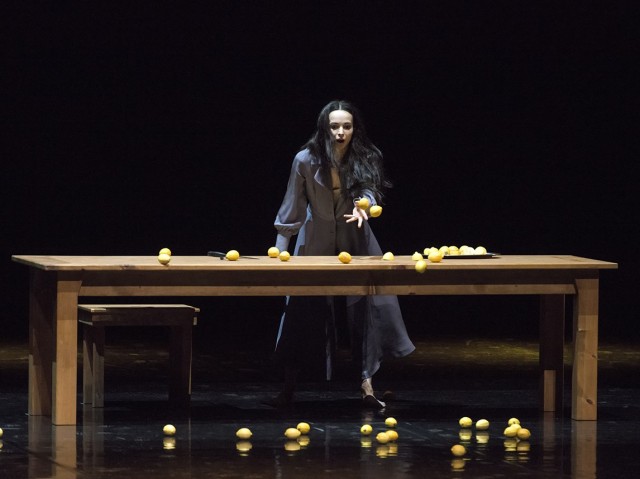
Diana Vishneva will perform “Woman in a Room” as part of Mariinsky tribute to Maya Plisetskaya at BAM (photo by Gene Schiavone)
On February 25, Vishneva and other members of the Mariinsky Ballet Company will perform Carmen Suite, choreographed by Albert Alonso specifically for Plisetskaya and with music by Rodion Shchedrin after Georges Bizet; Lopatkina will dance Camille Saint-Saëns’s The Dying Swan, choreographed by Michel Fokine; and, on film from 1975, Plisetskaya will be seen in Maurice Ravel’s Boléro, choreographed by Maurice Béjart. The February 26 schedule consists of ten pieces honoring Anna Pavlova and Vaslav Nijinsky, who had profound effects on Plisetskaya’s career; the evening includes Valeriya Martinuk and Alexei Popov performing the pas de deux of Colombine and Harlequin from Robert Schumann’s Le Carnaval, choreographed by Michel Fokine; Maria Shirinkina and Vladimir Shklyarov joining in Carl Maria von Weber’s Le Spectre de la rose, also choreographed by Fokine; Lopatkina and Roman Belyakov teaming up in Pyotr Tchaikovsky’s Pavlova and Cecchetti, choreographed by John Neumeier; and Martinuk and Popov taking on Tchaikovsky’s pas de deux of Princess Florine and the Bluebird from The Sleeping Beauty, choreographed by Marius Petipa. Vishneva is the star attraction on February 27, performing Carmen Suite and 2013’s Woman in a Room, with choreography by Carolyn Carlson and music by Giovanni Sollima and René Aubry, inspired by the films of Russian auteur Andrei Tarkovsky. The tribute concludes February 28 with a dozen works celebrating Plisetskaya, Pavlova, and Galina Ulanova, with Ekaterina Osmolkina and Maxim Zyuzin performing the Maria and Vaslav adagio from Boris Asafyev’s The Fountain of Bakhchisarai, choreographed by Rostislav Zakharov; Lopatkina and Andrey Ermakov in Gustav Mahler’s La Rose Malade, choreographed by Roland Petit; Lopatkina and Shklyarov in an excerpt from Shchedrin’s The Little Humped Back Horse, choreographed by Alexei Ratmansky; and Martinuk and Zyuzin performing the act III adagio from Farid Yarullin’s Shurale, choreographed by Leonid Yakobson. “I planned the book for a local, Russian audience,” Plisetskaya explains in her memoir. “But I was also thinking about a far-away Western audience. The far-away ones who know very little about the byways, the delirious fantasies, the masquerades of our strange, incredible, and unbelievable former Soviet life.” For four nights, all of that will be brought together in Brooklyn at BAM, where you can also currently see the Maly Drama Theatre’s marvelous version of Anton Chekhov’s The Cherry Orchard.


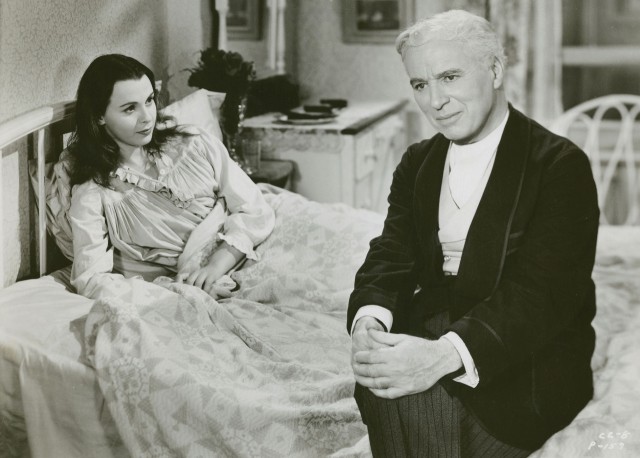
 “You will feel closer to Charlie the man, seeing this film, than in any of the other films where he plays a character, magnificently, but this is different. This is him,” Claire Bloom said before a sixtieth anniversary screening of Charlie Chaplin’s Limelight. In what was intended to be his farewell film, Chaplin bids adieu to his Little Tramp character and laments the end of an era in this deeply personal work, which features five of his children, his brother, his half-brother, and silent film comedians Snub Pollard and Buster Keaton. Though made in Hollywood in 1951, Limelight is set in Chaplin’s native London in 1914, the year he began his movie career at Keystone Studios. Chaplin is Calvero, a former vaudeville-style music hall star — modeled on himself as well as comedian Frank Tinney, Spanish clown Marceline, and his father — who is now a down-on-his-luck forgotten drunk. He comes home one day, smells gas, and breaks down the door of a neighbor’s apartment, saving a beautiful young ballerina, Thereza “Terry” Ambrose (Claire Bloom), from suicide. As the kind and gentle Calvero nurses her back to health, determined that she resume her career (in a way, as a surrogate for his current failures), Terry falls in love with him. Calvero tells her that it is not a real, romantic love; the character is partially based on Chaplin’s mother, whom he cared for while she suffered from mental illness, although there are obvious age parallels to his real-life wife, Oona O’Neill, whom he married in 1943 when he was fifty-four and she was eighteen. (Chaplin was sixty-three when Limelight was released, Bloom twenty-one.) But Terry insists her love is genuine and true, and soon they are both restarting their careers, with very different results.